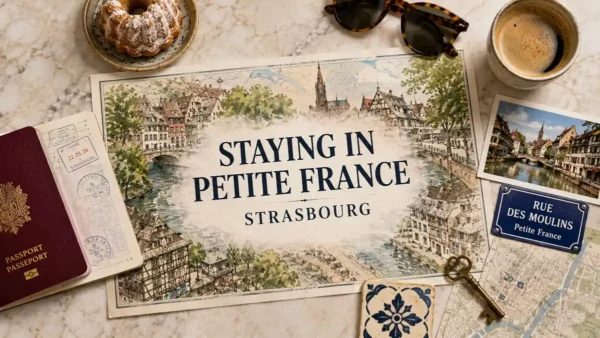

Choosing where to stay in Strasbourg goes wrong at the map, not at the hotel. Booking sites list Petite France and the Grande Île side by side, as if you had to pick one over the other. You don’t. Petite France is a quarter inside the Grande Île, and the Grande Île is the whole historic island — so half the choice most travelers agonise over isn’t a choice at all. The real decision is simpler and far more useful: sleep on the island, or sleep one bridge away from it. This guide gives you a default you can act on in a minute, the mental map to overrule it for your own trip, and the one season — the Christmas market — where the default flips entirely. Five bases, one verdict each, no hotel names.
Quick Answer
The Grande Île — Strasbourg’s historic island centre — is the best overall base, especially for first-timers. The island carries the city’s highest rates and its busiest evenings, so one bridge out buys calm and value. Krutenau, just southeast across the water, is the strongest alternative for travelers who want value and evenings out.
Trust Layer
Tripstou stay guide for travelers choosing where to base. Covers area atmosphere, budget, convenience, noise, and traveler fit.
Produced with AI assistance and reviewed by Alex Perrut, working in tourism since 2015, for the Tripstou editorial team. See our editorial process for details.
Last factual review: August 15, 2026.
Official sources consulted: France.fr, Atout France.
Key Takeaways
- The Grande Île is the island centre and Petite France sits inside it — they are not rival districts to choose between.
- Base on the Grande Île for a short first trip; one bridge out wins on value for longer stays.
- Krutenau is the strongest value alternative: walkable to the cathedral, priced for locals, and still lively after dark.
- Match the base to the traveler: Petite France for couples, Neustadt for families, the Gare district for early trains.
- During the Christmas market the island is pedestrianised and checked at entry, so book months ahead or base across the water.
- Outer quarters like Neudorf and l’Orangerie cost less and sleep quieter, but every trip in costs you a tram ride.
Table of Contents
How Strasbourg Is Laid Out: One Island, Five Bases
Strasbourg’s historic centre is an island, and Petite France sits inside it — not next to it. The Grande Île is ringed by the river Ill and UNESCO-listed. Everything else you will meet on a booking site — Krutenau, Neustadt, the station district — sits a bridge or a boulevard away.
The confusion is structural. Booking platforms treat every neighbourhood name as a flat, equal filter, so a quarter and the island containing it land in the same dropdown at the same level, looking like rivals. In Strasbourg the names nest instead: the Grande Île is the island, and Petite France occupies its western end, canals and all.
Once the hierarchy is clear, five bases cover almost every realistic booking. The Grande Île is the default centre, with the cathedral and the medieval lanes. Petite France is the postcard corner of that centre. Krutenau lies immediately southeast, across the water and walkable. Neustadt spreads north and east in wide imperial-era boulevards. The Gare district sits just west of the island, a short walk in.
| Base | Best for | Main trade-off |
|---|---|---|
| Grande Île (cathedral centre) | First-timers who want everything on foot | Highest rates and busy evening lanes |
| Petite France | Couples chasing the canal-and-timber setting | Day-tripper crowds outside your door |
| Krutenau | Value-minded travelers who want evenings out | One bridge between you and the sights |
| Neustadt | Longer stays that want room to breathe | Grand streets, but no postcard backdrop |
| Gare district | Early trains and one-night stops | Functional streets and flat evenings |
The Grande Île Is the Best Overall Base
The island centre puts the cathedral, the medieval lanes and every first-visit sight on foot. Staying inside the Grande Île means you step out of the door into the city you came for, with no bridge to cross and no tram to catch. It suits first-timers and short stays above all.
By day the island is the busiest ground in the city; by night it empties fast. The lanes around the cathedral fill with day-trippers until early evening, then hand the streets back to residents and hotel guests. Ask for a room off the main axis if you sleep lightly.
Convenience is the island’s whole argument. The historic centre is pedestrian-first, so you reach the cathedral, the museums and the canals without touching the tram. That matters most on a two- or three-day trip, where transit time is the one thing you cannot get back.
Price positioning is the counterweight. The island carries the city’s highest rates and skews high-end, with the mid-range squeezed and genuine budget rooms scarce. It is the wrong pick if you are staying a week, arriving by car, or watching the nightly rate closely.
The advantage you actually spend is the midday return: an island room lets you drop bags and rest between sights, which is the one thing no cheaper base across the water can offer.
For the quarter itself — its streets, its landmarks, its character beyond your hotel door — see our Grande Île area guide.
Best for: first-timers who want everything on foot.
Petite France Is the Postcard Pick — at a Price
The canal-and-timber quarter is Strasbourg’s prettiest address and its most contested one. Petite France sits at the western end of the Grande Île, so you are still on the island — just in its most photographed corner. It suits couples who want the setting itself to be the trip.
What you gain is that setting: half-timbered houses leaning over the water, the Ponts Couverts at the end of the street, and the view everyone queues to photograph a few steps from your door. What you lose is any exclusivity over it. Tour groups work these lanes all day.
The compensation comes after dark. Petite France empties earlier and more completely than the cathedral end of the island, and the canals keep it hushed. Crowds and charm run on the same timetable here — you are buying the evening, once the day-trippers have gone, more than the daytime.
Rates sit at the high-end edge of an already expensive island. The prettiest rooms — canal-facing, timber-beamed, low-ceilinged — carry the steepest premium in the city, and the quarter offers little genuinely mid-range.
Petite France or the wider Grande Île? Take Petite France for the setting and the quiet evening; take the cathedral end for sights, restaurants and choice. The full case sits in our Petite France vs Grande Île comparison. For what the quarter holds beyond your hotel, read the Petite France quarter guide.
Best for: couples chasing the canal-and-timber setting.
Is Krutenau a Good Area to Stay in Strasbourg?
Yes — one bridge southeast of the island, Krutenau swaps the postcard setting for value, locals and evening life. The quarter is student-heavy and genuinely lived-in, with bars and small restaurants that stay open when the island quietens. You keep walking distance to the cathedral and give up the half-timbered backdrop.
Krutenau feels inhabited in a way the island cannot manage. It is the student quarter, so cafés and bistros stay busy on weeknights and the streets keep moving after the centre has closed for the evening. Noise follows that, concentrated on the main café strips.
Reaching the sights costs you a bridge and nothing else. The cathedral, the museums and the market squares are a walk away, and the tram is there on the days you don’t feel like walking.
Rates sit solidly mid-range, and the value is the whole point: what buys a small room inside the island tends to buy a better one here. Krutenau is the wrong call if you want to open the curtains onto timber frames, or if you are travelling with early-sleeping children.
The saving repeats at dinner — Krutenau’s restaurants are priced for the people who live there, not for the cathedral square, which is where a week-long stay quietly makes its money back.
Krutenau against Petite France comes down to what you want your evening to look like: Petite France for a quiet, photogenic one, Krutenau for one you actually go out into. Our Petite France vs Krutenau comparison takes that further, and the Krutenau area guide covers the quarter itself.
Best for: value-minded travelers who want evenings out.
Neustadt Trades Postcard Views for Space and Calm
Neustadt’s wide boulevards north and east of the island suit travelers who want room and quiet. The German imperial-era quarter is residential, monumental and unhurried, with grand facades in place of timber frames. It works best for longer stays, and for anyone who finds the island’s evening crowds tiring.
This is the imperial city, laid out in broad avenues, squares and heavy stone facades. The UNESCO listing that covers the Grande Île was extended to take Neustadt in, which tells you the architecture is the draw — but it is a residential draw, not a sightseeing one. People live here.
The connection to the centre is easy: a walk from the nearer streets, a short tram ride from the further ones. That is the trade — a few minutes of movement in exchange for space, silence and full-sized rooms.
Rates land in the mid-range and generally sit under the island for comparable space, with the gap widening the further from the water you book. Neustadt rewards a stay measured in days rather than hours; on a single night it never gets to use its own advantages.
Best for: longer stays and travelers who want room to breathe.
Is It Better to Stay Near Strasbourg Train Station?
Only for early trains or one-night stops — the Gare district is convenient, not charming. The station sits just west of the island, a short walk from the centre, so you barely lose any time. The cost is atmosphere: the streets around it are functional, and evenings there fall flat.
The station’s case is entirely practical. It stands just west of the Grande Île, close enough that a base here costs you almost nothing in access — you walk to the cathedral in the afternoon and roll a suitcase to your platform in the morning without a taxi or a tram ticket.
Evenings are the weak point. The streets around a working station are utilitarian, the restaurant choice is thin, and nothing invites you to linger after dinner. That is fine for one night and wearing over four.
Rates are the friendliest to a budget among the five central options, which makes this the honest choice when the island is booked out or priced out and you still want to walk everywhere.
A station base pays off in the hours nobody counts — the first morning and the last, when everyone else is dragging luggage across the island.
Best for: early trains and one-night stops.
Best Areas by Traveler Type
First-timers take the Grande Île, couples take Petite France, and value-led travelers take Krutenau. Those three choices cover most trips. The rest of the routing comes down to whether you are travelling with children, planning late nights, or booking at the top of the market. Here is the full match-up.
- First-time visitors: the Grande Île — every landmark on foot, no transit to plan. More in where first-time visitors should stay in Strasbourg.
- Couples: Petite France — canals, timber frames and evenings that go quiet early. See the best areas in Strasbourg for couples.
- Families: Neustadt — bigger rooms, calmer streets, an easy walk or tram into the centre. Area logic in where to stay in Strasbourg with children; the hotel names live in our guide to family hotels in Strasbourg.
- Nightlife: Krutenau — the bars keep going once the island has emptied. Details in where to stay in Strasbourg for nightlife.
- Budget: the Gare district, or the outer quarters if you will take a tram — lower rates, short walk in. Fuller logic in where to stay in Strasbourg on a budget.
- Luxury: the Grande Île, canal-facing in Petite France — the city’s high-end rooms cluster on the island. See luxury stays in Strasbourg.
Two patterns cut across the whole list. Short trips reward the island; long trips reward the quarters across the water. And every type except luxury has a cheaper version of its answer one bridge out.
Is Staying on the Grande Île Worth the Premium?
Worth it for a first, short visit; for longer or value-led stays, one bridge out wins. The premium buys car-free mornings and a room you can return to between sights. Across the water you get calmer nights and more space for the same spend, at the cost of a bridge crossing each way.
What the premium really buys is time and mood. Car-free mornings, the cathedral bells instead of traffic, and the freedom to go back to the room at midday instead of pushing through the afternoon on tired legs. These are genuine advantages, and they count for most when the clock is tight.
What one bridge out gives back is calm and square metres. Krutenau, Neustadt and the quarters beyond them return quieter nights and larger rooms for the same spend, in exchange for crossing the water every time you go in or out. The crossing is short. The savings are not trivial.
The island premium is priced per night but consumed per day — the fewer days you have, the more of it you actually use.
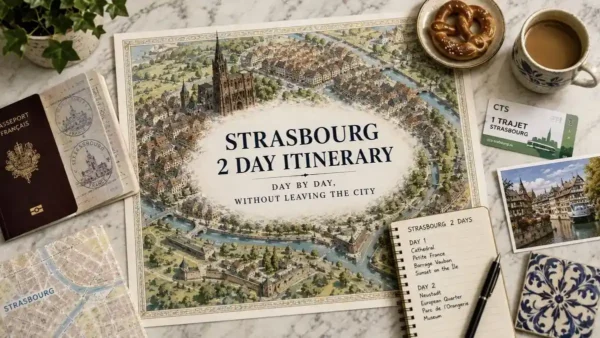
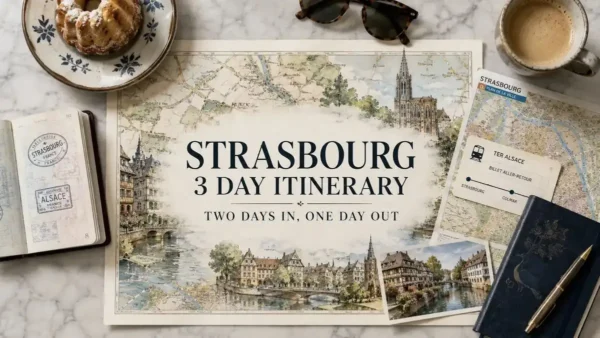
That is why the short-trip answer is the cleanest verdict on this page: base centrally so your walking goes into sightseeing instead of commuting. Our 2-day Strasbourg itinerary and 3-day Strasbourg itinerary both assume a central base for exactly that reason. Past four or five nights the arithmetic reverses, and the value of a quieter quarter compounds night after night.
The Christmas Market Season Inverts the Normal Advice
In market season the island turns magical, pedestrianised, checked at entry — and booked months ahead. Christkindelsmärik runs from late November to 24 December, and for those weeks the Grande Île stops behaving like a normal city centre. The base that is easiest in June becomes the hardest one to secure.
The island’s operating rules change with the market. According to the city’s official market information, vehicle access to the historic centre is closed during market hours, on-street and structure parking across the quarter is suspended for the period, large bags and suitcases are inspected at the island’s entry points, and pedestrians and cyclists face random checks. Treat all of that as the season’s pattern and confirm the current arrangements before you book or travel.
Driving in stops being a plan. The city’s Park & Ride tram relays exist precisely for these weeks: leave the car on the edge of the city and ride in.
Rooms on the island go months ahead, not weeks, and rates climb across the whole city — steepest on the island itself.
That leaves two clean strategies. Book the island far out and accept the entry checks as the price of stepping into the market from your doorstep. Or base deliberately across the water — Krutenau, Neustadt, the station side — and cross once each evening on your own schedule.
The closures and checks sit at the island’s edge, which is what makes the outside base work better than it sounds: you pass through them once on the way in, instead of every time you go back for a warmer coat.
For the market itself — where the chalets stand, what runs when, how the programme is organised — see the Strasbourg city guide.
Cheaper and Quieter: Other Areas Worth Knowing
Outer quarters cost less and sleep quieter — the trade is a tram ride or a longer walk. None of them earns a full block, because none of them changes the shape of the trip the way the main five do. They are worth knowing when the island is booked out or your budget is fixed.
Neudorf, south of the station and the water, is the most practical of the tail: residential, tram-connected and consistently cheaper than anything central. There is nothing to look at, which is exactly why it suits longer stays on a fixed budget.
Bourse-Esplanade sits between Krutenau and the university — quiet, studenty, close enough to walk in, and priced below the island. It is the sensible fallback when Krutenau itself is full.
L’Orangerie, around the park northeast of Neustadt, is the city’s leafiest address: green, calm, well-off and clearly further out. Choose it for a longer, slower stay with the tram as your route into the centre.
The European District, home to the Parliament and the Council of Europe, fills with institutional visitors and empties at weekends. It functions as a business base; leisure travelers gain little from sleeping there.
All four share one disqualifier: each asks you to travel to the city you came to see.
Hotels and places to stay
Compare hotels, apartments and stays for your dates in one search.
Search hotels and stays on hotels.com →
Tripstou may earn a commission if you book through this link, at no extra cost to you.
Frequently Asked Questions
Is Neustadt a good area to stay in Strasbourg?
Yes, if you want space, quiet and value within easy reach of the centre. Neustadt’s imperial boulevards suit longer stays and families, and the UNESCO listing extends here. Skip it if you are visiting for two nights and want half-timbered streets outside your window. The tram covers the gap on the days you don’t feel like walking.
Can you drive or park on the Grande Île during the Christmas market?
No. According to the city’s official market information, vehicle access to the historic centre is closed during market hours, and on-street and structure parking across the quarter is suspended for the period. Leave the car at a Park & Ride site outside the centre and take the tram in. Confirm the current arrangements before travelling.
How far in advance should you book a Strasbourg hotel for the Christmas market?
Months ahead, not weeks. Rooms on the Grande Île go first, and rates climb across the whole city once the market dates are published. If you are booking late, plan on basing across the water — Krutenau, Neustadt or the station side — and crossing once each evening.
Is Strasbourg walkable, or do you need the tram?
Strasbourg is walkable. The historic island is compact and pedestrian-first, and Petite France, Krutenau and the station district all sit within a walk of the cathedral. The tram matters only if you base further out — Neudorf, l’Orangerie or the far end of Neustadt — where it becomes your route in.
How many days do you need in Strasbourg, and does it change where you stay?
Two to three days covers the city, and that short window is exactly why a central base pays. Sleep on the Grande Île and your walking goes into sightseeing. Past four or five nights, the arithmetic reverses and a quieter quarter across the water saves more each night.
Related Guides
Next steps once your base is chosen — the quarters in depth, the trip framing, and how many days to give the city.
- Strasbourg travel guide — trip framing, things to do and the Christmas market programme.
- Grande Île area guide — the historic island centre in detail.
- Petite France quarter guide — canals, timber houses and the Ponts Couverts.
- Krutenau area guide — the lived-in quarter across the water.
- 2 days in Strasbourg — the short-trip route from a central base.
- 3 days in Strasbourg — the extra day and what it opens up.
Did this guide save you time or money? Tripstou is independent and reader-funded — if you'd like to give something back, you can support the site with a crypto contribution of any size.