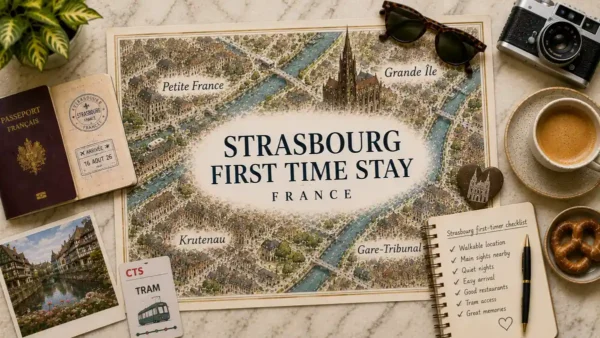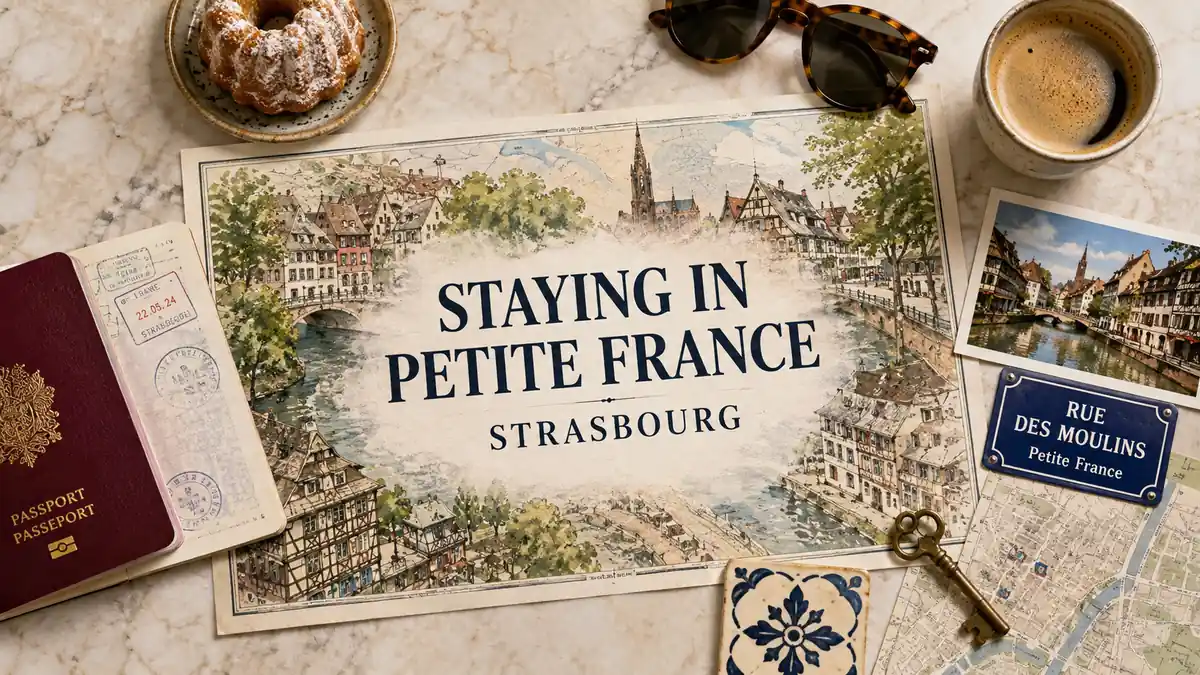
You have settled on Strasbourg, and now you are staring at a map of the old town wondering whether the canal quarter everyone photographs is also the place you should sleep. Petite France is the most recognisable address in the city — half-timbered houses leaning over water, flower boxes, footbridges — and that reputation cuts both ways. The same lanes that make the district famous fill with day-trippers by mid-morning and carry a nightly rate above most other parts of Strasbourg.
This page resolves the base decision and nothing else. You get the straight verdict on whether Petite France is worth booking, which of its three micro-zones suits which traveler, what the premium actually buys, and the tradeoffs — crowds, cobbles, awkward car access — that booking pages leave out. Where another district would serve you better, we say so and point you there instead of pretending the postcard fits everyone.
Quick Answer
Petite France is an excellent base for first-timers and couples who want a postcard setting and total walkability. The tradeoffs are heavy daytime crowds, canal-side noise, and a clear price premium over most other Strasbourg districts. Budget travelers and nightlife-focused visitors will sleep better and spend less in nearby Krutenau.
Trust Layer
Tripstou stay guide for travelers choosing where to base. Covers area atmosphere, budget, convenience, noise, and traveler fit.
Produced with AI assistance and reviewed by Alex Perrut, working in tourism since 2015, for the Tripstou editorial team. See our editorial process for details.
Last factual review: August 15, 2026.
Official sources consulted: France.fr, Atout France.
Key Takeaways
- Base in Petite France if a postcard setting and total walkability matter more to you than quiet nights and low rates.
- The district trades heavy mid-morning to early-evening crowds for two genuinely quiet hours that only guests sleeping there get.
- Book the quieter western edge for the best noise-to-setting balance, and the canal-side core only if the view is everything.
- Petite France sits mid-range to high-end with no real budget tier, so tight budgets stretch further a few streets out.
- A canal-facing window buys the photograph and the crowd taking it; ask for a courtyard room if you want calm.
- Arriving by car is this base’s weakest point, so settle the vehicle question before you reserve a room here.
Table of Contents
Petite France Is a Great Base — for the Right Traveler
Petite France is one of Strasbourg’s best bases if setting and walkability outrank quiet and price. It suits first-timers, couples, and short-stay travelers who want to step out of the door straight into the scenery. The cost is daytime crowds and a nightly rate premium over most other districts.
Two things rarely share a postcode: a setting people cross Europe to photograph, and a location you never need transport from. Petite France has both. The cathedral, the main squares, the covered bridges and the riverside paths all sit within an easy walk, so the base doubles as most of the itinerary and the transport question disappears from a short trip.
What booking pages and tourism sites skip is the other half of the deal. From mid-morning until early evening the lanes belong to visitors who are not staying in them, and the narrowest stretches beside the water get genuinely congested. You are buying a spectacular setting with a busy daytime lease attached. The thing you are actually paying for is the hour after the tour groups leave, when the district empties and you are still standing in it — a cheaper base off the island cannot buy that back.
If the district itself is not locked in yet, the full city-wide picture belongs in the parent guide to where to stay in Strasbourg, which sets every area against the others.
What Is Petite France, and Where Exactly Is It?
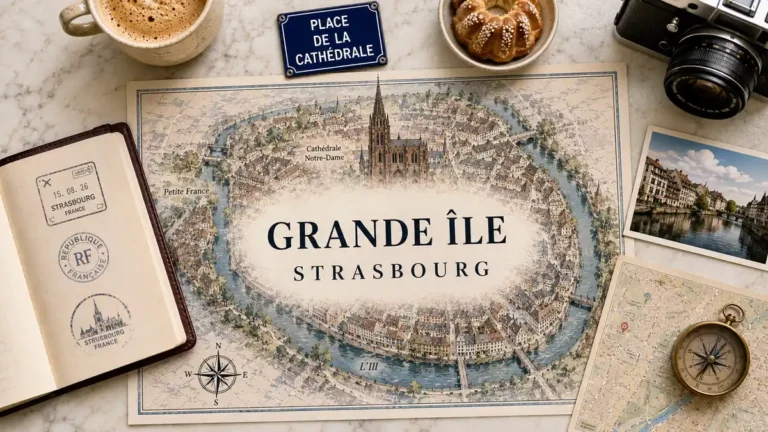
Petite France is the canal-laced south-western corner of the Grande Île, Strasbourg’s historic island centre. The quarter is small — a tight grid of half-timbered houses, footbridges, and channels of the River Ill. Everything else in central Strasbourg sits a short walk beyond its edges.
The houses date from the 16th and 17th centuries, when tanners, millers and fishermen worked the water here; that is the entire history you need for a stay decision. The district forms part of the Grande Île, a UNESCO World Heritage Site. Along its western side the Ill splits into channels beneath the Ponts Couverts, with the Barrage Vauban terrace immediately behind them — those two landmarks mark where the quarter stops.
Because Petite France sits inside the Grande Île, the two names blur on booking platforms, and travelers regularly book one thinking they booked the other; Petite France vs the Grande Île untangles which address you are actually reserving. For sightseeing, food, history and seasonal planning, the depth lives in the Strasbourg city guide.
What It’s Like to Stay in Petite France Day to Day
Petite France runs on a sharp daily rhythm: crowded and camera-filled by day, strikingly quiet by night. Day-trippers arrive mid-morning and thin out after dinner, when the lanes hand themselves back to the people sleeping there. Guests get the district’s two best hours, early and late.
Noise here is a daytime problem, not a nightlife one. The pressure points are the water-facing lanes and the footbridges, where tour groups, commentary and camera queues concentrate all afternoon; a room over one of those stretches hears the whole of it. Set back one street and the volume drops away sharply.
Evenings invert the district. Restaurant terraces stay busy, but the through-traffic disappears, and by late evening the canals are close to silent. That contrast is the strongest argument for sleeping inside Petite France instead of visiting it — the quiet version of the quarter is only available to people with a room in it.
The practical friction is underfoot. Cobbles, footbridges and stepped thresholds make wheeled luggage awkward, and historic buildings here often mean narrow staircases and no lift, which matters if you arrive late or travel heavy. During the Christmas market season the daytime crowd pressure climbs to its yearly peak, and the district is at its least comfortable for anyone who wanted a calm base.
Which Part of Petite France to Book: The Three Micro-Zones
The quieter western edge is the best-balanced booking for most travelers; the canal-side core is atmosphere-first. The eastern edge, facing the rest of the Grande Île, is the efficiency pick for a first sightseeing trip. The district is tiny, so the three zones differ by noise level far more than by walking time.
Price positioning is relative to the rest of Strasbourg, not to a fixed rate.
| Micro-zone | Atmosphere | Daytime noise | Price positioning | Best for |
|---|---|---|---|---|
| Canal-side postcard core | Half-timbered facades leaning over the water | Highest — tour groups pass all afternoon | High-end leaning, the district’s priciest | Postcard-view romantics on a short stay |
| Quieter western edge | Scenery at arm’s length, calmer streets | Moderate, and it fades early in the evening | Mid-range with some high-end options | Light sleepers who still want the district |
| Eastern, Grande Île-facing edge | Shopping streets and the cathedral approach | Busy, but spread across wider streets | Mid-range, the district’s softest pricing | First trips built around efficient sightseeing |
The Canal-Side Postcard Core
Book the canal-side core if the view is the reason you chose Strasbourg at all. This is the run of half-timbered facades bending over the water that appears in every photograph of the city, and waking up inside it reads very differently from walking through it once.
The atmosphere is the district at full strength — water on both sides, footbridges, terraces, and a constant low hum of visitors from mid-morning onward. Convenience is absolute: the whole quarter is at the door, and the rest of the island centre is a few minutes on foot. Price positioning is the highest in Petite France, leaning high-end, because the setting is the product.
Best for: postcard-view romantics who accept daytime crowds as the price of the address.
The Quieter Western Edge (Ponts Couverts and Barrage Vauban Side)
The western edge is the best-balanced booking in Petite France for most travelers. You sleep steps from the scenery without sleeping inside it, which removes the daytime noise problem while keeping everything that made you want the district.
The atmosphere is calmer and more residential, with the Ponts Couverts and the Barrage Vauban terrace as your immediate landmarks and fewer tour routes threading past the windows. Convenience barely suffers — the canal core is two or three minutes away, and the station side of the city is an easy walk. Price positioning is mid-range with some high-end options, generally softer than the water-facing core.
Best for: light sleepers who still want to wake up inside the district.
The Eastern, Grande Île-Facing Edge Toward the Cathedral
The eastern edge is the efficiency choice, and it suits travelers whose trip is built around sightseeing. It faces the rest of the Grande Île, so the cathedral, the shopping streets and the main squares are the closest things to your door.
The atmosphere is more ordinary old-town than canal fantasy — handsome streets, shops at ground level, and far less water in view. Convenience is the strongest on the page: you cross into the commercial centre in a couple of minutes and still walk home through Petite France at night. Price positioning is mid-range and typically the district’s gentlest, because the canal frontage is missing.
Best for: first-time visitors who want the shortest walk to the main sights.
Distance is close to irrelevant in a quarter this small. What changes between the three zones is how many strangers pass under your window between mid-morning and early evening, and that is the variable worth choosing deliberately at booking.
Hotels and places to stay
Compare hotels, apartments and stays for your dates in one search.
Search hotels and stays on hotels.com →
Tripstou may earn a commission if you book through this link, at no extra cost to you.
Is It Expensive to Stay in Petite France?
Yes — Petite France carries a clear premium over most other Strasbourg districts, and it is often worth paying. The premium buys the setting and a location that removes transport from the trip entirely. It stops being worth it once the stay is long enough for the view to become background.
In spend-style terms the district sits mid-range to high-end. Genuine budget stays are effectively absent inside it: the building stock is small, historic and protected, so there is no room for volume accommodation, and that scarcity holds the floor up. Mid-range rooms exist, though they skew smaller and more characterful than their equivalents elsewhere in the city. High-end is where the quarter is strongest, because a historic canal-side building is precisely the product a luxury traveler is paying for.
Trip length decides whether the premium pays, and it flips sooner than most people expect. Over two or three nights the setting is a large share of the whole experience and the surcharge buys a real part of the trip; stretched across a week it buys steadily less, because you stop noticing the canals and start noticing the crowd.
Best Fit by Traveler Type: Who Should Stay in Petite France
Petite France fits first-timers and couples best, families and luxury travelers well enough, and nightlife or budget travelers poorly. The split follows one variable — how much a postcard setting is worth to you. Each type below gets a straight verdict and the guide that takes the decision further.
- First-timers — strong fit. Everything on a first Strasbourg list is walkable from here, which deletes the transport question from a short trip; compare it with the city’s other options in the guide to the best area for first-timers in Strasbourg.
- Couples — the strongest fit on this page. The evening quiet-down turns the canals into the setting the photographs promised, which is exactly what a romantic trip is buying; more options in where couples should stay in Strasbourg.
- Families — workable, with caveats. Crowds, cobbles and stair-heavy historic buildings make arrival and pushchairs harder work than elsewhere; weigh the alternatives in the guide to the best areas for families in Strasbourg.
- Nightlife travelers — weak fit. The quarter goes quiet at roughly the hour a night out starts, so base yourself where the bars keep going and read where to stay for Strasbourg nightlife.
- Budget travelers — weak fit. This is a premium district with no real cheap tier inside it, and your money goes further a few streets out; the options are in staying in Strasbourg on a budget.
- Luxury travelers — good fit. Historic canal-side buildings are the district’s top product and its clearest justification for a high-end rate; see luxury stays in Strasbourg.
Who Shouldn’t Base in Petite France — and Where to Go Instead
Skip Petite France if you want nightlife, low prices, easy car access, or guaranteed quiet at every hour. Each of those needs is better served elsewhere in Strasbourg, usually within a short walk of the island. Giving up the postcard address costs less than most travelers expect.
Krutenau is the obvious alternative for the first two: livelier after dark, easier on the budget, and close enough to walk into the old town whenever you want it. The two are set against each other properly in Petite France vs Krutenau.
Arriving by car is the weak point of this base. Parking around the district is scarce and expensive, and these streets were laid out long before cars existed, so travelers driving to Strasbourg should settle the vehicle question before they book a room here.
- Want a real night out? Krutenau, where the bars run late and the walk home is short.
- Watching the budget? One of the districts just off the island, where the same money buys a larger room.
- Driving in? Anywhere the car is not fighting the historic street plan.
- Need silence at any hour? The western edge inside the district, or a residential area beyond the centre.
Three Booking Mistakes That Ruin a Petite France Stay
Three errors spoil most Petite France stays: expecting a quiet canal-facing room, arriving by car, and trusting hotel names. All three are avoidable at the booking stage, and all three cost nothing to fix in advance. None of them appear in the listing photos.
Mistake 1: booking the canal view and expecting calm. The window that gives you the photograph also gives you the crowd that comes to take it, all afternoon. Travelers book the view, get the footfall, and blame the hotel. The fix is cheap: choose the quieter western edge, or ask for a courtyard-facing room in the core.
Mistake 2: driving to the door. Petite France is a pedestrian-scale quarter of cobbles and footbridges, and parking nearby is scarce and expensive, so the last stage of a road trip is the most stressful part of the trip. Arrive by train where you can, or park outside the centre and walk in.
Mistake 3: trusting “Petite France” in the property name. Properties several streets outside the quarter borrow the name because it sells, and the listing map is often zoomed too far out to reveal the gap. Check the exact address before you pay. A name is not a location.
Frequently Asked Questions
Is Petite France noisy at night?
No — Petite France is quiet at night. The day-tripper crowds thin out after dinner, and by late evening the lanes and canals are close to silent. Restaurant terraces are the only real late-night source, so a room set back from the water or facing a courtyard sleeps well.
Is Petite France too crowded to stay in?
Not for most travelers. Crowding is concentrated between mid-morning and early evening, which is exactly when you are likely to be out sightseeing. It only spoils a stay if you planned to spend afternoons relaxing at your base or lingering on the footbridges.
How far is Petite France from Strasbourg train station?
It is a short walk. Strasbourg’s main station sits just west of the Grande Île, so most Petite France addresses are reachable on foot without needing a tram or taxi. The catch is the surface: cobbles and footbridges make wheeled luggage hard work on arrival.
How far is Petite France from Strasbourg Cathedral?
An easy walk across the Grande Île. Both sit on the same historic island, with the cathedral toward its eastern side and Petite France in the south-western corner, so no transport is involved. Book the eastern, Grande Île-facing edge if you want the shortest approach.
Can you park in Petite France if you’re driving to a hotel?
Assume you cannot park at the door. Parking in and around the quarter is scarce and expensive, and these lanes were laid out long before cars. Confirm what your property actually offers before booking, and plan to leave the car outside the historic centre.
Is Petite France walkable to the Christmas markets?
Yes. The main Christmas market areas sit in the central old town, an easy walk from Petite France, so a base here needs no transport during the season. Expect the quarter’s heaviest crowds of the year at the same time, especially through the afternoons.
Related Guides
These pages carry the decisions this guide deliberately hands off.
- Where to stay in Strasbourg — every district in the city compared, if the area is not settled.
- Petite France vs the Grande Île — which of the two overlapping addresses you are actually booking.
- Petite France vs Krutenau — the postcard base and the livelier, cheaper one, resolved head to head.
- Best area for first-timers in Strasbourg — the city-wide version of the first-visit decision.
- Staying in Strasbourg on a budget — where the money stretches once you leave the island.
- Strasbourg city guide — sightseeing, food and seasonal planning behind the stay decision.
Did this guide save you time or money? Tripstou is independent and reader-funded — if you'd like to give something back, you can support the site with a crypto contribution of any size.