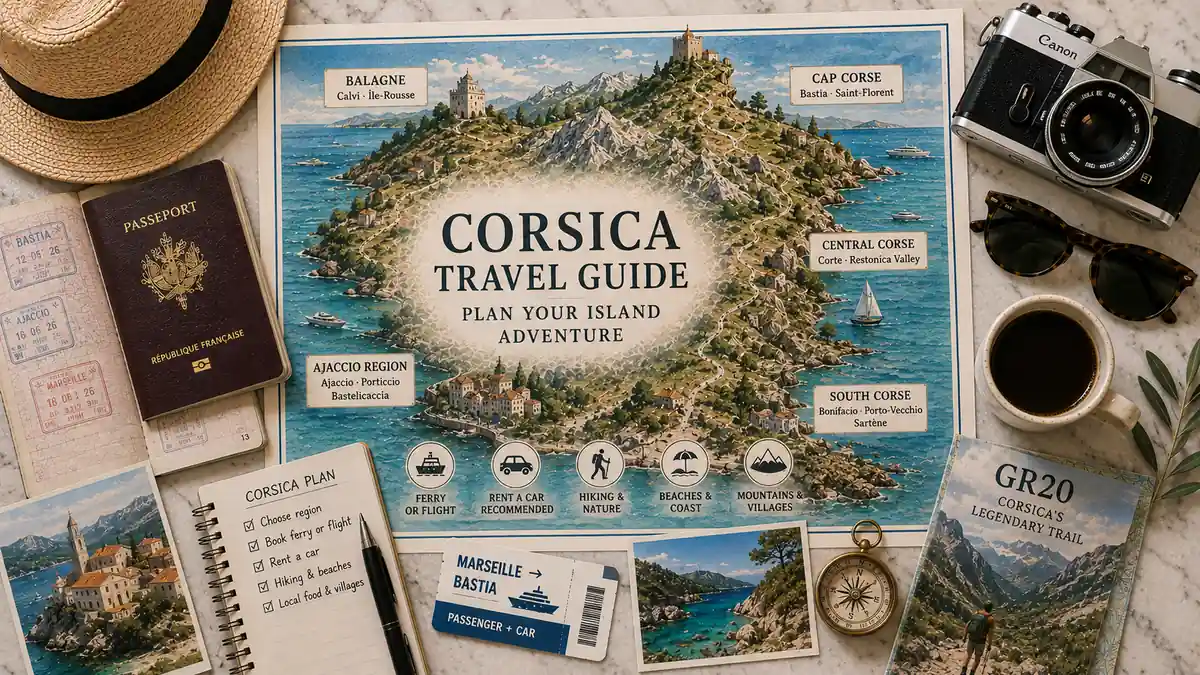
Corsica is France’s wildest island: a mountain range standing in the middle of the Mediterranean, with a coastline wrapped around its edges. It sits closer to Italy than to the French mainland, keeps its own language alongside French, and behaves nothing like the mainland Mediterranean coast most France trips end on. That difference is the appeal — and the reason the island does not slot neatly into a wider French route.
Your job as a planner is narrower than it first looks. You need to decide whether Corsica earns its own leg, how many days that leg needs, which half of the island to take, where to base yourself, and how much of each day the roads will quietly consume. This guide resolves those decisions in order: getting there by ferry or flight, how long the island really needs, north versus south, the five sub-areas and their base towns, and the honest mobility reality — plus when to go and what the GR20 actually demands of a hiker.
Quick Answer
Corsica is worth a dedicated trip: France’s wildest island, pairing serious mountains with a Mediterranean coast. A first visit works best with about 5–7 days and a rental car, covering one half of the island. Fly in for shorter trips, sail when you want your own car, and expect landscape over resort polish.
Trust Layer
Tripstou region guide for travelers planning a regional trip. Covers sub-areas, trip shape, base strategy, timing, and mobility tradeoffs.
Produced with AI assistance and reviewed by Alex Perrut, working in tourism since 2015, for the Tripstou editorial team. See our editorial process for details.
Last factual review: August 5, 2026.
Official sources consulted: France.fr, Atout France.
Key Takeaways
- Corsica rewards travelers who want mountains and coast in one trip, and frustrates anyone expecting an easy resort coastline.
- Give a first trip about 5–7 days and one half of the island, not an attempt at the whole coastline.
- Choose the south for beaches and short driving days, the north for mountains, hill villages and more variety.
- Rent a car: scheduled transport covers only the Bastia–Corte–Ajaccio axis, and road time governs every Corsican day.
- Travel between May and early October, since much of tourist Corsica shuts outside the main season.
- Treat the GR20 as serious alpine walking for experienced hikers; the Mare a Mare routes suit everyone else.
Table of Contents
Is Corsica Worth Visiting?
Corsica is worth visiting for travelers who want mountains and coast in the same day. The island is a granite range rising straight out of the Mediterranean, with its own language and identity. It rewards curiosity and effort, and it frustrates anyone expecting an easy resort coastline.
Hikers get more out of Corsica than any other group. The interior is genuine alpine country, topped by Monte Cinto at 2,710 metres, and the trail network crosses that terrain instead of skirting it. Walking here is the point, not a side activity.
Beach-led travelers are well served too, with a coastline that alternates granite coves, pale sand and cliff-backed inlets. The character is wild and low-rise, and large purpose-built resort strips are the exception across most of the island.
Families do well on the coast and struggle inland. Many bays shelve gently and the coastal towns are small and walkable, but mountain days run long and winding, and young children feel every hour of that.
Car-free travelers are the one group Corsica genuinely under-serves. Scheduled transport covers the Bastia–Corte–Ajaccio corridor and little else, so a trip without a car shrinks to a short list of towns on that line.
Corsica also behaves differently from mainland Mediterranean France. Villages sit high above the sea instead of on it, distances stay short while days stay long, and Corsican appears beside French on signs and menus. If you are still choosing where in the country to go, our France travel guide sets the national context, and best places to visit in France shows how the island sits among the regions. Travelers drawn here by wildness and weather-beaten coast often weigh the Atlantic version of the same instinct — our Brittany travel guide covers that greener, cooler alternative, with Corsica as the wilder, more mountainous option.
The most common first-timer error is treating Corsica as a beach destination that happens to have mountains. The mountains set the timetable here; the coast is what you reach at the end of the drive.
How to Get to Corsica: Ferry or Flight?
Fly to Corsica for speed and short trips; take the ferry when you want your own car on the island. Both run year round, with heavier schedules in the main season and thinner ones in winter. Four airports and four mainland ports spread arrivals across both ends of the island.
The four airports split the island neatly. Ajaccio (AJA) serves the west coast and the centre-south, Bastia (BIA) covers the northeast and Cap Corse, Calvi (CLY) lands you in the Balagne in the northwest, and Figari (FSC) is the entry point for Bonifacio and Porto-Vecchio in the far south. Choose the airport nearest your first base, not the one with the cheapest fare — a mismatched arrival can cost you a long mountain drive on day one.
Flying is fast in absolute terms: under roughly two hours from Paris and well under an hour from Nice. Mainland French routes operate year round, while many international routes run only in the main season. Confirm schedules when you book, since seasonal services appear and disappear.
Ferries sail from Marseille, Toulon, Nice and Sète, operated by Corsica Ferries, Corsica Linea and La Méridionale. Crossing times span a broad range — roughly 5 to 13-plus hours depending on route and ship — with the longest sailings scheduled overnight and the Nice hop the shortest. Treat those as ranges and check the exact crossing on your chosen date. Cars are carried on all mainland routes, and reaching the ports by rail is straightforward within France; our France train itinerary covers the mainland rail approach.
Three access patterns cover almost every trip:
- Fly and rent locally — best for trips of a week or less. You lose no travel days, and you pick up a car sized for narrow mountain roads. The tradeoff is rental cost and availability in the main season.
- Ferry as a foot passenger — suits travelers combining Corsica with a mainland leg who still plan to rent on arrival. Overnight sailings turn the crossing into a night’s travel, though you arrive tired.
- Ferry with your own car — the reason many drivers accept the crossing at all. You get familiar gear, luggage space and no rental limits, at the cost of a long sailing in each direction.
The car-on-ferry choice is really a trip-length choice. A crossing each way absorbs the better part of two travel days, which only pays back across a longer stay — on a four-night visit, the ferry eats the trip it was meant to serve.
How Many Days You Need in Corsica
Plan about 5–7 days for a first trip to Corsica, covering one half of the island. Slow mountain roads make short stays smaller than the map suggests, so days disappear into driving. Shorter visits work only as focused add-ons reached by air.
- 2–3 days — one sub-area at highlight pace. This buys a base town, its immediate coast and one inland drive. It is honest only as an add-on flown into a single airport, with no attempt to cross the island.
- 5–7 days — one half of the island, properly. This buys two bases, a mix of coast and interior, and enough slack for a weather-driven change of plan. It is the first-trip sweet spot for most travelers.
- 10–14 days — both halves, or coast plus deep interior. This buys the full north-to-south picture, including the slow west-coast corniche and a mountain stay. It fits travelers treating Corsica as the whole trip.
Corsica works best as a standalone trip. Once the island is more than a long weekend, it competes directly with the mainland for days, and splitting the difference tends to shortchange both. Our France itinerary guide covers overall route shaping across the country.
If Corsica has to share a trip, the day count decides how. A 7-day France itinerary rarely absorbs the island without becoming a Corsica trip with a Paris stopover; a 10-day France itinerary can carry a short flown-in island leg; and a 14-day France itinerary gives Corsica a full half without stripping the mainland.
The island punishes the add-on instinct in a specific way: the flight, the rental pickup and the first mountain drive consume most of day one, so a two-night stop delivers roughly one usable day.
North or South Corsica for a First Trip?
Choose the south for beaches and famous coastline, the north for mountains, hilltop villages and variety. Both halves fill a full week, and few first trips have the days for the pair. The south is the easier sell; the north is usually the more varied week.
The north runs from Calvi and the Balagne hill villages around Cap Corse to Bastia, then down the wild west coast towards Porto. It packs the most contrast into the shortest distances: citadel town, terraced vineyards, cape road and red-rock coast within one week. The tradeoff is road time — the west-coast approach is slow, and it is the section people most often underestimate.
The south centres on Bonifacio’s limestone cliffs and the gulf coastline around Porto-Vecchio, which is why most beach-led trips land at Figari. Driving days are shorter here and the coastal towns are geared to summer visitors. The tradeoff is exposure to peak-season crowds, and less interior variety within easy reach.
Beach quality drives many of these choices, and Corsica supplies several of France’s most celebrated stretches. We keep the national shortlist in one place — our guide to the best beaches in France — so this page stays on trip shape.
One consideration decides the split for most first-timers: if you are flying in and out of the same airport, take the half that airport serves and drop the ambition to see both.
Corsica’s Sub-Areas and Where to Base Yourself
Corsica resolves into five planning sub-areas, each with one natural base town. They are Balagne (Calvi), Cap Corse (Bastia), the Porto–Piana west coast (Porto), the interior (Corte) and the far south (Porto-Vecchio or Bonifacio). Base choice does more work here than in most French regions.
Balagne and the northwest
The Balagne is a compact arc of hill villages sitting above a wide bay and a walled citadel town. The anchor experience is the inland village circuit, driven or walked from the coast in a half day. The natural base is Calvi, which combines an airport, a port, a beach and a working town in one place. Best for: first-timers who want coast, villages and easy arrivals from a single base.
Cap Corse and Bastia
Cap Corse is a long finger of land north of Bastia, lined with terraced vineyards, watchtowers and small fishing hamlets. The anchor experience is the cape loop itself — a full unhurried day on a narrow coastal road. Bastia, the island’s northern port city, is the practical base and stays functional outside the main season. Best for: travelers who prefer slow coastal driving and lived-in port towns.
Porto and the Piana west coast
This is the island’s most dramatic coast, where red porphyry cliffs drop straight into the sea. The anchor experience is a boat trip along the Scandola reserve, which is reachable only by sea; access rules there are being tightened, so confirm with operators when you book. Porto is the natural base, small and strongly seasonal. Best for: scenery-led travelers willing to accept slow corniche driving.
Corte and the interior
Corte is granite Corsica: a university town wedged between mountain valleys, at the centre of the island. The anchor experience is walking into the Restonica valley from town, which puts high country within reach of a single base. Corte sits on the central rail axis, making it the one interior base that partly works without a car. Best for: hikers who want mountain Corsica without committing to the GR20.
Bonifacio, Porto-Vecchio and the far south
The far south pairs a limestone clifftop town with the island’s most celebrated stretch of coast. The anchor experience is Bonifacio’s old town above the strait, with the gulf beaches spread out to the north. Base in Porto-Vecchio for beach access and family logistics, or in Bonifacio for the setting. Best for: beach-led trips that want short driving days between swims.
These profiles are orientation, not a highlights list. For what to actually do in each area at depth, see things to do in Corsica; for the quieter villages and coves that reward a second visit, see hidden gems in Corsica.
| Sub-area | Character | Anchor experience | Base town | Best for |
|---|---|---|---|---|
| Balagne and the northwest | Hill villages above a wide citadel bay | The inland village circuit from the coast | Calvi, with the easiest arrivals on the island | First-timers wanting coast and villages together |
| Cap Corse and Bastia | Narrow cape road, vine terraces, fishing hamlets | Driving the full cape loop unhurried | Bastia, a working northern port city | Travelers who like slow coastal driving |
| Porto and the Piana west coast | Red porphyry cliffs falling into the sea | Boat trip along the Scandola reserve coast | Porto, small and strongly seasonal | Scenery-led travelers who accept slow roads |
| Corte and the interior | Granite university town among mountain valleys | Walking into the Restonica valley from town | Corte, on the central rail axis | Hikers wanting mountains without the GR20 |
| Bonifacio and the far south | Limestone cliffs and a celebrated beach coast | The clifftop old town above the strait | Porto-Vecchio or Bonifacio, depending on priorities | Beach-led trips with short driving days |
Base towns are chosen for access and services, not for size.
One Base or Multiple Bases in Corsica?
Two bases beat one on a 5–7 day trip, with one base per half of the area you are covering. A single base under-serves this island because the roads make every long day-trip cost more time than the map implies. Two bases keep daily driving inside a tolerable window.
The tradeoff is real but small. Moving costs you a packing morning and a check-in afternoon; staying put costs you the same hours in repeated drives, every day, on the island’s slowest roads. On trips of 10 days or more, three bases work well — typically one coastal base per half plus one interior stop.
Hotels and places to stay
Compare hotels, apartments and stays for your dates in one search.
Search hotels and stays on hotels.com →
Tripstou may earn a commission if you book through this link, at no extra cost to you.
A Car Is Effectively Essential in Corsica
A rental car is effectively essential in Corsica outside the Bastia–Corte–Ajaccio axis. Scheduled transport thins out quickly beyond that line, and most sub-areas have no practical alternative. Road time, not distance, shapes every Corsican day, so build itineraries around hours behind the wheel.
The reason is geography. A mountain spine runs the length of the island, and the roads follow contours instead of cutting through them, so routes bend, climb and double back. Crossing the island north to south on the main road takes roughly four hours, and that figure assumes the main road, dry conditions and no stops.
Map distances and GPS estimates understate real travel time here — sometimes badly. Build days on hours, not kilometres, and add buffer to anything that leaves the main axis. A drive that looks like 60 kilometres is not a one-hour drive on this island.
Several corridors are notably slow. The Restonica valley road, the Bavella pass, the Col de Vergio route and the Porto–Piana corniche are narrow, winding and exposed in places, with limited passing space and frequent oncoming traffic in the main season. Drive them in daylight, with time in hand, and treat them as the day’s main activity rather than a transfer between two other plans.
Going car-free is possible but limiting. The rail line and coastal services connect Bastia, Corte, Ajaccio and Calvi, which covers four useful bases and leaves out the west coast, the far south and every mountain valley in between. That is a real trip for some travelers, and a frustrating one for anyone who came for the interior. Mainland driving works on different assumptions entirely — our France road trip guide covers that execution depth.
Corsican driving is the part of the trip that punishes optimism most reliably. Never chain two mountain corridors into one day, and plan arrivals at your base before dark.
Best Time to Visit Corsica
The main season in Corsica runs roughly from May to early October, and outside it much of tourist Corsica closes. Late spring and early autumn are the planning sweet spot: warm sea, open businesses, lighter roads. Midsummer brings the crowds, the heat and the highest prices.
Shoulder months are where the island is at its best for most travelers. Coastal roads are quieter, the interior is comfortable for walking, and accommodation is easier to secure. Sea temperature is the price you pay — it lags the air by weeks at both ends of the season.
Summer is peak in every sense. Beaches, ferries and the slow corridors all fill at once, and the mountain roads that are merely slow in low season become slow and busy at the height of it. Book early if those weeks are fixed for you.
Winter is a different island. Resort towns such as Calvi and Bonifacio go very quiet, with much of their seasonal infrastructure shut, while Ajaccio and Bastia keep functioning year round as working cities. Ferry and flight schedules thin out, and interior passes can close temporarily after heavy snow, so mountain routes cannot be assumed open.
National timing logic runs differently from the island’s — our guide to the best time to visit France covers month-level depth for the mainland, and the France packing list covers what each season asks you to bring.
Shoulder season trades sea temperature for the interior. The mountain valleys are at their finest exactly when the coast is merely pleasant, which is why walkers and beach travelers rarely pick the same weeks.
The GR20 and Easier Ways to Hike Corsica
The GR20 is a very challenging route reserved for experienced hikers with good physical stamina. It runs about 180 km north to south across the island in 16 stages, passing Monte Cinto at 2,710 metres. Easier waymarked routes exist for everyone else.
The official figures set expectations honestly. An average stage involves roughly seven hours of walking, and the northern half between Calenzana and Vizzavona is the harder of the two halves, with the most demanding terrain on the route. This is high mountain walking on rock, not a long coastal path.
What filters people out is terrain, not mileage. Seven hours of walking on granite, scree and exposed traverses, repeated day after day, is the real requirement, and no amount of flat-ground fitness substitutes for it.
Two officially promoted alternatives cover the rest of the walking market. The Mare a Mare routes cross the island between Porto-Vecchio and Propriano, and the Mare e Monti links Calenzana to Cargèse along the northwest. Both are waymarked, and both stay well below GR20 difficulty while still crossing serious country.
This page is a regional planner, not a hiking guide. Anyone committing to the GR20 should plan it from dedicated trail sources and current official information, and anyone unsure whether they qualify as an experienced hiker with good physical stamina should read that qualifier as a genuine filter.
Frequently Asked Questions
Can you take your own car on the ferry to Corsica?
Yes. Every mainland ferry route to Corsica carries vehicles, sailing from Marseille, Toulon, Nice and Sète. Size matters once you land: a large family car or camper is harder work on the island’s narrow, winding mountain roads than the compact rentals most visitors pick up at the airport.
Is anything open in Corsica outside the main season?
Yes, but the tourist layer thins sharply. Ajaccio and Bastia keep working year round as real cities with shops, restaurants and transport. Many coastal hotels, restaurants and boat operators are seasonal; resort towns such as Calvi and Bonifacio go very quiet; and ferry and flight schedules both reduce.
Can you visit Scandola by land or only by boat?
Only by boat. Scandola has no land or pedestrian access, so the reserve is seen on boat trips leaving from Porto, Calvi, Ajaccio and nearby harbours. Access rules for the reserve are being tightened, so confirm the current conditions with your boat operator when you book.
Is there a train in Corsica?
Yes, a single line links Bastia, Corte and Ajaccio, with a branch running out to Calvi in the northwest. It is genuinely useful if you are basing yourself in Corte or moving between those towns. It reaches no part of the west coast or the far south.
Is Corsica expensive compared to mainland France?
In the main season, yes — Corsica generally runs above mainland French averages. Island supply, a short season and concentrated summer demand push up accommodation, car hire and eating out, and getting there adds a cost the mainland does not. Shoulder months sit noticeably closer to mainland norms.
Do people speak French in Corsica?
Yes. French is the everyday language of the island, and you will be understood everywhere in it. Corsican is the regional language, spoken among locals and printed alongside French on road signs, place names and menus. English is common in tourist businesses during the main season.
Related Guides
These guides cover the planning layers this page routes out to.
- France travel budget — how costs break down nationally, including where island trips sit against the mainland.
- France food guide — what to eat across the country, and how regional cooking differs from Paris norms.
- France wine regions — the country’s wine map, useful if tastings shape where you travel.
- Common scams in France — the tourist-facing tricks worth recognising before you arrive.
- Solo female travel safety in France — practical safety guidance for travelling France alone.
Did this guide save you time or money? Tripstou is independent and reader-funded — if you'd like to give something back, you can support the site with a crypto contribution of any size.