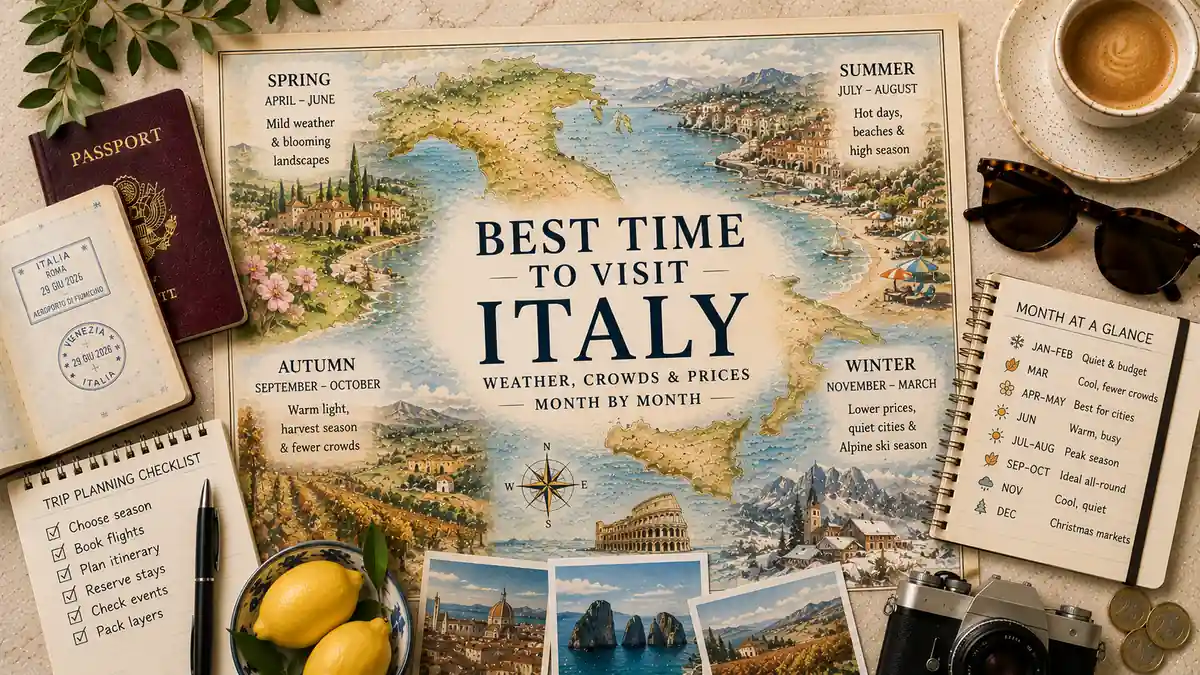
Choosing when to visit Italy is the single decision that shapes everything else about your trip — how much you pay, how long the queues are, and whether you spend July sweating in a museum line or swimming off a quiet cove. The right month depends on what you want: cities, coast, mountains, or harvest. This guide resolves the timing question across the three variables that actually matter — weather, crowds, and price — and shows how they trade off month by month and season by season. It also matches the best window to your trip type, from city sightseeing to Alpine hiking, and explains how the ideal timing shifts as you move from the cooler north to the long, warm south. By the end you will know the safe default window, the cheapest and quietest stretch, the time to avoid, and how to fine-tune all of it to your own plans.
Quick Answer
Late spring (April–June) and early autumn (September–October) are the best time to visit Italy: mild weather, lighter crowds, fairer prices. Summer suits the coast and islands but brings heat and packed cities; winter is cheapest and quietest but greyer with more closures. For most first-timers and city sightseeing, shoulder season is the safe default.
Trust Layer
Tripstou planning guide for travelers resolving one travel decision. Covers the main variable, traveler context, and practical tradeoffs.
Produced with AI assistance and reviewed by Alex Perrut, working in tourism since 2015, for the Tripstou editorial team. See our editorial process for details.
Last factual review: June 29, 2026.
Official sources consulted: Italia.it, ENIT.
Key Takeaways
- Late spring (April–June) and early autumn (September–October) are the all-round sweet spot, balancing mild weather, thinner crowds, and fairer prices.
- Summer delivers warm seas for the coast and islands but punishes the big inland cities with peak heat, crowds, and prices.
- For the lowest prices and emptiest sights, travel between New Year and Easter, accepting short, grey days in return.
- Pick your month by activity: shoulder season for cities, high summer for beaches, July–September for Alpine hiking, autumn for harvest and wine.
- Avoid August in the big inland cities, when heat, crowds, prices, and Ferragosto closures all peak together.
- Shift southern and island trips toward May or October to keep the warmth without August’s heat, crowds, and prices.
Table of Contents
When is the best time to visit Italy?
Shoulder season — late spring and early autumn — is the best all-round time to visit Italy. April through June and September through October deliver warm-but-not-scorching weather, thinner crowds than peak summer, and more reasonable prices. This is the window where Italy’s weather, crowds, and cost align most comfortably for the typical traveler.
“Shoulder season” simply means the months on either side of the summer peak, after the Easter rush has eased and before the heat and high prices of July and August arrive — and again once the August crowds clear. In Italy that lands roughly in April–June and September–October. You still get long, mostly warm days, open attractions, and full restaurant and transport schedules, but without the worst of the queues and surcharges.
This window suits the broadest range of travelers: first-timers building a classic cities-and-countryside trip, couples, and anyone who wants to walk Rome, Florence, and Venice in comfort. The main tradeoff is the sea — late spring water is still cool, and by mid-autumn beach days are fading, so committed swimmers may prefer high summer instead.
Reality check: shoulder season rarely sells out, so you tend to get better hotels and fewer compromises for less money than at the summer peak. For broader trip framing once you have your dates, see our Italy travel guide.
What is the best month to visit Italy?
May and September are the best individual months to visit Italy. Both offer warm, settled weather, long daylight, and crowds that have not yet hit — or have just passed — their summer peak. May edges ahead for spring greenery and blooms; September wins for warm seas and the start of harvest season.
Here is how the calendar reads month by month for the typical traveler:
- April: mild and green, with Easter the main crowd-and-price spike to plan around. Good for cities, still cool for swimming.
- May: warm, long days and manageable crowds — arguably the best single month for cities and countryside.
- June: reliably warm and the sea is swimmable, but crowds and prices start climbing toward the summer peak.
- July–August: hottest and busiest, best for the coast and islands, hardest in the big inland cities.
- September: warm seas, easing crowds and the harvest beginning — the strongest all-round month after May.
- October: cooler and quieter, ideal for cities and food trips, with shorter days toward month’s end.
- November–March: cool, grey and quiet, cheapest of the year outside the Christmas and New Year peak.
Treat any temperature or price comparisons here as broad ranges rather than fixed figures, and verify festival timing before you lock in dates — Easter, in particular, moves each year and reshapes April and early May.
Italy’s seasons: weather, crowds, and price compared
Each Italian season trades weather, crowds, and price differently, so the best one depends on your priorities. Spring and autumn balance all three; summer maximizes warmth and beach time at the cost of heat and crowds; winter minimizes cost and crowds but sacrifices daylight and reliable weather. Match the season to the axis you care about most.
The table below scores the four seasons on the three decision variables so you can line them up against your own priorities. Treat price as relative movement across the year, not absolute cost.
| Season | Weather | Crowds | Price |
|---|---|---|---|
| Spring (Mar–May) | Mild and fresh, occasional spring rain | Building toward Easter, then easing | Moderate, rising around Easter week |
| Summer (Jun–Aug) | Hot, often very hot inland and south | Heaviest of the year, especially August | Highest, peaking in midsummer |
| Autumn (Sep–Nov) | Warm early, cooler and wetter later | Thinning after September, quiet by November | Falling steadily through the season |
| Winter (Dec–Feb) | Cool to cold and grey, shorter days | Lightest, apart from Christmas and New Year | Lowest, outside the holiday peak |
Rule: you rarely win all three axes at once, so pick the variable that matters most and let it choose your season. If weather and an even balance lead, go spring or autumn; if beach time leads, accept summer’s crowds and cost; if budget and quiet lead, take winter’s greyer days.
When is the cheapest and least crowded time to visit Italy?
November to March — excluding the Christmas and New Year peak — is the cheapest and least crowded time to visit Italy. Flights and hotels drop well below summer levels, and major sights stay walkable. The trade-off is shorter, greyer days, colder weather, and some seasonal closures along the coast and in resort towns.
The discounts in deep winter can be substantial relative to July and August, though exact savings vary by city, route, and how far ahead you book — treat them as a meaningful drop rather than a fixed percentage. Big-city sightseeing is the clear winner: Rome, Florence, and Venice are at their quietest, and you can move through the headline museums and galleries with far less waiting.
The cost of going cheap is daylight and atmosphere. Days are short, some coastal hotels, beach clubs, and island ferries scale back or close, and the weather is a gamble. This window suits budget travelers, city-focused trips, and anyone who values empty piazzas over warm seas. For absolute costs by season, that decision belongs on a dedicated budget page rather than here.
Reality check: the lowest prices and thinnest crowds cluster in the stretch between New Year and Easter, when demand bottoms out — that is the single cheapest window to target.
When is the worst time to visit Italy?
August in Italy’s big cities is the toughest window for most travelers. Heat peaks, prices stay high, and around Ferragosto in mid-August many locals leave, so some family-run restaurants and shops close. The crowds and cost of midsummer hit hardest in Rome, Florence, and Milan, where there is little shade or relief.
The problem is a stack of factors landing at once: peak temperatures, the year’s densest crowds, top-of-the-range prices, and a mid-August lull when much of urban Italy pauses for the Ferragosto holiday. Some independent businesses shutter for a week or two — exact dates and closures vary year to year, so confirm locally rather than assuming. Christmas, New Year, and Easter form smaller spikes, with prices and crowds jumping for those holiday windows.
August is not universally bad, though. It is prime time for the coast, the islands, and the Alps, where heat is welcome or tempered by altitude and sea breezes. The travelers who should avoid it are those set on inland cities and indoor sightseeing; the ones who can embrace it are headed for the beach or the mountains.
Best time to visit Italy by trip type
The best time to visit Italy depends on what you came to do. City sightseeing rewards the mild shoulder months; beaches and islands need high summer; Alpine hiking has a short summer window; food and wine peak in autumn. Match the month to the activity, not the other way around, and the rest of the trip falls into place.
Rule: book the activity-defining month first, then build the rest of the trip around it. Once you know when you are going, you can decide where it makes sense to go — see our guide to the best places to visit in Italy to match destinations to your window.
When is the best time for city sightseeing?
The shoulder months — April–June and September–October — are the best time for city sightseeing in Italy. Temperatures are comfortable for walking all day, daylight is long, and queues are far shorter than in midsummer. You can cover Rome, Florence, and Venice on foot without the August heat or the deepest crowds.
When is the best time for beaches and the coast?
Mid-June through September is the swim-and-coast window in Italy, when the sea is warm enough for comfortable swimming and beach towns are fully open. July and August are the warmest but busiest and priciest; June and September offer warm water with thinner crowds. We rank timing here, not specific beaches.
When is the best time for mountains and hiking?
July to September is the Alpine hiking season in the Dolomites and the northern mountains. High trails, refuges, and lifts generally operate only in these months, once the snow has cleared and before it returns. Late June and early October can work at lower altitudes, but the high routes have a genuinely short window.
When is the best time for food, wine, and the harvest?
Autumn — roughly September through November — is the best time for food and wine in Italy. The grape and olive harvests, truffle season, and a wave of food festivals all cluster here, and cooler weather suits long lunches and cellar visits. Exact harvest timing shifts with the year and the region, so confirm dates locally.
Tours and activities
Book skip-the-line tickets, day trips and local tours with free cancellation on most activities.
You can also browse everything on getyourguide.com.
Tripstou may earn a commission if you book through this link, at no extra cost to you.
How timing differs across northern, central, and southern Italy
The south stays warm far longer than the north, so the ideal window shifts with region. Southern Italy and the islands offer beach weather from late spring into October; central Italy peaks in the shoulder months; the north and the Alps have cooler, shorter summers and a real winter season. The country’s length means timing is regional, not national.
Use these regional timing pointers to fine-tune your dates, and open the city guides for the detail this page does not absorb:
- Northern Italy: cooler and shorter summers, distinct winters, and the Alpine season concentrated in July–September. Venice is famously busy and atmospheric in the shoulder months, with the Carnival period drawing a major late-winter crowd — see the Venice guide, Milan guide, and Bologna guide for city-level timing.
- Central Italy: the classic shoulder-season heartland, best in spring and autumn when the cities are walkable and the countryside is at its finest. For specifics, see the Rome guide and Florence guide.
- Southern Italy and the islands: the longest warm season, with swimmable seas from late spring into October and mild, low-season winters — see the Naples guide for the south.
Reality check: to dodge the worst of the heat, push a southern or island trip toward May or October rather than midsummer — you keep the warmth without August’s crowds, prices, and peak temperatures.
Frequently Asked Questions
Is August a good time to visit Italy?
August is good for the coast, islands, and Alps but tough in the big inland cities, where heat, crowds, and prices all peak. Around Ferragosto in mid-August, some family-run shops and restaurants close as locals take their own holidays. Head for the sea or the mountains rather than Rome or Florence.
When is the best time to visit Italy for wine and the harvest season?
Plan a wine trip for September and October, the heart of Italy’s grape harvest, with the olive harvest and truffle season running into November. Cooler northern regions like Piedmont and Tuscany typically harvest earlier than the warmer south. Many wineries welcome visitors during the vendemmia, but book cellar tours ahead, as harvest weeks fill up.
Does the best time to visit differ for northern and southern Italy?
Yes. Southern Italy and the islands enjoy a longer warm season, with swimmable seas from late spring into October and mild winters. The north and the Alps have shorter, cooler summers and a genuine winter. The shoulder months suit both, but southern beach trips stay viable later into autumn than northern ones.
What is the rainiest time of year in Italy?
Late autumn and winter, roughly November through February, are the wettest months across most of Italy, with autumn often bringing the heaviest downpours. Spring sees occasional showers, while summer stays mostly dry, especially in the south. Rainfall varies by region — the north and the Alps stay wetter than the sunny south.
Is winter a good time to visit Italy?
Winter is a good time to visit Italy for cities, culture, food, and budget travel, offering the lowest prices and emptiest museums outside the Christmas and New Year peak. It is also ski season in the Alps. The trade-offs are short, grey days, cold weather, and reduced coastal and island services.
When is swimming season in Italy?
Swimming season in Italy runs roughly from June to September, when the sea is warm enough for comfortable swimming and beach towns are fully open. The warmer south and the islands stretch the window from late May into October. July and August bring the warmest water but the biggest crowds and highest prices.
Related Guides
- Italy travel guide — the full cluster hub for planning your trip end to end.
- Best places to visit in Italy — decide where to go once you have your window.
- Italy itinerary — turn your dates and destinations into a route.
- Rome guide — central Italy timing and the capital in detail.
- Venice guide — northern Italy timing, including the Carnival period.
- Naples guide — the south’s long, warm season up close.
Did this guide save you time or money? Tripstou is independent and reader-funded — if you'd like to give something back, you can support the site with a crypto contribution of any size.