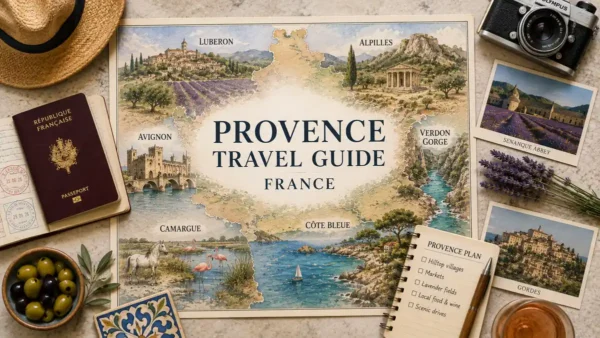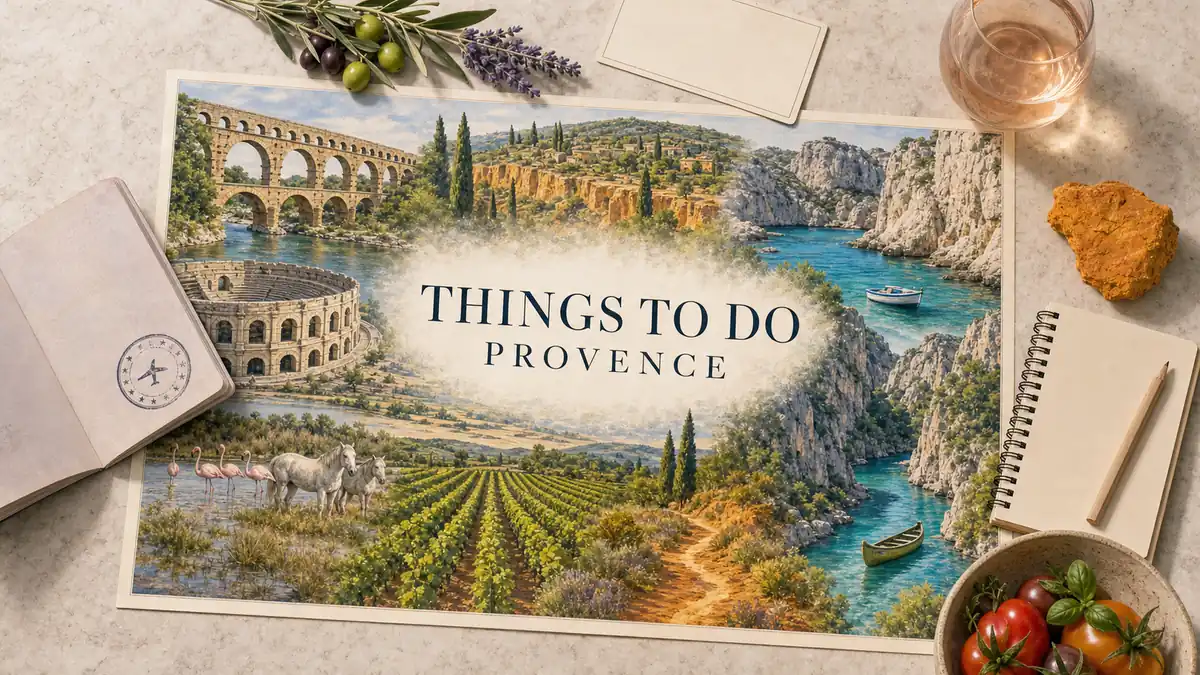
Every Provence guide hands you the same twenty villages and leaves the actual question unanswered: what will you do with the four or five days you have? Village names are not a plan. A morning market, a Roman amphitheatre, a boat into a limestone inlet and a canyon paddle are four completely different days, and they suit completely different travelers.
This guide resolves the experiences, not the postcodes. For each one you get the same four things: what the experience is actually like, roughly how much of your day it eats, who it rewards, and which version to choose when there is more than one — guided or self-guided, boat or footpath, casual tasting or a full cellar day. It closes with a picking rule for first-timers, because the most common Provence mistake is not choosing the wrong experience. It is choosing eight of them.
Quick Answer
Provence is worth dedicated trip days for an experience range few French regions match. Roman sites, art, coastal inlets, canyon water and cellar-door wine sit in one compact area, and the trip works when you pick a handful instead of chasing villages. Book limited-capacity experiences ahead in high season; shoulder seasons suit everything else.
Trust Layer
Tripstou attraction guide for travelers deciding whether an experience is worth doing and how to do it well. Covers value, booking versions, timing, access, and traveler fit.
Produced with AI assistance and reviewed by Alex Perrut, working in tourism since 2015, for the Tripstou editorial team. See our editorial process for details.
Last factual review: August 22, 2026.
Official sources consulted: France.fr, Atout France.
Key Takeaways
- Provence earns dedicated days for experience density — Roman sites, coast, canyon, markets and wine inside one compact region.
- Three or four experiences done properly beat a village-a-day sprint; every extra stop converts into driving time you never budgeted.
- Take the Calanques by boat when time is short, and walk in only if the swim is the actual point of the day.
- Guided days in Provence mostly buy access and a driver, not information — book them for wildlife, wine and car-free travel.
- Most experiences hold up outside peak summer; only the water days genuinely need warm months to be worth the drive.
- Book limited-capacity experiences before you travel, and treat high-summer coastal access as conditional, not guaranteed.
Table of Contents
Provence Is Worth Your Trip Days — for the Experiences, Not the Checklist
Provence earns dedicated trip days for its experience density, not its village count. One compact region gives you Roman amphitheatres, Van Gogh’s painting ground, sea inlets reachable by boat, a canyon you can paddle and cellar-door rosé. Few French regions hold that range in such a small area.
What the region is known for is a specific combination: Roman heritage that survived largely intact, the light that pulled painters south, a rocky Mediterranean coastline, and a food culture organised around weekly markets. Lavender is Provence’s signature seasonal experience, and its timing and location decisions are resolved separately in the guide to Provence’s lavender fields.
The region’s reputation is built on villages. But villages are where you park. What you will remember is the thing you did after parking, and that is the layer most Provence planning skips entirely.
The honest case for skipping Provence is real. If your ideal trip runs on major museums, nightlife and dense urban walking, the region will feel slow and car-dependent, and Paris or Lyon will serve you better. Provence rewards travelers willing to build a day around one thing and let it take the time it takes.
The most useful way to judge that tradeoff is against the rest of the country. If you are still weighing where Provence sits among things to do across France, judge it as an experience region, not a sightseeing one. And if it is going into a longer route, the sequencing question belongs with your wider France itinerary, where Provence works best as a multi-day block and badly as a stopover.
Are Provence’s Roman Ruins Worth a Full Day?
Yes — for history-minded travelers, Provence’s Roman circuit justifies a full day. Everyone else should pick one flagship site and give it a morning. The ruins here are unusually complete, and seeing two or three in sequence shows how an entire Roman province was engineered rather than just decorated.
The Pont du Gard converts sceptics. It is a UNESCO-listed Roman aqueduct bridge built to carry water to Nîmes, and the dimensions do nothing for you until you are underneath it. Standing under it does the work. Plan it as a riverside half-day with a walk and a swim attached, not a ten-minute photo stop.
Arles and Nîmes deliver the other half of the circuit as living stage sets. The Arles amphitheatre still stands in the middle of a working town, and Nîmes holds both an amphitheatre and the Maison Carrée, one of the best-preserved Roman temples anywhere. Pairing one town amphitheatre with the aqueduct is the version most travelers should organise their day around.
Passes are a maths problem, not a loyalty test. A combined ticket pays off only if you will genuinely visit several sites in the same town, and travelers doing one monument and one museum are usually better off with single tickets. Check current rates and what each pass actually covers before you commit at the desk.
- Time needed: half a day for one flagship site; a full day to combine a town amphitheatre with the aqueduct.
- Best season: spring and autumn — these are open-air sites with almost no shade in high summer.
- Guided vs self-guided: self-guided works everywhere; a guide earns its cost mainly at the aqueduct, where the engineering story is invisible without one.
Following Van Gogh and Provence’s Immersive Art Scene
Provence’s art experiences split in two: open-air Van Gogh settings and one indoor immersive projection show. Both run at half-day scale. Give them time if art is part of why you came south, and skip both without guilt if it is not. Neither one fills a full day, and neither rewards being rushed.
Is tracing Van Gogh’s footsteps worth a half-day?
Yes, if you enjoy knowing exactly where a painting came from. Van Gogh painted in Arles and later in Saint-Rémy-de-Provence, and the appeal is standing in the light and landscape behind canvases you already know. These places are not museums of his work. They are the settings.
This is a self-guided experience by default. Marked walking routes connect the sites in both towns, and the reproductions placed at each viewpoint do the interpretive job a guide would otherwise do. It suits travelers who like slow, low-commitment mornings — and it disappoints anyone expecting to see the originals, which hang in galleries elsewhere in the world.
Is Carrières de Lumières worth booking?
Yes for most travelers, and especially for families and anyone travelling with art-resistant teenagers. The show projects large-scale artworks across the walls and floor of a former limestone quarry near Les Baux, and the setting does as much work as the images. The visit itself is short. Treat it as part of a half-day, not the half-day.
The tradeoff is that this is a spectacle, not a gallery. Purists who want to study brushwork will find it loud and hurried, and the programme rotates, so the artist you read about may not be the artist showing when you arrive. Book a time slot ahead in high season, aim for an early or late entry to dodge the heaviest crowds, and check current admission at the venue before you budget for a family.
Provence’s Two Great Water Days — and Which One to Choose
Provence has two water days worth building a trip around: the coastal inlets and the Verdon canyon. One is a swimming day among limestone coves between Marseille and Cassis; the other is a full day paddling turquoise water under vertical cliffs. Both need warm months, and both reward committing the whole day.
Should you see the Calanques by boat or on foot?
Take the boat if you are short on time or travelling with children. Walk in if you are a confident hiker who wants the water itself. The Calanques are limestone inlets along the national park between Marseille and Cassis, and the two versions produce different days — one covers distance, the other earns the swim.
- By boat — Who it suits: families, travelers with one day on the coast, and anyone who wants to see several inlets in a single outing. Tradeoff: you see the coastline from the outside, and many trips cruise past without landing, so the swim you pictured may never happen.
- On foot — Who it suits: fit walkers in proper shoes who want an emptier cove and a swim they earned. Tradeoff: the paths are rocky, exposed and hot, the descent is the easy half, and the climb back out is the part people underestimate.
The choice is really a choice about swimming. If getting into that water is the reason you came, no boat schedule will do it for you, and the walk stops being optional.
Access is the part to check. The national park applies restrictions during the hottest and driest stretch of the year, and both trails and launch points can be limited at short notice, so confirm current access with the park before you build a day around it. Boat operators are the more dependable choice when land access is uncertain.
Is kayaking the Gorges du Verdon worth a full day?
Yes, if you can give it the whole day and the drive that comes with it. Paddling under the Gorges du Verdon’s limestone walls is the most memorable outdoor day Provence offers: the water is a startling turquoise, the cliffs run vertically above you, and the scale is only legible from the surface.
The version choice is water level or rim level. On the water, kayaks and pedalos launch from the lake end of the canyon and let you paddle into the narrow section beneath the cliffs; you need no technique, only the willingness to keep going. From the rim, a road loops above the gorge with a chain of viewpoints, delivering the photographs with none of the effort.
Choose the rim if you have small children, limited mobility, or a group that will not agree on anything physical. Choose the water if the point of the day is being inside the canyon instead of looking down into it. The gorge is vertical. The view down is nothing like the view up, and the two options are not interchangeable.
Verdon punishes half-commitment. It sits too far from the rest of the region to slot beside anything else, so either give it a whole day or leave it off the list — a rushed Verdon is worse than no Verdon. Rental runs seasonally and the canyon is a warm-weather experience, so confirm what is operating before you commit a long drive to it.
Do You Need a Tour to See the Camargue’s Flamingos and White Horses?
No — you can self-drive the Camargue’s edges and see flamingos from public roads and paths. But guided trips get you closer, more reliably, because guides know which lagoons are holding birds and which ranches are working that morning. Self-drive suits independent travelers; guided suits anyone who wants a near-guarantee.
The Camargue is a river delta of salt lagoons, reed beds and open grazing land, and the wildlife is the entire point: pink flamingos standing in shallow water, white horses in the marsh, black bulls behind fences. It reads flat from the car. The interest is in what is standing in it.
A half-day covers the headline sightings. A full day earns the quieter parts — a ride across the marsh, a birding hide, a working ranch — and is the version worth booking if wildlife is a genuine reason for your trip. Horseback riding is widely available and is the format that puts you in the terrain, not beside it.
The guided version earns its cost for three travelers in particular: photographers who need the right light at the right lagoon, first-timers with a single morning, and anyone without a car. Independent travelers with a vehicle and patience do fine alone. Nothing here needs a guide to be safe or legal — only to be efficient.
Tasting Provence: Morning Markets, Wine Cellars, and Cooking Days
Provence’s food experiences start with the weekly morning market and run to bookable cooking and truffle days. A market costs you nothing but an early start; a cellar visit or a class costs a half-day and a reservation. Choose by whether food is your trip’s backdrop or one of its reasons.
What are Provençal markets actually like?
Most Provençal towns hold one weekly morning market, and it is the region’s lowest-effort signature experience. Stalls of produce, olives, cheese, soap and textiles thread through old-town streets and squares, and most are winding down by lunchtime. You need no ticket, no booking and no plan.
Build the morning around the market; do not squeeze it in. Arrive early, buy the components of a picnic, and let the stalls decide your lunch — that is the version people remember afterwards. Antiques and brocante markets run on their own rhythm and sit closer to browsing than to shopping. The market day varies by town, so check locally once you know where you are staying, and treat two markets in a trip as plenty: they rhyme with each other, and by the third the discovery has gone.
Markets are not universal. If you dislike crowds, heat and slow-moving lanes, a market morning will feel like an obstacle, and you will get far more out of an early start at a Roman site while everyone else is queueing for cheese.
Is wine tasting in Provence worth a half-day?
Yes, if you plan the day around one or two estates and not a list. Provence is rosé country, the style most associated with the region, and cellar-door visits are common and informal across the vineyard areas. Just north, Châteauneuf-du-Pape offers tasting visits for travelers who want serious reds.
The casual version is a drop-in tasting on the way somewhere else, which is enough for most travelers. The dedicated version is a half-day across two estates with someone else driving, and it is the only version worth choosing if you actually intend to taste more than a token pour. The driver question shapes this day more than the wine does.
Are cooking classes and truffle experiences worth booking?
Yes for travelers who want to take something home beyond photographs. A market-to-table cooking class turns a market morning into a full day with a purpose, and it suits solo travelers and couples who want company. Families with young children usually find the format long and the pace slow.
Truffle experiences are a winter thing. Hunts with dogs and truffle-focused meals cluster in the cold months, and out of season what you find is a shop, not an experience. Both formats run in small groups and fill up, so book before you travel and treat the date as fixed once you hold it.
Hiking and Cycling in Provence: From Ochre Trails to Mont Ventoux
Provence’s outdoor range runs from short ochre-trail walks to Mont Ventoux, one of road cycling’s genuine tests. Between those poles sit village-to-village walks and rolling vineyard rides. Pick by effort level first, because the scenery is good at every level and the difficulty is not.
The Sentier des Ocres is the accessible entry point. The marked trail loops through the old ochre workings at Roussillon, where the rock runs orange, red and violet, and it works for almost anyone in ordinary shoes — a short loop, not a hiking day. Wear something you do not mind staining.
Village-to-village walking is the step up. Marked paths link hilltop settlements across the Luberon and the Alpilles, and a half-day between two of them gives you the landscape at walking pace with lunch at the far end. This is the format for travelers who want the exercise without the summit.
Mont Ventoux is a different sport. The climb is long, exposed and bare near the top, and it belongs to riders with real fitness and a bike they trust, not to a casual holiday cycle. Road access up the mountain varies with the season and the conditions, so check before you plan a day around it.
Ventoux is the one Provence outing where the weather decides for you. The summit generates its own conditions, there is no shelter to wait them out, and riders who fix a date instead of keeping a flexible window are the ones who end up not riding at all. Everyone else gets the better deal on the flatter vineyard and orchard roads below.
Are Guided Tours in Provence Worth It?
Guided tours earn their cost in Provence for wildlife access, wine days, and travelers without a car. Everything else here works self-guided. The region’s sites are well signed and rarely require an intermediary between you and what you came to see. Book the guide for access, not for information.
- Self-guided by car — Who it suits: confident drivers who want to set their own pace and stop where they like. Tradeoff: parking near the popular sites is genuinely difficult in high season, and a driver cannot drink at a tasting.
- Single-experience guided bookings — Who it suits: travelers who want one thing done properly, typically a wildlife morning, a wine afternoon or an aqueduct visit. Tradeoff: you still need your own transport to reach the meeting point.
- Full guided day tours — Who it suits: car-free travelers based in one town, and anyone whose trip is too short to absorb a driving mistake. Tradeoff: you get a fixed route and a fixed clock, which is the opposite of how Provence rewards being visited.
The guide you are paying for in Provence is usually a driver. Once you see that clearly, the cost question stops being about knowledge and becomes a question about logistics — which is much easier to answer honestly.
Three practical rules cover everything on this page. Book the limited-capacity experiences before you travel: boat trips, immersive art slots, cooking classes and truffle days all fill in high season, and there is no walk-up fix. Buy a combined ticket or pass only when you can name the several sites you will actually use it on; for one monument and one museum, singles usually win. And treat coastal access as conditional — restrictions apply in the Calanques during high summer, so confirm what is open with the park before a day depends on it.
Tours and activities
Book skip-the-line tickets, day trips and local tours with free cancellation on most activities.
You can also browse everything on getyourguide.com.
Tripstou may earn a commission if you book through this link, at no extra cost to you.
How to Choose: Fewer Experiences, Matched to Your Season
First-timers get more from three or four experiences done properly than from a village-a-day sprint. Provence is dispersed, and every additional stop converts into driving time you will not get back. Start with the season, which decides what is even open, then filter by travel style.
Most of Provence’s experiences hold up outside peak summer; only the water days genuinely need warm months. Markets, Roman sites, art and walking all work better in the shoulder seasons, when the light is good and the crowds are thin. Summer buys you the sea and charges you for it.
| Season | Experiences at their best | Weakest fit | Who it suits |
|---|---|---|---|
| Spring | Markets, Roman sites, ochre trails, village walking | Sea swimming still cold for most | First-timers wanting breadth without heavy crowds |
| Summer | Calanques swims, Verdon paddling, coastal boat trips | Open-air Roman sites with no shade | Families and water-focused travelers |
| Autumn | Wine estates, harvest energy, long hiking days | Some coastal operators winding down | Food-led travelers and comfortable-weather walkers |
| Winter | Truffle days, immersive art, near-empty Roman sites | Water experiences largely out of season | Repeat visitors and quiet-season travelers |
Autumn is the underrated half of the year here. The vineyards are working, the hiking is comfortable, the sea holds its warmth for a while, and the coastal crowds have gone — the tradeoff is that some boat and rental operators wind down as the season turns, so water plans need confirming before they are counted on.
Winter suits a narrower traveler. Truffle experiences are at their strongest, the immersive art venue is indoors by definition, and the Roman monuments come as close to empty as they ever get. The cost is that most of the outdoor programme is off the table and short days limit how much fits into one.
Once the season has filtered the list, use time budgets as the planning unit. Almost everything on this page resolves as either a half-day or a full day: a market morning, a Van Gogh walk, an immersive art slot and a cellar-door tasting are half-days, while the Roman circuit, the canyon, the wetland and a Calanques hike are full days. Count them against the days you have, leave one day unplanned. Then stop.
The breadth-versus-depth tradeoff is the whole decision. Four experiences taken at their proper pace read as a rich trip; eight at half-pace read as a blur of car parks and closing times. If two of your choices sit at opposite ends of the region, one of them is quietly costing you a day you never budgeted.
The mistral settles more Provence plans than any guidebook does. When the wind is up, the boat trips and the canyon go first, so the travelers who lose nothing are the ones who picked an indoor or inland second choice before they left home.
Which towns to base these experiences in is a separate question, and it deserves a deliberate answer — our roundup of the best places to visit in France puts Provence’s towns in national context so you can see what you are trading. For bases, driving distances and how the region actually connects, the Provence guide is where those logistics live.
Frequently Asked Questions
How many days do you need in Provence?
Budget three to five days for a first visit, which is enough for three or four experiences at their proper pace. Each one on this page runs as a half-day or a full day, and the drives between them take longer than the map suggests. Fewer days means fewer experiences, not faster ones.
Do you need a car in Provence?
For most of these experiences, yes. The Roman sites, the canyon, the wetland and the vineyards sit far apart, and public transport between them is slow. Car-free travelers can still base themselves in one town and book guided days out — the Provence guide covers bases and getting around.
What is the best time of year to visit Provence?
Late spring and early autumn are the strongest all-round windows. Both give you warm days without peak crowds, and they suit the markets, Roman sites, walking and wine estates that make up most of the list. Choose high summer only if swimming and paddling are the point of the trip.
What is there to do in Provence in winter?
Winter is truffle season, and the food experiences built around it are at their best. The immersive art venue is indoors, the Roman monuments come close to empty, and the weekly markets keep running. What you lose is the water: the coast and the canyon are out of season, and daylight is short.
How far in advance should you book Provence experiences?
Book before you leave home for anything with limited capacity — boat trips, timed art slots, cooking classes and truffle days — especially in high season. Outside the busy months, a few days ahead is usually enough. Roman sites and markets need nothing booked; you can decide those on the morning.
Is Provence a good destination for families with young children?
Yes, with the right shortlist. Boat trips, the immersive art show, market mornings and a wildlife morning in the wetlands all work well with children. The long canyon day, the coastal hike and a serious wine afternoon do not. Provence rewards families who pick three easy wins over a full programme.
Related Guides
These guides resolve the decisions this page deliberately leaves to them — where to base yourself, which places to prioritise, and how Provence fits a wider France trip.
- Provence Guide — bases, getting around, and how the region connects.
- Provence Lavender Fields — timing and location decisions for the region’s signature season.
- Things to Do in France — where Provence sits in the national experience picture.
- Best Places to Visit in France — which towns and regions earn priority nationally.
- France Itinerary — fitting a Provence block into a longer route.
Did this guide save you time or money? Tripstou is independent and reader-funded — if you'd like to give something back, you can support the site with a crypto contribution of any size.