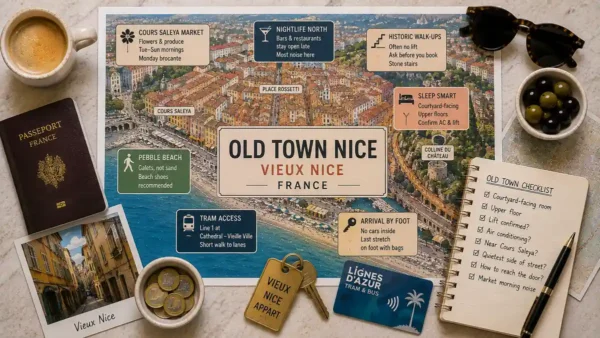
You have already chosen Nice, and you have already decided that the evening is the point. That narrows the stay decision into something most area guides handle badly, because most of them are written for readers who want the night to happen somewhere else. This page inverts that. Every other stay guide treats night noise as a defect to design around; for you it is the product, and the real question is how much sleep you are willing to trade for how few steps home.
The answer sits in three zones, judged on one axis: how close you sleep to where the evening physically happens. Two of them are genuine nightlife zones running at different tempos. The third is not a nightlife zone at all, which is precisely why it earns a place here. Each carries a cost, and the costs are not interchangeable.
Quick Answer
The Old Town is the zone to book when being inside the night matters most in Nice. The trade is direct: you sleep inside the noise you came for, since the bar streets sit under the windows. Carré d’Or is the strongest alternative, keeping the night walkable but off your street.
Trust Layer
Tripstou stay guide for travelers choosing where to base. Covers area atmosphere, budget, convenience, noise, and traveler fit.
Produced with AI assistance and reviewed by Alex Perrut, working in tourism since 2015, for the Tripstou editorial team. See our editorial process for details.
Last factual review: August 7, 2026.
Official sources consulted: France.fr, Atout France.
Key Takeaways
- Book the Old Town if being inside the night matters most, and accept a broken night as the price.
- The Port suits a long-dinner evening at your doorstep, with the Old Town’s louder night a headland walk away.
- Carré d’Or trades bar noise for traffic noise plus a walk, which is the easier of the two to book around.
- Nice’s trams wind down around midnight, so book within walking distance and keep the timetable out of your night.
- A rear- or courtyard-facing room changes your night more than moving to a quieter zone does.
- Match the zone to your loudest hour, not your average one — all three keep the return home on foot.
Table of Contents
Which Area of Nice Has the Best Nightlife?
The Old Town is Nice’s nightlife centre, with the Port as the smaller, more local second zone. The densest bar streets run north of Cours Saleya, folded into the narrow lanes behind it. The Port holds a looser, dinner-led evening. Everything else in central Nice is quieter than both.
The two zones sit beside each other on a map and behave as separate evenings on the ground. Castle Hill rises between them, so crossing from one to the other means going around the headland instead of cutting through it. That is a piece of topography, not a distance claim, and it changes how a night actually unfolds.
Most nightlife-first visitors end up choosing one zone and staying inside it all evening. The hill quietly turns zone-hopping into a decision rather than an afterthought, which is why picking the zone matters more here than in a flat city centre where you can drift between clusters.
Carré d’Or is not a nightlife zone. Its evening happens inside hotels and dining rooms, not along the street, and that is exactly what makes it useful as a base. It appears on this page as a sleeping option near the night, never as a source of it.
The Old Town Is the Zone if the Night Comes First
The Old Town is the zone to book when being inside the night outranks sleeping through it. The bar streets are also the accommodation streets, so the walk home is measured in minutes and flights of stairs. You will hear the evening from your bed, and that is the deal.
The lanes are loud where the bars are, and the sound does not stop at your front door. Narrow streets and hard stone surfaces bounce noise upward, so the evening reaches the second and third floors with very little softening. For the reader this page is written for, that is not a warning. It is the thing being purchased: the shortest possible distance between the last drink and the pillow.
Convenience here is close to absolute. Dinner, the evening itself, and the way home all sit inside the same handful of lanes, and no part of the night depends on a schedule or a transfer. Nothing has to end early because something else stops running.
Accommodation in the Old Town leans apartment-led, in older buildings where stairs are normal and lifts are frequently absent. That matters more on the way back up. In spend-style terms the zone reads budget to mid-range, and what you are paying for is position, not polish — high-end expectations around insulation, space and lifts sit awkwardly against this kind of building stock.
Book the Old Town for the nights, not for the mornings. The zone’s real cost is the shape of the next day, and it lands hardest on trips of 2 or 3 days, where one broken night is a meaningful share of the whole visit.
For the zone’s full character as a base — daytime feel, layout, and who it suits beyond the nightlife axis — see our guide to staying in Nice’s Old Town. If your question has already narrowed to the straight choice between the lanes and the grid, Old Town versus Carré d’Or resolves that binary directly.
Best for: the traveler whose night out is the reason for the trip and who will trade sleep quality for a doorstep.
The Port Suits a Slower, More Local Night
The Port works when you want a local-feeling evening at your doorstep instead of the densest bar streets. Its nights run to long dinners and terrace drinks around the basin, with a resident crowd mixed into the visiting one. It is a real second nightlife zone, running at a lower intensity.
Castle Hill sits between the Port and the Old Town, and that separation does most of the work here. Being based at the Port means the Old Town’s night is near you without being on your street: reachable on foot around the headland, but not arriving through your shutters at the end of it.
Connectivity is a genuine strength across the day. A tram line terminates at Port Lympia and runs through to the airport, which keeps the zone plugged into the rest of Nice for daytime movement and early-evening plans. Read that as convenience, not as a ride home at the end of a long night; the late-return section below explains why those are different things.
Accommodation here tends toward hotels and newer apartment stock compared with the Old Town’s older buildings, which usually means lifts, better glazing, and rooms that face something other than a bar street. In spend-style terms the Port reads mid-range: less of a position premium than the seafront addresses, more comfort than the lanes.
The Port’s advantage is that it never forces the choice. You can have a quiet night in your own zone and a loud one in someone else’s, on the same trip. An Old Town booking sells that flexibility away in exchange for proximity.
Our full profile of staying at the Port in Nice covers the zone’s wider character as a base. If you are weighing it against the quiet-near option specifically, Carré d’Or versus the Port takes that comparison on its own terms.
Best for: the traveler whose ideal evening is a long dinner and a terrace, with a louder night available nearby when wanted.
Carré d’Or Keeps You Near the Night Without Living in It
Carré d’Or is the zone for sleeping properly while keeping the Old Town’s night within walking range. The grid of wide streets between the seafront and the shopping core buys separation without buying distance. You walk to the evening, and you walk back out of it.
Carré d’Or is not a nightlife zone, and booking it as one is the mistake to avoid. Its evening offer is venue-internal: bars and restaurants that belong to hotels and dining rooms, not clusters spilling across the pavement. Nothing about the street layout produces the kind of night the Old Town lanes produce.
The zone is not silent either. Its night noise is traffic-shaped, generated by wide streets and boulevards rather than by people outside bars. That distinction is the entire decision input here: you are not trading bar noise for quiet, you are trading bar noise for traffic noise plus a walk. Traffic noise is steadier, more predictable, and far easier to design out at booking time. You can book around traffic noise. A bar street you cannot.
Accommodation tends to be hotel-led, in buildings newer and better insulated than the Old Town’s, with lifts far more common. In spend-style terms Carré d’Or reads mid-range to high-end — the address costs more than the lanes, and comfort is what the premium actually buys you.
The trade only makes sense if you will genuinely make the walk. Readers who book the grid for the sleep and then find the distance discouraging end up with neither the night nor the value; our full guide to Carré d’Or as a base covers the zone’s wider character before you commit to it.
Best for: the traveler who wants a full night out and a full night’s sleep, and will walk home for both.
How Do You Stay Near the Nightlife and Still Sleep?
Choose the building and the room, not just the zone. A rear-facing or courtyard room changes the night far more than which side of a zone line you sleep on. Two bookings on the same street can deliver completely different nights.
Most of the sleep outcome is decided at booking time, and the levers are ordinary ones:
- Rear- or courtyard-facing rooms — the strongest control you have, suiting anyone staying inside a bar zone; the tradeoff is usually a worse view and sometimes a smaller room.
- Upper floors — they lift you away from street level and pavement conversation; in older lift-less buildings the tradeoff is the climb, every time you come home.
- One lane off the cluster — a street that is adjacent to the bars without hosting them keeps the walk short and cuts the volume; the tradeoff is losing the doorstep feeling that made you choose the zone.
- Accommodation type — a real lever, since hotels and apartments handle late returns and noise differently; the full apartment-versus-hotel comparison sits in the FAQ below.
Booking listings will tell you some of this and hide the rest. Floor number, lift availability and courtyard orientation are usually stated or visible in photographs. What is downstairs on a busy night is not. Photographs shot from the window are the most honest signal a listing gives you, because they show what your room actually faces instead of what the description implies.
The reflex is to solve noise by moving further out. The smaller move is to the back of the same building, which keeps every advantage you booked the zone for. Orientation beats postcode.
Hotels and places to stay
Compare hotels, apartments and stays for your dates in one search.
Search hotels and stays on hotels.com →
Tripstou may earn a commission if you book through this link, at no extra cost to you.
Getting Back Late: Plan for a Walk, Not a Tram
Book within walking distance of your evening, because Nice’s trams wind down around or shortly after midnight. Weekend service runs later than weeknights, but an overnight window with no useful public transport remains. A walkable return takes the timetable out of the night entirely.
The tram network is built around the city’s day and early evening, not around its late one. Evening service stretches later at weekends, and that is as far as planning around it should go. The gap is real.
This reshapes the zone choice more than any comfort argument does. Sleeping inside your evening zone, or in the one beside it, removes the return journey from the decision completely: no last departure to watch, no fallback to arrange, no reason for the night to end on someone else’s schedule. Sleeping further out means the night ends when the network does, or it ends by taxi.
Which Zone Fits Which Kind of Night
Match the zone to the shape of your night: inside it, beside it, or a quiet walk from it. Bar-street-first nights point to the Old Town, local-evening nights to the Port, and sleep-first nights to Carré d’Or. All three keep the return home on foot.
All comparisons are qualitative and zone-level.
| Zone | Closeness to the evening | Sleep outlook | Late return | Typical stay style |
|---|---|---|---|---|
| Old Town | Inside the densest bar streets | Noisy where the bars are | Minutes on foot, no timetable | Apartment-led, older buildings, stairs common |
| The Port | Its own evening at your doorstep | Calmer than the Old Town lanes | Walkable within the zone itself | Hotels and newer apartments tend to lead |
| Carré d’Or | A walk from the Old Town night | Traffic noise, bookable around | A short walk back, no transfer | Hotel-led, newer and better insulated |
Pick the zone that matches the loudest hour of your night, not the average one. Old Town bookings disappoint when the trip turns out quieter than planned, and Carré d’Or bookings disappoint when it turns out louder. None of the three is a compromise.
If nightlife is not truly the axis deciding your booking — if beach access, a residential feel or a different budget shape matters more — the full where to stay in Nice breakdown covers the areas this page deliberately leaves out. For trip-level orientation before you lock the stay decision, start with the Nice travel guide.
Frequently Asked Questions
Does Carré d’Or have nightlife?
Not as a street-level scene. Carré d’Or’s evening happens inside hotels and dining rooms, not in bar clusters spilling across the pavement. Its night noise comes from traffic on the wide streets, not from people outside bars. Book it as a quiet base within walking range of the night, not as the night itself.
Is an apartment or a hotel better for a nightlife stay in Nice?
A hotel suits most nightlife stays. Reception handles a late arrival, lifts are far more common, and no one minds the hour you come in. Apartments win on space and on the Old Town’s most central addresses, but stairs, keys and quiet-hours etiquette all become your problem at the end of a long night.
Which room should you book if you stay above Nice’s bar streets?
Take the rear- or courtyard-facing room every time, even over a higher floor or a better view. Orientation decides what reaches your pillow; height only softens it. If the listing shows no photograph taken from the window, treat the room as street-facing until the host confirms otherwise.
Is Jean Médecin good for nightlife in Nice?
Jean Médecin is sometimes named among Nice’s livelier central areas, and it is well connected. This page still resolves to three zones, because Jean Médecin’s evening is not the concentrated bar-street kind the Old Town holds, or the terrace-led one at the Port. Base there for convenience, not for the night.
Should you book further out in Nice and take a taxi back after a night out?
Not if you can avoid it. Nice’s evening tram network winds down before many nights do, so a return from outside walking range depends on finding a taxi at the hour you want one. Staying inside or beside your evening zone removes that dependency from the night completely.
Is it worth splitting your stay between two Nice nightlife zones?
Rarely. The Old Town and the Port are adjacent zones, so a split buys you a change of atmosphere and costs you a check-out, a bag move and half a day. On a short trip, choosing one zone and then choosing the right room inside it returns far more.
Related Guides
- Where to Stay in Nice — the full area breakdown across every traveler type.
- Staying in Nice’s Old Town — the lanes as a base, beyond the nightlife axis.
- Staying in Carré d’Or — the grid’s character, comfort and daily convenience.
- Staying at the Port in Nice — the basin as a base and who it suits.
- Carré d’Or vs the Port — the two-zone choice resolved head to head.
- Old Town vs Carré d’Or — lanes or grid, decided on one page.
- Nice Travel Guide — trip-level orientation before the stay decision.
Did this guide save you time or money? Tripstou is independent and reader-funded — if you'd like to give something back, you can support the site with a crypto contribution of any size.