You have booked Nice, and you want one straight answer: how careful do you actually need to be? The honest version sits between the two you will find online. Most visits pass without anything happening at all. Almost all of the trouble that does happen comes from a short list of situations — a crowded seafront, a busy market stall, a bag left on a beach towel, an overconfident swim — and each of those has a response you can learn in a minute.
This guide gives you the calibrated version: what the real risk is, where it concentrates, what the common approaches look like from the inside, how much respect the sea deserves, whether insurance is worth buying, and what to do in the first hour if something goes wrong. It is written the way a careful local would tell a visitor what is actually true — nothing dramatised, nothing smoothed over.
Quick Answer
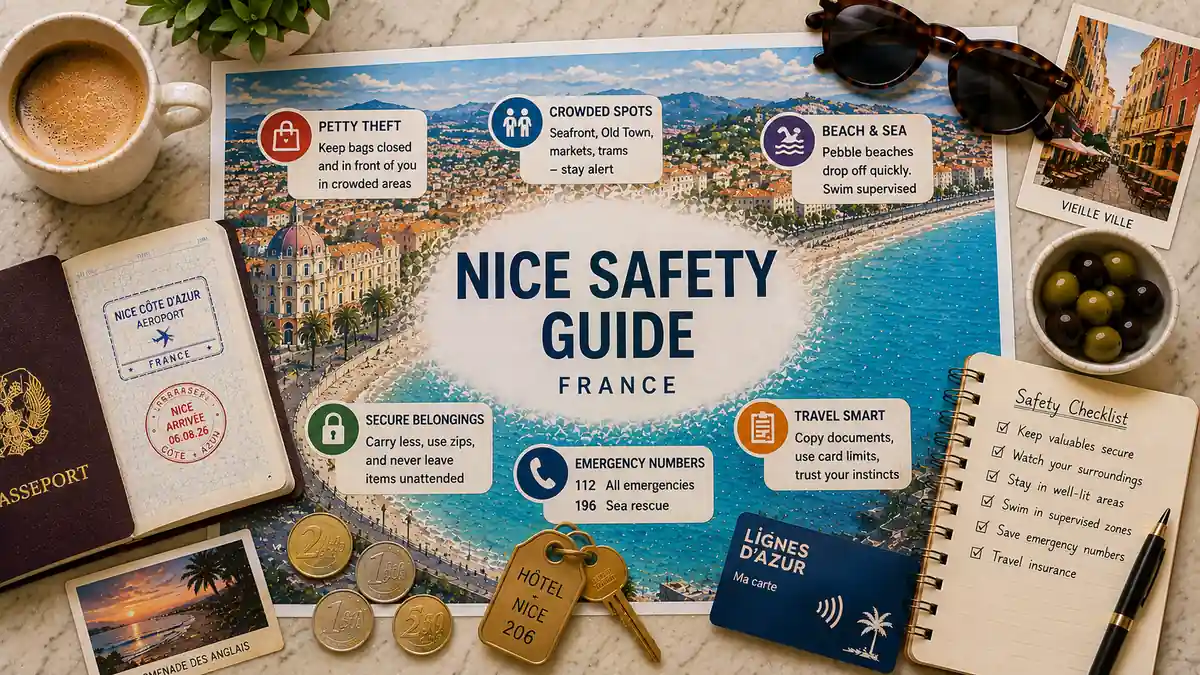
Nice is safe for visitors: pickpocketing and petty theft are the realistic risk; violent crime against visitors is rare. Risk concentrates where visitors crowd and get distracted — the seafront, the Old Town, markets, trams, and the beach while you swim. Carry less, secure it in crowds, and the odds sit strongly in your favour.
Trust Layer
Tripstou safety guide for travelers deciding how safe a destination is and what precautions actually matter. Covers real risk levels, common scams, situational awareness, and protection choices.
Produced with AI assistance and reviewed by Alex Perrut, working in tourism since 2015, for the Tripstou editorial team. See our editorial process for details.
Last factual review: August 6, 2026.
Official sources consulted: France.fr, Atout France.
Key Takeaways
- Property crime is the realistic risk in Nice; violent crime against visitors stays rare, which changes your habits, not your route.
- Theft follows crowds and distraction, so the seafront, the Old Town, markets and packed trams are where you carry least.
- Most losses come from distraction teams — one stranger engages you while a second takes the bag you turned away from.
- Nice’s pebble beaches shelve steeply into deep water: swim inside a supervised zone and check the flag before entering.
- Travel insurance earns its place on medical repatriation and high-value items, not on the phone a pickpocket takes.
- Save 112 for any emergency and 196 for sea rescue; after a theft, report, replace and block in that order.
Table of Contents
Nice Is Safe for Most Visitors — Petty Theft Is the Real Risk
Most visits to Nice pass without incident. The realistic risk is property crime — a bag lifted in a crowd, a phone off a café table — not violence against visitors, which stays rare. Nice is a busy Mediterranean city carrying a large seasonal population, and the problems it has are the ones that come with that.
The distinction between property crime and violent crime is the whole verdict, and it is worth holding onto. Things get taken in Nice. People, overwhelmingly, do not get hurt. That is a very different city from the one described by pages that treat every kind of crime as a single quantity of danger, and it points you at completely different precautions: what you carry and how you carry it, instead of where you are allowed to walk.
The official advisories back the same shape. Both the UK’s Foreign, Commonwealth and Development Office and the US State Department describe pickpocketing and distraction theft as the dominant risk visitors face in France, usually worked by small teams in crowded places. What neither of them does is name Nice, the Riviera or the Côte d’Azur as a place needing extra caution. That absence is worth as much as anything they say. If this stretch of coast were a standout problem, it would be in the text.
Nice pairs a visible policing presence and dense municipal camera coverage with a pickpocketing problem that has not gone away. Both things are true at once, and the combination confuses people. Cameras and patrols shape serious crime and public order. They do very little about a hand in a bag in a moving crowd, because the theft takes a second and the thief is anonymous inside a hundred other visitors before anyone reviews anything.
That is also why the sites that award cities a numerical safety score are not worth your trust. They rank places against each other using inputs the reader cannot check, then present the output as a fact about the street you are standing on. Nothing in that number tells you what to do differently in Nice.
None of this should change your trip plan. It changes your habits, not your route: if you were going to spend a day walking the Promenade and the Old Town, our 2 days in Nice itinerary still stands as written, and our 3 days in Nice itinerary covers the longer stay without a single detour for safety reasons.
Which Areas of Nice Should You Avoid?
None, in the way the question means it. Visitor Nice is compact, and the risk that actually affects visitors is situational, not geographic — it follows crowds, distraction and time of day. The useful question is when and how you are exposed, and the answer is the same everywhere you will spend your time.
The avoid-lists circulating online mostly point somewhere you were never going. The districts they name are outer residential neighbourhoods, kilometres from the seafront, the Old Town and everything else on a visitor’s map. The reason not to walk through them is not danger — it is that there is nothing there for you. Several entries have been copied between pages so many times that they no longer correspond to a place in Nice at all, which tells you how much checking went into the rest of the list.
What genuinely varies here is time of day, crowd density and what you are doing. Theft concentrates where visitors are most concentrated and most distracted, which means the places you specifically came to see:
- The Promenade des Anglais and the seafront at their busiest — moving crowds, open bags, phones out for photographs.
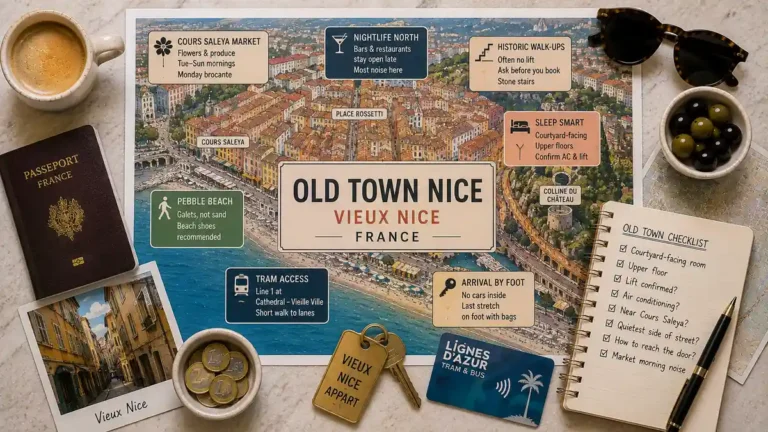
- Vieux Nice and the Cours Saleya market — narrow lanes, stop-start walking, constant incidental contact with strangers.
- Packed café terraces and full trams — where a bag hooked on a chair back or a phone face-down on the table sits within someone else’s reach.
- The beach while you are in the water — the one situation where your belongings are visibly unattended and everybody can see it.
Read that list again and notice what it is: an itinerary. The places where theft concentrates in Nice are the places worth going, which is exactly why a map of areas to avoid would not have protected anyone.
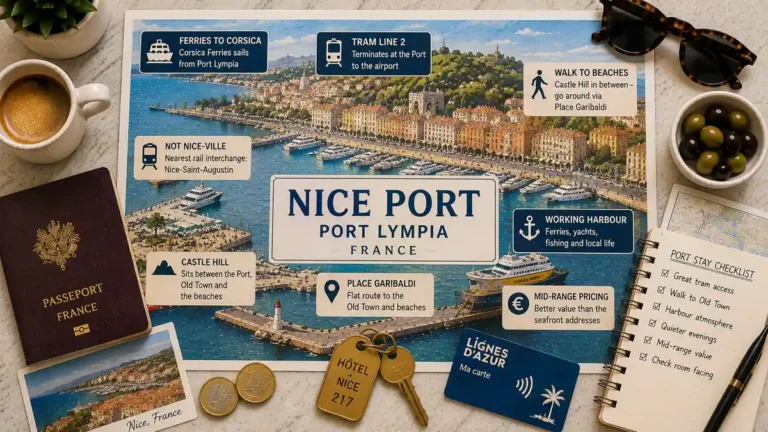
If the question underneath yours is which part of the city to book, that is a different decision with different criteria — convenience, atmosphere, noise, price — and our guide to where to stay in Nice resolves it properly. If you want the layout itself, and how the Old Town, the seafront and the station district fit together, our Nice travel guide covers the orientation this page assumes you already have.
Is Nice Safe at Night?
Central Nice at night is broadly fine. What changes after dark is emptiness, alcohol and attention — the conditions around you, not the streets themselves. The busy parts stay busy late, and the same stretch that felt ordinary in the evening reads differently once it empties out.
Nice is a going-out city, and the going-out parts behave accordingly. The Old Town’s bar lanes and the streets around them stay populated deep into the night, which is protective in itself and also where alcohol concentrates. Most night-time friction in Nice is that: crowded bars, drunk people, an argument that is not about you. Keep your bag closed and your phone off the table and you have handled the realistic version.
The Promenade des Anglais is the one place worth being explicit about, because it works in two modes. By day it is packed, and the only thing to think about is your belongings in a moving crowd. Late at night, long stretches of it run empty between pools of light, with the sea on one side and a road on the other. That is not dangerous by definition — it is simply a place with no one else in it. Walk it accompanied if you are going a distance, or take the lit parallel streets a block inland, which get you to the same place among people.
An empty street is not automatically a dangerous street. What it removes is the thing that quietly keeps you safest in Nice: other people, in numbers, going about their evening.
Arriving in the middle of the night is a separate problem, and worth naming as one. Landing somewhere unfamiliar in the small hours, tired, luggage in hand, with fewer services running and fewer people around, is a hard arrival in any city — that difficulty is about the hour and your unfamiliarity, not about Nice being unsafe. Decide how you are getting from arrival point to bed before you travel, not on the pavement afterwards; our guide to getting around Nice covers what runs late and how the network works.
Common Scams in Nice and How to Spot Them
Nice’s scams are France’s ordinary distraction repertoire, worked hardest where tourists cluster. There is no local speciality and nothing exotic to learn: someone manufactures a moment of confusion, and someone else takes what you stopped watching. Once you know the shapes, you see them forming from several metres away.
Each pattern below is described the way you will actually meet it — what it is, where it happens, the tell, and what you do:
- The distraction team. Two or more people working together: one engages you with a question, a map, a petition, a spilled drink or a sudden press of bodies, while another takes the bag or pocket you have turned away from. This is the pattern the official advisories describe, and it is the one that accounts for most losses. The tell is the unnecessary contact — a stranger closer than the situation requires. Step back, put a hand on your bag, and keep moving.
- Beach theft while you swim. Bags and phones go missing from towels on busy public beaches while their owners are in the water, which is the one place your belongings sit unwatched in plain sight. There is no tell, because there is no interaction. The fix is structural: go to the beach with nothing you would mind losing, or swim in shifts so someone stays with the pile.
- The scooter snatch. A bag carried on the road-side shoulder, along the seafront and other roads with easy two-wheeled traffic, can be pulled as a scooter passes. Carry bags on the inside shoulder, strap across the body, and keep the phone in your hand, not loose in an outer pocket, when you are walking beside traffic.
- The car-door grab. Known locally as vol à la portière: at a red light or in slow traffic, someone opens a passenger door or reaches through an open window for the bag on the seat. Lock the doors as soon as you get in, and keep bags in the footwell or the boot, never on the passenger seat.
- The helpful stranger at the ticket machine. Someone appears beside you at a transport machine offering to help with a screen you are struggling with, and either watches your PIN, keeps your change, or sells you something that is not a valid ticket. Staff wear uniforms. Decline help, use the machine yourself, and shield the keypad.
- The unlicensed taxi tout. An approach on foot at arrival points, offering a ride at a price agreed verbally that changes on the way, or a car with no meter and no markings. Licensed taxis wait in the rank and carry visible identification. Take the rank or book in advance.
None of this is unique to Nice; the same repertoire runs in every French city that receives large numbers of visitors, and our guide to safety in France covers the national picture. What Nice adds is geography. On the seafront, two of these patterns overlap in one place — your bag is both on a towel and beside a road that scooters use. Treat the beach strip as the spot where you carry the least.
Is Nice Safe for Solo Female Travelers?
Yes for the overwhelming run of trips. Solo women travel in Nice every day without trouble, in a city where eating alone, walking alone and sitting on a terrace alone attract no particular attention. One situation is worth knowing about in advance: the long seafront stretches late at night, once they have emptied out.
Daytime and early-evening solo travel in Nice is unremarkable, and that is the honest headline. The city is walkable, busy, used to visitors from everywhere, and small enough that you are rarely far from a populated street. Museums, markets, beaches, restaurants and the Old Town in the evening are all ordinary things to do alone here.
The nuance is about a specific situation, not about the city’s character. On empty seafront stretches after the crowds have gone, some women encounter unwanted attention — comments, someone falling into step, a conversation that will not end. It is a situation with a practical response, and the response is not complicated. Take the inland parallel streets home instead of the seafront, walk with company on longer stretches, keep one earbud out so you can hear what is behind you, and go into a bar or a lit shop if someone is following. Trusting the read of a moment and acting early is not overreaction; it is the whole skill.
The busy street and the empty one are a block apart in Nice, which is the useful part. Choosing the populated route home costs you nothing but a slightly less pretty walk.
Solo travelers of any kind ride along with the same advice. The exposure that matters is being distracted in a crowd or isolated in an empty place, and neither of those is specific to who you are.
Is It Safe to Swim at Nice’s Beaches?
Yes, with respect for what the water actually does here. Nice’s beaches are pebble, and they shelve steeply, so the water gets deep close to shore. Swim inside a supervised zone, read the flag before you get in, and follow what the lifeguards on duty tell you.
Start with the physical reality, because it surprises people who have only swum from sand. The pebbles shift under your feet, so footing is unstable at exactly the moment you need it. The shelf drops away quickly, so you go from standing to swimming in very little distance and there is no long shallow section to wade back through. When there is swell, waves break directly onto the stones at the water’s edge instead of running out over a flat beach, which is the part that knocks people over. Water shoes solve most of the discomfort and some of the risk.
Nice’s beaches are harder to leave than to enter. The swell pushes you back onto shifting stones with nothing flat to stand on, so plan the exit while you still have energy for it, and face the shore on the way out instead of turning your back on the water.
The flags tell you what the sea is doing before you commit to it:
- Green — swimming supervised, conditions calm and no particular hazard.
- Yellow — swimming supervised but conditions are difficult; strong swimmers only, and stay close in.
- Red — swimming prohibited. Not a suggestion, and not a judgement of your ability.
- Purple — a marine hazard or a water-quality problem, jellyfish included. It flies alongside one of the colours above, not in place of one.
Supervision follows a pattern worth understanding. Lifeguard posts cover marked zones along the city shore, staffed through the summer bathing season, during daylight hours, with the fullest coverage at peak. Outside those zones, outside that season, or after the posts close, nobody is watching the water — and that is a genuinely different proposition, especially alone. Swimming at night, after drinking, or on an unsupervised stretch is where a manageable sea becomes an unforgiving one. If you need help in the water or see someone who does, 196 reaches sea and coastal rescue.
Beach behaviour in Nice also runs on local rules — what you can wear off the beach, why the pebbles must stay where they are — and our Nice travel tips guide handles that side of it.
Do You Need Travel Insurance for Nice?
For most visitors, yes. Not because Nice is dangerous, but because the mishaps that realistically happen here are exactly what a policy exists for. A stolen phone, an unplanned hospital visit, a trip cancelled at short notice. Being uncovered costs far more than being covered.
The scenarios are worth naming, because “travel insurance” is an abstraction until you attach it to something concrete:
- Theft. A bag or phone taken in a crowd, on a terrace or from a beach towel — the most likely claim on this trip, and the one that needs a police report to go anywhere.
- Medical. An accident on unstable pebbles, an illness, a scooter or road incident. Treatment is the small part; an ambulance, a hospital stay or getting you home is not.
- Disruption. A cancelled flight, a missed connection, a trip you cannot take because something happened before you left.
It matters less in some cases, and it is fair to say so. Travelers with meaningful cover already in place — through a credit card’s travel benefits, a home contents policy that extends to possessions abroad, or a reciprocal European healthcare entitlement — may be duplicating what they have. Short trips with little at stake and nothing expensive in the bag shift the calculation too. The way to decide is to check what you already hold before you buy anything, because the gap between policies is usually medical repatriation and high-value items, not the everyday claims.
The theft cover is the part travelers over-value and the medical cover is the part they under-value. Nice’s pickpocket takes a phone you could replace; it is the ambulance, the hospital and the flight home that would actually reshape the trip’s budget — and if you are working out what that budget looks like overall, our guide to what a Nice trip costs sets out the rest.
Travel medical insurance
SafetyWing Nomad Insurance provides travel medical coverage designed for travelers and digital nomads, with flexible Monthly and Annual plans.
Check Nomad Insurance coverage and current pricing →
New Nomad Insurance Essential members can get 8 weeks of electronic theft coverage free with reward code TRIPSTOU8.
Apply the reward before creating your SafetyWing account by looking for the pink camera icon on the Nomad Insurance page.
Tripstou may earn a commission if you purchase through this link, at no extra cost to you.
Emergency Numbers and What to Do If Something Happens
One number covers everything: 112 reaches emergency services anywhere in France, free, from any phone, at any hour. A handful of direct numbers are worth knowing as well, and if you are robbed there are three moves to make in order — report it, replace what identifies you, block what can be used against you.
Save these before you travel. All of them are free and answered 24/7:
- 112 — all emergencies, from anywhere in the European Union. Use this one if you are unsure which service you need.
- 15 — SAMU, the medical emergency service, for illness and injury.
- 17 — police, for a crime in progress or an immediate threat.
- 18 — fire and rescue, who also attend accidents and rescues on land.
- 114 — emergency contact by SMS, for deaf and hard-of-hearing callers or anyone who cannot speak safely.
- 196 — sea and coastal rescue, for anyone in difficulty in the water or seen in difficulty from the shore.
The number almost nobody saves is 196, and it is the one that matters on a beach. Dialling 112 works from the water’s edge too, but 196 puts you straight through to the maritime rescue coordination centre that will send the help.
If something is stolen, work in this order. Report it to the police and get the written report — insurance claims will not proceed without one, and you need it to replace a passport. Replace what identifies you: a lost or stolen passport goes through your country’s consulate or embassy, and starting that on day one rather than the day before your flight is the difference between an errand and a crisis. Block everything usable: call your bank to stop cards, have your mobile provider disable the SIM, and lock or wipe the phone remotely from another device — your accommodation can usually put you on a laptop within minutes.
Do these three things in that sequence and the loss stays a loss, instead of turning into a fraud problem and a travel-document problem on top of it.
Frequently Asked Questions
Is Nice safe for families with children?
Yes. Nice suits families well, and the risks that matter with children are practical, not criminal. The beaches are the main one: pebbles make footing unstable and the seabed drops away quickly, so keep young swimmers inside a supervised zone and within arm’s reach.
Is the tram safe to use in Nice?
Yes. The tram is a safe way to move around Nice, and the only realistic risk on it is theft. Pockets get worked in the boarding crush and as the doors close at busy stops. Keep your bag in front of you and your phone away from the door.
Is the area around Nice train station safe?
Yes, with ordinary station-district awareness. Like the surroundings of most big-city stations, it is busy and functional by day and noticeably quieter late in the evening, when fewer people are about. Keep your luggage in contact with you, and walk lit, populated streets after dark.
How do I keep my phone and cards safe on the beach if I am swimming alone?
Carry as little as possible and keep what you must bring on your body. A waterproof pouch worn in the water covers a phone and one card. Leave your passport, spare cards and anything valuable at your accommodation, and photograph your documents before you travel.
Are there jellyfish in the sea at Nice?
Sometimes, and you will not know by looking. The purple flag at a supervised post is the signal that something in the water is worth avoiding, jellyfish included. Outside a supervised zone or after the posts close, no flag flies, so you are swimming without that warning at all.
Should I worry about terrorism in Nice?
Not in a way that should change your plans. Both the UK and US travel advisories maintain a standing terrorism warning for France as a whole, at national level, with no Nice-specific designation. Stay aware in crowded places, follow instructions from authorities, and travel as you would anywhere in Europe.
Related Guides
These guides pick up the decisions that sit next to the safety question:
- Nice travel guide — the city in full, and how the areas fit together.
- Where to stay in Nice — how the neighbourhoods differ and who each one suits.
- Getting around Nice — the tram, the buses, and what runs late.
- Nice travel tips — the local rules and customs visitors get wrong.
- 2 days in Nice itinerary — a short stay, sequenced.
- 3 days in Nice itinerary — the longer version, with room for the coast.
Did this guide save you time or money? Tripstou is independent and reader-funded — if you'd like to give something back, you can support the site with a crypto contribution of any size.