
3 days is the length at which Nice stops being only a city trip. 2 days fill the city; the third day is the one that can leave it, and knowing that changes how the first 2 days are paced — nothing has to be compressed, because the museum hill and the old town no longer compete for the same afternoon. This guide gives one ordered route, not a menu. Day 1 takes the historic core and the sea. Day 2 climbs to Cimiez and the newer city. Day 3 leaves Nice for the coast, by train and bus, with no rental car at any point. You also get a defended default for that third day, three alternatives tied to traveler types, and the one scheduling rule — the Tuesday closure — that decides which day you leave the city.
Quick Answer
Spend 2 days in Nice itself and use Day 3 for a coastal day trip, entirely car-free. The real decision is what Day 3 buys; the default is Èze Village in the morning, Monaco after. It suits first-timers who want the city done properly plus one real taste of the Riviera, from one base.
Trust Layer
Tripstou itinerary guide for travelers planning a route. Covers pacing, stop count, stop order, base logic, and trip length.
Produced with AI assistance and reviewed by Alex Perrut, working in tourism since 2015, for the Tripstou editorial team. See our editorial process for details.
Last factual review: August 6, 2026.
Official sources consulted: France.fr, Atout France.
Key Takeaways
- Spend Day 1 and Day 2 in Nice itself, then use Day 3 to leave the city for the coast.
- The whole route runs car-free: Nice is the rail hub, and the one off-rail village is reached by bus.
- Keep one hotel for all 3 nights, because every day on this route leaves Nice and returns to it.
- If a Tuesday falls mid-trip, take the day trip that day — Matisse, Masséna and Chagall all close.
- Èze Village plus Monaco is the default third day; swap in Villefranche, Antibes or Menton to match the day you want.
- 3 days covers Nice properly plus one coast day, not the Riviera; if time shrinks, cut a city day.
Table of Contents
The Recommended Route for 3 Days in Nice
The route is two city days plus one coast day, run from a single base without a car. Day 1 and Day 2 take Nice at an unhurried pace; Day 3 leaves the city for the coastline beside it. No hotel change, no rental car, no repacking.
- Day 1: Old Nice, Castle Hill and the sea — the historic core
- Day 2: Cimiez, the museums and the newer city — the museum hill
- Day 3: Èze and Monaco — the day the coast opens
Car-free is a design principle here, not a compromise. Nice is the rail hub of this stretch of coast, so the coastal destinations sit on a line that starts where you are already standing, and the one village off that line is served by bus from the city. A 3-day visitor who rents a car pays for parking twice over — once at the hotel, once at a destination — to reach places the train already reaches.
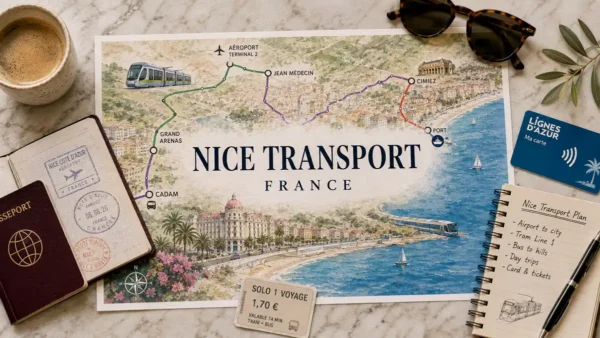
The day trip sits on Day 3 for a reason: you leave Nice after the city has stopped being unfamiliar, so the coast reads as an extension of a place you know instead of a second arrival. That default has one exception, the Tuesday museum closure, and the section on which day to leave the city handles the swap in full. Tickets, city buses, trams and how the network actually works are covered in the Nice transport guide; this page assumes only that you use it.
What separates this route from a 2-day one is not the extra day at the end. It is that Day 1 and Day 2 are written knowing Day 3 exists — the old town and the museum hill each get a full day, because neither has to make room for the other.
Should You Stay in One Hotel for All 3 Days?
Yes — one hotel for all 3 nights, including the night before the day trip. Every day on this route radiates from Nice and returns to it, so a second base would move your luggage without shortening a single journey. Moving hotels only pays off when the route moves forward; this one goes out and back three times from the same door.
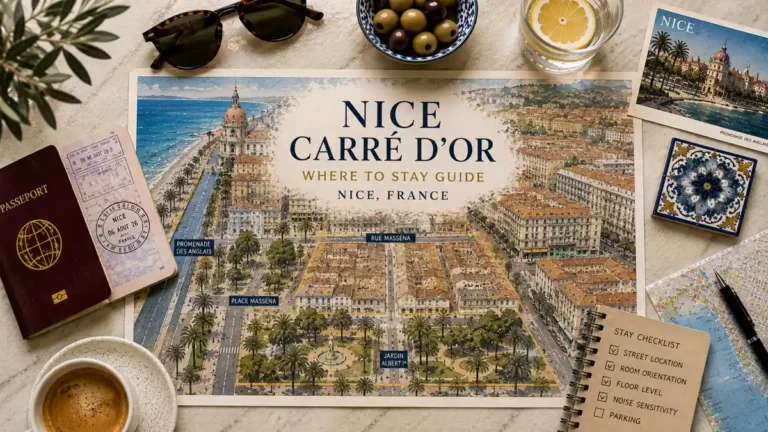
The one decision worth making carefully is which part of Nice you sleep in, since it sets how long the walk to the station and the old town is on each of the 3 mornings. That is a stay question, not a route question, and the guide to where to stay in Nice resolves it by area.
Hotels and places to stay
Compare hotels, apartments and stays for your dates in one search.
Search hotels and stays on hotels.com →
Tripstou may earn a commission if you book through this link, at no extra cost to you.
Day 1: Old Nice, Castle Hill and the Sea
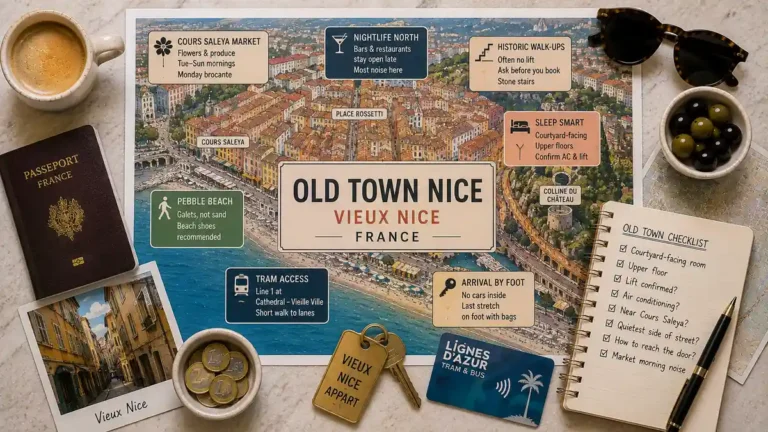
Day 1 covers Old Nice, Castle Hill and the Promenade des Anglais, all on foot. It goes first because it needs no transport and it teaches you the city’s layout. With 3 days in hand, the historic core gets a full unhurried day instead of half of one.
You are based in Nice for night 1, and the day never leaves walking distance of it. Vieux Nice sets the shape of the city, Castle Hill gives the view that explains its geography, and the Promenade des Anglais carries the afternoon along the water. Three anchors, one day, nothing booked.
What Day 1 deliberately defers is the museum hill. On a 2-day trip Cimiez has to be pushed against the old town and one of them loses; here it has Day 2 to itself, so the market end of the old town keeps its whole morning and the lanes are allowed to be aimless. Castle Hill then sits between the two halves of the day as the natural break — go up while the light is good, allow more time than the map suggests for the climb, and come down to the seafront rather than doubling back through the lanes.
The day ends where it started: back at your base, on foot, with the evening in the old town or along the water. This is the night to stay out late, because Day 2 is the only morning on the route with something that can close, and it is not today. How the old town and the surrounding neighbourhoods feel after dark is covered in the Nice safety guide.
Day 2: Cimiez, the Museums and the Newer City
Day 2 climbs to the Cimiez museum hill, then comes back down through the newer city. The museums get a whole morning and the afternoon stays loose, which only works because the coast has its own day. Nothing here competes for time with Day 3.
Night 2 is in the same bed as night 1, and the day’s only vehicle leg is the short city-bus ride uphill. The Musée Matisse and the Musée national Marc Chagall are the anchors; both sit inland and above the city, which is why they earn a morning of their own instead of being wedged into the end of a walking day.
State the constraint once and plan around it: Musée Matisse, Musée Masséna and the Musée national Marc Chagall all close on Tuesday. That closure is the only fixed point in the whole route, and the section on which day to leave the city explains the reorder it forces. Treat this day as the movable one.
The afternoon comes back down into the newer city — Place Masséna and the streets around it — at the same pace as the morning, because Day 3 owns the coast and nothing needs catching up. Keep it loose. Practical know-before-you-go details, from what to carry to how the city runs day to day, sit in the Nice travel tips. The evening returns to base once more, with an early-ish start ahead of it.
Day 3: Èze and Monaco — the Day the Coast Opens
Day 3 pairs Èze Village in the morning with Monaco in the afternoon, done without a car. The two combine comfortably in one day, and this is the day that makes a 3-day trip something other than a longer 2-day trip. Your base stays in Nice.
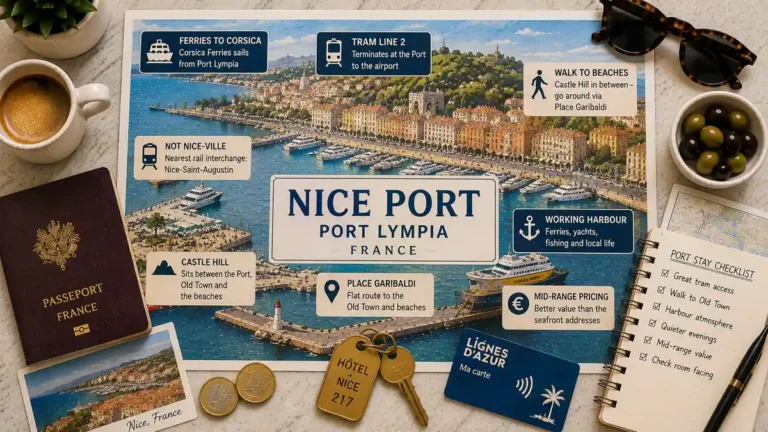
You are still in the same room for night 3, or checking out and leaving from Nice at the end of the day; the day trip changes nothing about where you sleep. The role of this day is range. Èze Village is the hilltop half, Monaco is the coastal half, and Nice is the point you return to in the evening.
Èze Village is not on the coastal railway, which is the one access fact that catches people out. You reach it by bus from Nice’s Vauban bus station, or by taking the train to Èze-sur-Mer and continuing with a connecting bus or a steep climb up to the village. Bus service along that corridor thins on Sundays, so a Sunday day trip is the version worth checking before you commit the morning to it. Monaco, by contrast, is on the coastal rail line with its station in the middle of the principality — there is no border control between France and Monaco, and entry conditions follow France.
Do Èze first, then drop to the coast. The hilltop village is the half of Day 3 that a slow start ruins, while the Monaco half absorbs whatever is left of the afternoon and evening without complaint, which is exactly why this pairing survives a late breakfast and a reversed one does not.
Which Day Trip Should You Take From Nice?
Take Èze and Monaco by default; three alternatives beat it only for specific travelers. Villefranche-sur-Mer, Antibes and Menton are the swaps, and each fits a different kind of day. All four options run from Nice by public transport, out and back on the same day.
One day slot, four candidates — pick the row that matches the day you actually want.
| Day trip | Who it suits | How you get there |
|---|---|---|
| Èze Village and Monaco | Best for: a hilltop village paired with glamour | Bus from Vauban station, then the coastal railway |
| Villefranche-sur-Mer, the nearest stop | Best for: a slow harbour day and a swim | Coastal train, the shortest hop of the four |
| Antibes, the old-town alternative | Best for: ramparts, a covered market, lived-in lanes | Coastal train, station a short walk from the centre |
| Menton, the farthest stop east | Best for: the sunniest and least crowded option | Coastal train, the longest ride of the four |
Access is what makes the shortlist this short. Monaco, Villefranche-sur-Mer, Antibes and Menton all sit on the coastal rail line with stations at or near their centres, and Nice is the hub they all run from; Èze Village is the only one that needs the bus. Relative distance is the only ordering worth carrying in your head: Villefranche is the shortest ride out, Menton the longest, with Monaco and Antibes between them.
Cost does not decide this. Coastal rail and the bus corridor are cheap enough that the fare difference between the nearest and farthest option will not change your day, so choose by the day you want and not by the ticket — what the trip as a whole costs sits in the Nice trip cost guide.
Menton is the swap that eats the whole day. Being farthest east, it replaces Day 3 instead of extending it, so it suits travelers who want one long, sunny, unhurried outing and not the two-stop rhythm the default is built on.
Tours and activities
Book skip-the-line tickets, day trips and local tours with free cancellation on most activities.
You can also browse everything on getyourguide.com.
Tripstou may earn a commission if you book through this link, at no extra cost to you.
Which Day Should You Take the Day Trip?
Take the day trip on Day 3, unless a Tuesday falls inside your trip. If it does, leave the city on the Tuesday: Nice’s main museums close that day. Everything else in the route works on any weekday, so only the museum day is genuinely fixed.
Musée Matisse, Musée Masséna and the Musée national Marc Chagall all close on Tuesday, so the museum day and a Tuesday must never land on the same date. The fix is a swap, not a redesign. If Tuesday is your second day, the coast moves to Day 2 and Cimiez moves to Day 3; if Tuesday is your first day, the coast opens the trip and the two city days follow it. The route survives both, because only one of its three days has a closure to dodge.
Where the day trip lands also decides how the trip ends, which is a choice a 2-day visit never gets to make. Keeping the coast on Day 3 means finishing outside Nice, with the last evening spent on a return journey. Moving it earlier means the trip ends in the city, on foot, with a last unhurried evening in the old town — the better shape if your flight or train leaves late on the final day.
Is 3 Days Enough in Nice?
Yes, 3 days is enough for Nice done properly plus one real day on the coast. It is not enough to see the French Riviera, which needs a longer trip and probably more than one base. Treat the coast day as a taste, not a survey.
What 3 days buys is completeness with room to breathe: the historic core and the seafront on one day, the museum hill and the newer city on another, and one full day of range beyond the city limits. What it does not buy is a second coastal destination, a beach day that costs nothing else, or the sense of having covered the coast between Cannes and the Italian border. Travelers who came for the coastline rather than the city should plan a longer trip; travelers who came for Nice will finish this one satisfied.
Car-free holds for the whole route. Every day starts on foot or at a station in Nice, and no leg of the plan improves with a rental car — the two city days need no vehicle at all, and the third day is served by the rail line and the bus corridor.
The honest complication is that a 3-day trip rarely contains three whole days. A flight landing in the afternoon or leaving in the morning eats one end of the plan, and the day to sacrifice is a city day, never the coast day — the old town and the seafront absorb a half-day gracefully, while a truncated day trip is just a long commute. Keep the day trip whole, and let Day 1 or Day 2 shrink around your arrival. Transfer options between the airport and the city are covered in the Nice airport transport guide, and if you are still weighing how many days Nice deserves at all, the Nice travel guide takes that question from the top.
How to Adapt This Route With More or Fewer Days
Cut the coast day first when time shrinks; add a second one first when it grows. One rule adapts the route in both directions without rebuilding it. At 2 days the trip becomes city-complete; at 4 it gains range along the same stretch of coast, from the same base and the same shortlist.
- Cut first (2 days): the coast day goes, and what you lose is the range, not a sight — the trip stops being a Riviera taste and becomes a finished city visit. Days 1 and 2 also tighten, since the old town and Cimiez must now share a shorter trip; the route for that version is the 2-day Nice itinerary.
- Add first (4 days): a second coast day, drawn from the same four candidates. Either split the default — Èze one day, Monaco the next, each at half the pace — or add the alternative your traveler type pointed to in the day-trip section. No new towns; the shortlist is the shortlist.
- Never: a parallel set of alternative itineraries. One route, adapted at the edges, is what keeps 3 days coherent.
The order of those rules matters more than the rules themselves. Because the coast day is both the first thing cut and the first thing doubled, it is the part of this trip that scales — the two city days stay the same shape at 2, 3 or 4 days.
Frequently Asked Questions
Is 3 days enough for the French Riviera?
No — 3 days buys Nice plus one day on the coast, not the Riviera. Seeing the region properly means several towns, more nights and probably a second base further along the line. Treat this trip as a Nice trip with one coastal day attached.
Do you need a passport to go to Monaco from Nice?
There is no border control between France and Monaco, so nothing is checked on the train, bus or road crossing. Entry conditions follow those of France. Carry whatever identification you would normally travel with in France, and treat the crossing as an ordinary journey along the coast.
Is Monaco worth a day trip from Nice?
Yes, as half a day and not a whole one. Monaco rewards travelers drawn to the harbour, the terraces and the sheer density of it, which is why the default pairs it with Èze Village. Travelers who prefer old lanes and markets will get more from Antibes.
Is it worth renting a car for 3 days in Nice?
No. The two city days need no vehicle, and the coast day runs on the rail line and the bus corridor that Nice sits at the centre of. A car only starts to earn its keep on longer trips that head inland or beyond this shortlist of coastal towns.
Can you fit a half-day trip into the arrival or departure day?
Only with a full morning on arrival or a late evening departure, and only to the nearest stop. Villefranche-sur-Mer is the shortest hop out of Nice, which makes it the one realistic half-day candidate. Anything further east turns the half day into a commute with a view.
Related Guides
These guides carry the decisions this route treats as settled, and the execution detail it deliberately routes out.
- Nice travel guide — orientation, planning and how many days the city deserves.
- 2 days in Nice — the city-complete version, without the coast day.
- Where to stay in Nice — which area to book for a single 3-night base.
- Getting around Nice — tickets, trams, buses and how the network works.
- Nice airport to city centre — arrival and departure options for a short trip.
- Nice trip cost — what 3 days costs, day trip included.
- Nice travel tips — practical know-before-you-go for first-timers.
- Is Nice safe? — how the city and its neighbourhoods feel after dark.
Did this guide save you time or money? Tripstou is independent and reader-funded — if you'd like to give something back, you can support the site with a crypto contribution of any size.