Search for things to do in Nice and you get the same thirty entries in a different order every time. Almost none of them tell you which ones genuinely repay a short stay, which are pleasant filler, and which you can skip without regret. That is the gap this page fills.
What follows is a set of experiences ranked by payoff — the return you get for the time and the money you put in. Each one carries a verdict, the traveler it suits, and the condition that turns it into a skip. The order is a priority list, not a plan: it tells you what to choose and how much weight to give it, without deciding your days for you. Sequencing is a separate job and belongs to the itinerary guides. Nice makes the choosing easy, because most of what makes the city good is outdoors and costs nothing.
Quick Answer
Nice rewards even a short stay: the sea, the old town and the coastal views carry it. The highest-payoff experiences are mostly free and outdoors, and the two real decisions are the pebble beach and which museum you choose. Pick one museum, walk the coast, and treat beach clubs as optional comfort.
Trust Layer
Tripstou attraction guide for travelers deciding whether an experience is worth doing and how to do it well. Covers value, booking versions, timing, access, and traveler fit.
Produced with AI assistance and reviewed by Alex Perrut, working in tourism since 2015, for the Tripstou editorial team. See our editorial process for details.
Last factual review: August 23, 2026.
Official sources consulted: France.fr, Atout France.
Key Takeaways
- Nice’s three highest-payoff experiences — the promenade, Vieux Nice and the Colline du Château view — are free and unbookable.
- Every beach in Nice is pebble, so water shoes and a padded mat matter more than any booking you could make.
- Pay for a beach club only when comfort is the day’s purpose, never when you are fitting in a quick swim.
- Choose one museum by interest: Chagall for a single focused body of work, Matisse for the city connection.
- The Nice Museums Pass covers municipal museums only, so a Chagall-focused visitor gains nothing from buying it.
- The Mont Boron coastal walk delivers the city’s best effort-to-reward view and outperforms a paid boat trip.
Table of Contents
Is Nice Worth Visiting?
Nice is worth visiting, and the payoff comes from its coast, its old town and its viewpoints. The city has no headline monument that justifies the trip on its own; it earns its place through everyday experiences that cost little and repay a short stay. Sand-beach seekers and nightlife hunters should temper expectations.
Payoff here means return on time and money, and that is how everything below is ordered. The sections run in priority order — what repays a first visit most sits nearest the top. It is a ranking of weight, never a schedule. Nothing on this page tells you which day to do what.
Three traveler types get the most out of Nice. First-timers on the Riviera get a walkable seafront city that works without a car. Slow travelers get a place where doing very little — a swim, a market, a long walk — is the actual product. Art-minded visitors get two serious museums without the queues of a bigger city. Nice suits all three at short notice, because almost nothing here needs booking.
Two groups should adjust their expectations before arriving. Anyone picturing soft sand will meet stones instead, and anyone expecting a late-night club city will find the evenings gentle and dinner-shaped. Neither ruins a trip. Both change what you pack and what you plan for.
Take one paid experience at most on a short sunny stay and give the rest of your time to the coast. Nice’s ticketed attractions are genuinely good, and its free ones are why people come back.
It helps to know what a skip verdict means here, because it is not the same as a warning. Nothing in Nice is unmissable, and nothing on this page is bad. A skip is a substitution — the hour you would have given to one thing goes to something that pays you back more, and the only real mistake is spending a short stay indoors while the coast is doing its best work outside.
Where to base yourself, how the city is laid out and the practical side of a trip are all resolved in the Nice guide. For a sense of where the city sits among the country’s headline experiences, see the wider round-up of things to do in France.
Nice’s Highest-Payoff Experiences Are Free
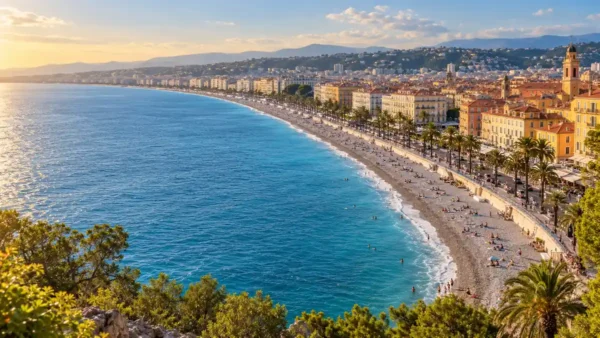
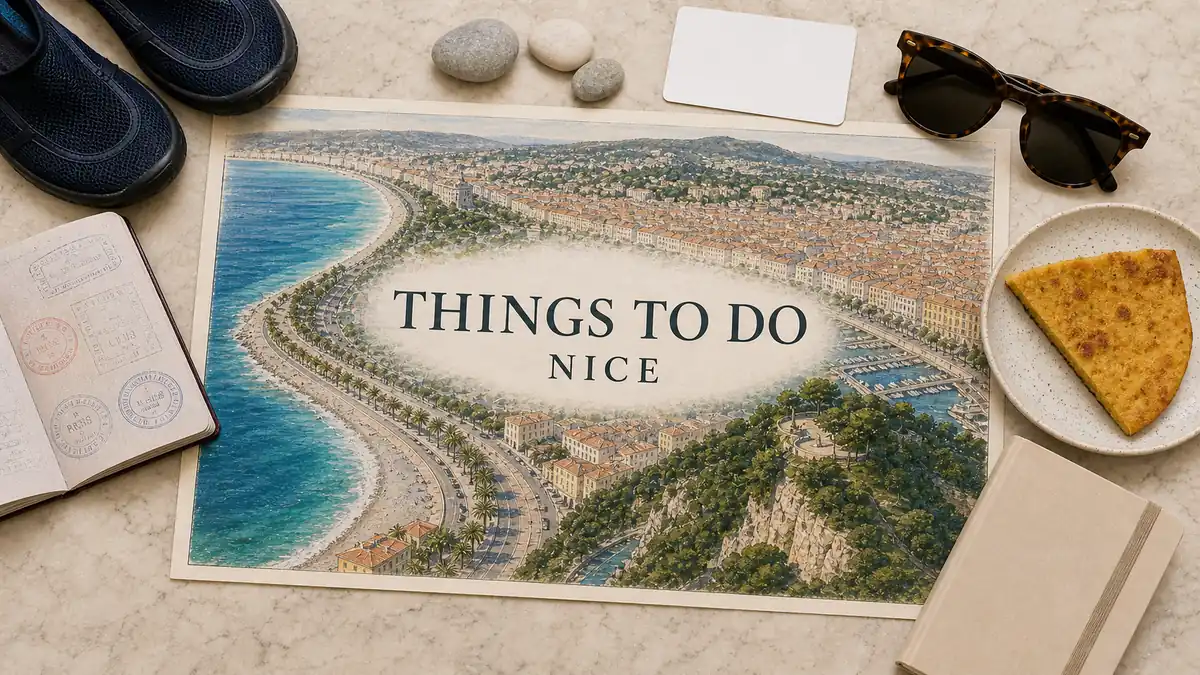
Three free experiences define a first visit to Nice. Walking the Promenade des Anglais along the Baie des Anges, wandering the pedestrianised lanes of Vieux Nice, and climbing Colline du Château for the bay panorama cost nothing and deliver more than any ticketed attraction in the city.
This is unusual, and it is the reason Nice punishes over-planning. In most European cities the best experiences sit behind a ticket desk, so the trip becomes a booking exercise. Here the three highest-payoff things are open, unbookable and repeatable, which means a free-only trip in Nice is close to the full version of the trip. Budget travelers lose very little.
Walking the Promenade des Anglais
The walk itself is the attraction, and there is nothing along it you need to stop for. The seafront runs roughly seven kilometres in a long curve around the Baie des Anges, open to everyone at any hour, with the water on one side and the city on the other. The payoff is rhythm: a wide, uninterrupted, flat walk with the sea permanently in view. It suits walkers, runners, families with buggies, and anyone who wants a low-effort way to understand the shape of the city. It disappoints in midday summer heat, when there is little shade, and in high season when the busiest stretches near the centre get crowded.
Getting Lost in Vieux Nice
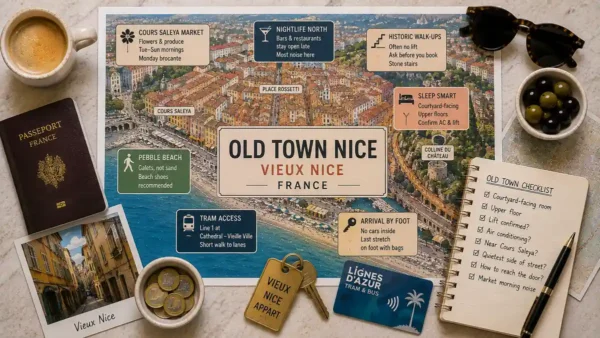
Wandering with no destination is the correct way to use the old town. The core is pedestrianised, so the lanes belong to people instead of cars, and the whole quarter reads as one continuous experience — narrow streets, tall ochre buildings, food counters, small shops and the open square of Cours Saleya all running together. Give it an unstructured stretch of time and let the turns decide. It suits almost everyone, and it is the part of Nice that most reliably surprises people who expected a beach resort. It disappoints anyone who dislikes crowds and noise in tight spaces, which is exactly what the lanes deliver in summer.
Climbing Colline du Château for the View
The panorama is the whole point, and it is the best free view in Nice. Colline du Château is a public park on the headland between the old town and the port, with the Baie des Anges and its curve of rooftops on one side and the working port on the other. There is no castle left to see; the reward is entirely the outlook and the shaded green space at the top. It suits anyone who wants the postcard view without paying for it. The trade-off is honest: getting up there is a real climb on foot, and in high heat or with limited mobility it stops being worth the effort.
Turning these picks into a day-by-day order is a different job entirely. The 2-day Nice itinerary and the 3-day Nice itinerary handle sequencing and time allocation; this page only decides what deserves the weight.
The Beaches Are Pebble — and It Changes Your Beach Day
Every beach in Nice is pebble, from one end of the Baie des Anges to the other. The stones are smooth but unforgiving, which makes lying down uncomfortable without padding and makes walking into the water slow and careful. A beach day still works well here. It simply needs different kit from a sand holiday.
The practical consequence is that comfort in Nice is something you carry or something you rent. Almost every complaint about the city’s beaches traces back to arriving with a thin towel and nothing else. A short kit list solves most of it:
- Water shoes — the entry into the sea is the painful part, and rubber soles remove it completely.
- A thick mat or padded mattress — a towel laid directly on large stones is not enough.
- Shade of some kind — the beaches are open and unshaded along their length.
- A bag that closes — stones hold heat and dust, and there is no soft place to set things down.
Water shoes change the pebble beach more than anything else you can pack. They turn a wincing, arms-out entry into an ordinary swim, and they cost less than one afternoon of rented comfort.
There is one upside worth naming. Pebble beaches produce noticeably clearer water than sand beaches, because nothing clouds up when the sea moves. Swimming in Nice is visibly better than the seating is.
Is a Private Beach Club Worth It?
A beach club is worth it when comfort is the point of the day, and wasteful when swimming is. You are paying for a padded lounger, shade, service and a place to leave your things — real value on a full beach day, and money burned on a quick dip between other plans. The three versions of a Nice beach day:
- Public beach, own kit — suits independent travelers, families on a budget and anyone dipping in and out during the day. Trade-off: you carry everything, and comfort depends entirely on what you brought.
- Private beach club lounger — suits couples, anyone committing to a full day by the sea, and travelers who want food, drinks and a bathroom within reach. Trade-off: the cost is per person and per day, and it anchors you to one stretch of coast.
- Swim and move on — suits short stays and anyone treating the sea as one experience among several. Trade-off: no base, no shade, and a wet swimsuit for the walk back.
Booking a club makes sense in high summer, when the good ones fill early. Outside the busiest weeks, walking up and asking is usually enough. Skip the club entirely if your beach time is measured in an hour or two.
Chagall or Matisse: Which Museum Is Worth Your Half-Day?
Pick one museum, and let your own interest decide which one. The Musée Chagall holds a single concentrated body of work and rewards visitors who want depth over breadth. The Musée Matisse traces the artist’s long relationship with Nice itself, which makes it the better fit if the city is the draw.
Both are modest in scale, which is a feature. Neither demands a full day, and neither punishes you for arriving without background knowledge. Chagall works best for visitors who want one intense, coherent encounter with a body of work and are happy to look slowly at a small number of large pieces. Matisse works best for visitors who want to understand why so many painters settled on this coast, since the collection and its setting explain each other.
One question settles it faster than any comparison of the collections: did you come for the art, or did you come for Nice? Art-led visitors get more from Chagall, because the work is the reason to be in the room. City-led visitors get more from Matisse, because the museum makes sense of the light and the landscape they have been walking through all week.
Four versions of this decision exist, and the right one depends entirely on why you came:
- Chagall only — suits art-led visitors who want depth over breadth and are content to spend their gallery time with a small number of large works. Trade-off: it sits outside the municipal system, so it stands alone as a separate ticket no matter what else you do.
- Matisse only — suits visitors whose real subject is Nice itself, and anyone with a companion who is lukewarm about galleries, since the setting carries part of the visit. Trade-off: the weekly closure day is a genuine trap for short stays.
- Both — suits travelers who came substantially for the art and have a grey stretch of weather to absorb. Trade-off: two separate purchases, and two museum visits is a lot of indoor time in a city whose case rests outdoors.
- Neither — suits short sunny stays, first-timers and anyone whose priority is the sea and the old town. Trade-off: you leave the city’s strongest indoor option unused, which stings the moment the weather turns.
The honest verdict: on a short stay with good weather, neither museum is mandatory. The coast outperforms both. On a grey day, or for anyone who came partly for the art, one of them is the strongest indoor experience the city offers.
The practical details worth knowing are few. Admission to the Musée Matisse is €12, and the museum is closed on Tuesdays. The Nice Museums Pass costs €15 and runs for four days, covering the city’s municipal museums — the Musée Chagall is a national museum, so the pass does not include it.
That last line is the one people miss when they buy the pass expecting it to cover the city’s best-known art collection. The pass is a municipal product; the national museum simply is not in it, whatever your plans look like.
Tours and activities
Book skip-the-line tickets, day trips and local tours with free cancellation on most activities.
You can also browse everything on getyourguide.com.
Tripstou may earn a commission if you book through this link, at no extra cost to you.
The Mont Boron Coastal Walk Is the Payoff Most Visitors Miss
The coastal path around Cap de Nice and Mont Boron gives the best effort-to-reward return in the city. It follows the eastern edge of town above and beside the water, opening onto viewpoints over the bay, the port and the open sea, and it costs nothing. Heat and mobility are the two reasons to skip it.
The character of the route is what sells it. You leave the promenade crowds behind within minutes, the noise drops away, and the walk alternates between wooded hillside, rocky shoreline and sudden openings where the whole coastline appears at once. It is a real walk, with climbs and steps underfoot. That is precisely why so few visitors do it, and why it stays quiet in the middle of a busy season.
This is not simply more promenade. The seafront is flat, urban and social; you walk it with the city on one shoulder and other people all around you. The coastal path is the opposite product — uneven, green, exposed and largely empty. Doing both is therefore not repetition, and doing only the promenade leaves the better half of Nice’s coast untouched.
The walk also scales to whatever effort you have in you, and that is the part most visitors do not realise:
- The short out-and-back — walk to the first proper opening over the water and return the same way. Suits anyone testing whether they like the terrain, and travelers with a limited appetite for climbing. Trade-off: you get the view without the sense of having left the city behind.
- The full stretch — keep going along the eastern edge until the path runs out of coastline. Suits confident walkers and photographers chasing the best light on the bay. Trade-off: it needs real time and real legs, and there is no comfortable way to cut it short.
- The wooded upper ground — favour the hillside sections over the rocky water’s edge. Suits anyone who wants shade and the widest panorama more than proximity to the sea. Trade-off: more sustained climbing, and the water stays at a distance.
What the walk demands is modest but non-negotiable: shoes with grip, water you are carrying yourself, and something between you and the sun. Nothing along the way is going to supply any of it, so the mistake to avoid is treating this as a spontaneous extension of a beach afternoon in flip-flops.
It suits reasonably fit walkers, photographers and anyone who has already done the promenade and wants the same coast at a higher grade. It is the wrong call in peak afternoon heat, with small children, or for anyone with knees that dislike steps and uneven ground.
This walk is also the honest alternative to a paid boat trip. It shows you the same coastline, seen slowly, from above, for nothing — and it lets you stop wherever the view is best. The boat wins on one axis only: it puts you at sea level looking back at the city, which the path can never do.
If the coastline is what hooks you, the wider Riviera has stronger claims still, and those destinations are weighed up among the best places in France.
What Food Should You Try in Nice?
Nice has its own cuisine, and it is worth planning meals around. Socca, salade niçoise and pan bagnat are the three dishes that define local eating, and all three are at their best eaten casually, standing at a counter or on a bench in Vieux Nice. Formal restaurants add little here.
The local repertoire is small and easy to work through:
- Socca — a thin chickpea-flour pancake, baked and served hot in torn pieces. Eat it immediately; it does not survive the walk home.
- Salade niçoise — in its local form, a raw-vegetable salad; the cooked-potato-and-green-bean version belongs to menus elsewhere. Ordering it in Nice is the whole point.
- Pan bagnat — the same ingredients pressed into a round roll soaked in olive oil. It is the best beach lunch in the city and it travels perfectly.
Matching the dish to the situation is most of the skill here. Socca is the snack you eat on your feet, at the counter, the moment it comes out — it is a bad idea to buy for later. Pan bagnat is the one that travels, which makes it the beach lunch and the coastal-walk lunch. Salade niçoise is the sit-down dish of the three, and the one worth giving a table and an hour to.
Where you eat matters as much as what, and the options divide cleanly:
- Standing at a counter — suits solo travelers, anyone eating between other plans, and the socca-first approach. Trade-off: no seat, no shade and no lingering.
- Takeaway eaten outdoors — suits families, beach days and anyone who resents paying restaurant prices for lunch. Trade-off: you are dependent on finding somewhere decent to sit, and pebbles are not a table.
- A sit-down terrace — suits couples, longer evening meals and travelers who want the local dishes served properly. Trade-off: it is where the tourist-pricing risk lives, and the food is rarely better than the counter version.
The Cours Saleya market belongs in this section because it explains the food more than any restaurant will — the produce, the flowers and the noise of the square sit at the edge of the old town and show you where the local repertoire comes from. Walk it, taste something, and leave. Buying is optional.
Eating well in Nice is mostly a matter of standing up. The dishes that define the place were built for hands, counters and street corners, and the sit-down versions are consistently the weaker ones.
Nice at Night Belongs to Vieux Nice and the Promenade
Evenings in Nice peak in two places: the promenade at dusk and the old town at dinner. The seafront draws walkers and runners as the light drops and the bay turns colour, and the lanes around Cours Saleya fill with people eating outdoors. Anyone hunting a big club scene will find the city thin.
The dusk walk is the underrated half of the evening. Heat leaves the promenade, the light does the work, and the same stretch that felt exposed and glaring in the afternoon becomes the best free hour of the day. It costs nothing and needs no plan. Count it as a separate experience from the daytime promenade, because it genuinely is one: the crowd shifts from tourists in swimwear to locals running, walking dogs and sitting on the wall, and the bay picks up colour the midday sun bleaches out.
Dinner in the old town is the other half, and it comes with a caveat. The lanes are dense with terraces, and the ones closest to the busiest squares trade on their location. Walking two or three streets further in changes the quality noticeably.
Reading a Vieux Nice terrace is a skill you can pick up in a single evening. The tells are consistent — an oversized menu that tries to cover every cuisine on the coast, photographs of the dishes, and a host working the pavement for passers-by. The places worth sitting down in tend to look less eager and sit on a quieter corner, and the price difference between the two is smaller than the quality difference.
What the evening is not is a nightlife proposition. Nice does the slow half of the night extremely well and the late half barely at all. What the city actually offers is dinner and a walk. Anyone building a trip around late bars is measuring it against a standard it has never tried to meet.
Fit varies by group. Couples do best here — the seafront-and-terrace evening suits a slow pace and needs no reservations. Families do well too, because the old town stays lively and comfortable without becoming a nightlife district. Solo travelers get an unusually easy evening, since a walk and a counter dinner require no company and attract no attention. Groups looking for late bars and clubs will exhaust the options quickly and would be better served by a larger city.
What to Do in Nice When It Rains
Rain reshuffles the ranking; it does not ruin the day. The museum choice moves to the top, the narrow sheltered lanes and food stops of Vieux Nice carry the middle, and the beach and the coastal walk drop out entirely. One indoor anchor plus the old town is enough for a wet day.
How much rewriting you need depends on how much rain you actually get, and the two cases behave very differently. A passing shower barely registers: the lanes of Vieux Nice are shelter in themselves, and waiting it out with something to eat is a real answer, not a consolation. A full wet day is the case that needs a decision, because the outdoor core of the city — the beach, the coastal path, the hilltop view — closes down all at once.
The indoor anchor is the museum you were already choosing between, so bad weather makes that decision for you. Check the day of the week before committing, since one of the two closes weekly — the details sit in the museum section above.
Vieux Nice does the rest. The lanes are narrow and tall enough to offer real shelter, the food is counter-based and indoors-adjacent, and browsing the shops in the wet is a genuine pleasure here. It is the one part of the city that barely changes in bad weather.
A wet day does not hit every traveler equally. Beach-led visitors lose their entire reason for being here and need a genuine replacement. Art-led and food-led visitors barely notice, since their picks were indoors anyway. Wanderers land in the middle: the old town still works, but the views and the open coast that give the city its scale are gone for the duration.
What stops working is worth stating plainly. Pebble beaches in the rain are miserable, the coastal path becomes slippery on rock and steps, and the Colline du Château view is the first thing low cloud takes away. Move those to a drier day instead of forcing them.
One thing rain does not justify is inventing a plan. Nice has no deep bench of indoor attractions waiting to be discovered in bad weather, and a wet day spent hunting for one is worse than a wet day spent slowly in the lanes with a single museum in it.
Frequently Asked Questions
Is the Nice Museums Pass worth it?
Only when two or more municipal museums are genuinely on your list. The pass costs €15 and runs for four days across the city’s municipal collections, so a single Matisse visit is cheaper and simpler on a standard ticket. The national Musée Chagall sits outside it entirely, which settles the question for most art-led visitors.
Is the Cours Saleya market worth visiting?
Yes for anyone drawn to atmosphere, food culture and photographs; no for anyone shopping seriously. The open square at the edge of Vieux Nice works as a sensory stop inside a wider wander, which is where nearly all of its value sits. Travelers with nowhere to cook lose nothing by looking and moving on.
Is Castle Hill free, and how do you get up?
Yes, Colline du Château is a free public park with no ticket and no booking involved. You reach it on foot from the old town side or the port side, on stairways and sloping paths that climb steadily. It is a genuine effort in heat, and the wrong call for anyone with limited mobility.
Is a boat trip from Nice worth it?
Worth it mainly for the perspective, since seeing the coastline from the water is a different experience from seeing it from the path. It suits repeat visitors, travelers with limited mobility and anyone who wants the coast without the climbing. Skip it on a short first stay, when the free coastal walk delivers more.
What can you do in Nice with kids?
Plenty, once the pebble beach is handled: water shoes turn a painful sea entry into an ordinary swim. The promenade is flat and buggy-friendly along its whole length, Colline du Château doubles as a shaded park with a view, and the counter food of Vieux Nice suits children who dislike long restaurant meals.
Do you need to book things to do in Nice in advance?
Mostly no. The experiences that carry the city — the promenade, Vieux Nice, Colline du Château and the coastal walk — are open, free and unbookable, so a spontaneous trip loses very little. Book only where capacity is genuinely limited, such as beach club loungers in peak summer or a guided experience you have already decided on.
Related Guides
- Nice guide — the full city guide, covering where to base yourself, how the city works and the practical side of a trip.
- 2-day Nice itinerary — these experiences arranged into a workable two-day order.
- 3-day Nice itinerary — the longer version, with room for the coastal walk and a museum.
- best places in France — where the Riviera coastline ranks against the country’s other destinations.
- things to do in France — the national picture, and how Nice’s experiences compare with the headline ones elsewhere.
Did this guide save you time or money? Tripstou is independent and reader-funded — if you'd like to give something back, you can support the site with a crypto contribution of any size.