
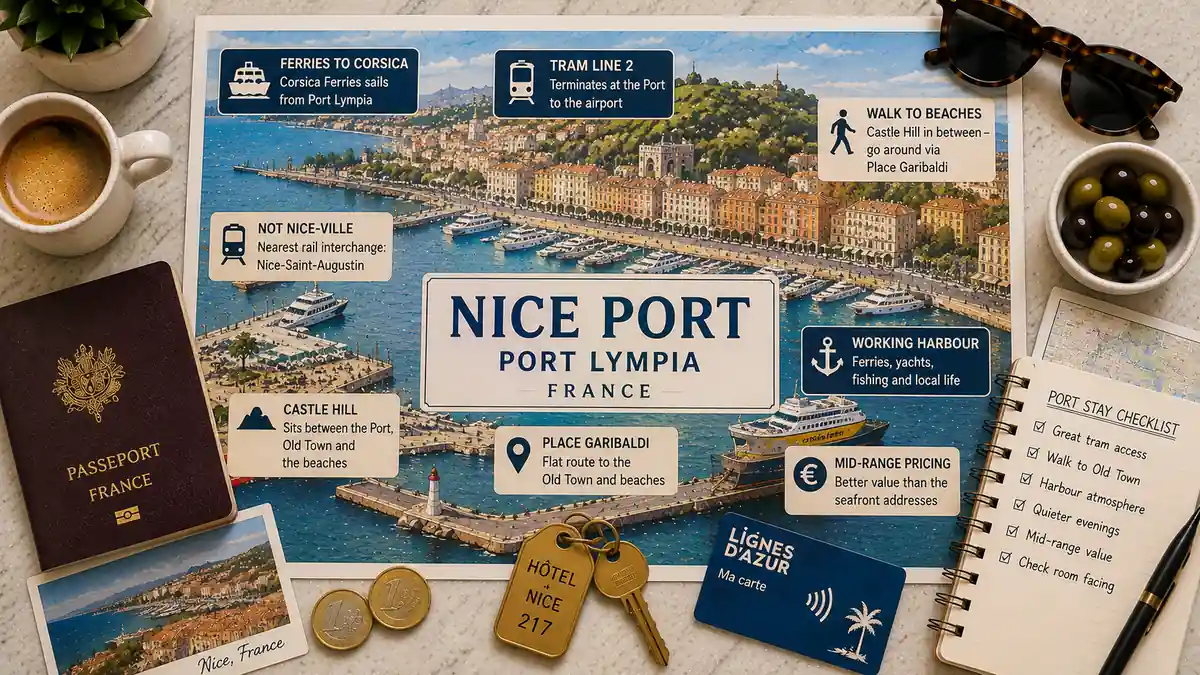
You have shortlisted the Port and you need one thing settled before the booking page loads: what basing yourself east of Castle Hill actually commits you to. The Port — Port Lympia and the quartier around it — sits at the eastern end of central Nice, and that position is the whole story. It gives you a working harbour under the window, the terminus of a tram line that runs through to the airport, and a calmer street grid behind the quays. It also breaks the straight seafront walk most people picture when they book Nice.
This guide gives the verdict and its condition, the physical reality of the hill, what the quartier feels like day to day, and the booking realities that decide the answer either way.
Quick Answer
The Nice Port area is a strong base if you want a working harbour and the tram terminus outside. Castle Hill stands between the Port, the Old Town and the main beaches — you go around it via Place Garibaldi. Book here for quayside character; book elsewhere if the Promenade at your door is the point.
Trust Layer
Tripstou stay guide for travelers choosing where to base. Covers area atmosphere, budget, convenience, noise, and traveler fit.
Produced with AI assistance and reviewed by Alex Perrut, working in tourism since 2015, for the Tripstou editorial team. See our editorial process for details.
Last factual review: August 6, 2026.
Official sources consulted: France.fr, Atout France.
Key Takeaways
- A Port base trades a direct seafront line to the beaches for a working harbour and the tram terminus at the door.
- Castle Hill sits between the Port, the Old Town and the main beaches, so every crossing goes around it or over it.
- The flat route runs inland through Place Garibaldi, which is the crossing that works with luggage, prams and tired legs.
- Port Lympia works for a living, so ask for a street-facing room if the harbour view is not the draw.
- Tram Line 2 starts at the Port and runs to the airport terminals, but it does not call at Nice-Ville station.
- Expect mid-range pricing overall, since nothing at the Port carries the Promenade premium the bayfront addresses charge.
Table of Contents
Where the Port Sits in Nice
The Port quartier is the harbour basin east of Castle Hill and the streets around it. It meets the rest of central Nice at Place Garibaldi, the flat hinge between the harbour and the Old Town. Everything a Port address commits you to follows from that geography.
Two squares anchor the quartier. Place Garibaldi holds its northern edge, where the grid opens toward the rest of the city, and Place Île-de-Beauté sits at the head of the basin beside the church of Notre-Dame-du-Port. Between them run the streets most listings sit on — rue Barla, rue Cassini, rue Arson — while boulevard Franck Pilatte carries the eastern quayside out along the water.
The relationship with the Old Town is worth fixing on the map now. Vieux-Nice is bounded on its eastern side by Castle Hill and on its northern side by Place Garibaldi, which is why Garibaldi, and not the seafront, is the flat connector between the two quartiers. If you are still deciding which part of the city to base yourself in at all, the shortlist lives in our guide to where to stay in Nice; this page assumes the Port is already on it.
What Is the Port Area of Nice Actually Like?
The Port reads as a live harbour quartier — quays, antique dealers and tourist-facing restaurants. It is tourist-oriented rather than residential, but the streets carry less footfall than the lanes on the far side of Castle Hill. That combination — activity on the water, calm on the pavement — is what a base here buys.
The eating and drinking scene concentrates along the quays and around the two squares, and it is aimed squarely at visitors. Terraces face the moored boats, tables spill toward the water in warm weather, and the character is harbourside dining more than neighbourhood bistro. Practically, that means you will not walk far for dinner from a Port address, and you will rarely be the only visitor at the table.
The antiques trade gives the streets their second layer. Dealers and brocante shopfronts sit between the restaurants, and they set the daytime tone of the quartier — browsing rather than sightseeing traffic. It is a quiet kind of street life. The quartier was working-class long before it was visited, and the current mix still shows both.
A Port address is tourist-facing without being walked through — the hill sits where a through-route would otherwise run, so the quartier carries its own footfall and nobody else’s. That is the practical difference between a busy quartier and a saturated one, and it is the main thing a Port base gives you back for the geography.
The Port Is One Hill Removed From the Old Town and the Beaches
The tradeoff of a Port base is separation, and it is physical. Castle Hill (93 m) rises between the harbour and Vieux-Nice, and the seafront artery ends at the hill. The Old Town and the main Baie des Anges beaches are reached around the hill or over it, never on a straight line from the door.
This is the expectation that breaks most often at the Port. Travelers book Nice picturing the door opening onto the Promenade des Anglais, and at a Port address that picture does not hold. The water outside your window is harbour water, not bay water, and the bay is on the other side of a hill.
There are exactly two ways across, and they suit different moments of a stay:
- Around the hill: the level route runs round the foot of Castle Hill, either inland through Place Garibaldi or along its seaward side, and reaches the Old Town without a climb. This is the everyday option — no steps, and it works with luggage, prams and tired legs.
- Over the hill: the direct route climbs Castle Hill and drops down the other side into Vieux-Nice and the seafront. It is the shorter line on a map and the harder one underfoot.
Neither route is a problem in itself. What matters is that both are decisions you make each time, and neither is the effortless seafront stroll people budget for mentally when they choose a base. If your days are built around returning to the room between beach sessions, that friction lands several times a day. If your days run outward and back once, it barely registers.
Check which side of Castle Hill a listing sits on before you book. On a city map both sides look equally central and both sit on the water; only one of them opens onto the Promenade.
A Working Harbour, Not an Ornamental Marina
Port Lympia works for a living, and a base here sits beside that work. Yachts and pleasure craft share the basin with ferries to Corsica and cruise calls. Expect vessel and vehicle movement on the quays as a normal ambient condition of the address, not as an occasional event.
The mix is the point. This is a commercial and pleasure port at once: private boats on their moorings, Corsica Ferries sailings using the harbour, cruise ships calling. A live quay also brings the traffic that services it, and waterfront air on a working harbour is not the air of a pedestrian lane. None of that makes the quartier unpleasant — it makes it active, which is a different thing, and it is exactly what people who like harbour towns come for.
If the water view is not the reason you are booking, ask for a room facing the streets behind the quay. The address stays the same; the frontage does not.
The Tram Terminus Is the Port’s Convenience Card
Tram Line 2 terminates at Port Lympia and runs through to the airport terminals. A Port base therefore starts the network at its front door, with a direct through-run west across the city. Place Garibaldi, at the quartier’s northern edge, is served by both tram lines.
That double coverage is what makes the quartier feel connected despite sitting at the eastern edge of the centre. Line 1 runs on the surface; Line 2 passes underground through the central section and calls at Garibaldi – Le Château. From a Port address you effectively choose between the terminus at the harbour and the interchange at the square.
One caveat belongs in the booking decision. Line 2 does not serve Nice-Ville station — its rail interchange is Nice-Saint-Augustin. If you are arriving or leaving by train, plan that leg separately from the rest of the stay; the Port’s tram advantage is an airport and cross-city advantage, not a railway one. For network depth, fares and how the lines actually work day to day, the complete Nice guide carries it.
Is It Expensive to Stay Near the Port?
A Port stay lands mostly in the mid-range band, with budget and high-end options both present. It is not a headline seafront address, and the pricing reflects that position. What the money buys here is quayside character and the tram terminus, not the Promenade outside the door.
Read across the three spend styles and the pattern holds. Budget travelers find the Port kinder than the bayfront, because nothing here carries a Promenade premium. Mid-range is the quartier’s centre of gravity, and it is where the harbour-view rooms and the streets behind them compete most directly. High-end exists, and it leans on the yacht-basin setting instead of on beach access.
The Port’s softer pricing is the hill’s pricing — the discount and the detour are the same fact. You are not paying less for a compromised location; you are paying less for the walk you agreed to give up. Wider trip-cost planning belongs with the city guide, not with one quartier.
Hotels and places to stay
Compare hotels, apartments and stays for your dates in one search.
Search hotels and stays on hotels.com →
Tripstou may earn a commission if you book through this link, at no extra cost to you.
Book Here If — Book Elsewhere If
A Port base rewards travelers who want the harbour outside the window and the tram at the door. It asks them to accept that the route to the Old Town and the main beaches bends around a headland instead of running straight. That trade decides the booking. Everything else is detail you can live with either way.
Book here if:
- You want a working harbour in view and quayside restaurants downstairs.
- You value a tram terminus at the front door and a through-run to the airport terminals.
- You prefer a calmer street grid and accept reaching the Old Town and the main beaches around the hill or over it.
Book elsewhere if:
- Stepping straight onto the Promenade or the main beaches is the point of the trip.
- You expect a straight seafront walk between your room and the Old Town.
- Ambient activity on a live quay is a deal-breaker for you.
Best for: travelers who want a live harbour and the tram at the door, and will trade the straight seafront stroll for it.
Two threads run past this page. If your choice has narrowed to two areas and you want them weighed head to head, that is settled in the Carré d’Or and Port comparison. If the deciding factor is who you are traveling as, the audience guides resolve it — first-time visitors, couples, families, nightlife, budget and luxury — each with its own verdict.
Frequently Asked Questions
Do ferries to Corsica leave from Nice Port?
Yes. Corsica Ferries sails to Corsica from Port Lympia, and the crossings share the basin with yachts and pleasure craft. For a stay decision, what matters is not the schedule but the consequence: this is a commercial quay with vessel and vehicle movement, not a purely ornamental one.
Does the tram go all the way to the Nice Port area?
Yes. Tram Line 2 terminates at Port Lympia, so the network starts inside the quartier and runs west through to the airport terminals. Place Garibaldi, on the quartier’s northern edge, is served by both lines, so which stop suits you depends on where in the Port your listing sits.
Can you walk from Nice Port to the beach?
Yes, but not in a straight line. The main Baie des Anges beaches lie on the far side of Castle Hill, so the walk goes around the foot of the hill — inland through Place Garibaldi or along its seaward side — or over the top. The harbour basin itself is a working port, not a swimming spot.
Is Nice Port near Nice train station?
Not on Tram Line 2. Line 2 runs from Port Lympia to the airport terminals, and its rail interchange is Nice-Saint-Augustin, not Nice-Ville. If you are arriving or leaving by train, treat that leg as its own arrangement, planned separately from the tram convenience the Port otherwise gives you.
Is the Port area of Nice hilly?
No. The harbour basin and the two squares beside it sit at sea level, and Castle Hill rises at the quartier’s western edge, not through its streets. The gradient is something you meet when you cross to the Old Town or the beaches, not something you live with at the address.
Related Guides
- Where to Stay in Nice — the full area shortlist if the Port is still one option among several.
- Carré d’Or vs Port — the head-to-head between the two areas, decided on the points that separate them.
- Complete Nice Guide — transport, costs and everything about the city beyond the stay decision.
- Where to Stay in Nice for First-Time Visitors — the base that works when you have never been.
- Where to Stay in Nice for Couples — areas judged on atmosphere and evenings out.
- Where to Stay in Nice on a Budget — the areas that stretch a stay furthest.
Did this guide save you time or money? Tripstou is independent and reader-funded — if you'd like to give something back, you can support the site with a crypto contribution of any size.