Choosing a base in Lyon is harder than it looks, because the city’s shape misleads on a hotel map. Two rivers — the Saône and the Rhône — squeeze the historic centre onto a narrow peninsula, with the old town on one bank and a hill quarter rising directly behind it. The result is that several very different neighbourhoods sit within easy walking distance of each other, while districts that look equally central on a booking map — the ones clustered around the stations — actually put you outside the part of Lyon you came to see.
This guide resolves one decision: which area to book, and for which kind of trip. It gives the verdict first, then maps the layout so you can read any hotel map correctly, then works through every area worth booking, matches traveler types to areas, and ends with the districts that deserve a second thought before you commit.
Quick Answer
Presqu’île is the best area to stay in Lyon for most travelers: central, walkable, and the best-connected base. The tradeoff is that it is the busiest choice and feels pricier than the hill and east-bank quarters. Vieux Lyon is the strongest alternative for atmosphere-first travelers who accept crowds and evening noise.
Trust Layer
Tripstou stay guide for travelers choosing where to base. Covers area atmosphere, budget, convenience, noise, and traveler fit.
Produced with AI assistance and reviewed by Alex Perrut, working in tourism since 2015, for the Tripstou editorial team. See our editorial process for details.
Last factual review: August 10, 2026.
Official sources consulted: France.fr, Atout France.
Key Takeaways
- Presqu’île is the safest default in Lyon: central, flat, walkable, and one footbridge from the Renaissance old town.
- Vieux Lyon buys atmosphere at the cost of daytime tour groups and evenings that stay loud outside your window.
- Lyon’s quieter, better-value quarters sit uphill or across the Rhône, so the saving costs you gradient, not distance.
- Booking beside Part-Dieu station because it looks central is the most common Lyon mistake — the sights are elsewhere.
- Short trips repay a central room; longer stays absorb the extra walking and gain calmer evenings uphill or east.
- Settle the area first by traveler type, then choose the property — the two decisions reward being kept separate.
Table of Contents
Presqu’île Is the Best Area to Stay in Lyon for Most Travelers
Presqu’île is the best base for most travelers: central, well connected, and walkable to nearly everything. The peninsula holds Lyon’s main squares, its shopping and dining core, and its transport spine, with the Renaissance old town a footbridge away across the Saône. Booking here removes the transport question from your trip.
The verdict rests on geometry more than on beauty. Vieux Lyon and the Croix-Rousse slopes have more character per street, and nobody would argue otherwise. What Presqu’île has is position: every other quarter worth staying in is a short flat walk or one river crossing away, which is exactly what a compressed trip needs.
Travelers who put atmosphere above convenience should look at Vieux Lyon instead, and the area blocks below take each option in turn with its tradeoff stated plainly. The peninsula’s quieter argument is flexibility — from here you can change your mind about dinner, a museum or a whole neighbourhood at short notice, because you never have to commit to a journey first.
How Lyon’s Layout Shapes Where You Should Book
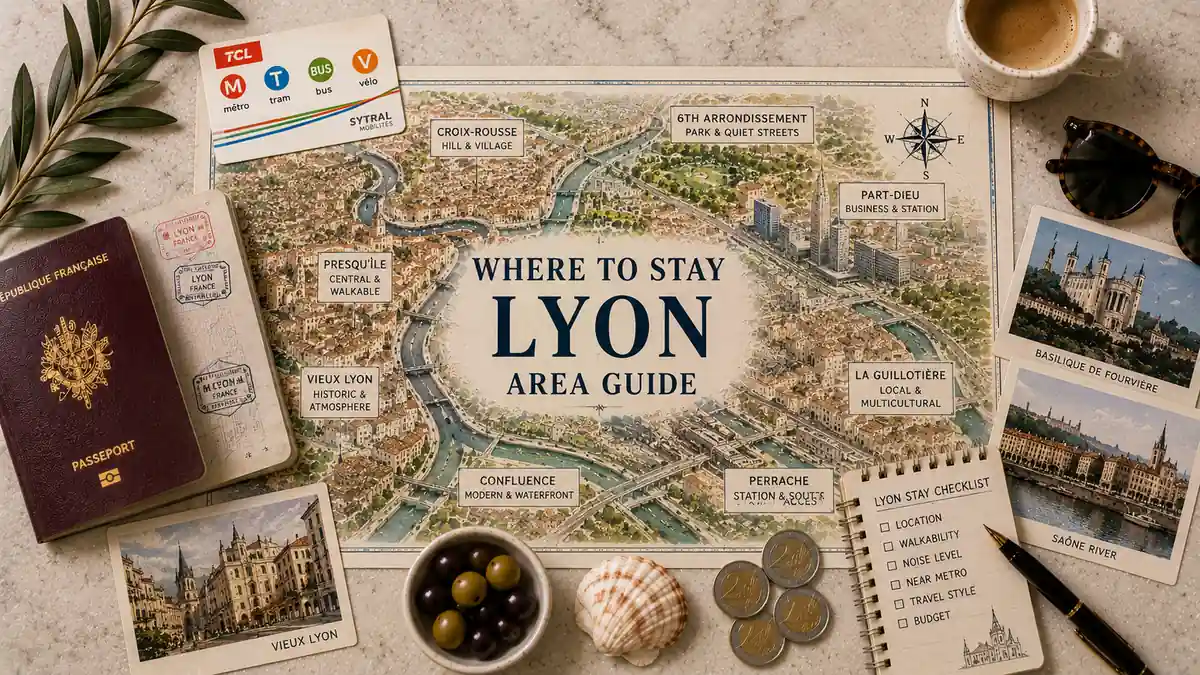
Lyon’s centre is a peninsula between two rivers, with the old town and hill quarters directly beside it. The Saône runs to the west, the Rhône to the east, and the sights cluster tightly on either side of the western bank. Central Lyon is therefore broader than a hotel map suggests — and the station districts sit outside it.
Arrondissement numbers are the fastest way to decode a listing. The 1st and 2nd cover Presqu’île, its northern and southern halves. The 5th is Vieux Lyon and the Fourvière hill above it. The 4th is the Croix-Rousse plateau, while the Pentes — the slopes below the plateau — fall into the 1st. The 6th is Brotteaux and the Parc de la Tête d’Or, east of the Rhône. The 3rd is Part-Dieu, and the 7th is La Guillotière, also on the east bank.
Walking between the central quarters is genuinely easy. Presqu’île and Vieux Lyon are separated only by a footbridge, and the slopes of Croix-Rousse begin at the top of the peninsula. Crossing the Rhône into the 6th or 7th changes the experience: the walk stays short, but the sightseeing stops at the water, so those districts trade proximity for calm. For the wider city context behind the stay decision — what actually fills the days — the Lyon travel guide covers the ground this page deliberately leaves out.
Read the table as a shortlist, then use the area blocks below for the reasoning behind each row.
| Area | Feel | Convenience | Relative price | Best for |
|---|---|---|---|---|
| Presqu’île (1st, 2nd) | Busy commercial and dining core | Everything central within walking distance | Leans mid-range to high-end | Maximum walkability and widest choice |
| Vieux Lyon (5th) | Renaissance streets, lively and touristed | Old town sights on the doorstep | Mid-range with a tourist premium | Atmosphere first, crowds accepted |
| Croix-Rousse (1st, 4th) | Local, village feel above the centre | Walk down easily, climb back up | Relative value against the peninsula | A residential base with local rhythm |
| Confluence (2nd) | Modern riverside redevelopment, notably quiet | Removed in feel from the historic core | Mid-range in newer buildings | New-build space and light |
| Brotteaux and Tête d’Or (6th) | Elegant residential streets by the park | Across the Rhône from the sights | Leans upmarket and residential | Calm evenings beside the big park |
Presqu’île Puts Everything Within Walking Distance
Presqu’île is the base where Lyon’s core sits on your doorstep, which suits travelers who want to walk everywhere. Squares, shops, bouchons, cinemas and the main transport interchanges all sit inside the same narrow strip of land, so the peninsula rewards anyone who plans loosely and improvises on foot.
Day to day, the peninsula feels like a working city centre wearing a nineteenth-century face. Place Bellecour opens out at its middle, Place des Terreaux anchors the northern end, and dense shopping and restaurant streets run between them. It stays busy into the evening. That energy is the reason to book here and the reason a room facing a main street is a gamble.
Everything else is a short walk or one bridge away. Vieux Lyon sits across a footbridge over the Saône, the Croix-Rousse slopes rise at the northern end of the peninsula, and the east-bank districts are one crossing of the Rhône — so no part of central Lyon needs planning.
On price, Presqu’île leans mid-range to high-end by local standards, with the grandest addresses clustered around the main squares and better value on the quieter side streets a block back. For street-level depth — how the quarter shifts in character between Terreaux, Bellecour and the southern end — the Presqu’île neighbourhood guide goes further than a stay page should.
Best for: travelers who want maximum walkability and the widest choice on their doorstep.
Vieux Lyon Is the Atmosphere Pick — With a Tradeoff
Vieux Lyon is the city’s most atmospheric base, and also its most touristed and evening-noisy. Renaissance facades, hidden courtyards and the traboules threading between them make the quarter feel unlike anywhere else in the city, and Saint-Jean puts you at the foot of the funicular up to Fourvière.
Staying inside the UNESCO-listed old town means waking up in the postcard. The streets are narrow, cobbled and pedestrian-heavy, the restaurant density is high, and the whole quarter is compact enough to cross in a stroll. The same qualities produce the tradeoff: daytime tour groups fill the main lanes, and the bars and restaurants keep the evening loud well after the sightseeing crowd has gone.
Reach is good here, though narrower than the peninsula’s. You are beside the old town’s own sights and a bridge from Presqu’île, with the hill behind you; anything on the east bank becomes a longer walk. Prices sit mid-range for the city, with a visible tourist premium on the best-positioned streets.
For the quarter in detail — its courtyards, its quieter southern end and how it empties out late at night — read the Vieux Lyon neighbourhood guide. Travelers weighing the two banks against each other will find the choice resolved properly in Vieux Lyon vs Presqu’île for where to stay in Lyon; the short version is that one bank gives you charm and the other gives you reach.
Best for: atmosphere-first travelers who accept crowds and evening noise.
Croix-Rousse Feels Local — and It’s Closer Than It Looks
Croix-Rousse is not too far out to stay in: the Pentes — its slopes — border the centre directly. The tradeoff here is the hill, not the distance. The plateau higher up sits further from the sights and keeps a genuine village feel, while the slopes drop straight into the northern end of Presqu’île.
The two halves of Croix-Rousse behave differently as bases. The Pentes are the artier, steeper streets running down towards Terreaux, full of small studios, bars and independent shops, and they keep you within a walk of the centre. The plateau is flatter, quieter and more residential, built around a daily market street and a neighbourhood rhythm that has little to do with tourism.
Gradient is the thing travelers misjudge here. Every walk home from the centre ends uphill, and that one fact decides whether the quarter feels charming or tiring by the third night. Check the contour lines around an address before you book it.
Value is the quiet reason people stay up here: Croix-Rousse undercuts the peninsula, which matters most on longer stays. The full picture of the quarter — plateau and slopes alike — sits in the Croix-Rousse neighbourhood guide, and travelers torn between the local base and the central one can weigh it directly in Presqu’île vs Croix-Rousse for where to stay in Lyon.
Best for: travelers who want a local, village-feel base above the centre.
Confluence Is the Modern, Quiet Outlier
Confluence is Lyon’s modern, quiet outlier: redeveloped, riverside and calm in the evenings. What you give up is closeness to the historic core, even though the district occupies the southern tip of the same peninsula, where the Saône finally meets the Rhône. It rewards travelers who want new over old.
The district reads as a piece of contemporary city design. Regeneration brought bold modern architecture, waterfront walkways and a cultural and shopping quarter to what was industrial land, and the streets are wide, new and notably calm after dark. It currently positions itself as Lyon’s design and waterfront address, and that reputation is still forming.
Distance is the honest weak point. You are on the same peninsula as the centre but at the far end of it, so reaching the old town and the main squares becomes a deliberate trip instead of a stroll out of the door. That distance is precisely what buys the quiet.
Rooms here land mid-range for the city, usually in newer buildings, which appeals to travelers who value space and light over cobbles. Confluence is the one area on this page chosen mainly for what it lacks: crowds, noise and the constant background hum of a historic centre.
Best for: travelers who prefer new-build space and light over historic surroundings.
Brotteaux and Tête d’Or Are Lyon at Its Calmest
Brotteaux and Tête d’Or are Lyon at its calmest: elegant, residential and beside the city’s great park. The 6th arrondissement sits east of the Rhône, so evenings are quiet and the sightseeing is a river crossing away. It suits travelers who want a break from the centre at the end of the day.
The atmosphere is closer to a smart residential district than a visitor quarter. Wide nineteenth-century avenues, good bakeries, unhurried cafés and the Parc de la Tête d’Or on the doorstep set the daily rhythm, and the park itself is the reason many travelers pick the area at all. Mornings here feel like living in Lyon.
Getting to the sights is easy without being immediate. Crossing the Rhône into Presqu’île is straightforward, and the east bank is well served, but you will make that crossing every day of a sightseeing trip. Families and longer-stay travelers usually find the exchange worthwhile; a two-night visitor rarely does.
Prices lean upmarket, in keeping with the address, though the streets further from the park temper that. The 6th is the base that gives back what a busy day takes out, and no other quarter in Lyon pairs quiet evenings with green space this easily.
Best for: travelers wanting a calm, upmarket base beside the park.
Is Staying Central in Lyon Worth the Extra Cost?
For most short trips, yes — the central premium buys walkability that a station-side saving cannot. Lyon’s sights, restaurants and river walks cluster in a small area, so a central base converts directly into time on foot and fewer decisions about how to reach anywhere.
Trip length is the variable that flips the answer. On a compressed weekend, every crossing you avoid is time returned to the city, which is why a 2 days in Lyon itinerary works best from the peninsula or the old town. Give yourself a slower 3 days in Lyon itinerary, or a longer stay, and a quieter base uphill or across the Rhône starts to make sense: you have the days to absorb the extra walking, and the evenings get calmer.
The three spend styles play out differently across the city:
- Budget: the Croix-Rousse slopes and the east-bank streets away from the park stretch the money furthest while keeping you walkable to the centre.
- Mid-range: Presqu’île, Vieux Lyon and Confluence dominate this band, and it is where the widest choice sits.
- High-end: the 6th and the grander addresses around the main squares carry the upmarket end, bought for quiet and space as much as for position.
What travelers underestimate is how small the central premium is in geographic terms. The quieter, cheaper quarters sit a short walk from the peninsula, so the saving is real while the sacrifice is mostly gradient and evening convenience. Let the density of your days settle it ahead of the price difference — packed itineraries repay a central room, slow ones do not.
Best Areas in Lyon by Traveler Type
Most stay decisions in Lyon collapse to trip type: match yours to an area, then go deeper. The table below routes six common traveler profiles to the area that fits them, with the reason compressed into a line. Each row has a dedicated page carrying the full logic, the tradeoffs and the exceptions.
| Traveler type | Area that fits | Why it fits | Deeper guide |
|---|---|---|---|
| First-time visitors | Presqu’île, either half of it | Central, walkable, hardest to get wrong | where to stay in Lyon for first-timers |
| Couples | Vieux Lyon or the Pentes | Atmospheric streets and short walks home | where to stay in Lyon for couples |
| Families | Brotteaux and Tête d’Or | Quiet streets with the park nearby | where to stay in Lyon for families |
| Nightlife-focused travelers | Presqu’île and the Croix-Rousse slopes | Bars and late venues within walking distance | where to stay in Lyon for nightlife |
| Budget travelers | Croix-Rousse plateau and the east bank | Better value a short walk out | where to stay in Lyon on a budget |
| Luxury travelers | The 6th and central Presqu’île | Grand addresses, quiet streets, upmarket dining | where to stay in Lyon for luxury |
Once the area is settled, the property choice is a separate decision, and this page deliberately names no hotels. Travelers who want character rooms inside the quarters described above can pick from the best boutique hotels in Lyon and work backwards from the address.
Hotels and places to stay
Compare hotels, apartments and stays for your dates in one search.
Search hotels and stays on hotels.com →
Tripstou may earn a commission if you book through this link, at no extra cost to you.
Other Areas Worth Knowing: Part-Dieu, Perrache and La Guillotière
These districts look convenient on a hotel map but suit narrow cases. Part-Dieu, Perrache and La Guillotière all sit within easy reach of the centre, and each has a clear reason it did not make the main list: station function, an edge position, or a character that fits some travelers and not others.
Part-Dieu is the main station and business district in the 3rd, east of the Rhône. It works for a single night around a rail connection or a work trip, and it makes a poor leisure base — the surroundings are offices and a shopping centre, and the historic city is a journey away. Booking beside Part-Dieu because it is where the train arrives is the most common Lyon booking mistake: you buy one easy arrival and pay for it on every day that follows.
Perrache is the second station, at the southern end of Presqu’île, and it is the workable edge case of the three. You stay on the peninsula, which keeps the centre walkable, though the immediate surroundings are functional and the atmosphere improves as you head north. La Guillotière, across the Rhône in the 7th, is lively and multicultural, and it currently reads as one of the city’s changing quarters — good for travelers who want a non-touristic base, less so for anyone hoping for a postcard one.
Around Part-Dieu after dark, and in the immediate metro surroundings of La Guillotière, some travelers find the atmosphere less comfortable than in the central quarters, without either area being off-limits; that nuance belongs in the Lyon safety guide instead of here.
Frequently Asked Questions
Is Confluence a good area to stay in Lyon?
Yes, for travelers who want space, quiet and new buildings. Confluence pairs waterfront walking and contemporary architecture with evening streets that stay empty. Skip it if the point of your trip is stepping straight out into cobbled lanes and bouchon noise, because that is a walk away, not a doorstep.
Is La Guillotière a safe area to stay in?
Broadly yes, with one honest caveat. La Guillotière is a lively, multicultural quarter in the 7th, and most visitors base themselves there without trouble. Some travelers find the streets immediately around the metro uncomfortable after dark, while the wider district is ordinary residential Lyon and reads that way by day.
Where should I stay in Lyon near the train station?
Choose Perrache over Part-Dieu if you want a station and a real base. Perrache sits at the southern end of Presqu’île, so you stay on the peninsula and keep the centre walkable. Part-Dieu only makes sense for a single night around an early or late connection.
Is the 6th arrondissement a good area to stay in Lyon?
Yes, and the part of it you book matters. The 6th runs from the Rhône bank across Brotteaux to the Parc de la Tête d’Or; addresses nearer the river keep the centre closest, while the streets around the park trade a few blocks for greenery and the quietest evenings in Lyon.
Where should you stay in Lyon for a weekend?
Stay central — Presqu’île or Vieux Lyon — because two nights leave no room for commuting to the sights. The peninsula gives you reach and the widest choice of restaurants; the old town gives you the Renaissance streets. Either keeps the whole weekend inside walking range.
What is the best area to stay in Lyon for food and bouchons?
Vieux Lyon and Presqu’île put you closest to the traditional bouchons. The old town’s streets around Saint-Jean are thick with them, while the peninsula spreads its eating across bouchons, markets, bistros and modern kitchens. Book Vieux Lyon for tradition and Presqu’île for range across a longer stay.
Related Guides
These pages carry the decisions this guide deliberately hands off.
- Lyon travel guide — the wider city context behind the stay decision.
- Presqu’île neighbourhood guide — street-level depth on the central peninsula.
- Vieux Lyon neighbourhood guide — the Renaissance quarter in detail.
- Croix-Rousse neighbourhood guide — the slopes and the plateau explained.
- Vieux Lyon vs Presqu’île — the two central bases resolved head to head.
- Presqu’île vs Croix-Rousse — central reach against local calm.
- Best boutique hotels in Lyon — property picks once the area is chosen.
- Lyon safety guide — neighbourhood-by-neighbourhood reassurance and caution.
Did this guide save you time or money? Tripstou is independent and reader-funded — if you'd like to give something back, you can support the site with a crypto contribution of any size.