You book at a certain level in Paris or on the Riviera, and the question about Lyon is not which hotel — it is whether Lyon is that kind of hotel city at all. Nothing you have opened so far has answered it. The results for this search are platform filters and property rosters: a list of names, sorted by a label the platform invented, with no line anywhere on which part of the city those names sit in or whether that matters. It matters here, because Lyon’s top end is small and it does not sit in the quarter you would guess from a map. This page gives you the honest ceiling first, then where the high end physically sits, then one verdict per quarter — what the premium buys there, and what no amount of it will fix. The names come later, and elsewhere.
Quick Answer
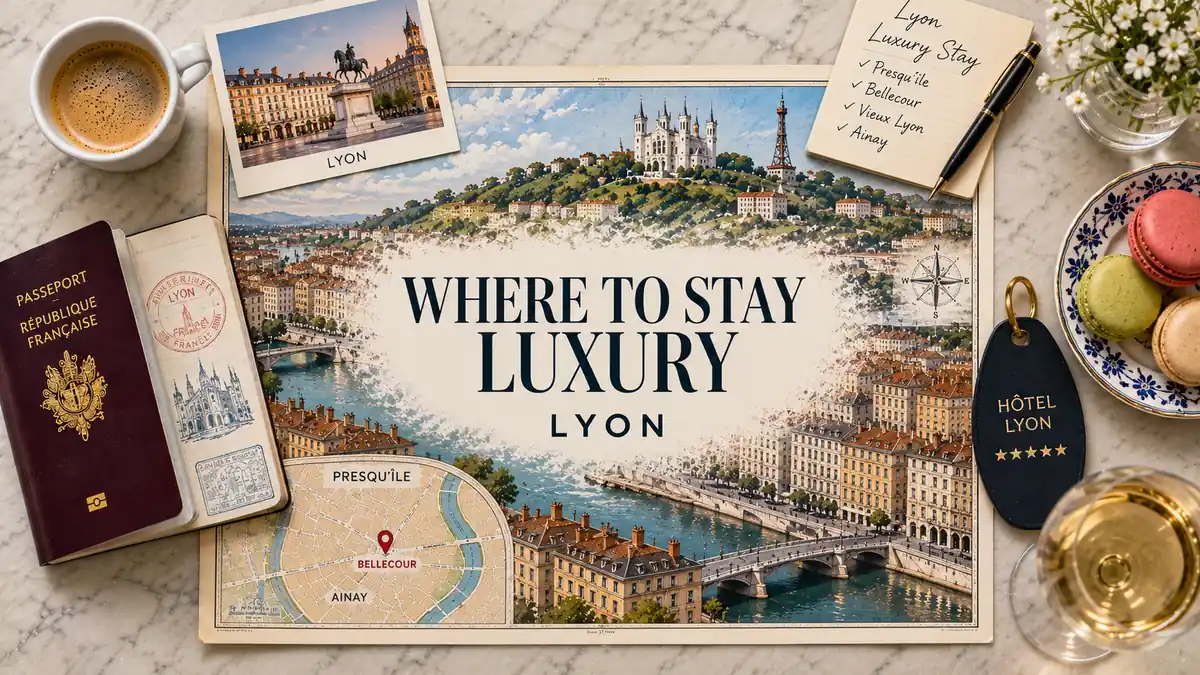
The central Presqu’île, around Bellecour and Ainay, is Lyon’s strongest luxury base — grand addresses on calm streets. Lyon has no single luxury quarter: the top of the market splits between those addresses and Vieux Lyon’s historic buildings. Choose Vieux Lyon if the Renaissance shell itself is what you came for.
Trust Layer
Tripstou stay guide for travelers choosing where to base. Covers area atmosphere, budget, convenience, noise, and traveler fit.
Produced with AI assistance and reviewed by Alex Perrut, working in tourism since 2015, for the Tripstou editorial team. See our editorial process for details.
Last factual review: August 14, 2026.
Official sources consulted: France.fr, Atout France.
Key Takeaways
- Lyon is a five-star city with no Palace hotel, so the top of its market has an official, visible ceiling.
- Book Bellecour or Ainay on the Presqu’île for a grand address, calm streets and the whole core on foot.
- Choose Vieux Lyon when the Renaissance building is what you are paying for, and accept that grand rooms are rare.
- The 6th holds Lyon’s upmarket postcode, not its top-end hotels, so the smart quarter and the good hotel diverge.
- Croix-Rousse is not a high-end market, which makes it a quarter to spend time in and not to book.
- A platform’s luxury filter carries no standard; the official French star classification does, and the quarter decides everything after it.
Table of Contents
Does Lyon Have Five-Star Hotels — and How High Does the Top End Go?
Lyon has five-star hotels and not one Palace hotel. France’s hotel stars are an official national classification, and the Palace distinction sits above them. Awarding it falls to Atout France, the state tourism agency, and the national roster runs to 33 hotels. Lyon holds none of them.
The distinction gathers in Paris, on the Côte d’Azur and in the ski resorts — three markets that were built around that kind of hotel and staked their identity on it. Lyon was not. It works at the top of the standard classification and stops there, and everything else on this page follows from that one fact.
Knowing the ceiling is what lets you stop shopping for one. Once you accept where Lyon tops out, the question is no longer how far up the market you can reach. It becomes which form of high-end stay this city genuinely does well — and that is a question about quarters, answered by geography.
Which Is the Best Area in Lyon for Luxury Hotels?
There is no single luxury quarter in Lyon — the strongest bases are the central Presqu’île and Vieux Lyon. At this level you are not choosing a neighbourhood so much as a form: a historic building in the old town, or a grand address on the peninsula. Name the form and the map narrows by itself.
A third form exists, and it is the one that catches people out: an upmarket quarter that carries the postcode without the supply. That is the 6th, and it earns its own section below because the honest answer there is split. Anyone asking which part of Lyon is the smart one lands there, and that is not the question that finds the rooms.
The hub’s routing already points high-end travelers at the 6th and the central Presqu’île, for grand addresses, calm streets and good eating within reach. That still holds. This page sharpens the second half of it: inside the Presqu’île, the answer is Bellecour and Ainay. If the base is not settled at all yet, start with the hub guide to choosing a Lyon base, and planning the rest of the Lyon trip covers everything past where you sleep.
Form first is not a stylistic preference. It is the only order that works when the supply is this thin — pick the quarter first and you may reach the shortlist to find the form you actually wanted is not sold there.
Is the 6th Arrondissement Where Luxury Travelers Actually Stay?
The 6th is where upmarket Lyon lives — but most of the city’s top hotels are not there. The classified top-end supply concentrates in Vieux Lyon and on the Presqu’île, so booking the 6th on reputation alone lands you in a pleasant residential quarter that is thin on rooms.
Day to day the quarter is comfortable and unhurried: ordered streets, good food shops, Tête d’Or at the end of them, very little visitor traffic passing through. The appeal is genuine. Nobody here is performing for anyone, and after a few days in a busy centre that reads as luxury in its own right.
Position is the trade. You are east of the Rhône, with the historic core on the other side of the river, which suits a trip built around the quarter itself and tires out a trip built around the old town and the peninsula. Every outing starts with a decision to leave.
Calm, space and park-side residential Lyon are what the premium gets you here. The shortlist is what it cannot fix: high-end options are scattered, toward Brotteaux and on toward Part-Dieu, found one at a time and never as a cluster you can choose between. Spending more does not lengthen that list.
Search for the smart part of Lyon and the 6th is the right answer. Search for the top-end rooms and it is not. Most travelers arrive here having run the first search while believing they ran the second.
Best for: residential calm by Tête d’Or, when a specific property — not the centre — is what pulled you there.
In Vieux Lyon, the Premium Buys the Building and the Position
In Vieux Lyon the premium buys a Renaissance building and its position in the old town, not floor space. Grand rooms are rare in that stock and no amount of money adds one. Character is what this quarter has instead of scale, and at the top end that is the whole proposition.
Living inside the quarter is what is actually being sold. A door on these lanes means the old town is where you sleep and not where you go, and at this level that access is most of what you are buying. It is the one thing a base across the river cannot replicate at any price.
Position is strong for the trip this suits: the old town at the door, the Saône a street away, the peninsula over a bridge. How the quarter is laid out and how it behaves across a day belongs to Vieux Lyon at ground level, and this page adds only the high-end verdict on top of it.
The fabric is what you are paying for — a courtyard, a stair, ceilings and windows that have looked that way for centuries, and a door opening straight into the quarter. Scale is what none of it can fix. If a top-end stay means generous proportions to you, a Renaissance shell will not produce them, and paying further up only buys a better version of the same footprint.
The test for Vieux Lyon is whether you would still book it on a wet trip with the shutters closed. If the answer is yes, the building is doing the work you are paying for. If the appeal was really the streets outside, a central base reaches the same streets and gives you more room to come back to.
Best for: trips where sleeping inside a Renaissance house is itself the reason to book.
On the Presqu’île, the Grand Addresses Cluster Around Bellecour and Ainay
Lyon’s grand addresses cluster on the Presqu’île, around Bellecour and Ainay, where the streets stay calm. This is the form closest to what a Paris- or Riviera-calibrated traveler expects: scale, formality, the city’s core within walking reach of the door. It is the safe answer, and the reasons are good ones.
Bellecour and Ainay are the composed end of a busy peninsula. The squares carry the grandeur, and the streets behind them stay residential after dark — which is why the addresses built around formality ended up on this stretch and not on the noisier ones.
Convenience is the strongest of any quarter on this page. The core is walkable end to end, both rivers are a few streets off, and the day begins on foot from the door with nothing to cross first. Which stretch of the peninsula a given address sits on is its own question, settled in the Presqu’île, end to end.
What the premium buys is the grand address itself — proportion, formality, service, a central position on streets that stay quiet. What it cannot fix is that a few streets beyond them this is the city’s working centre, commercial and busy and entirely unbothered by your stay. No address here makes the stay historic in the Vieux Lyon sense either; that character sits across the Saône.
Ainay is the part of this answer people skip. It keeps the formality of the squares and loses their foot traffic, and it is where the calm in “grand address on a quiet street” actually comes from.
Best for: trips that want formality and a central door, with the whole core reachable on foot.
Hotels and places to stay
Compare hotels, apartments and stays for your dates in one search.
Search hotels and stays on hotels.com →
Tripstou may earn a commission if you book through this link, at no extra cost to you.
Vieux Lyon or the Presqu’île for a Luxury Stay?
Choose Vieux Lyon if the building is the point; choose the Presqu’île if the address and the scale are. That is the whole cut at this level — character on one side, grandeur on the other. Walkability, calm and centrality both quarters deliver, in different measure and never as the deciding factor.
One tiebreaker settles most of these. Take the hotel out of the picture: if the trip still wants the old town at the door in the evening, book there; if it wants the city core on foot and a formal address to return to, book the peninsula. Both quarters are defensible at this level, which is precisely why they split the top of the market between them. Everything the two do differently outside the luxury question is argued out in the head-to-head between Vieux Lyon and the Presqu’île.
Croix-Rousse Is Not a High-End Market — and the Rest Is Scattered
Croix-Rousse is not a high-end market, and an upscale stay belongs elsewhere in the city. What the hill offers is a handful of independent addresses, which is a genuine kind of stay and not this one. Guides that rank the quarter as a luxury base are describing the streets, not the rooms.
It still suits the traveler who came for the hill itself and is content with a smaller, independent place to sleep — a legitimate choice, just not the one this page resolves. What the quarter is like to wake up in is covered in what Croix-Rousse is actually like as a base.
The rest of the map thins the same way. High-end options do exist toward Brotteaux and around Part-Dieu, scattered instead of clustered, which means they are found individually and judged individually. None of that is a judgement on the properties themselves. It only means the quarter cannot be the thing you book there — the property has to carry the whole decision by itself.
What Does a Luxury Hotel in Lyon Actually Get You?
A luxury hotel in Lyon buys a building, a position and calm — not scale, and not a palace-tier product. Each quarter delivers its own version of those three and fails at something the others do not, and the failure is usually what decides it. None of them fails quietly.
| Quarter | What the premium buys | What it cannot fix |
|---|---|---|
| Vieux Lyon, the old town | A Renaissance building and a door into the old town | Scale — grand rooms are rare in this stock |
| Presqu’île (Bellecour and Ainay) | A grand address, formality, calm central streets | The working city a few streets beyond them |
| The 6th (Brotteaux, Tête d’Or) | Residential calm, space, park-side Lyon | A shortlist that stays short and scattered |
| Croix-Rousse, up the hill | Quarter character and independent, personal stays | It is not a high-end market at all |
Read across the four and the pattern is consistent: Lyon’s high end sells context, and the thing it cannot sell is size. That comes from the buildings themselves, not from a lack of ambition in the market. A Renaissance house and a nineteenth-century corner on a square are what the city has to work with, and both are excellent at everything except sheer size.
Read the right-hand column before the middle one. All three strong quarters produce a genuinely good stay; the difference that shows up by day three is the thing each one cannot fix.
Which Quarter Suits Which High-End Trip
Character points to Vieux Lyon, grand-address centrality to Bellecour and Ainay, residential calm to the 6th. The whole page compresses into that. What follows sorts the same quarters by the shape of the trip instead of the shape of the quarter, which is how the decision actually gets made.
- The historic-building trip — Vieux Lyon, where the building is the thing being bought and the streets are a bonus.
- The grand-address trip — Bellecour and Ainay, for formality and a central door on streets that stay quiet.
- The quiet residential trip — the 6th, by Tête d’Or, where park-side calm comes with the centre reached deliberately.
- The quarter-first trip — Croix-Rousse loses this one, because the quarter delivers and the high-end stay to match it does not exist.
What to Check Before Booking a High-End Hotel in Lyon
Judge a high-end Lyon listing on its official classification and its exact position, not on the platform’s luxury filter. That filter is a label almost anything can qualify for and it carries no floor. The classification does carry one, and the position decides what the stay is like once you are inside it.
The filter problem is worth naming plainly, because it is the mechanism behind most of the disappointment at this level. A search interface applies the word “luxury” to whatever it chooses to apply it to. It is a sorting convenience with no standard behind it, and it is doing none of the work you assume it is doing.
- Does it carry the official French star classification, or only the platform’s own label?
- Where exactly does it sit — on a main square, in the streets behind one, or inside the old town proper?
- Is the quarter doing the work this trip needs, or is it simply a good address on a good street?
- Would this still be your pick if the same building stood in one of the other quarters above?
In practice the supply here is small and spread out, so there is not much to choose from and the quarter usually arrives attached to a property you already liked the look of. Check that quarter’s consequences before you confirm, against the verdicts above. It takes a minute, and it is the step people skip. Once the quarter is settled, the shortlist itself is the next move — Lyon’s boutique and top-end hotels, compared is where the properties get named.
A classification tells you what the building has. The quarter tells you what your days are like. Only one of those appears on the listing page, which is why every check above exists to put the other one back.
Frequently Asked Questions
What’s the difference between a five-star hotel and a Palace in France — and does Lyon have one?
No Lyon hotel holds the Palace distinction, though the city does have five-star hotels. France’s hotel stars are an official national classification, and the Palace distinction sits above them, awarded by Atout France. So in Lyon the star classification is the only official mark a hotel can show you.
Is Fourvière a good place to stay for a luxury trip?
It works only if you want to be above the old town instead of inside it. Fourvière is the hill directly over Vieux Lyon, in the same arrondissement, reached from the quarter by funicular. High-end options up there are scattered, so the property has to justify the position by itself.
Are Lyon’s top hotels in historic buildings?
Mostly, yes. The top end concentrates in Vieux Lyon’s Renaissance stock and in the grand addresses on the Presqu’île, so the building is usually part of what you are paying for. That is a supply pattern, not a rule, and the scattered options further east do not follow it.
Should you book a boutique hotel or a grand hotel in Lyon?
Let the quarter decide it. Boutique logic fits Vieux Lyon, where the stock is small, historic and personal; grand-hotel logic fits the Presqu’île, where formality and scale are what the address is for. Settle the form first, then take the shortlist to the property guide.
Is Lyon’s fine dining near where you’d stay?
Mostly, with one exception. The city’s most celebrated restaurant sits outside Lyon, north at Collonges-au-Mont-d’Or, so no base in the city solves that one. Its associated brasseries, and much of the eating that justifies the trip, are on the Presqu’île, which a central base reaches on foot.
Related Guides
- Where to stay in Lyon — the base decision made without a high-end constraint attached to it.
- Vieux Lyon — Renaissance lanes at ground level, and what a few nights inside them involve.
- Presqu’île, Lyon — which stretch of the peninsula a listing actually sits on, and what that changes.
- Croix-Rousse, Lyon — the hill on its own terms, and the kind of stay it genuinely rewards.
- Vieux Lyon vs Presqu’île — the same two quarters weighed on every ground, not only the high-end one.
- Boutique hotels in Lyon — named properties and how they compare, for readers who have settled the quarter.
- Lyon travel guide — the trip beyond the room: what Lyon is for, and how long it takes.
Did this guide save you time or money? Tripstou is independent and reader-funded — if you'd like to give something back, you can support the site with a crypto contribution of any size.