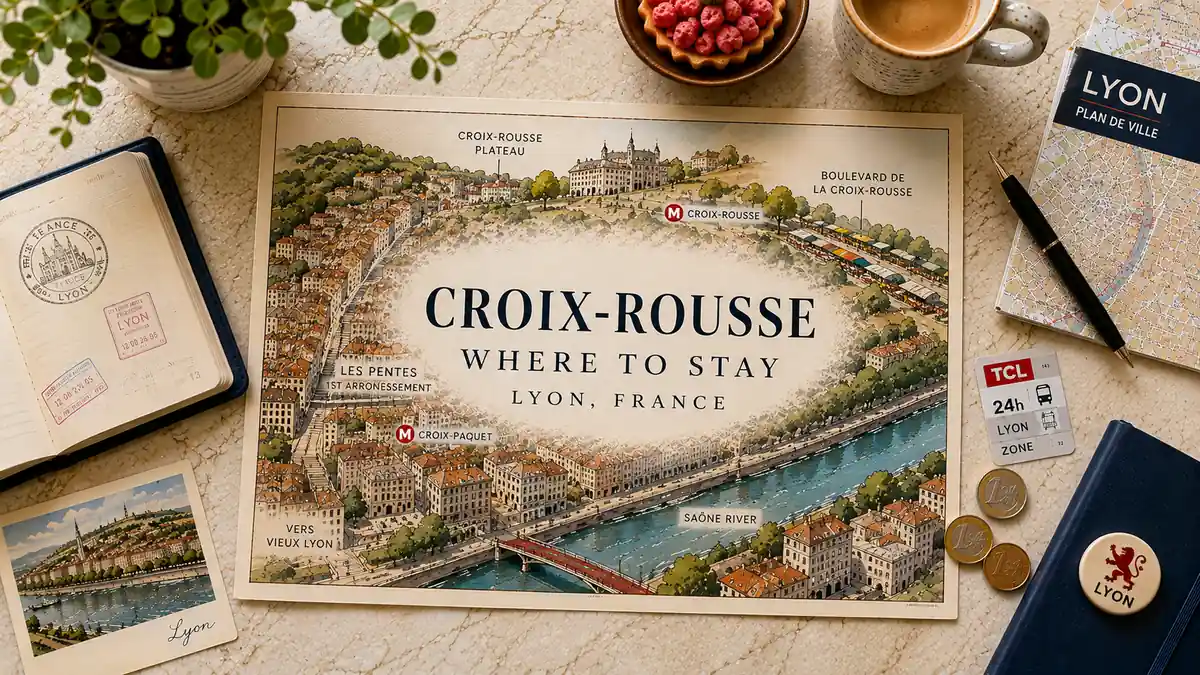
Croix-Rousse is settled. What is not settled is how high on the hill you sleep, and that is the decision this page resolves. The quarter splits into two halves that behave like separate bases: the pentes (the slopes of the 1st arrondissement, falling toward Terreaux) and the plateau (the flat top in the 4th).
One half puts the city centre within a downhill walk and makes you earn it back. The other keeps your daily life level, around a boulevard and its market, with a metro ride standing between you and the river quarters. Which half you book changes your mornings, your evenings and your last trip home more than the exact street address does. What follows names the micro-zones inside each half, ties each one to the Metro C station you would actually exit at, and says plainly who should not book this hill at all.
Quick Answer
Croix-Rousse is a strong base for travelers wanting village calm, and the real choice is pentes or plateau. How high you land and which Metro C station you exit at decides the stay. Book the plateau for flat everyday ease near the market; take the pentes for character within a walk down to the centre.
Trust Layer
Tripstou stay guide for travelers choosing where to base. Covers area atmosphere, budget, convenience, noise, and traveler fit.
Produced with AI assistance and reviewed by Alex Perrut, working in tourism since 2015, for the Tripstou editorial team. See our editorial process for details.
Last factual review: August 11, 2026.
Official sources consulted: France.fr, Atout France.
Key Takeaways
- Book the plateau for flat, everyday living around the market; book the pentes for character and a walk down to the centre.
- The hill is genuinely steep — Metro C climbs it on a 17% rack section, so gradient is a daily cost.
- Choose your Metro C station before your street: Croix-Paquet sits below the climb, Croix-Rousse on the flat top.
- Supply on the hill is thin and skews to small independents and apartments, so expect a short shortlist.
- The common mistake is booking a charming mid-slope address, then paying the climb four times a day.
- Skip Croix-Rousse entirely if you are step-averse, nightlife-first, or in Lyon for one short, early-train night.
Table of Contents
Croix-Rousse Is a Good Base — If You Pick Your Half First
Croix-Rousse is worth booking, provided you choose your half deliberately. The quarter works as a base for travelers who want somewhere with its own daily life instead of a central address. The condition matters because the pentes and the plateau ask different things of you every day.
The quarter functions as a base because it does not need the rest of the city to work. A market runs along Boulevard de la Croix-Rousse, the food streets around it are used by the people who live there, and the plateau is walkable at village scale. You can spend a morning here without a plan and without a metro ride.
Its shape comes from the silk trade. The canut workshops needed tall windows and high ceilings for their looms, which is why the building stock reads differently from the centre’s, and the streets and traboules were cut to move fabric down the hill on foot. That inheritance explains why the grid climbs the way it does — the layout was designed around the descent.
If the peninsula is still in play, that head-to-head belongs elsewhere: Croix-Rousse vs Presqu’île compared weighs the two bases directly, and hands the internal decision back to this page.
This guide starts where the quarter-level answer stops. Croix-Rousse is not one base. It is two, stacked vertically, and everything below resolves which one is yours.
Pentes or Plateau: Which Half Should You Book?
Book the pentes to stay close to the centre; book the plateau for a level daily life. Three variables settle it: how much gradient you cross each day, which Metro C station you exit at, and how much evening activity you want outside your door. Atmosphere alone will not choose for you, because both halves share it.
Gradient exposure is the first variable, and the two halves do not share it. On the pentes, almost every trip involves slope: the streets are cut into the hillside and stairways stand in for pavements in places. On the plateau, the ground goes flat the moment you are up, and a whole day can pass without a climb.
Station access is the second. Both halves sit on Metro Line C, but the exit station changes what a stay feels like — Croix-Paquet drops you at the bottom of the slope just above Terreaux, while Croix-Rousse, Hénon and Cuire put you on the flat top. Exit stations behave like addresses here.
Evening character is the third, and this is where the halves diverge after dark. The slopes go quiet early and feel more isolated, with activity concentrated at a handful of restaurant corners and empty stretches between them. The plateau keeps a low residential hum around the boulevard. Neither half is a nightlife district, and neither pretends to be.
Read the table as a shortlist, then use the two area blocks below for the reasoning behind each row.
| Stay variable | Pentes (1st arrondissement) | Plateau (4th arrondissement) |
|---|---|---|
| Gradient exposure | Slope on almost every walk home | Flat ground once you are up |
| Nearest Metro C station | Croix-Paquet, at the foot of the climb | Croix-Rousse, Hénon or Cuire |
| Evening character | Quiet early, activity at restaurant corners | Low residential hum near the boulevard |
| Getting to the centre | A downhill walk into Terreaux | Metro down, or a long descent on foot |
| Supply character | Small independents and converted apartments | Apartments with a few small addresses |
Pick the half that survives your tiredest evening. Imagine arriving back after a long dinner in the centre, carrying shopping, at the end of a walking day: the pentes stop being romantic at that moment, and the plateau’s flat spine starts looking like design rather than compromise.
Both halves assume the hill is already your answer. If you are still weighing this quarter against the river districts and the peninsula, the guide to where to stay in Lyon compares the city’s bases first, and this page picks up once the quarter is fixed.
Hotels and places to stay
Compare hotels, apartments and stays for your dates in one search.
Search hotels and stays on hotels.com →
Tripstou may earn a commission if you book through this link, at no extra cost to you.
The Climb Decides More Than the Address
Yes, the hill is real, and there is a hard number that proves it. Metro Line C is a rack railway, and the section between Croix-Paquet and Croix-Rousse climbs a 17% gradient — the steepest in regular French metro service. That engineering exists because the slope defeats casual repetition on foot.
The hill tops out at roughly 254 metres, and the vertical distance is what travelers underestimate. A map flattens it. The route from the bottom of the pentes to the boulevard looks short in metres and reads long in minutes, because it is a stair-and-slope route, not a straight line.
The rack system is the clearest evidence available. Standard metro traction cannot hold that section, so the line uses a toothed rail to climb it, and it replaced an earlier funicular that had done the same job on cables. A city does not solve the same hill twice for a gentle slope.
Day to day, the cost is repetition. One climb is a pleasant walk with the rooftops opening up behind you. Four climbs is the shape of your day. Sleeping on the flat spine means the slope only happens when you choose it; sleeping mid-slope means it happens every time you leave and every time you come back.
The street layout makes it harder than the contour lines suggest. The canut workshops were built up the hillside and the routes between them — traboules, stairways, tight switchbacks — were cut for people moving goods downhill. Coming back up was always the harder half.
The gradient is a scheduling problem before it is a fitness problem. Travelers who plan two returns to the room each day, for a rest or a change of clothes, pay the hill twice as often as travelers who leave in the morning and come back once — which is why the same address suits one trip and ruins another.
Which Metro C Station Should You Sleep Near?
Sleep near Croix-Rousse station if you want the flat top, and near Croix-Paquet if you want the centre close. The exit station shapes a stay more than the street name does, because it fixes where your climb starts and how far the boulevard and the market sit from your door.
Line C runs the hill in sequence: Hôtel de Ville–Louis Pradel, Croix-Paquet, Croix-Rousse, Hénon, Cuire. Your station is your altitude.
Croix-Paquet is the low entry. It sits just above Terreaux at the foot of the steep section, which puts the centre within a short walk down and leaves you below the boulevard, the market and most of the quarter’s daily life. It suits travelers who want a Croix-Rousse address without giving up the peninsula’s proximity.
Croix-Rousse is the station that serves the quarter itself. It comes out at the top of the climb, on the boulevard, with the market street at hand and the plateau level in every direction. If you booked the hill for the quarter itself and not the view of it, this is your station.
Hénon and Cuire sit deeper into the plateau. They trade proximity to the boulevard for quieter residential streets and a longer ride each time you go down, which works well for a longer stay and works badly for a two-night trip built around the centre.
Hôtel de Ville–Louis Pradel is the connection that makes the whole line usable. It is where Line C meets Line A at the bottom of the hill, so the plateau sits one interchange from the peninsula’s spine and from the routes that cross the city.
Getting down to the centre is either a walk or a ride, and the two are not equivalent in both directions. Walking down from the boulevard through the slopes into Terreaux is an easy descent that most travelers enjoy. The same route upward is the trip people quietly stop making. Riding the line is quick either way, which is why plateau addresses treat it as the default and slope addresses treat it as optional.
Book the station before you book the street. Two addresses that look adjacent on a map can sit on opposite sides of the steep section, and the one below it lives a different day from the one above it.
Staying on the Pentes: the Climbing Streets of the 1st
The pentes suit travelers who want the centre within walking distance and accept a climb to get home. These are the slopes of the 1st arrondissement, falling from the boulevard toward Terreaux, and they hold the quarter’s most atmospheric streets. The condition attached is physical: nearly every return is uphill.
Day to day the pentes feel like a working hillside. Old canut buildings carry tall windows and high ceilings, small independent shops and studios occupy the ground floors, and the streets bend and drop in ways that make the same walk feel different each time. Stairways appear where a street would be too steep to pave.
Convenience here is measured downhill. Terreaux and the peninsula’s northern squares are a genuine walk away, close enough that many stays never use the metro to reach the centre at all. Croix-Paquet sits at the bottom of the slopes for the trips you would rather not make on foot, and the boulevard, the market and the plateau’s flat streets are above you.
Supply on the slopes is thin and skews independent. What exists is mostly small owner-run addresses and apartments inside converted canut buildings, so the choice is narrow and the character is specific — high ceilings, old staircases, and buildings that were never designed around luggage. Property style becomes a separate decision once the half is settled, and the shortlist of boutique hotels in Lyon is where to take it.
After dark the slopes go quiet. Activity holds at a few restaurant corners, and the stretches between them are empty and steep, which reads as calm to some travelers and as isolation to others.
Around Croix-Paquet: the Low Entry Above Terreaux
Croix-Paquet is the lowest Croix-Rousse address you can book. The station sits just above place des Terreaux at the foot of the rack section, so you are on the hill without being on top of it, and the centre is a short walk from the door.
The tradeoff is which quarter you actually get. Mornings here belong to the peninsula’s edge more than to the plateau’s market, and travelers who came for the village rhythm may find they commute up to it.
Best for: travelers who want a hillside address with the centre still on foot.
The Upper Slopes, Near the Boulevard Rim
The upper slopes give you the quarter’s character with the plateau in reach. Addresses just below the boulevard rim sit inside the canut streets while keeping the market, the flat top and Croix-Rousse station within a short walk — a short uphill walk.
What you accept is the last stretch. The final climb to the boulevard is brief and steep, and it is the part of the day travelers underestimate when they book for the view over the rooftops.
Best for: travelers who want canut streets without losing the plateau’s daily life.
Staying on the Plateau: the Flat Top of the 4th
The plateau suits travelers who want a level, self-contained daily life and do not mind riding down to the centre. This is the flat top of the 4th arrondissement, built around the boulevard and its market. Once you are up, the hill stops being a factor and the quarter behaves like a small town.
Life on the plateau runs at village pace. The boulevard is the spine, the market fills it in the mornings, and the surrounding streets carry bakeries, greengrocers and cafés used by residents. Evenings are residential and low-key, built around dinner and an early quiet.
Convenience up here is horizontal. Croix-Rousse station sits on the boulevard, so the whole spine is level walking from it, and the deeper plateau streets stay flat in every direction. The centre is a metro ride down or a long, easy descent on foot — and that descent only works in one direction.
Supply on the plateau is thin as well, and skews toward apartments. Residential buildings dominate, short-let flats outnumber hotels, and the hotel addresses that do exist are small and independent in character. The practical consequence is a short shortlist: you will compare fewer places here than in the central quarters.
The Boulevard Spine and the Market Street
The boulevard is the most convenient address on the hill. Boulevard de la Croix-Rousse carries the market, the everyday shops and the station, and everything along it is flat, so a stay here needs no planning around the gradient at all.
The cost is being on the main street. Market mornings bring set-up, deliveries and crowds directly below the windows, and the boulevard is the busiest surface the quarter has. A room facing a courtyard or a side street solves most of it.
Best for: travelers who want the market and the station on the same flat street.
Deeper In: Toward Hénon and Cuire
Hénon and Cuire suit longer, slower stays. The plateau continues north into residential streets that get quieter with every block — still flat, still on Line C, but further from the boulevard’s shops and a longer ride from the centre.
The distance is the whole tradeoff. This part of the quarter is residential first, so daily life is calm and the trip into the city turns into a decision instead of an afterthought.
Best for: longer stays that value quiet streets over a short ride to the centre.
Who Croix-Rousse Suits — and Who Should Skip It
Croix-Rousse rewards travelers who want a lived-in address and punishes anyone needing level ground or late nights. The hill filters people more sharply than most Lyon quarters do. Slope, distance from the centre and an early-quiet evening are not neutral features — each one wins the quarter some travelers and loses it others.
Each traveler type below gets one line inside this quarter’s context, then the page that carries the full verdict:
- First-time visitors: the plateau if the quarter genuinely appeals, though a first visit is usually better served closer to the centre — see the best area for first-time visitors.
- Couples: the pentes, where the canut streets and the quiet restaurant corners do the work — more in where couples should stay in Lyon.
- Families: the plateau only, for the flat ground and the market, since slopes and pushchairs do not combine — see the best family bases in Lyon.
- Nightlife-focused travelers: not here, because the hill goes quiet early — Lyon’s nightlife bases all sit downhill.
- Budget travelers: workable, but the choice is narrow enough that it is worth comparing against the cheapest areas to stay in Lyon.
- Luxury travelers: poorly served here, since the quarter’s inventory is small and independent in character — Lyon’s high-end stay options are elsewhere.
Three traveler types should skip the hill outright. Anyone step-averse or with limited mobility will fight the gradient daily, even on the plateau, because getting up there is part of every arrival. Nightlife-first travelers will spend their evenings commuting in both directions. And anyone with a single functional night in Lyon, shaped by an early train, should stay where the ground is flat and the station is close.
Your Doorstep: the Market, the Food Streets, and the Walk Down
A base here puts a working market, everyday food streets and a downhill walk into the centre at your door. That combination is the practical case for the quarter: the market runs on Boulevard de la Croix-Rousse daily except Monday, in the mornings, and most of what you need day to day sits on the flat.
The market is the quarter’s clock. It fills the boulevard every day except Monday, in the mornings, which gives a stay here a natural rhythm — produce and bread in the morning, clear pavement afterwards. Booking on the boulevard puts it under the window; booking two streets back keeps it a short walk and takes the delivery noise out of your morning.
The everyday food streets around the boulevard are the second doorstep asset. They carry bakeries, cheesemongers, small grocers and neighbourhood restaurants used by people who live here, and their value to a stay is ordinariness: you can eat well without planning anything and without descending into the city.
The walk down to the centre is the third, and it is genuinely pleasant. Dropping from the boulevard through the pentes into Terreaux is a descent through stairways and open views that most travelers make at least once a day, and it puts the peninsula’s squares in reach with no transport at all. The return trip is the part to think about.
Lyon’s monuments and museums are a separate list, and every one of them is downhill from here — the full Lyon guide covers the city this page deliberately leaves out.
The doorstep is what makes the climb worth accepting. Travelers who shop the market and eat on the hill collect something from the quarter every day; travelers who eat in the centre every night pay the gradient twice and get nothing back for it.
Frequently Asked Questions
Can you walk from Croix-Rousse to Vieux Lyon?
Yes, but it is a long, one-directional walk. Vieux Lyon sits across the Saône at the foot of the other hill, so the route drops off the plateau, crosses the peninsula and then the river. Most travelers walk it once and take the metro back up the hill.
Does Croix-Rousse have hotels or mostly apartments?
Mostly apartments. The hill’s inventory is thin and skews to short-let flats and small independent addresses, so hotel-style service is the exception. Practically, that means fewer front desks, more self check-in, and older staircases — worth confirming access before you book a top-floor canut apartment.
Is Croix-Rousse safe at night?
Croix-Rousse is a residential quarter after dark, and the question is really about emptiness, not risk. The plateau keeps a low hum around the boulevard, while the pentes go quiet early, with activity concentrated at a few restaurant corners and long empty stretches of steep street between them.
What days is the Croix-Rousse market open?
It runs every morning except Monday, along Boulevard de la Croix-Rousse. Afternoons are clear, so a stay here works around a morning rhythm: produce, bread and cheese early, then an ordinary boulevard for the rest of the day. Monday is the one day to plan around.
Is Croix-Rousse hard to reach with a suitcase?
Not if you arrive by Metro Line C. The rack railway does the climbing for you, so a plateau address is a level walk from Croix-Rousse station. Dragging a case up the pentes on foot is the version that hurts — stairways stand in for pavements on several of the slope routes.
Is there parking in Croix-Rousse?
Assume parking is difficult and plan the stay without a car. The plateau is a dense residential quarter with narrow streets, and the pentes were laid out for people on foot, not vehicles. Metro Line C connects the hill to the city centre directly, which makes a car the harder option here.
Related Guides
These pages carry the decisions this guide deliberately hands off.
- Best areas to stay in Lyon — every quarter in the city weighed against the others.
- Croix-Rousse vs Presqu’île — the hill and the peninsula resolved head to head.
- Where to stay in Lyon for first-timers — the full first-visit base logic.
- Where couples should stay in Lyon — the romantic-base decision in full.
- Best boutique hotels in Lyon — property picks once the half is chosen.
- Lyon travel guide — the wider city context behind the stay decision.
Did this guide save you time or money? Tripstou is independent and reader-funded — if you'd like to give something back, you can support the site with a crypto contribution of any size.