Lyon carries two reputations that contradict each other. As a city it is underrated — the place travelers pass through on the way to Provence — and inside its Old Town it is over-touristed, with a handful of lanes absorbing almost everyone who does stop. The usual advice makes that worse. Lyon lists run to thirty-odd entries and grade none of them, which leaves you to work out on arrival that the famous quarter is the weakest part of the visit.
The payoff here is concentrated in food, and it rises as you move away from the crowds. That one pattern decides most of what deserves your time. What follows is a short, graded set of experiences — each with a verdict, who it suits and the catch — including the two things Lyon is most famous for that most often disappoint.
Quick Answer
Lyon rewards eaters most: a meal in a certified bouchon is the city’s highest-payoff experience. Payoff rises as you leave the crowded Old Town, where the famous “secret” traboules are the most oversold item in the city. Prioritise the Gnafron-sticker bouchon label and the Croix-Rousse side of Lyon over checkbox sights.
Trust Layer
Tripstou attraction guide for travelers deciding whether an experience is worth doing and how to do it well. Covers value, booking versions, timing, access, and traveler fit.
Produced with AI assistance and reviewed by Alex Perrut, working in tourism since 2015, for the Tripstou editorial team. See our editorial process for details.
Last factual review: August 23, 2026.
Official sources consulted: France.fr, Atout France.
Key Takeaways
- Lyon’s highest-payoff experience is a meal in a certified bouchon, which makes food the anchor of every other decision here.
- Look for the official Bouchons Lyonnais label and its Gnafron window sticker before you look at the menu.
- The traboules reward a short, quiet detour, but the “secret passageway” pitch oversells passages that run through people’s homes.
- Lyon’s return per hour climbs as you leave the Old Town — murals, riverbanks and the Croix-Rousse climb cost nothing.
- Make time for one museum, the Musée des Confluences; the rest are fair to skip on a first visit.
- Book a food tour on a first visit for legibility, not access; confident French-menu readers lose little going alone.
Table of Contents
Lyon Is Worth Visiting — but the Payoff Isn’t Where the Crowds Are
Lyon is absolutely worth visiting — as France’s food capital, not as an Old Town photo stop. The city’s historic districts are UNESCO-listed and genuinely handsome, but the quarter that draws the crowds returns the least per hour. Payoff in Lyon runs roughly inverse to foot traffic.
The grading criterion on this page is payoff per hour of a first visit: what an experience costs you in time, effort and crowd tolerance against what it actually gives back. That test reshuffles the standard Lyon list. It lifts a two-hour lunch above three museums. It drops the most photographed lane in the city.
What Lyon is famous for is food. It has been France’s gastronomic capital by long consensus, home to the bouchon tradition and to the covered market that carries Paul Bocuse’s name. Its second claim is architectural: Vieux Lyon, Fourvière, the Presqu’île and the Croix-Rousse slopes are UNESCO-listed as one continuous historic ensemble. Both claims are real. Only one of them is a reason to come.
The crowding is the part nobody grades. Vieux Lyon’s Renaissance lanes are narrow, and they absorb nearly every visitor the city receives, which makes them loud, slow and repetitive by mid-morning. Ten minutes uphill, the same city is close to empty. That gradient is steeper here than in most French cities, because the crowd never spreads out — there is one postcard quarter and everybody is standing in it.
The failure mode is predictable enough to name. A traveler arrives mid-morning, walks straight into the lanes below the cathedral because that is what every list opens with, spends two hours in the busiest and least representative part of Lyon, and leaves convinced the city is small, pretty and slightly overrated. Lyon is none of those things. They spent their morning in the one corner that behaves that way.
Who Lyon rewards is narrower than the lists admit. It suits travelers who plan the day around meals, walkers happy to climb a hill for a neighbourhood instead of a monument, and returning visitors to France who have already done the cathedral circuit. It under-delivers for landmark hunters. Nothing here overwhelms the way Paris or Rome does, and a trip built on ticking off sights will feel thin by the second afternoon.
Lyon’s inverted reputation cuts both ways: nationally underrated, locally over-visited. The traveler who treats the famous quarter as optional ends up with a better version of the city than the one the brochures sell.
Graded by what each experience returns for the time, effort and crowds it costs on a first visit.
| The experience | Worth it for | The catch |
|---|---|---|
| Eating in a certified bouchon | Anyone who came to Lyon to eat well | The imitations cluster exactly where the tourists do |
| Grazing the counters at Les Halles | Food-first and solo travelers, and wet afternoons | A polished food hall, not a picturesque market |
| Hunting murals across Croix-Rousse | Walkers on any budget who dislike queues | The slopes are steep and take a morning |
| Climbing to Fourvière for the view | Travelers who want the whole city laid out | A real hill; the basilica interior divides people |
| Threading the Vieux Lyon traboules | Curious walkers with modest expectations | Cramped, busy, and doors may simply be shut |
Where to stay, how to get around and when to go all belong to the Lyon travel guide, which handles the logistics this page deliberately leaves alone. If you are still deciding whether Lyon earns a stop at all, the ranking of the best places to visit in France shows where it sits against Paris, Provence and the coast.
Eating in a Certified Bouchon Is Lyon’s Highest-Payoff Experience
A meal in a certified bouchon is the best thing you can do in Lyon, full stop. A bouchon is a small, traditional Lyonnais restaurant serving offal-leaning classics in cramped rooms with paper cloths. One word separates the real ones from the imitations: certification.
A bouchon is an institution, not a decorating style. The rooms are small, the tables close, the card short and often handwritten, and the cooking runs on the cheap, rich repertoire that once fed Lyon’s silk workers. Service is brisk and sometimes blunt. Imitations copy the look and skip the kitchen.
Certification is the shortcut past all of that. Lyon’s official label, Les Bouchons Lyonnais, is awarded to restaurants that meet a charter covering cooking, produce and service, and certified houses display a window sticker showing Gnafron — the wine-loving puppet from Lyon’s Guignol tradition. Look for the sticker before you look at the menu.
The dish repertoire tells you the rest. A real bouchon card circles the same names: salade lyonnaise, quenelles de brochet, tablier de sapeur, andouillette, fromage de canut, tarte aux pralines. You do not need every one of them on one card. You do need most of them to be there.
The imitations give themselves away in four ways:
- A menu that runs to several pages. A bouchon kitchen is tiny and cooks a short list; length signals a freezer, not a repertoire.
- Laminated cards in four languages. The real rooms print or write for a local table first, and translate afterwards if at all.
- A photograph of every dish, in the window and on the page. Certified houses put a sticker in that window instead.
- Dense clustering on the tourist lanes around Place Saint-Jean. That concentration is a marketing decision. The rooms locals eat in are spread across the whole city.
None of that helps if offal is a hard no, and it is worth settling that before you book, not at the table. The repertoire leans on organs and cheap cuts by design, and tablier de sapeur and andouillette are the two that catch people out. A bouchon still works around them: salade lyonnaise, quenelles de brochet, fromage de canut and a slice of tarte aux pralines make a complete Lyonnais meal with nothing difficult on the plate. What does not work is walking a strict vegetarian into a bouchon and hoping. That is the meal to spend at the market counters.
The commonest mistake is treating a bouchon as scenery. People photograph the paper cloths, order the single dish on the card they already recognise, and leave having eaten in a Lyonnais room without eating Lyonnais food. The room is not the experience. The card is, and the card is short precisely so that ordering unfamiliar things is low-risk.
The certification is a floor, not a ceiling, and knowing which it is changes how you use it. Plenty of excellent Lyonnais kitchens never applied for the label, and some certified rooms are merely competent. On a first visit, when you cannot tell one from another off the pavement, the sticker is still the most reliable filter you have: use it to rule places out, and let a recommendation from a hotel desk, a market trader or a guide do the ruling in.
Are the Traboules Worth It, or a Tourist Trap?
The traboules are worth a short detour, but “secret passageway” is the most oversold pitch in Lyon. They are covered passages threading through buildings in Vieux Lyon and Croix-Rousse, and the well-known ones carry a steady stream of visitors. Expect atmosphere, not discovery.
Traboules are working infrastructure. They were cut through blocks so silk workers could move cloth between streets under cover, and most still run through the entrance halls, courtyards and stairwells of buildings where people live today. You are walking through somebody’s front hall.
That is the honest reason the secret-passage pitch fails. The famous ones appear in every guide and on every walking tour, so at any reasonable hour you will share them with strangers. Access is a courtesy extended by residents, not a service, and residents who have had enough of the noise close their doors. Nothing about entry is guaranteed on a given day.
The pitch fails harder than the passage does. “Secret” primes you to expect a door only you know about, a courtyard with nobody in it, and the small thrill of being let into something private. What arrives is a stone corridor with three other groups in it and a resident edging past with shopping. The passage itself is genuinely interesting. The promise attached to it is what oversells.
Some travelers should leave them off the list altogether. If stairs and uneven stone are a problem, most of the well-known passages are not worth attempting. If walking through a stranger’s building would make you uncomfortable — and a fair number of people discover mid-corridor that it does — that discomfort is the correct read of the situation, not squeamishness to push past. And if your time in Lyon is short, one passage taken as a shortcut covers the whole experience.
How to use a traboule without being the reason the next door gets locked:
- Go quietly. Voices carry hard up a stone stairwell, and noise is what gets doors shut for good.
- Move through instead of gathering. A group standing in a courtyard blocks the residents who actually need the passage.
- Accept a closed door and walk on. A shut traboule is a decision someone made, not a puzzle to solve.
- Keep cameras pointed away from windows, letterboxes and open apartment doors.
- Come early, or take the ones off the main tourist lane. Solitude is not on offer at midday.
They still reward under two conditions, and both are worth engineering. Early, before the walking groups start moving, a traboule gives you the courtyard, the spiral staircase and the light shaft with nobody in them — which is the version everyone else came for and did not get. That version is quiet enough to notice how the buildings actually work: the passage cuts a block in half, the stairwell borrows daylight from a shaft, the whole thing exists because cloth had to move without getting wet.
The second condition is context. With a guide who knows the silk trade, the passages stop being corridors and start being evidence — of how a whole industry was housed, and why the buildings above them have the windows they do. Without that, a traboule is a dim hallway, and photographs of dim hallways look identical to everybody else’s.
The traboules disappoint because they are marketed as a destination when they function as a shortcut. Use one to get from one street to the next and it delivers. Queue for one as a sight and it cannot.
Les Halles Paul Bocuse Is for Tasting, Not Shopping
Les Halles Paul Bocuse is worth it if you eat at the counters, not if you browse. It is a covered hall of specialist traders — oysters, cheese, charcuterie, pralines — most of them with a few seats attached. Treat it as a meal venue, not a sight.
What you do here is graze. Each trader is a specialist, and many keep a counter or a handful of stools where you eat what they sell on the spot, with a glass beside it. A slow circuit of three or four counters adds up to a full meal, and a genuinely Lyonnais one.
It suits food-first travelers above everyone else, and it is the strongest wet-weather move in the city, because the whole thing is indoors and none of the pleasure depends on the light. It suits solo travelers unusually well too. Counter eating removes the awkwardness of taking a table for one in rooms built for groups.
Skip it if you came for a picturesque market. Les Halles is a polished indoor food hall with hard surfaces and price tags, and travelers hoping for crates, awnings and haggling have walked into the wrong building. Check its trading pattern before you build a meal around it, since a food hall does not keep shop hours.
The useful comparison is with a bouchon, because both are eating decisions and a short stay rarely absorbs both at full length. A bouchon is a commitment: one room, one pace, a fixed repertoire you order into and stay with for a couple of hours. The hall is the inverse. You graze, you change your mind at the third counter, you eat standing if the stools are taken, and you leave the moment you have had enough. Travelers who want Lyonnais produce without the ceremony belong at the counters. Travelers who came for the Lyonnais table should give the evening to a bouchon and use the hall for the lighter meal.
Where it goes wrong is when the hall becomes a substitute for the bouchon instead of its complement. It sells superb produce, but it will not hand you the handwritten card, the argument about tablier de sapeur, or the room full of people who eat there every week. Anyone who grazes here and considers Lyon’s food scene handled has bought the delicatessen and skipped the restaurant.
Eating alone and eating well collapse into a single decision at these counters. A stool buys you the city’s produce without spending an evening slot you would rather give to a bouchon, which is why it earns its place even on a stay with very few meals in it.
Is Notre-Dame de Fourvière Worth the Climb?
Notre-Dame de Fourvière is worth the climb, mostly for the view, not the church itself. The terrace beside the basilica lays out the whole city below, both rivers included, from the hill above the Old Town. The interior is a bonus, not the reason to go up.
The view carries the verdict. From the esplanade the city reads at once: the two rivers converging, the red roofs of Vieux Lyon directly beneath you, the Presqu’île running between the waterways, and the Alps on the skyline when the air is clear. That is the view that makes Lyon’s geography click into place.
The climb is real. Fourvière is a steep hill reached on foot by long stair-and-ramp paths up from the Old Town, and it costs genuine effort in summer heat or with children in tow. A funicular runs up from the Old Town for anyone who would prefer not to walk it, which makes the hill a non-issue for tired legs or limited mobility.
One variable decides whether the trip up pays, and it is visibility. The entire case for Fourvière rests on what you can see from the terrace, so haze, low cloud or steady rain removes most of the reason to go. On a clear morning it is among the strongest hours you can spend in Lyon. On a grey one it is a hill with a church on top, and the time is better spent under cover.
Who it suits divides cleanly. Photographers and anyone still assembling a mental map of a new city get the most from the esplanade, and get more of it early or late, when light sits on the roofs instead of directly overhead. Travelers who have already climbed one European viewpoint this trip can skip it without regret — the composition is excellent, not singular. Anyone who genuinely likes church interiors collects a second payoff the rest do not.
Skip the interior if churches leave you cold and time is short. The basilica is elaborate — heavy mosaics, gilding and marble, closer in feel to a Byzantine church than to most French ones — and it divides visitors sharply. People who like ornament love it. Everyone else gets the full payoff from the terrace and can walk away without having missed the point.
Effort and reward come apart here, which is unusual in a hill city: the funicular delivers exactly the view the staircase does. Save the legs for the Croix-Rousse slopes, where the climb is part of what you came for.
The Best Free Things in Lyon Sit Outside the Old Town
Lyon’s best free experiences — the murals, the riverbanks, Croix-Rousse — all sit outside the crowded Old Town. The free layer here is unusually strong for a city of its size, and it is concentrated exactly where the tour groups are not. Nothing here needs a ticket or a booking.
This is where the crowd inversion pays out in cash. Four experiences carry it, and each one is an activity rather than a place to tick off:
- Hunt Lyon’s painted walls. The city has an unusual density of large-scale trompe-l’œil murals, and the Mur des Canuts in Croix-Rousse is the headline: an entire building façade painted as a street scene, repainted over the years so the imaginary neighbourhood ages alongside the real one. Finding several across a morning beats any museum queue.
- Climb through the Croix-Rousse slopes. The old silk-weaving quarter runs up a steep hill north of the centre — stairways, tall workshop windows, small squares — and the climb is the experience. The village atmosphere at the top is the reward.
- Walk both riverbanks. The Rhône’s landscaped banks are where Lyon exercises, drinks and sits by the water. The Saône side is narrower, older and quieter. Doing one of each shows you two different cities in an afternoon.
- Slow down in Parc de la Tête d’Or. A large urban park with a lake, botanical glasshouses and a zoo, and the place Lyon goes on a warm afternoon. It is the strongest free option with children.
If only one of the four fits, choose by what you want the hours to feel like. The murals suit a curious walker and break neatly into pieces, so they survive a half-morning as well as a full one. The Croix-Rousse climb gives the strongest sense of a Lyon that goes to work, and asks the most from your legs. The riverbanks are the answer on hot days, tired days, and days spent with someone who has had enough of sightseeing. The park is the family option, and the only one of the four that will hold a child for hours.
The Croix-Rousse carries a warning the word “free” hides. It costs nothing in money and a great deal in effort — long stair flights, a steady gradient and no shortcut once you commit on foot. Travelers who found the walk up to Fourvière hard should not assume this one is gentler, and are better served by the riverbanks, which are flat the whole way.
The pattern behind all four is the same. Lyon’s free layer is residential: these experiences happen where people actually live, which is why they stay uncrowded and why they feel more like the city than the Old Town does.
Lyon’s most photographed walls stand in working neighbourhoods, not in the UNESCO quarter people queue for. That detail is the clearest evidence that payoff here runs opposite to foot traffic.
Free experiences of this quality are not universal across the country, and the wider roundup of things to do in France is where Lyon’s version sits alongside the national picture.
Musée des Confluences Is the One Museum Worth Planning Around
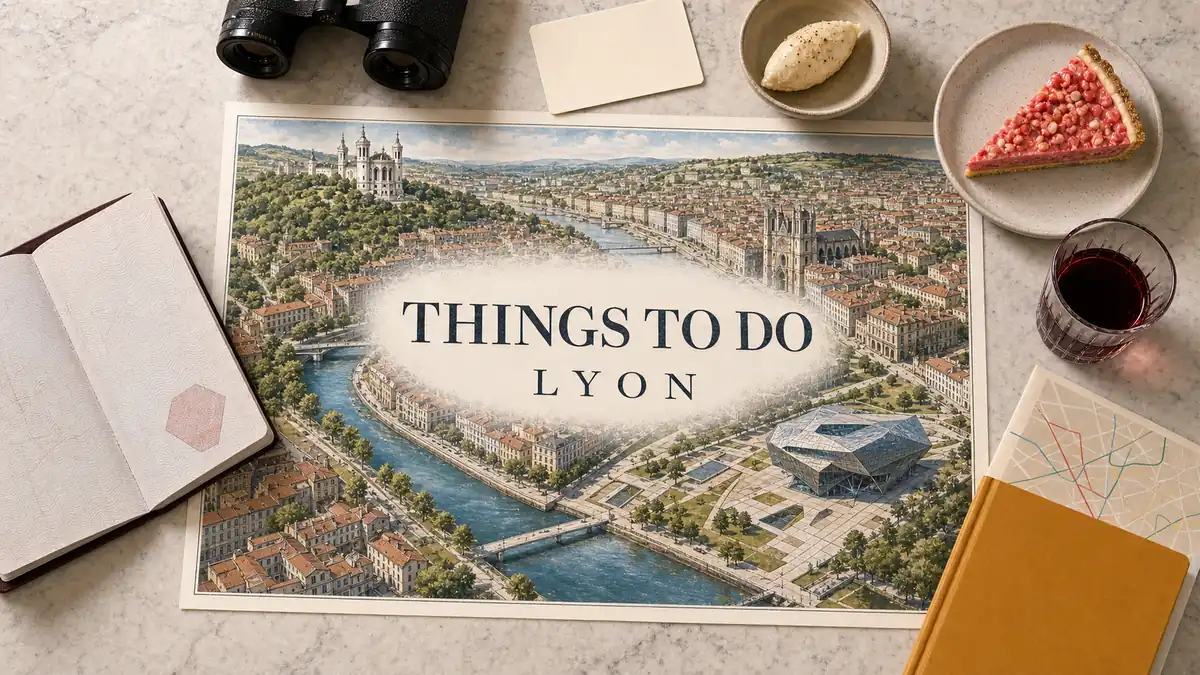
If you make time for one museum in Lyon, make it the Musée des Confluences. It stands where the Rhône and Saône meet, in a deconstructivist glass-and-steel building, holding a collection that runs across natural history, anthropology and science. The building alone justifies crossing town.
Confluences earns the trip on two counts. The architecture is a crystal-and-cloud form set on the spit of land between the rivers, and it is worth seeing from the outside even if you never go in. Inside, the collection is deliberately cross-disciplinary, arranged around big questions instead of by department, which is why it holds people who normally find museums dull.
It suits curious generalists and families best, because the displays are built to be walked through and argued about, not read at length. It suits specialists least. Anyone hoping for a deep single-subject collection will find the breadth frustrating, and that is a fair reason to spend the afternoon elsewhere. Travelers who normally avoid museums are the group most often converted here, which is the strongest thing anyone can say about a museum.
Musée Lumière is the conditional second, and the condition is strict. Cinema was invented in Lyon by the Lumière brothers, and the museum occupies the family house beside the site of their factory. To a traveler who cares about film history, standing on that ground carries an afternoon by itself. To everyone else it is a handsome villa with old equipment inside. There is almost no middle ground, which makes it one of the easier calls on this page.
Everything else is skippable on a first visit. Lyon holds fine art, textile, printing and Gallo-Roman collections, and each would be a comfortable afternoon in a city with less to eat. Here they compete with lunch, and lunch wins. Three conditions flip that verdict and only three: a return visit with the food already covered, a full day of rain, or a real specialist interest in what a particular collection holds.
Booking two of them into a short stay is where people quietly lose the trip. Those are the hours a long lunch and a hill needed, and museums are the part of Lyon most easily replicated in a dozen other European cities. The bouchon is not.
Lyon’s museum problem is not quality, it is competition. Three hours in a gallery costs you the meal that justifies the whole trip, which is why the honest answer on a short stay is one museum, not four.
Is a Lyon Food Tour Worth It?
A Lyon food tour is worth it on a first visit. It converts an intimidating food scene into a legible one in a single morning, with somebody to explain andouillette before you order it. Repeat visitors who read a French menu confidently can skip it without losing much.
What a guided version buys is legibility, not access. Bouchon cards are written for people who already know what a tablier de sapeur is, plates arrive without explanation, and the difference between a certified room and a tourist imitation is invisible from the pavement. Three versions of the decision cover almost everyone:
- A self-guided bouchon meal plus a market graze. Best for confident eaters who have read the certification rules and are happy to order blind. It is the cheapest path and the most flexible. The tradeoff is context: you get the food without the story, and the trap risk on the lanes around Place Saint-Jean is real.
- A guided food tour. Best for first-timers and short-stay travelers who want the city’s food explained while they are eating it. It buys curation, ordering help and the history behind the dishes. The tradeoff is that it spends a meal slot you could have given to a bouchon of your own choosing.
- A guided old-town and traboule walk. Best for travelers who want the passages to mean something instead of photographing a stairwell. It buys context, and the guide handles the etiquette so your group is not the one residents complain about. The tradeoff is group pace, and no solitude at all.
Working out which of the three you are takes a single question: can you read a bouchon card and predict what will arrive? If yes, you do not need a guide to eat well, and the fee mostly buys stories you could read yourself. If no, the tour repays itself at the first ordering decision, because the alternative is choosing the two dishes you already recognise and missing the point of the meal.
One caution applies to every guided version. A tour that spends its time on the lanes around Place Saint-Jean is selling you the crowded Lyon with commentary attached, which is the opposite of what this page argues for. The versions worth booking cross the river, climb a hill, or work the market counters — the test is whether the route goes where residents go.
The picking rule for this whole page is appetite first, crowds last. Grade any Lyon experience by how much eating it involves and how many people you will share it with, and the set orders itself: the certified bouchon, the market counters, the hills and murals, and only then whatever the Old Town still has to offer.
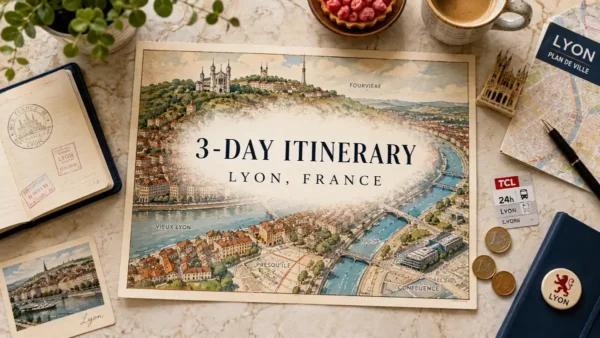
Turning that order into an actual trip is a different job, and it belongs to the itinerary pages — the 2 days in Lyon itinerary and the 3 days in Lyon itinerary both do that work.
Tours and activities
Book skip-the-line tickets, day trips and local tours with free cancellation on most activities.
You can also browse everything on getyourguide.com.
Tripstou may earn a commission if you book through this link, at no extra cost to you.
Frequently Asked Questions
Are Lyon’s traboules free and open to the public?
Free, yes — nobody sells a ticket to a traboule. Whether one is open is a separate question, because these passages run through occupied buildings and the decision belongs to the people who live there. Assume some of the doors you try will be shut, and build no plan around a specific one.
Do you need to book a bouchon in Lyon in advance?
Book if you can. Certified bouchons are small rooms with few tables, and the good ones fill at dinner, especially at weekends and during busy festival periods. Lunch is the easier service to walk into. If your trip holds one proper bouchon meal, reserve that one and keep the rest flexible.
How do you get up to Fourvière?
Two ways: the funicular from the Old Town, or a steep walk up the stair-and-ramp paths from the same side of the hill. Choose by legs, not by principle, because the view at the top is identical either way. Take the funicular with children, in heat, or with limited mobility.
What can you do in Lyon with kids?
Parc de la Tête d’Or carries a family day on its own, with a lake, botanical glasshouses and a zoo. Mural hunting works well as a walking game, and the riverbank paths are flat and pram-friendly. For food, take children to a bouchon at lunch, when the rooms are calmer.
What is the Fête des Lumières and when is it?
The Fête des Lumières is Lyon’s annual light festival, held over several nights in early December. Light installations take over the city for its duration, and the crowds it draws saturate accommodation citywide and fill restaurants. Either book far ahead to attend, or avoid the window deliberately.
Related Guides
- Lyon travel guide — where to stay, how to get around and when to go, all the logistics this page leaves out.
- 2 days in Lyon itinerary — how these experiences fit into a short weekend stay.
- 3 days in Lyon itinerary — the longer shape, with room beyond the food and the hills.
- Things to do in France — where Lyon’s experiences sit in the national picture.
- Best places to visit in France — the destination-level ranking, and how Lyon compares with Paris and Provence.
Did this guide save you time or money? Tripstou is independent and reader-funded — if you'd like to give something back, you can support the site with a crypto contribution of any size.