Most people searching for Lyon safety are not worried about danger in the abstract. They are worried about three specific things: whether the area they are about to book feels fine, whether walking back across the Presqu’île at midnight is sensible, and whether the metro is where their phone disappears. The honest answer to all three is reassuring — which is exactly where most safety pages stop being useful, handing you a numeric score that says nothing about a street, or advice generic enough to fit any city on earth.
This guide does the opposite. It names the areas, names the situations, and passes on what Lyon police, the transport operator TCL and the Lyon Tourist Office actually tell visitors. No scores, no scare stories — just where the risk sits and what to do about it.
Quick Answer
Lyon is a safe city for visitors, and violent crime affecting tourists is rare. The real risk is petty theft, concentrated where tourists and transport meet: Vieux Lyon, Bellecour, Part-Dieu and crowded metro carriages. Keep valuables zipped and in front in crowds, and take the metro or an official taxi over a long late-night walk.
Trust Layer
Tripstou safety guide for travelers deciding how safe a destination is and what precautions actually matter. Covers real risk levels, common scams, situational awareness, and protection choices.
Produced with AI assistance and reviewed by Alex Perrut, working in tourism since 2015, for the Tripstou editorial team. See our editorial process for details.
Last factual review: August 10, 2026.
Official sources consulted: France.fr, Atout France.
Key Takeaways
- Lyon reads as a safe city for visitors: the realistic risk is a stolen wallet, not a confrontation.
- Theft peaks where crowds compress: Vieux Lyon’s alleys, Bellecour on event nights, Part-Dieu’s concourse and rush-hour carriages.
- Lyon has no no-go areas for visitors — read the risk by the hour and by how empty a street has become.
- Late at night, stay on lit main routes and take the metro or an official taxi over a long walk home.
- A genuine TCL agent never asks for your PIN and never handles your card, so decline help at ticket machines.
- Travel insurance is worth buying for Lyon — medical cover and theft-claim paperwork justify it, not the city’s risk level.
Table of Contents
Lyon Is a Safe City — Petty Theft Is the Real Risk
Lyon is a safe city for visitors, with low violent-crime risk and a real but manageable petty-theft problem. That theft risk is not spread evenly across the city. It concentrates in a handful of predictable places: tourist landmarks, busy transport nodes and any crowd dense enough to hide a hand.
Pickpockets follow density. They work where people are packed close, distracted and slow to notice — the queue for the Fourvière funicular, the alleys of Vieux Lyon on a Saturday evening, Bellecour when an event empties into it, the concourse at Part-Dieu, a metro carriage at rush hour. The same street that feels lively at 8pm and deserted at 2am carries two completely different risk profiles, which is why the hour tells you more than the address does. Festivals and peak summer lift all of it, simply because they lift the density.
Lyon’s centre is a peninsula, so almost every visitor funnels through the same few bridges, squares and metro stops — which is why the theft map here looks like a scatter of dots and never like a shaded district.
Reading the city by density is also what turns the verdict into behaviour: it tells you to zip your bag before boarding a packed metro, not to cross a neighbourhood off your list. Country-level context — national scam patterns, national framing, how France reads as a whole — sits in our France safety guide. If you are still shaping the trip itself, our complete Lyon travel guide covers orientation, districts and what the city is actually like.
Is Lyon Safe at Night?
Yes, Lyon is safe at night in the areas visitors actually use. The centre stays busy and well lit long after dinner, and that ordinary foot traffic is precisely what makes it comfortable. The answer changes with the hour and with how empty a street has become, far more than with the district’s name.
Night safety in Lyon is a movement problem, not a map problem. The precautions that matter are few and boring:
- Stay on lit main routes. The quays and the big squares stay populated far longer than the side streets connecting them.
- Use the metro or tram while they are still running. Check the last departure before the evening settles in, so the decision is already made.
- After that, take an official taxi rank or a licensed ride-hailing app. A long walk home is the one choice that reliably makes a good night worse.
- Keep your phone away on emptier stretches. A lit screen in an outstretched hand is the most visible thing on a dark pavement.
- If a street has emptied out, turn back onto the busier parallel one. On the Presqu’île that is rarely more than a block away.
Quieter zones away from the centre feel less predictable once the crowds thin, and they are worth a little more attention — the area-by-area calibration comes in the next section. Etiquette and crowd-timing know-how, which is a different subject entirely, sits in our Lyon travel tips.
How safe is the nightlife around Rue Mercière?
The bar streets around Rue Mercière are safe to enjoy, and the realistic risk there is theft. Crowded terraces, bags hung on chair backs and phones left face-down on tables are the pattern that costs people their evening. Keep bags on your lap or between your feet with a strap through your arm, and treat a phone on the table as a phone already halfway into someone else’s pocket.
On drinks, ordinary discipline is enough: watch yours arrive, keep it with you when you move, and abandon anything you have lost track of. None of this is Lyon-specific anxiety. It is what any busy bar street in Europe asks of you.
Getting home after midnight
The ladder home is short: metro or tram while they run, an official taxi or licensed ride-hailing app after that, and a walk only where the route stays lit and populated the whole way. Decide which one you are using before the evening gets late — the choice is far worse to make at 2am on an empty pavement.
If you are walking, take the busier route even when it is longer. The shortcut through quiet streets saves a few minutes and removes the only thing that was protecting you, which is other people.
Which Areas Deserve Extra Caution After Dark?
Lyon has no no-go areas for visitors, so this is a question about attention, not avoidance. Vieux Lyon and the Presqu’île around Bellecour are the busy, well-lit core, and they stay comfortable late. A few pockets simply feel less predictable once the crowds thin, and those deserve a bit more awareness.
Start with the positive calibration, because it covers where you will spend most of your time. Vieux Lyon and the Presqu’île are the lower-risk heart of the city after dark: populated, overlooked, patrolled by ordinary life. Their real risk is a pickpocket in a crowd, and that risk peaks during the day and in evening crushes, never in the form of confrontation.
A few places come up often enough in visitor accounts to be worth naming, though none of them is dangerous in any meaningful sense: La Guillotière, the streets immediately around Part-Dieu and Perrache stations late at night, and the lower Rhône quays once the walkers and runners have gone. What they share is emptiness and late station churn. La Guillotière in particular is a lively, mixed, thoroughly ordinary part of the city by day, and describing it as unpredictable late is not the same as calling it unsafe.
Choosing where to base yourself is a different decision, driven by convenience and atmosphere as much as by how a street feels at midnight — our guide to where to stay in Lyon resolves that one.
Is the Lyon Metro Safe?
The Lyon metro is safe to ride, and it is also where pickpockets do most of their work. Both halves are true at once: violence on the network is rare, opportunistic theft in a packed carriage is not. It remains the sensible way to get home late, with your bag closed and in front of you.
The risk sits in the crush, not the network. Boarding and alighting are when it peaks — bodies pressed together, everyone’s attention on the doors, a bag swung round to the back where its owner cannot see it. Busier tourist corridors and the big interchange flows concentrate the same behaviour, which is a reason for ordinary alertness on a packed platform and nothing more.
Part-Dieu is the one stop where the boarding crush and the visitor-luggage flow overlap, so that is the platform worth being deliberate on.
If something does go missing on the network, report it fast. TCL asks that transport incidents be flagged quickly, while the relevant footage can still be reviewed — the sooner it is logged, the more there is left to look at. How the metro, trams and funiculars actually connect, including the climb up to Fourvière, is covered in our Lyon transport guide.
Common Scams in Lyon
Scams in Lyon are few, and they follow one recognisable structure: distraction, fake authority, or the too-helpful stranger. Once you can name the shape, the individual variations stop working on you. The short list below covers what visitors actually run into, where it tends to happen, and what to do in the moment.
- The fake transport agent. Someone approaches near a ticket machine or on a platform, presents themselves as transport staff, offers to help you buy or validate a ticket, and steers the conversation towards your bank card. Lyon police and TCL both make the same point publicly, and it ends the approach cleanly: a genuine TCL agent never asks for your PIN and never handles your card. Keep the card in your own hand, decline help at the machine, and walk to a staffed counter if you are genuinely stuck.
- Distraction approaches. A petition, a map, a dropped item, a spilled drink, a conversation that comes too close — anything that puts something in your hands and your eyes somewhere other than your bag. It clusters at Bellecour, in the Vieux Lyon alleys and on busy café terraces. Two people usually run it, one talking and one collecting. Step back, put a hand on your bag, say no clearly and keep walking.
- ATM shoulder work. Machines on busy pedestrian streets attract watchers who read your PIN over your shoulder, then engineer a bump or a question at the moment the cash appears. Prefer a machine inside a bank lobby during opening hours, cover the keypad with your free hand, and put the cash away before you turn from the machine.
Anything beyond this short list tends to be a national pattern that turns up in any large French city, not a Lyon speciality.
Is Lyon Safe for Solo Female Travelers?
Lyon works well for solo female travelers, with the same petty-theft caveats that apply to everyone. The verdict does not change by traveler type here; it just gets sharper about evenings and empty stretches. The busy, walkable centre is a genuine advantage, because there is usually someone around.
Evenings are where the calibration sharpens. The centre’s real asset for a solo traveler is that it stays populated — the Presqu’île, the quays and the streets around Bellecour carry ordinary foot traffic well past dinner, so you are rarely the only person on a street. Plan the return leg before you go out, keep a charged phone, and take the busier way back even when it is longer.
Bar and club contexts ask for the same drink discipline described earlier, and there is no reason to treat Lyon as a special case. Unwanted attention happens here as it happens anywhere; firm disengagement and moving towards a busier spot handles nearly all of it. If something more serious happens, 3919 is the national helpline for women experiencing violence, and the full set of emergency numbers and the reporting sequence sits in the next section.
Emergency Numbers and What to Do If You’re Robbed
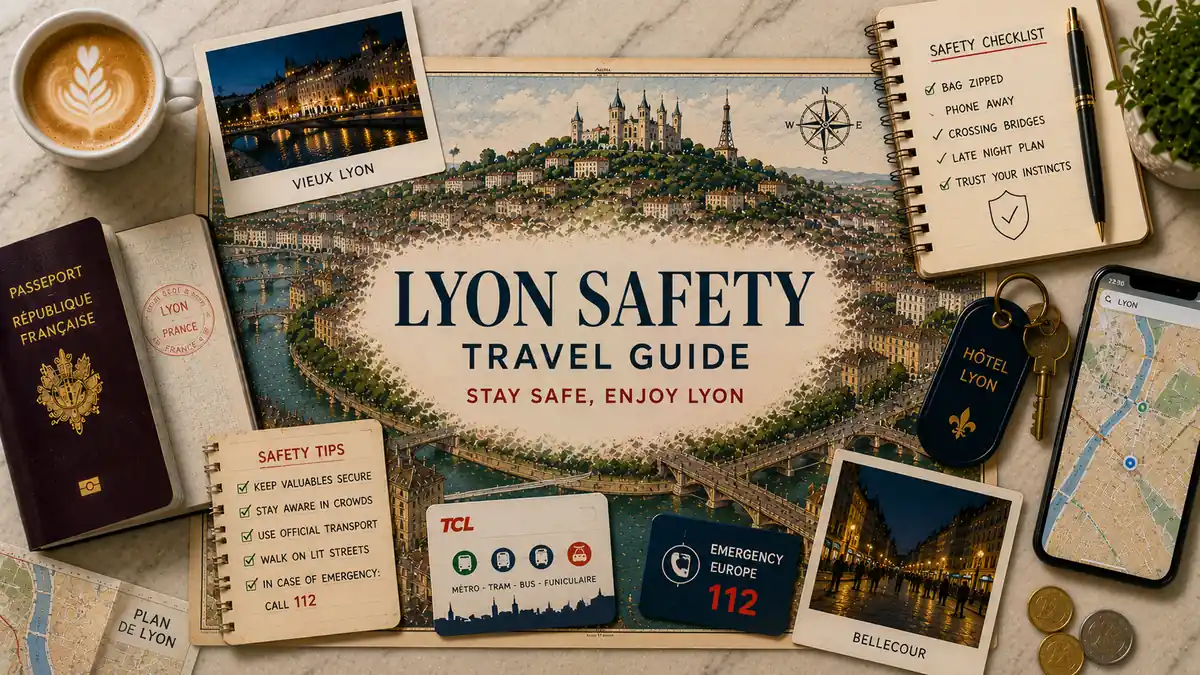
Call 112 for any emergency in Lyon — it works everywhere in Europe and from any phone. A theft is not an emergency in that sense; it becomes recoverable paperwork the moment you report it properly. The numbers below, and the reporting sequence under them, are the only act-now facts you need.
- 112 — all emergencies, anywhere in Europe.
- 17 — police.
- 15 — SAMU, medical emergencies.
- 18 — fire and rescue.
- 114 — SMS line for deaf and hard-of-hearing users.
- 3919 — national helpline for women victims of violence.
Reporting a theft has three steps. Call 17 in the moment if the thief is still nearby or you feel unsafe. Then file a plainte — the formal police report — at a commissariat; that document is what your insurer, your bank and your embassy will ask for. If it happened on the metro, tram or bus, tell TCL quickly so the relevant footage can still be reviewed.
Local addresses and non-urgent switchboard numbers change often, so ask rather than rely on a printed one: your accommodation or the tourist office on Place Bellecour can point you to the nearest commissariat. Cancel bank cards as soon as you can, file the report next, and note the incident details while they are fresh.
Do You Need Travel Insurance for Lyon?
Travel insurance is worth buying for Lyon, though danger is not the reason. What tips the decision is medical cover and the paperwork side of a theft claim, not the city’s risk level. For most short trips it is a small cost that buys a clean route through the annoying scenarios.
Insurance earns its keep in three situations. Medical treatment abroad is the heaviest — a routine clinic visit is manageable, but anything involving admission, surgery or repatriation is not a bill you want to meet alone. Theft claims are the second, and this is where the plainte from the previous section matters: without a report number, a stolen laptop is a story, and with one it is a claim. Cancellation is the third, and it matters in proportion to how much of the trip you prepaid.
It matters less when cover you already hold reaches France. Some health arrangements and some card issuers include medical or cancellation protection, so check what you have before paying twice for it. Where insurance sits inside the overall budget is a cost question, handled in our Lyon trip cost guide; this page resolves only the yes or no.
With the safety side settled, the next decision is route and pacing — our 2-day Lyon itinerary and 3-day Lyon itinerary pick up from here.
Travel medical insurance
SafetyWing Nomad Insurance provides travel medical coverage designed for travelers and digital nomads, with flexible Monthly and Annual plans.
Check Nomad Insurance coverage and current pricing →
New Nomad Insurance Essential members can get 8 weeks of electronic theft coverage free with reward code TRIPSTOU8.
Apply the reward before creating your SafetyWing account by looking for the pink camera icon on the Nomad Insurance page.
Tripstou may earn a commission if you purchase through this link, at no extra cost to you.
Frequently Asked Questions
Is Lyon safer than Paris?
Both cities are safe for visitors, and the honest answer is that the difference is scale, not danger. Lyon is smaller and less heavily touristed, so the crowds that pickpockets work are fewer and more concentrated. The precautions are identical either way: bag closed, phone away, busy routes late.
Is La Guillotière dangerous?
No — La Guillotière is a lively, mixed, ordinary part of Lyon, not a dangerous district. It is busy and unremarkable by day and through the evening. What visitors report is that it feels less predictable late, once the crowds thin, so it asks for the same attention any emptying street does.
Is it safe to walk along the Rhône quays at night?
Yes, where the quays are busy and lit — which covers most of the evening. The lower riverside path is a different proposition once the walkers and runners have gone: long, quiet and poorly overlooked. Prefer the main street level late at night, and move up if a stretch empties out.
Is the Part-Dieu station area safe?
Yes, with ordinary station-node caution. Part-Dieu is a theft context, not a violence one: heavy footfall, visible luggage and distracted arrivals make it one of the city’s busier pickpocket spots. Keep bags closed and in front on the concourse and platforms, and treat the surrounding streets as quieter and less predictable late.
Is Lyon safe during the Fête des Lumières crowds?
Yes — the festival is safe and hugely popular, though it creates the densest crowds of the Lyon calendar. Those crowds pack the Presqu’île and Vieux Lyon shoulder to shoulder, which is exactly the condition pickpockets need. Carry a zipped bag in front, leave the day pack behind, keep your phone pocketed.
Related Guides
- Lyon travel guide — orientation, districts and what the city is actually like.
- Where to stay in Lyon — which area to base yourself in and why.
- Getting around Lyon — how the metro, trams and funiculars connect.
- Lyon travel tips — etiquette, bouchon and traboule know-how, crowd timing.
- 2 days in Lyon — a tight route for a short first visit.
- 3 days in Lyon — the fuller version with room to slow down.
- Lyon trip cost — what a trip realistically adds up to.
- Is France safe? — the national picture behind the city verdict.
Did this guide save you time or money? Tripstou is independent and reader-funded — if you'd like to give something back, you can support the site with a crypto contribution of any size.