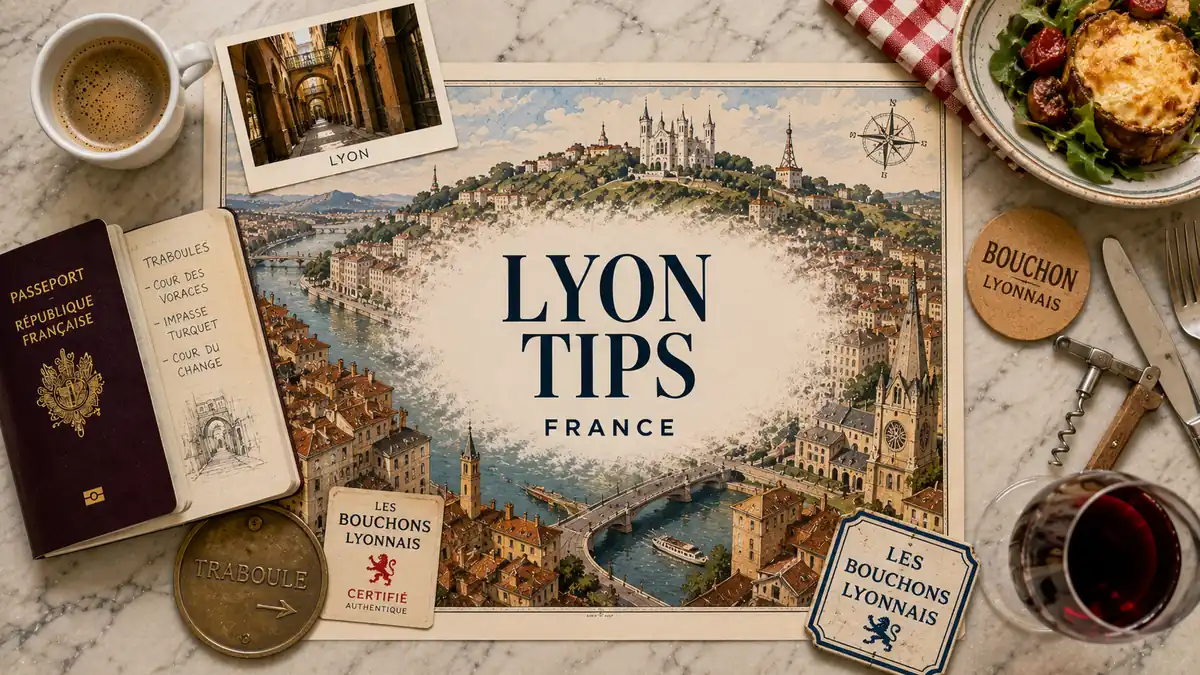
Your trip to Lyon is booked. What decides whether it lands is conduct — where you eat, and how you move through Vieux Lyon and its covered passageways. Lyon runs on two systems that exist almost nowhere else in France. The first is the bouchon: a certified, tightly defined kind of restaurant with its own ordering rituals, sitting in a district thick with imitations. The second is the traboule: passageways cutting through private Renaissance buildings, open to visitors only because residents agreed to tolerate them. Get either wrong and the day sours quietly — a mediocre expensive lunch, a locked door, a resident who stops opening theirs. Most first-timer disappointment in Lyon traces back to one of those two systems, plus bad timing inside Vieux Lyon. This page covers the mechanics of both, the crowd logic around them, and the mistakes that make a good city feel flat.
Quick Answer
Eat in certified bouchons away from the Rue Saint-Jean strip, and treat traboules as private homes you are visiting. Timing changes everything else: Vieux Lyon empties on weekdays, and dinner reservations are the standard habit. Book bouchon tables ahead, walk the old town early or midweek, and expect early December to be a different city.
Trust Layer
Tripstou planning guide for travelers resolving one travel decision. Covers the main variable, traveler context, and practical tradeoffs.
Produced with AI assistance and reviewed by Alex Perrut, working in tourism since 2015, for the Tripstou editorial team. See our editorial process for details.
Last factual review: August 10, 2026.
Official sources consulted: France.fr, Atout France.
Key Takeaways
- Check the window for the “Les Bouchons Lyonnais” certification sticker before the menu — it is the one reliable bouchon signal.
- Book bouchon dinners before you arrive; small rooms, local demand and weekends leave almost nothing for walk-ins.
- Treat traboules as private hallways: enter quietly, keep moving, photograph the architecture and never linger in a resident’s courtyard.
- A locked traboule door is a decision, not an obstacle — walk to the next one and lose ten minutes.
- Visit Vieux Lyon early or midweek, and save the traboules for mid-afternoon once organised tour groups have cleared.
- If your trip touches early December, book accommodation and restaurant tables months ahead — the festival reshapes the whole city.
Table of Contents
What Do First-Time Visitors Get Wrong in Lyon?
First-timers get Lyon wrong by treating it like a generic French city: eating on instinct and winging the logistics. The errors are almost never about which sights they chose. They are conduct and assumption errors, and every one of them has a fix that costs nothing.
Two of those mistakes are big enough to own their own sections below. The first is eating wherever the frontage looks charming in Vieux Lyon, which is precisely the behaviour the tourist strip is built to capture. The second is walking into a traboule as if it were a public arcade, when access to those passageways depends entirely on visitors behaving like guests. Both are covered in full further down.
The remaining mistakes are cross-trip assumptions, and each has a reason attached:
- Arriving with no shape to the days. Lyon’s core is compact but split across two hills and a peninsula, so an unplanned first day disappears into climbing and doubling back. Decide the shape before you land — see what fits into 2 days in Lyon, or the extra breathing room in a 3-day Lyon itinerary.
- Treating the Lyon City Card as an automatic buy. The card exists and suits some trips, but whether it earns its place depends on how many days you have and what you actually plan to enter. That maths belongs with Lyon trip costs.
- Going complacent in the busiest districts. Dense pedestrian streets, funicular platforms and festival crowds are where pockets get worked in any city, and Lyon is no exception — the district-level detail sits in our guide to how safe Lyon is.
- Assuming everything resolves on arrival. Restaurant tables, traboule access and quiet streets are all things Lyon rations by timing, and none of the three can be fixed at the moment you want them.
Lyon punishes improvisation in one narrow way: the food. You can wing the transport and recover the same afternoon. A badly chosen lunch in Vieux Lyon is the meal you came here for, and there is no second attempt at it on a short trip.
How to Spot a Real Bouchon
The “Les Bouchons Lyonnais” certification sticker in the window is the one signal that separates real bouchons from imitators. Anyone can print the word bouchon on an awning; the label is awarded, and it is displayed where you can see it before you sit down. Check the window before the menu.
Everything else is supporting evidence, and it reads fast once you know what you are looking at. A real bouchon has a short handwritten chalkboard that changes, because the kitchen cooks what it bought. The room is small and the tables are close, usually under red-and-white checked cloths. The menu leans hard on pork and offal — quenelle, andouillette, tablier de sapeur, salade lyonnaise — and it does not apologise for it or translate it into four languages with photographs.
Density is the tell on Rue Saint-Jean. Along that stretch of Vieux Lyon, almost every frontage advertises itself as a bouchon, with laminated picture menus outside and someone at the door inviting you in. Authentic bouchons in the same district do not need any of that, because their tables are already spoken for. The trap is not the street itself — it is the concentration of self-declared bouchons on it, which is statistically impossible and visibly so.
The checkable signals, in the order you can read them from the pavement:
- Certification sticker visible in the window.
- Handwritten chalkboard, short, and clearly rewritten recently.
- Small room, close tables, checked cloths.
- Pork and offal dominating the dishes, with no photographs anywhere.
- No host outside working the passing crowd.
A restaurant that has to tell you it is a bouchon usually is not one. The certified rooms assume you already know what they are, which is why their signage is so much quieter than their neighbours’.
Do You Need to Book Restaurants in Lyon in Advance?
Yes — book bouchon dinners in advance, because the rooms are small and locals fill them. Reservation is the standing habit in Lyon, and weekends and holidays tighten it further. A Saturday evening walk-in in Vieux Lyon usually ends at whichever table the tourist strip had left.
The habit exists because of the format. A bouchon is a handful of tables in one room with a kitchen sized to match, so a single walk-in group of four can be the difference between a full service and a turned-away evening. Owners plan the chalkboard around the covers they expect. There is no overflow room.
Pressure is not constant across the week. Weeknight lunches are the easiest service to walk into, and a day or two of notice covers most weeknight dinners. Weekends, public holidays and the early-December festival period need considerably more lead time, and the best-regarded rooms fill first regardless of season. If your trip includes exactly one Saturday, that is the meal to book before you fly.
Booking also protects the meal itself. A kitchen that knows its number of covers cooks to the chalkboard; the table that appeared at the door gets whatever survived the evening. The reservation is not only about getting in — it is about eating the food the room is known for.
What Do You Actually Order in a Bouchon?
Start with a kir, order from the chalkboard, and expect generous, offal-leaning plates served without hurry. A bouchon meal is a fixed ritual more than a menu decision, and knowing its shape removes most of the awkwardness. Nothing about it requires French.
The kir opens the meal almost by default — white wine with blackcurrant liqueur, drunk while you read the board. The board is the real menu: if a printed multilingual card arrives first and the chalkboard is decorative, you have already learned something about the room. Portions are built for people who worked physically and walked home, so the traditional run of starter, main, cheese and dessert is generous to the point of being optional. Two courses is a fair reading of it.
Service is unhurried by design. The table is yours for the evening, plates arrive when they are ready, and the bill comes when you ask for it and not a minute earlier. Waiting is the format working correctly. No tip is demanded in a bouchon and none is expected — the nationwide conventions sitting behind that, including service charges, greetings and how much people actually leave, are covered in our France travel etiquette and tipping norms.
The conventions in short:
- Kir first, read the chalkboard while you drink it.
- Order from the board, not from anything laminated.
- Two courses is enough for most people; four is the tradition.
- Expect pork, offal and freshwater fish to lead the list.
- Ask for the bill — it will not appear on its own.
Portion size is what first-timers misjudge, not the offal. People arrive braced to be adventurous and leave defeated by volume, which is why booking the big bouchon meal for a day you are walking a lot is better planning than it sounds.
How to Visit the Traboules of Lyon
Roughly 40 of Lyon’s several hundred traboules are open to the public, on the condition that visitors stay quiet. These are working residential buildings in Vieux Lyon and on the Croix-Rousse slopes, with residents living behind every door. Access is real, and it is conditional.
That conditionality is the whole subject. Nothing about a traboule is a monument with an opening time and a ticket desk; it is a shortcut through a courtyard that people call home, made available by an arrangement that both sides can withdraw from. Understanding that one point resolves almost every question a visitor has.
Finding an open traboule
Signage is inconsistent, so plan for a search rather than a checklist. Some accessible doors carry a small plaque; many carry nothing that reads as an invitation from the street. Public access rests on an agreement between the city and the buildings’ residents, and under that agreement the accessible traboules are in principle open through the working day, between 08:00 and 19:00.
In practice, doors are locked more often than that principle implies. Residents lock them when groups have been loud, when litter appears, or simply because someone secured the building on their way out. Treat any list of traboules as a set of candidates and not as guaranteed entries, and build a loop with several of them so a locked door costs you nothing.
What are the rules once you’re inside?
Enter quietly, keep moving, and leave through the far side. A traboule is a passage, and using it as one is the entire etiquette. The rules are short and they are the reason the doors are open at all:
- Talk quietly or not at all — stone stairwells amplify everything.
- Do not linger in the courtyard; standing in one is standing in somebody’s hallway.
- Keep stairs and doorways clear, because residents are using them while you are there.
- Photograph the architecture; leave windows, doormats, laundry and residents out of frame.
- Do not prop doors open, and close behind you what you opened.
- Go through in small groups, not as a block of a dozen people.
What to do at a closed door
Walk away. A locked traboule door is a resident exercising their side of the arrangement, and it is not a puzzle, a mistake or an invitation to try harder. Do not push it, do not press the intercom, and do not follow a resident through when one opens it with a key.
The cost of getting this wrong is not yours to pay — it lands on the next visitor, and on the building’s willingness to stay in the scheme at all. Move to the next door on your list and lose ten minutes.
Every locked door in Vieux Lyon was open once. The access you get is a direct product of how the last group behaved, which makes silence the entry fee for a free attraction.
How Do You Avoid the Crowds in Vieux Lyon?
Go on weekdays and early in the morning; Vieux Lyon’s crowds are a schedule problem, not a geography problem. The same handful of streets are calm early and impassable by midday on a Saturday. Shifting the hour does more than finding an alternative street.
Guided tours set the rhythm of the district. They arrive in the mid-morning and move as blocks, which means the streets are busiest when the tours are between stops and noticeably calmer while they are inside the passageways. By mid-afternoon most organised groups have finished, and that is the window when traboule doors are least likely to have a queue in front of them. Early morning is the other clean slot: the streets belong to residents and deliveries, and the district looks like the Renaissance quarter it actually is.
The working rules:
- Weekdays over weekends, in every season.
- Early morning for empty streets and photographs.
- Mid-afternoon for traboules, once organised tours have cleared.
- Avoid the late-morning to lunchtime band on any Saturday or Sunday.
Two adjacent decisions shape this and are resolved elsewhere. How you move between the riverside, the hill and the peninsula — including the Fourvière funiculars — is its own choice, covered in getting around Lyon by public transport and funicular. Season-level timing and the wider picture of the city sit in our Lyon travel guide.
Time your visit against the tours, not against the clock. When the groups are inside the traboules the streets breathe, and when they break for lunch the streets fill — so decide which of the two you came for and go opposite.
What Is Lyon Like During the Fête des Lumières?
For four evenings in early December, around the 8th, Lyon hosts Europe’s biggest light festival. The city centre closes to traffic during festival hours and fills with a crowd unlike anything else in Lyon’s year. Plan around it deliberately, in either direction.
In practice, the pedestrianised centre means you walk everywhere and you walk slowly, in dense moving crowds, after dark and usually in the cold. Accommodation pressure across the whole city is extreme during that window, and rooms go months in advance — if the festival is why you are coming, settle where to stay in Lyon and book the base long before you fix anything else. Restaurant tables follow the same pattern, so a bouchon reservation stops being a good habit and becomes a requirement.
If you are travelling in early December for unrelated reasons, plan on the city not behaving normally: museums busy, dining booked out, and a quiet morning in Vieux Lyon considerably harder to find. Neither version of the trip is a bad one. They just need different assumptions.
Early December splits visitors into two groups: those whose trip is the festival, and those whose trip collides with it. Both book far earlier than they would any other week of the year.
Frequently Asked Questions
What hours are the traboules open?
Publicly accessible traboules are open in principle from 08:00 to 19:00, under the city’s agreement with residents. There is no ticket desk and no posted schedule to check, so doors are frequently locked inside those hours. Plan a loop of several candidates instead of relying on one.
Can you see the traboules without a guided tour?
Yes. Traboules are free to walk through on your own, and no guide or ticket is required for the publicly accessible ones. Signage is inconsistent, so going self-guided means accepting that some doors will be locked. A guide adds interpretation and local knowledge; it does not unlock doors residents have closed.
Do you tip in a bouchon?
No. Bouchon staff neither expect nor ask for a tip, and leaving nothing is entirely normal. Nobody comments and nobody chases you. If the meal was good, saying so to the person who cooked it carries further in a small owner-run room than anything you leave on the table.
Do I need to book a bouchon on a weekend?
Yes. Weekend dinner service in a certified bouchon is the hardest table in Lyon to walk into, so book before you arrive, not on the day. If you missed the window, take a weekend lunch instead — the same kitchen, the same board, and far less pressure on the room.
How do I get mobile data when I arrive in France?
Buy an eSIM before you fly and activate it when you land. It saves hunting for a shop on arrival and starts working as soon as you switch it on. The real choice is which plan and how much data — the options are compared in our guide to the best eSIM for France.
What shoes should I wear in Lyon?
Wear shoes you can walk hills and cobbles in. Vieux Lyon’s lanes are cobbled and uneven, and the climbs to Fourvière and up to the Croix-Rousse are steep enough to punish thin soles. Grip matters more than warmth — wet cobblestones are the actual hazard, not the distance.
Related Guides
These pages resolve the decisions this guide deliberately routes outward.
- Lyon travel guide — the city overview, districts and seasonal context.
- 2 days in Lyon itinerary — what realistically fits into a short first visit.
- 3-day Lyon itinerary — the slower version with room for the hills and the traboules.
- Getting around Lyon — metro, tram, bus and the Fourvière funiculars.
- Lyon trip costs — budgeting the trip and whether the City Card earns its place.
- Where to stay in Lyon — choosing a base by district and trip type.
Did this guide save you time or money? Tripstou is independent and reader-funded — if you'd like to give something back, you can support the site with a crypto contribution of any size.