You have an Italy trip booked and one purchase left to decide: travel insurance, what kind, and how much of it. The answer is not the same for every reader, and it does not depend on which company you choose. It depends on two things you already know — whether a Schengen visa application is part of your trip, and what cover you happen to hold already through a health plan, a card, or an employer. This guide works through that in order: whether cover is legally required for you, which coverage categories carry real weight on an Italian trip, how much medical and evacuation cover to think in terms of, what a policy will not pay for, and what to do on the ground to keep a claim viable. It selects between coverage types. It names no insurers, ranks no policies, and quotes no prices.
Quick Answer
Italy requires no travel insurance from visa-exempt visitors; Schengen short-stay visa applicants must hold at least €30,000 in medical cover. Everyone else is deciding on emergency medical and repatriation cover, because visitors without reciprocal healthcare entitlement are billed for treatment in Italy. Buy medical and evacuation cover first; add cancellation cover for prepaid, high-value trips.
Trust Layer
Tripstou selection guide for travelers choosing between multiple places. Covers selection criteria, traveler fit, and trip value.
Produced with AI assistance and reviewed by Alex Perrut, working in tourism since 2015, for the Tripstou editorial team. See our editorial process for details.
Last factual review: July 28, 2026.
Official sources consulted: italia.it, enit.it.
Key Takeaways
- Italy requires no travel insurance from visa-exempt visitors, so for most travelers buying cover is a financial decision, not a legal one.
- Schengen short-stay visa applicants must hold at least €30,000 of medical cover, valid across the Schengen area for the entire stay.
- Buy emergency medical and evacuation cover first: visitors without reciprocal healthcare entitlement are billed for the treatment they receive in Italy.
- Check the cover you already hold — health plan, payment card, employer scheme — before you buy anything new.
- Commonly quoted USD coverage minimums are marketplace convention, not law — set your level from repatriation distance, trip length, age and activity.
- For theft or treatment in Italy, keep the written police report and the itemized invoice — claims are assessed on evidence.
Table of Contents
Do You Need Travel Insurance for Italy?
Travel insurance is not required to enter Italy unless you are applying for a Schengen visa. Visa-exempt visitors face no legal insurance obligation at the border. Visa applicants do, as part of the application itself. Everyone else is making a financial decision, and it turns on what cover you already hold.
Three facts about your own situation settle most of this page. The first is whether your trip involves a Schengen visa application, because that is the only circumstance in which an insurance condition attaches to you by rule. The second is what cover you already hold — through a domestic health plan, a payment card, an employer scheme, or a European healthcare card if you are entitled to one. The third is the shape of the trip itself.
Visa applicants have the least room to improvise. Their cover has to satisfy a stated requirement and be documented in the format their consulate asks for, which makes it a compliance task with a deadline. Everyone else is weighing exposure against premium, and the exposure is mostly medical.
Trip shape decides the rest. A four-night city break with a refundable hotel and a cheap flight carries little cancellation exposure. A two-week trip with prepaid tours, a non-refundable villa, and three connecting flights carries a lot. Age and activity plans push the same lever.
The three sections that follow take these in order: the visa requirement, the cover you may already have, and the coverage categories worth paying for. Nothing is resolved here. This section only tells you which of the next ones is yours.
Schengen Visa Applicants Must Hold €30,000 in Medical Cover
Schengen short-stay visa applicants must hold travel medical insurance of at least €30,000. The policy must cover medical expenses, hospitalization and repatriation. It must be valid in all Schengen countries and remain valid for the entire stay. This condition applies to the visa application, not to entry generally.
Documentation format is set by the consulate handling your application. Consulates differ. Some itemize the four benefits the policy must show and state their own figure in local currency; others require a letter from the provider confirming the policy is valid across the Schengen area, and will not accept an insurance card on its own. Treat €30,000 as the Schengen-wide floor that applies to visa applicants, then check the figure and paperwork format your own consulate publishes before you buy. Everything else about the visa — who needs one, which documents, how long it takes — belongs to the full Italy visa requirements guide.
What Cover You Might Already Hold, and Where It Stops
Check what you already hold before you buy — existing cover usually helps partially and stops short of the rest. Most travelers carry some fragment of protection through a health plan, a payment card, or an employer scheme. None of it is guaranteed to reach Italy, and the only way to know is to read the terms you hold.
The check takes an afternoon and it changes what you should buy. Work through this list before you compare a single policy:
- Your domestic health plan’s overseas and out-of-network terms
- A European Health Insurance Card, if you are resident in the EU, EEA or Switzerland
- The UK Global Health Insurance Card, if you are a UK resident
- Travel benefits attached to the payment card you booked with
- Employer, university, or membership-scheme travel cover
Read each one for the same three questions: whether it applies outside your country of residence, whether it pays a provider directly or reimburses you after you have paid, and whether it includes repatriation. Repatriation is where partial cover runs out. It is the benefit that domestic plans, payment cards, and public entitlements most consistently leave to a travel policy.
Does Your Home Health Insurance Work in Italy?
Many domestic health plans do not travel, and the ones that do usually change shape at the border. Some cover emergencies abroad at a reduced level, some cover nothing outside their national network, and almost none cover medical repatriation. Your plan document is the only authority on which of those applies to you.
The practical mechanism matters as much as the wording. Private clinics and many providers in Italy expect payment at the point of care, and you claim the money back afterwards instead of having the bill settled for you. That makes the itemized receipt — the fattura — the document your claim depends on. Ask for it before you leave the building.
Does EHIC or GHIC Cover You in Italy?
The European Health Insurance Card covers residents of the EU, EEA and Switzerland for state-provided healthcare in Italy’s public system, and nothing beyond it. For those same EU, EEA and Swiss residents, the card does not cover private healthcare, does not cover rescue or repatriation, and does not cover planned treatment arranged in advance. An EU, EEA or Swiss resident using the card in Italy pays the same patient charges an Italian resident would pay. UK residents hold the Global Health Insurance Card instead, the post-Brexit replacement, and should check its stated scope with the UK service that issues it. Neither card is insurance, and travelers resident outside those countries — including US, Canadian, Indian and Australian readers — hold neither.
Which Coverage Categories Actually Matter for an Italy Trip
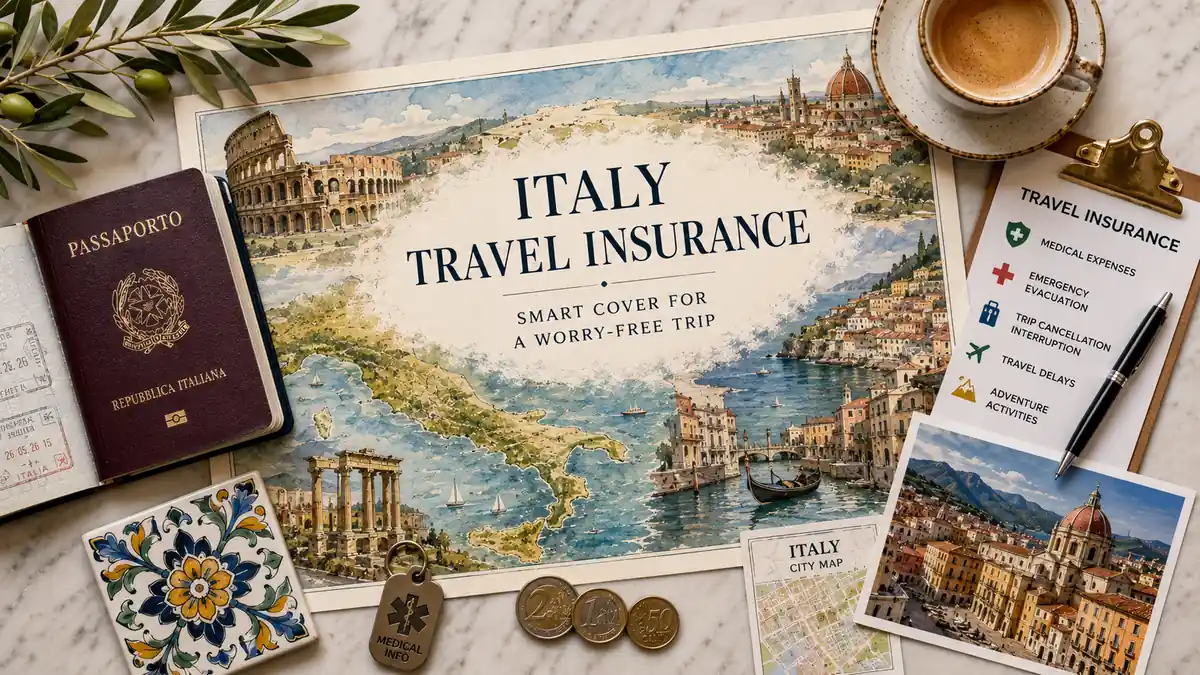
Emergency medical and evacuation cover matters most for Italy; cancellation and baggage cover follow. That order reflects what a bad day actually costs: a hospital admission and a medically supervised flight home dwarf a lost suitcase. Inclusions and limits vary by policy, and the certificate is the authority on both.
Three categories carry the weight on an Italian trip. Each is described below as what that type of cover is generally for — never as what any particular policy includes, since that is set by the certificate you sign.
Emergency Medical and Evacuation Cover
Emergency medical and evacuation cover pays for treatment you did not plan and transport you cannot arrange yourself. It sits at the top of this list because it is the only category whose worst case is open-ended. A broken ankle on a Dolomites trail, a cardiac event in a hilltop town, an air ambulance home: these are costs no one can size in advance. Trip cancellation caps out at what you prepaid. Medical exposure does not.
What separates this category from the others is the evacuation half, which most travelers skim past. Medical cover pays for the hospital. Evacuation cover pays to move you — from a rural clinic to a hospital equipped for your condition, or from Italy to your home country under medical supervision. Those are separate benefits with separate limits on most policies, and the certificate states each one.
Pick this if: you have no confirmed, portable cover for emergency treatment and repatriation from Italy.
Trip Cancellation and Interruption Cover
Trip cancellation and interruption cover protects money you have already committed and cannot get back. It earns a place on an Italy trip because Italian itineraries tend to be prepaid: timed museum entries, high-speed train tickets bought early for the cheap fare, an agriturismo held with a non-refundable deposit. The larger that committed share, the more this category is worth to you.
Its defining feature is timing. This cover only has value while the risk is still in the future, and buying after a disruption is already visible does not reach backwards to cover it. A strike announced, a storm forecast, a diagnosis received — once an event is known at the point of purchase, it sits outside the cover by design. That is why the buying window matters more here than in any other category.
Pick this if: your non-refundable prepaid spend is large enough that losing it would materially hurt.
Baggage, Theft and Personal Property Cover
Baggage, theft and personal property cover reimburses possessions that are stolen, lost in transit, or damaged. It has a place on an Italy trip because petty theft in crowded cities is the problem travelers report most, which our guide to Italy safety covers in full. Here, theft is a paperwork problem.
What makes this category distinct is that the claim is decided at the moment of the incident, long before you fill in a form. A stolen bag needs a written police report filed in Italy, and insurers typically require one before they will assess a theft claim. Take the report before you leave the country; reconstructing it from home is far harder. Valuables usually sit under separate sub-limits, and property left unattended is commonly excluded outright — both stated in the certificate rather than assumed.
Pick this if: you are traveling with camera gear, a laptop, or other kit worth more than your policy excess.
Of the three, evacuation is the one travelers underweight, because Italy feels close to home. But a lift off a mountain trail or a transfer from a small island is a logistics problem, and logistics is what the evacuation half of a policy exists to pay for.
Categories, not policy terms — the certificate you sign sets the actual inclusions and limits.
| Coverage category | Who it matters most for | What it typically does not do | What the claim hinges on |
|---|---|---|---|
| Emergency medical and evacuation | Travelers without portable cover for treatment abroad | Typically excludes planned or elective treatment abroad | Prompt insurer notification and itemized medical receipts |
| Trip cancellation and interruption | Travelers with large prepaid, non-refundable bookings | Typically excludes events already known at purchase | Proof of prepaid costs and the cancellation reason |
| Baggage, theft and personal property | Travelers carrying valuable electronics or camera gear | Typically excludes unattended property; sub-limits vary by policy | A written police report filed while in Italy |
How Much Medical and Evacuation Cover to Buy for Italy
Only Schengen visa applicants face a legal minimum; everyone else is choosing against convention, not a rule. The numbers you see quoted on comparison sites are seller conventions, and they are not derived from Italian or European law. Set your level from your own exposure: repatriation distance, trip length, age, and activity risk.
The legal floor. One figure on this page carries legal force, and it binds a single group: Schengen short-stay visa applicants must hold at least €30,000 of medical cover, on the terms set out earlier in this guide. It is a minimum for a visa application. Visa-exempt travelers have no floor to clear.
Marketplace convention. Insurance marketplaces and sellers commonly steer travelers toward figures in the region of USD 50,000 of medical cover and USD 100,000 or more of medical evacuation cover. Those numbers are a selling convention published by the marketplaces that quote them — not a legal threshold, not a medical standard, and not a Tripstou recommendation. They are useful only as a signal of how large the evacuation side of the exposure can get.
What should actually set your number is your own exposure, and four things drive it. Repatriation distance comes first: getting you home under medical supervision scales with how far home is. Trip length raises the odds that something happens at all. Age tends to raise both the likelihood and the complexity of treatment. Activity risk — skiing in the Alps, via ferrata in the Dolomites, diving off Sardinia — changes both the chance of an incident and the difficulty of reaching you.
A traveler flying home to Melbourne carries a different evacuation exposure from a traveler driving home to Lyon, even though both are standing in the same Italian hospital. Copy the reasoning, not the number.
Medical-Only or Comprehensive: Which Fits Your Italy Trip?
Medical-only cover suits short, low-cost trips; comprehensive earns its price on prepaid, high-value ones. The dividing line is how much money you have already committed and cannot recover. Add trip length, your age, activity plans, and the number of connections, and the answer usually becomes obvious.
Three options cover almost every Italy trip:
- Medical-only cover — suits short city breaks with refundable or low-value bookings, and travelers whose main worry is a hospital bill. Tradeoff: nothing comes back if you cancel, and delays and baggage are on you.
- Comprehensive cover — suits multi-week trips, prepaid tours and villas, older travelers, and anyone with connecting flights. Tradeoff: you pay for benefits you probably will not claim, and the cancellation half is priced against the trip value you declare.
- Annual multi-trip cover — suits travelers making three or more European trips a year, with Italy as one of several. Tradeoff: per-trip duration caps apply, and a long Italian stay can fall outside them.
Most Italy trips land on comprehensive. The typical Italian itinerary is booked months ahead, involves at least one internal train or flight, and carries timed-entry tickets that are rarely refundable — which is exactly the exposure the cancellation half is priced for. Medical-only is the right call when your bookings are genuinely refundable or cheap enough to write off.
Trip length is the wrong pivot. The share of the trip you have already paid for is the variable that flips this decision: two travelers on identical two-week Italy trips reach opposite answers when one prepaid everything and the other booked refundable. Count your unrecoverable spend before you shop.
What Drives the Cost of Travel Insurance for Italy?
Four variables set the price: your age, the length of the trip, the total trip value you declare, and the coverage level and deductible you choose. Age is the steepest driver. Declared trip value drives the cancellation half of the premium almost on its own, which is why a medical-only quote and a comprehensive quote for the same traveler can look nothing alike.
Raising the deductible lowers the premium and moves the first slice of any claim onto you. Adding a pre-existing-condition waiver, adventure-activity cover, or cancel-for-any-reason cover raises it, and each is sold on its own terms. Marketplaces that sell these policies typically price comprehensive cover at roughly 4–8% of declared trip cost; that is their published pricing convention, not a Tripstou figure, and it is worth treating as a sanity-check range while you verify the actual price against your own trip details.
Travel medical insurance
SafetyWing Nomad Insurance provides travel medical coverage designed for travelers and digital nomads, with flexible Monthly and Annual plans.
Check Nomad Insurance coverage and current pricing →
New Nomad Insurance Essential members can get 8 weeks of electronic theft coverage free with reward code TRIPSTOU8.
Apply the reward before creating your SafetyWing account by looking for the pink camera icon on the Nomad Insurance page.
Tripstou may earn a commission if you purchase through this link, at no extra cost to you.
What Travel Insurance for Italy Usually Will Not Cover
Most disputes trace to a handful of standard exclusions listed in the policy certificate. The categories repeat across the market even though the wording and the limits differ from policy to policy. Reading the exclusions section before you buy is the highest-value ten minutes in this whole process.
These are the categories that surface most often:
- Pre-existing medical conditions
- Adventure and winter-sport activities
- Alcohol-related incidents
- Unattended property theft
- Events already known at the time of purchase
- High-value items above the stated sub-limit
Pre-existing conditions are the most consequential of these. Policies commonly exclude conditions you already had when you bought unless a waiver applies, and waiver availability, its qualifying window, and what it actually covers differ from insurer to insurer. Declare your medical history honestly at purchase. A non-disclosure is the cleanest way to lose a claim.
Activity exclusions catch skiers and hikers in particular. Base policies often treat winter sports, via ferrata, climbing, and motorcycling as outside standard cover, sold as an add-on or not offered at all. If your Italy trip includes anything more strenuous than walking, check the activity schedule in the certificate before you assume it is included.
The remaining categories are more mechanical. Alcohol-related incidents are widely excluded; unattended-property rules mean a bag left on a café chair may not qualify as theft; valuables such as cameras, jewelry, and laptops usually sit under item sub-limits well below the headline baggage figure; and anything already known when you bought — a published strike date, a named storm, a diagnosis — is treated as foreseeable.
Exclusions live in three places in a certificate, and they are not always labeled as exclusions. Read the general exclusions section first, then the per-benefit conditions attached to each cover type, then the definitions page, where words like “unattended”, “valuables” and “pre-existing” are given the narrow meanings the policy will apply. Definitions decide claims.
No policy is universally best, and no page can tell you a claim will be paid. Whether a claim pays depends on the policy terms you agreed to and the circumstances of the incident. The point of reading exclusions before you buy is to find out what you are not covered for while you can still choose differently.
How Do You Claim on Travel Insurance in Italy?
Report theft to the police and keep every receipt — claims fail on missing documentation. Insurers assess what you can evidence, and evidence gathered in Italy cannot be recreated once you are home. Collect the paperwork as the incident happens, then notify your insurer inside the window its certificate states.
The sequence matters as much as the documents:
- Get the written police report. For theft or loss, file a denuncia — a formal written report — with the Polizia di Stato or the Carabinieri, and keep the stamped copy. Insurers typically require one before they will assess a theft claim.
- Keep the itemized medical receipt. Italian providers issue a fattura, the itemized invoice for treatment. Ask for it at the point of payment; a medical reimbursement claim is built on it.
- Notify your insurer inside its stated window. Notification deadlines vary by policy and some are short. Check the certificate and call the assistance line early — many insurers want to be told before major treatment, not after it.
- Keep proof of prepaid costs. For cancellation or interruption claims, hold on to booking confirmations, payment records, and any written cancellation notice from the supplier.
Italian public emergency departments treat patients regardless of where they come from. Travelers without reciprocal healthcare entitlement are billed for the treatment they receive. Keep the itemized invoice. It is both the record of what you paid and the basis of any reimbursement claim.
Following this procedure improves the quality of a claim. It does not decide the outcome — that rests on the policy terms and the circumstances of the incident.
Frequently Asked Questions
Is travel insurance for Italy worth it for a one-week trip?
It usually is, but the value sits in the medical half. A week is long enough for a hospital admission and a flight home under supervision, which no trip length reduces. Whether the cancellation half is worth adding depends on how much of that week you prepaid.
Can I buy travel insurance after booking my Italy trip?
Yes, and most travelers do. Cover can normally be bought at any point before departure. What changes with delay is eligibility for time-sensitive benefits: some policies tie waivers and certain cancellation reasons to buying within a stated period after your first trip payment, and the certificate states that window.
Does my credit card travel insurance cover Italy?
Only your card’s benefit terms can answer that. Card travel benefits vary widely by issuer, card tier and country of issue, and they carry their own conditions on how the trip was paid for. Read the benefits guide for medical limits, repatriation and geographic scope before relying on it.
Does travel insurance for Italy cover pre-existing conditions?
Not by default on most policies. Where a waiver is offered it has its own qualifying rules, and the exclusion can reach both halves of a policy — a hospital claim and a cancellation caused by that condition. Ask the insurer in writing whether yours is accepted before buying.
Does travel insurance cover flight delays and missed connections in Italy?
Comprehensive policies commonly include delay and missed-connection benefits; medical-only policies do not. Where the benefit exists it typically starts after a stated number of hours and pays capped costs against receipts, so the delay length and your evidence decide the claim. The certificate sets both.
Does travel insurance cover skiing and adventure activities in Italy?
Often not under base cover. Skiing, via ferrata and climbing are commonly sold as an activity add-on where a policy offers one. The part travelers miss is the evacuation link: if the activity sits outside your cover, a mountain rescue arising from it sits outside it too.
What happens if I get sick in Italy without insurance?
You will be treated. Italian public emergency departments treat patients regardless of origin, and travelers without reciprocal healthcare entitlement are billed for the care they receive. Buying a policy after you are already ill does not reach back to cover it, so the cost stays with you.
Related Guides
- Is Italy safe? — the full picture on petty theft, night-time safety, and what travelers actually need to watch for on the ground.
- Italy visa requirements — who needs a Schengen visa, which documents the application takes, and how the entry rules work.
Did this guide save you time or money? Tripstou is independent and reader-funded — if you'd like to give something back, you can support the site with a crypto contribution of any size.