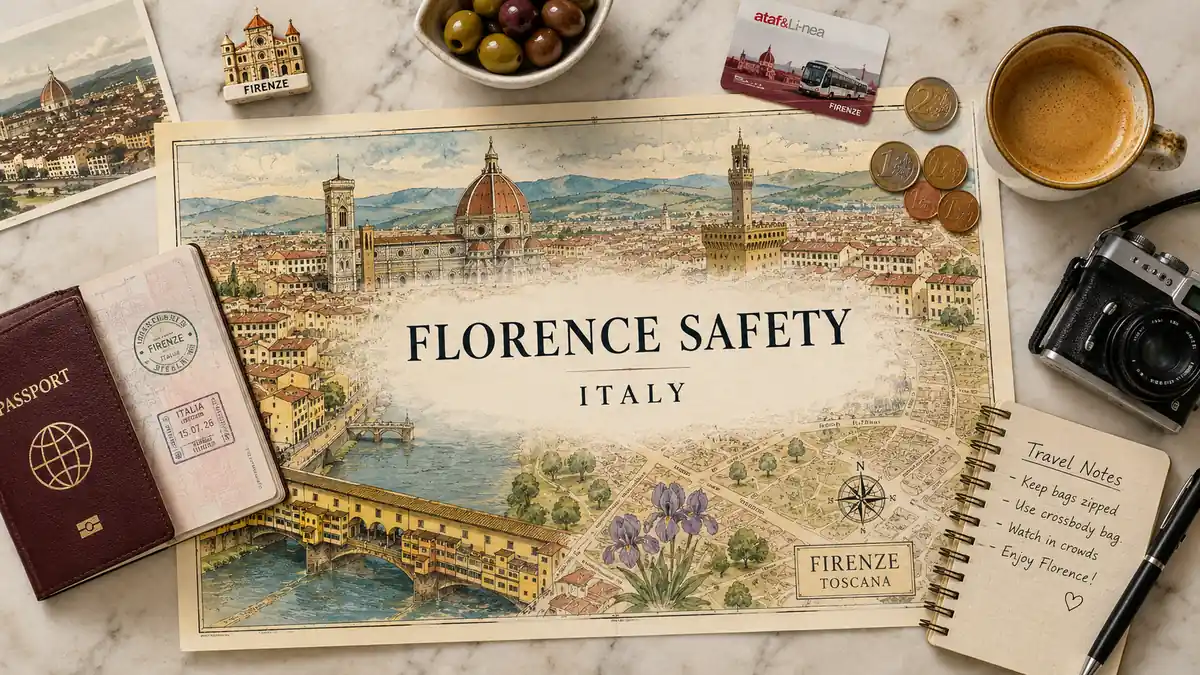
Florence is one of Italy’s safest major cities, and the one risk worth managing is pickpocketing in crowds. Violent crime against visitors is rare, the center is walkable day and night, and most trips pass without a single problem. This guide resolves the full safety picture — whether it’s safe after dark, how it feels for solo female travelers, which areas call for extra awareness, the scams worth recognizing, and the habits that keep your valuables where they belong.
Quick Answer
Florence is very safe; violent crime is rare and the only real risk is pickpocketing in crowds. Caution matters most around busy tourist sights and the Santa Maria Novella train station area. Basic bag awareness handles nearly all of it, and most visitors leave without any trouble at all.
Trust Layer
Tripstou planning guide for travelers resolving one travel decision. Covers the main variable, traveler context, and practical tradeoffs.
Produced with AI assistance and reviewed by Alex Perrut, working in tourism since 2015, for the Tripstou editorial team. See our editorial process for details.
Last factual review: July 15, 2026.
Official sources consulted: italia.it, enit.it.
Key Takeaways
- Florence ranks among Italy’s safest big cities; pickpocketing in crowds is the one risk worth actively managing.
- Raise your guard around the Duomo, Ponte Vecchio, San Lorenzo market, and the Santa Maria Novella station area.
- The center is safe to walk at night, with busy, well-lit streets and normal after-dark caution enough.
- Solo female travelers find Florence comfortable and easy, facing the same pickpocketing plus occasional low-level street attention.
- A zipped crossbody bag worn in front defeats nearly every pickpocket attempt in crowds, buses, and queues.
Table of Contents
How safe is Florence for tourists?
Yes, Florence is very safe for tourists. Violent crime is rare, the historic center is compact and highly walkable, and pickpocketing in crowds is the one risk worth managing. You can explore the city on foot day and night with ordinary big-city awareness and expect no trouble at all.
The reassurance holds across almost every situation a traveler meets here. Muggings and assaults on visitors are uncommon, and the dense, tourist-heavy core stays busy from morning until late. What thieves actually want is your phone or wallet in a distracted moment, taken quietly, without any confrontation. That is a very different problem from personal danger, and it responds entirely to habits rather than fear.
This verdict is Florence-specific. For how the country reads as a whole — emergency numbers, national context, and the wider legal picture — see our guide on whether Italy is safe. If you want orientation, neighborhoods, and what to prioritize on the ground, the Florence travel guide sets the broader scene. Both sit alongside this page; neither replaces the safety focus here.
Which areas of Florence need extra awareness?
No Florence neighborhood is genuinely dangerous or off-limits. The real distinction is pickpocket density: a handful of crowded, tourist-heavy spots concentrate the risk, not any no-go zone. Stay alert around the main sights and the train station, and the rest of the city asks nothing special of you.
The places to raise your guard are exactly where crowds compress. The area around the Duomo, the Ponte Vecchio, the San Lorenzo market stalls, and the Piazza della Signoria draw the densest foot traffic, and crowded city buses add another moment where bags press together. None of these are unsafe to visit — they are simply where a hand is most likely to test an open pocket.
Florence’s thieves favour transition moments over landmarks: boarding a packed bus or paying at a market stall, when your hands and attention are both busy. Standing still to admire a facade is low-risk; moving through a squeeze is where wallets go.
Because the areas that feel safest are also the most convenient to base in, choosing a location is partly a comfort decision. See where to stay in Florence to match a neighborhood to your trip; on safety grounds alone, every central area is fine.
Is the Santa Maria Novella train station area safe?
The Santa Maria Novella station area is safe to use but is the city’s top spot for pickpockets and opportunists. It is busy, full of luggage-laden travelers, and an easy hunting ground for distraction. Keep your bag zipped and in front of you on the platforms, concourse, and nearby streets, especially at night when the crowd thins and touts are more visible. Treat it as a place to move through with purpose, not to linger.
Is Florence safe at night?
Florence is safe to walk at night in the central and tourist areas. Streets around the Duomo, Ponte Vecchio, and the main piazzas stay busy and well-lit into the evening, and violent incidents are rare. Use the same common sense you would apply in any city after dark, and you will be fine.
The center genuinely comes alive at night, which is part of why it feels comfortable. Groups spill out of restaurants, the bridges stay populated, and the Oltrarno’s bars keep the south bank lively. Pickpocketing eases somewhat after the daytime crush, though it never disappears near busy nightlife. If you take a taxi late, use an official white cab or an app-booked ride instead of an unmarked car offered on the street.
The one after-dark spot worth skipping is the Cascine park west of the center; it empties out at night while the tourist core stays lively. Quiet emptiness, not crime, is the reason.
Is Florence safe for solo female travelers?
Florence is a comfortable, popular destination for solo female travelers. The main concerns mirror what every visitor faces: pickpocketing in crowds, plus occasional low-level street attention. Serious crime against solo visitors stays rare, and women routinely explore the city alone, day and night, without incident. It ranks among the easier European cities to visit on your own.
Practically, that means the precautions are the same ones every traveler here uses, with a little extra situational awareness. Unwanted comments or persistent vendors can happen near the busiest tourist streets, and a firm, unbothered response usually ends it. Trust your instincts about bars and late walks the way you would anywhere. Solo dinners, evening strolls across the bridges, and museum days all read as entirely normal here, which is exactly why so many women choose Florence for a first solo trip in Italy.
Common Florence scams and how to spot them
Florence scams rely on distraction and overcharging, and recognizing the pattern defeats them. None of the common ones involve violence; they target attention and wallets, mostly where tourists gather around major sights and cafes. Once you know the handful of recurring setups, you can decline each in a sentence and move on.
The scams are enduring rather than seasonal, so learning the shape of them matters more than tracking any specific version. Here are the ones you are most likely to meet, and the move that shuts each down:
- Bracelet or rose “gift” distraction: someone ties a string bracelet on your wrist or presses a rose into your hand, then demands payment while an accomplice works the crowd. Keep your hands to yourself, say no clearly, and walk on.
- Inflated bills near attractions: a cafe or restaurant beside a major sight adds vague cover charges or menu prices that were never posted. Check prices before you sit, and ask for an itemized receipt.
- Fake-police passport or wallet check: a “plainclothes officer” asks to inspect your documents or cash for counterfeits. Real Italian police never demand your wallet or PIN on the street, so offer to walk to the nearest station instead.
- Unofficial guides and ticket sellers: someone offers to skip the line or sell entry outside a museum, then charges a premium for worthless or overpriced tickets. Buy only from official desks or the venue’s own site.
The fake-police check is the one Florence scam worth a firm mental script, because it trades on your instinct to comply. Genuine officers will never need your PIN or your wallet in hand — a calm “I’ll show my ID at the station” ends the encounter every time.
How to avoid pickpockets in Florence
Keep your valuables zipped, in front of you, and closest to your body in any crowd. Pickpocketing in Florence happens in predictable moments — packed sights, buses, ticket queues, and busy market lanes — so awareness in those settings prevents nearly every incident. A crossbody bag worn across the front does most of the work.
None of this requires gadgets or paranoia, just a few consistent habits in the moments that matter:
- Wear bags in front in crowds: a zipped crossbody or front-facing daypack in packed areas removes the easy target. Skip open totes and unzipped backpacks around the Duomo and San Lorenzo.
- Guard the squeeze on buses and in queues: keep a hand over your bag as you board a crowded bus or shuffle through a ticket line, where bodies press close by design.
- Mind your table: never drape a bag on the back of a chair or leave a phone on a cafe table. Keep them on your lap or between your feet with a strap around an ankle.
- Split and shield your valuables: carry a day’s cash separately from cards, shield the keypad at ATMs, and keep your passport at the hotel unless you truly need it.
The back pocket and the outer backpack pouch are where Florence loses the most wallets. Move both to a front zip and you close the gap that awareness alone cannot cover. These are safety habits, not general logistics; for etiquette, transport, and money pointers beyond safety, see our Florence travel tips.
Frequently Asked Questions
Is Florence safe for families with kids?
Yes, Florence is an easy, safe city for families with children. Violent crime is rare, the center is walkable, and the main sights sit close together. The only real caution is pickpocketing in crowds, so keep bags zipped and hold small children’s hands around the packed Duomo and market areas.
Is public transport safe in Florence?
Yes, Florence’s buses and trams are safe to use, with pickpocketing the only real concern, not any threat to your person. Thieves work the crowded moments when boarding and standing, so keep your bag zipped and in front. For late rides, choose an official white taxi or an app-booked car.
What should you do if you get pickpocketed in Florence?
Report the theft to the police to get a written report (denuncia), which you will need for any insurance or travel-document claim. Cancel affected cards immediately, and contact your consulate if your passport is gone. Florence’s central police stations handle tourist reports routinely, so act quickly but calmly.
Is the fake police scam real in Florence?
It exists but is uncommon, and one rule defeats it: genuine Italian police never stop tourists to inspect a wallet, cash, or PIN for counterfeits on the street. If someone in plain clothes demands this, decline and offer to continue at the nearest station. Real officers will simply agree.
Related Guides
- Florence travel guide — orientation, neighborhoods, and what to prioritize across the city.
- Where to stay in Florence — match a base to your trip and travel style.
- Florence travel tips — etiquette, transport, and money pointers beyond safety.
- Is Italy safe — national context, emergency numbers, and the wider picture.
- Getting around Florence — trams, buses, and walking routes across the center.
- Florence airport transfer — the arrival leg, and which option suits a late landing.
Did this guide save you time or money? Tripstou is independent and reader-funded — if you'd like to give something back, you can support the site with a crypto contribution of any size.