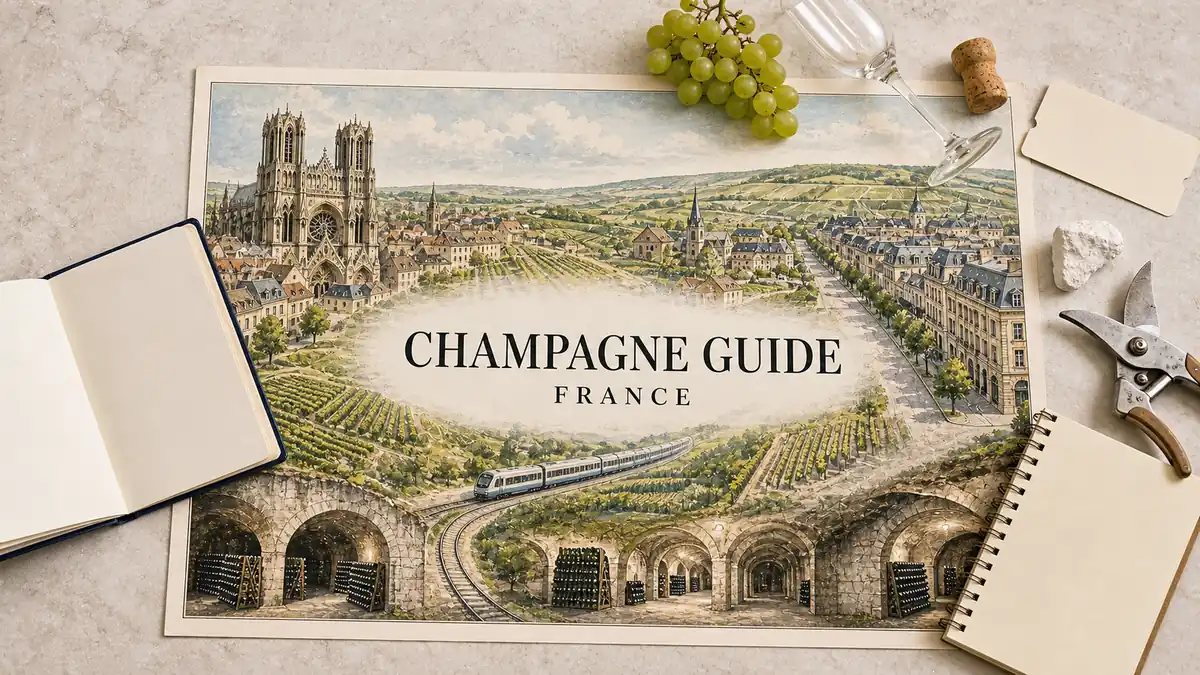
Champagne, France is the wine region in the north-east of the country where the sparkling wine is made, and it is worth visiting for the cellar visits in Reims and Épernay, the vineyard villages on the hillsides and Reims Cathedral. Reims sits under an hour from Paris by fast train, so the real decision is length: a day trip limits you to one town and its houses, while a night or more adds the second town and a village. If wine is the reason for the trip, stay a night or two, based in Reims for the train and the city or in Épernay for the vineyards.
Champagne in Short
- A day trip from Paris works but holds you to one town and its houses; a night adds the second town, and a longer stay adds a day in the vineyard villages.
- Reims is the base for the fastest train and the cathedral, Épernay the base for the Avenue de Champagne and the villages, and a split stay suits any first trip of two nights or more.
- Trains cover Paris, Reims and Épernay, but the vineyard villages need a car, a bike, a driver or a tour, and only a driver or a tour lets everyone in the group taste.
- Most big champagne houses sell timed tours that need booking ahead, especially in English, while growers receive visitors mostly by appointment.
- Late spring and early summer are the easiest time to visit; harvest is the busiest season and winter visits are more limited and appointment-led.
- The Côte des Bar lies far to the south in the Aube and works as a separate trip, not as a detour from Reims or Épernay.
In This Guide
Who Champagne Suits, and Why It Works Best as a Paris Add-On
Champagne suits wine lovers and history-minded visitors who are already in Paris, and it works best as a one-to-two-night add-on to a Paris stay, not as a standalone week. Travelers with little interest in wine get far less from it, because the region’s days are built around cellar visits.
The region offers more than a tasting room. Its hillsides, houses and cellars are listed together by UNESCO as the World Heritage site “Coteaux, Maisons et Caves de Champagne”: the vineyard slopes between Cumières and Mareuil-sur-Aÿ (Hautvillers and Aÿ included), the Avenue de Champagne in Épernay and the Colline Saint-Nicaise in Reims. Reims adds Notre-Dame Cathedral, the Palais du Tau and the Basilique Saint-Remi, so a companion who does not drink still has a full day.
As a standalone holiday, Champagne runs thin quickly. Two towns, a few vineyard drives and a string of cellars fill a long weekend well; a week asks the cellars to carry more than they can. Champagne earns its place when Paris is already on the route. If you are still choosing a wine area, start with France’s wine regions compared.
Champagne also lies outside the Paris region, in the Grand Est, so the sights around the capital belong to a different plan; the Paris region guide covers those. Skip Champagne if you would not book a cellar visit at home: the region rewards curiosity about how the wine is made and gives little to anyone who only wants a glass with a view.
How Do You Get from Paris to Reims and Épernay?
Take the TGV from Paris Gare de l’Est to Reims, a journey of about 45 minutes according to the official Reims tourism site. For Épernay, a direct regional train leaves from the same station; it is slower than the TGV to Reims, but it needs no change.
That difference shapes the base. Reims is the quicker hop, which makes it the easier choice for a short trip or a late arrival. Épernay costs more time on the train and pays it back by starting you among the vineyards.
A regional train also links Reims and Épernay, so a split stay works without a car. Flying in? Get into central Paris first and take the train from Gare de l’Est; no shortcut from the airports is worth planning around. For rail beyond this line, see planning train travel across France.
How Many Days Do You Need in Champagne?
A day trip from Paris works, but it limits you to one town and its houses. One night lets you see both Reims and Épernay. Two to three nights add a full day in the vineyard villages, which is where the region stops feeling like a train excursion.
What each length buys:
- A day trip from Paris: one town, one or two booked house visits and an evening train back. It suits travelers testing whether the region is for them, and it competes with the other day trips from Paris for the same free day.
- One night: Reims and Épernay both, with an unhurried dinner in between. Couples who want the two towns without a vineyard day get the most from it.
- Two to three nights: both towns plus a day among the hillside villages with a driver, a tour or a bike. This is the length for anyone travelling mainly for the wine.
- Inside a longer France road trip: a night or two on the way east, with the car already solving the village problem. Drivers who can share the wheel fit this best.
A Champagne day trip fails on timing more than on distance. A single timed cellar slot fixes your train, your lunch and which town you see, so book the slot first and choose the train around it.
Reims or Épernay: Where to Base Yourself
Base in Reims for the fastest train from Paris, a real city and big houses you can walk between; base in Épernay for the Avenue de Champagne and shorter hops to the vineyard villages. On a first trip of two nights or more, split the stay between the two. A village stay suits drivers or travelers with a tour already booked.
| Factor | Reims | Épernay | Village stay |
|---|---|---|---|
| Train from Paris | TGV, about 45 minutes | Direct regional train, slower | Usually needs a car |
| Big houses on foot | Yes, several | Yes, along the Avenue de Champagne | Few or none |
| Vineyard villages | Montagne de Reims nearby | Vallée de la Marne and Côte des Blancs close | On the doorstep |
| Evenings and dining | Widest choice, a city feel | Smaller, quieter town | Very limited |
| Who it fits | Short trips, train travelers, sightseers | Wine-focused stays | Drivers and booked tours |
Reims: Cathedral City with the Fastest Train
Reims is the base with the most to do outside the cellars. Three sights carry a day on their own:
- Notre-Dame Cathedral, the city’s Gothic landmark;
- the Palais du Tau, beside the cathedral;
- the Basilique Saint-Remi.
The chalk cellars of the Colline Saint-Nicaise, part of the UNESCO listing, are in Reims too, and the city is home to houses such as Ruinart, Pommery and Veuve Clicquot. Champagne also turns up at the table here, poured with meals and paired with local biscuits; the French food guide covers the regional cooking around it.
What Is the Avenue de Champagne?
The Avenue de Champagne is Épernay’s street of champagne houses, listed by UNESCO as part of the region’s World Heritage site. Grand house façades line it, with cellars beneath, and Moët & Chandon and Perrier-Jouët are among the names on it. A cellar visit is the town’s main event: you can book a cellar tour with tastings before you arrive and walk the rest of the avenue afterwards. In December the street hosts Habits de Lumière, a light festival along the avenue.
When Splitting the Stay Makes Sense
Split the stay whenever you have two nights or more: one night in Reims for the city and the arrival train, one in Épernay for the avenue and the villages. The cost is one more packing session and a short regional train between the two.
Hotels and places to stay
Compare hotels, apartments and stays for your dates in one search.
Search hotels and stays on hotels.com →
Tripstou may earn a commission if you book through this link, at no extra cost to you.
Champagne’s Vineyard Areas and What Each One Is For
The vineyards around Reims and Épernay fall into three areas (the Montagne de Reims, the Vallée de la Marne and the Côte des Blancs), all within reach of the two towns, while the Côte des Bar lies far to the south in the Aube. The signposted Route Touristique du Champagne links them with driving circuits through each area.
Montagne de Reims
The Montagne de Reims is the wooded upland between Reims and Épernay, and it is the vineyard area to pick from a Reims base. Its two landmarks are not cellars: the Faux de Verzy, a forest of strangely twisted beech trees, and the Phare de Verzenay, a lighthouse standing among the vines. Come here for a short drive and a walk between tastings.
Vallée de la Marne and Hautvillers
The Vallée de la Marne is the obvious first vineyard day, and Épernay is its natural base. Hautvillers, the hilltop village whose abbey is linked to Dom Pérignon, sits on the UNESCO-listed slopes alongside Aÿ and Cumières, and the villages lie close enough together to string into one outing by bike or car. First-time visitors who want the postcard version of Champagne should start here.
Côte des Blancs
The Côte des Blancs is the Chardonnay country south of Épernay, home to villages such as Oger and Le Mesnil-sur-Oger. Its champagnes are made from white grapes, so it pulls drinkers who already know what they like and want to taste the difference at the source. From Épernay, you can reserve a half-day tour that pairs these Chardonnay villages with Hautvillers.
Is the Côte des Bar Worth the Detour?
The Côte des Bar is worth it only as a separate trip, not as a detour from Reims or Épernay. It lies far south in the Aube, reached via Troyes, with Les Riceys and Essoyes, the village tied to Renoir, as its anchors. Skip it on a short visit; save it for a slower drive south.
Can You Visit Champagne Without a Car?
Yes for the towns: trains link Paris, Reims and Épernay, and the big houses in both towns are walkable. The vineyard villages are the catch, because reaching them takes a car, a bike, a driver or a small-group tour.
- Train and walking: covers Reims, Épernay and their big houses with no planning beyond the timetable. It suits short trips and anyone who wants to taste freely, and it leaves the villages out.
- Rental car: the most freedom across the Route Touristique and the only practical way to reach scattered growers on your own schedule. Tasting is the problem: the person at the wheel has to spit or skip, which turns a wine trip into a chauffeuring job for one of you. See renting a car in France for the logistics.
- Private driver or small-group tour: starts from Reims or Épernay and solves both the transport and the tasting problem. Groups who want a full village day with everyone drinking pay for it with a fixed route and someone else’s pace.
- Bike: works in the Vallée de la Marne and the Côte des Blancs, where villages sit close together. Riders who taste lightly handle it best; hills and a full glass do not mix well.
A driver costs more than a rental car and often still works out as the better deal in Champagne, because it is the only option where every person in the group tastes and nobody drives afterwards.
How Champagne House Visits Work, and Why to Book Ahead
Book ahead: most big champagne houses run ticketed, timed tours that need advance booking, especially for English-language slots. Growers (vignerons) receive visitors mostly by appointment and offer a smaller, family-run tasting.
A big-house visit is a guided walk through the cellars followed by a tasting. In Reims the tour often goes down into the chalk cellars of the Colline Saint-Nicaise, and in Épernay into the cellars under the Avenue de Champagne, both part of the UNESCO listing. Prices vary with what is poured: a prestige tasting costs several times a basic visit, so choose the tier before choosing the house.
The houses of Reims and Épernay are also what most day-trippers from Paris come for, and many see them on an organised small-group day that covers both towns’ cellars with the transport arranged. That format suits travelers who want both towns in one day without juggling train times and slots.
Pace the visits. A couple of house tours a day stays enjoyable; beyond that the cellars start to blur and the tastings stop teaching you anything. English slots fill first, so book them as soon as your dates are fixed.
Can You Visit Small Grower Producers?
Yes, small grower producers welcome visitors, mostly by appointment and typically in the vineyard villages. The experience is closer and less staged than at a big house: often a family member pours, the cellar is small and the talk turns to that grower’s own plots. Because growers sit in the villages, a driver or a tour is the easiest way to reach them; from Reims, you can book this day tour, which pairs a big Reims house with a family-run winery.
Tours and activities
Book skip-the-line tickets, day trips and local tours with free cancellation on most activities.
You can also browse everything on getyourguide.com.
Tripstou may earn a commission if you book through this link, at no extra cost to you.
Late Spring and Early Summer Are the Easiest Time to Visit
Late spring to early summer is the easiest time to visit Champagne: the houses are open, the vineyards are green and the pace is calmer than at harvest. Harvest, from late summer to early autumn, is the most atmospheric season and the busiest, and winter visits are more limited and appointment-led.
Each window changes what the trip feels like more than the weather does. For how the region fits the national calendar, see the best time to visit France.
- Late spring and early summer: open houses, green slopes, easy booking.
- Harvest: pickers in the vines and a working region; book cellar slots early.
- Winter: fewer open doors and more appointments, lifted in December by the Habits de Lumière light festival on the Avenue de Champagne.
What a Champagne Trip Costs, by Spend Style
The cost of a Champagne visit is driven by the tastings and by how you reach the villages, more than by the train. A day trip by train with one booked house visit is the cheapest way in.
A tight trip stays at that: a train from Paris, one house visit at the basic tier, and lunch in town. A comfortable trip adds one or two nights in Reims or Épernay and a grower visit, which costs less than a prestige house tasting and often teaches more. A high-end trip is where Champagne gets expensive quickly: a private driver for the villages, prestige tastings at the big houses and a night in a vineyard village. For budget figures across the country, see what a France trip costs.
The Strongest First Trip: Two Nights, Both Towns, One Village Day
The strongest first trip arrives in Reims by TGV, spends a night there, moves to Épernay for the Avenue de Champagne and gives one day to the Vallée de la Marne or the Côte des Blancs with a driver, a tour or a bike. From there, return to Paris or continue east.
Reims first makes sense because the fast train lands there and the city fills the afternoon of an arrival day. Épernay second puts you next to the villages for the day that matters most. Book the house slots and the village day before anything else; the rest of the trip fits around them.
Drivers on a wider route can treat Champagne as a stage of a France road trip route, keeping one night in a village and handing the keys to a driver for the tasting day. Heading further east, Strasbourg is the natural next stop, and the Strasbourg guide picks up from there. For a longer loop that places Champagne among the rest of the country, see a full France itinerary.
Sources and Review
This page plans a visit to the Champagne region (bases, access from Paris, cellar visits and timing); it is not a Reims city guide, a day-by-day itinerary, a directory of champagne houses or a hotel roundup.
Written with AI assistance, this Champagne plan was then gone over by Alex Perrut, working in tourism since 2015, for the Tripstou editorial team; the editorial process page explains the checks.
Official sources consulted: Reims Tourisme, Mission Coteaux, Maisons et Caves de Champagne, France.fr.
Keep Planning France
- France’s wine regions: how Champagne compares with the other places to taste across the country.
- France travel guide: the wider planner for building a trip around Paris and beyond.
- Best places to visit in France: other destinations worth combining with a Champagne stay.
Did this guide save you time or money? Tripstou is independent and reader-funded — if you'd like to give something back, you can support the site with a crypto contribution of any size.