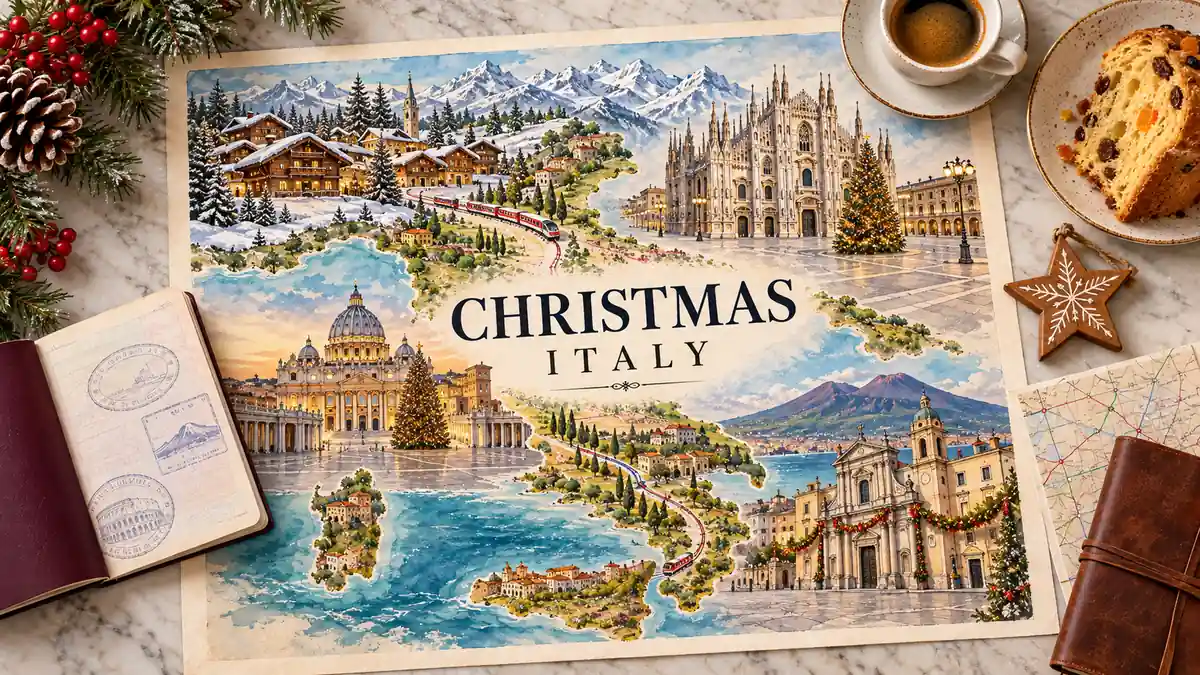
Christmas in Italy is lived at the table and in church more than at the shops, and it looks different depending on where you stand. In the Alpine north, South Tyrol’s market towns fill their squares with wooden stalls and mulled wine. In Naples, artisans on one narrow street in the old centre craft nativity figurines, and Christmas Eve means a seafood dinner. Rome holds the religious centre of the season, from church nativity scenes to Midnight Mass beside St Peter’s. So the real decision is which version of the season you want to stand in. This guide explains what the season is and how long it runs, which traditions a visitor can actually join, and what Italians eat on Christmas Eve and Christmas Day. It then shows where each tradition is strongest, what closes on the holidays, and how to chain the places into one trip.
Quick Answer
Christmas in Italy is a family, faith and food season, strongest in South Tyrol’s markets, Naples’ nativity street and Rome. Go north for Alpine markets in Bolzano, Merano and Trento, south for nativity scenes and the Christmas Eve seafood dinner, Rome for the religious season. Most sights and many restaurants close on Christmas Day; book meals ahead.
Trust Layer
Tripstou selection guide for travelers choosing between multiple places. Covers selection criteria, traveler fit, and trip value.
Produced with AI assistance and reviewed by Alex Perrut, working in tourism since 2015, for the Tripstou editorial team. See our editorial process for details.
Last factual review: October 1, 2026.
Official sources consulted: Italia, Italy’s official tourism portal, ENIT Italian National Tourism Agency.
Key Takeaways
- Italy’s Christmas season runs from the Immacolata to the Befana, and the weeks before Christmas Eve are when visitors see the most.
- For Alpine market atmosphere base in Bolzano, Merano or Trento; for the most traditional Christmas, with presepi and the seafood Vigilia, choose Naples.
- Rome suits travelers who want the religious season, with Midnight Mass watched on screens in St Peter’s Square and churches open on the holidays.
- Christmas Eve and Christmas Day meals are private family affairs, so book a restaurant that opens on those days well in advance.
- Most sights close on Christmas Day and many on New Year’s Day, so plan travel days around the holidays and check each sight first.
- The Befana week is the overlooked window: Alpine markets stay open until the Epiphany, after the big family days are over.
Table of Contents
The Italian Christmas season runs from the Immacolata to the Befana
Italy’s Christmas season runs from the Immacolata on 8 Dec to the Befana on 6 Jan. The Immacolata is the Feast of the Immaculate Conception; the Befana is the Epiphany, when an old woman of folklore brings children sweets. The weeks before Christmas Eve are the visitable part; the holidays themselves belong to families.
The season moves through a fixed ladder of feasts. Each one changes what a visitor sees in the street:
- Immacolata (8 Dec): the traditional start of the season, when lights, trees and nativity scenes start to appear.
- Santa Lucia (13 Dec): a children’s feast in some northern towns, with small gifts and sweets.
- Novena: the nine days of devotion and music leading up to Christmas Eve.
- Vigilia (24 Dec): Christmas Eve, the meatless fish dinner at home and Midnight Mass.
- Natale (25 Dec): Christmas Day, a public holiday built around a long family lunch.
- Santo Stefano (26 Dec): St Stephen’s Day, a second public holiday for visiting relatives.
- Capodanno (1 Jan): New Year’s Day, a public holiday with a slow, late start.
- Befana (6 Jan): the Epiphany, a public holiday and the season’s last act.
Early to mid December is visit mode. Markets are open, nativity scenes are up and city centres are lit. From 24 to 26 Dec the country switches to family mode, and public life goes quiet. The soundtrack runs throughout: zampognari (bagpipers in shepherd dress) play in the south and in Rome.
The Befana week is the window most visitors miss. Alpine markets stay open until the Epiphany, the big family days are over, and the season ends with a children’s feast that visitors can watch in any town square.
Which Christmas traditions will you actually meet as a visitor?
The traditions a visitor actually meets are the presepi, street music, lights and church services; the meals stay private. Presepi are nativity scenes, built in churches, squares and shop windows through December. Midnight Mass and the Befana night are open to anyone. The Vigilia, the Christmas Eve family dinner, happens behind closed doors.
The presepe is the tradition with the deepest roots. It traces back to St Francis of Assisi, who staged a living nativity at Greccio, in Lazio, in the 13th century. Greccio still stages one. Today presepi range from small church scenes to whole hillside villages modelled in miniature, and Naples has a street devoted to making them (see the Naples pick below).
Music marks the weeks before Christmas. In the south and in Rome, zampognari play bagpipes and shepherd pipes in squares and outside churches, a sound Italians tie to the Novena. Lights go up across city centres from the Immacolata onward.
Midnight Mass is a national habit. Every parish church holds one, and visitors are welcome at the back. At the Vatican, free tickets for the basilica are scarce and requested far ahead, so the square with its screens is the realistic plan.
The Befana closes the season on the night of 5–6 Jan. She brings sweets to good children and coal to the rest. Her figure turns up in markets, shop windows and town squares in the first days of January.
- What you can see and join: presepi in churches and squares, living nativities, zampognari, the lights, Midnight Mass, the Befana’s appearances.
- What stays inside the home: the Vigilia dinner, Christmas Day lunch and the opening of gifts.
What Italians eat on Christmas Eve and Christmas Day
Christmas Eve is a meatless fish and seafood dinner; Christmas Day is a long lunch of broth, pasta and roast. Panettone or pandoro closes both meals. Visitors rarely sit at either table, because both meals are family affairs, so the practical move is booking a restaurant that opens on the 24th or 25th well in advance.
Eating out is how most travelers meet this food. Restaurants that open on the 24th or 25th often serve a set holiday menu, and their tables go early. The easier way in is the week before Christmas Eve: fried salt cod, panettone and regional sweets fill bakeries, delis and market stalls all through December, with no booking and no family invitation needed.
Christmas Eve: the Vigilia fish dinner
The Vigilia is a lean, meatless day that ends in a fish and seafood dinner. The menu changes by family and region, but some dishes recur across the country:
- baccalà (salt cod), fried or stewed
- spaghetti alle vongole, pasta with clams
- fried or stewed fish and seafood
- capitone (eel), a southern Christmas Eve classic
The fixed count of “seven fishes” is an Italian-American framing. In Italy the number of dishes varies by family. There is no set figure.
Christmas Day lunch by region
Christmas Day lunch is long, meaty and regional. Families sit down at midday and stay at the table for hours. Each part of the country has its own signature:
- north: tortellini, cappelletti or agnolini in broth, then capon
- central Italy: abbacchio, roast young lamb
- south: regional pasta dishes, with seafood carried over from the night before
Every region claims its version is the real one. The shape is the same everywhere: a first course, a roast and dessert, eaten slowly at home.
Panettone or pandoro?
Panettone comes from Milan and pandoro from Verona, and most Italian tables carry both. The difference is easy to taste:
- panettone: a tall, domed sweet bread with candied fruit and raisins
- pandoro: a star-shaped, plain golden cake dusted with icing sugar
Regional sweets fill the gaps. Naples has struffoli, small fried dough balls in honey, and torrone (nougat) appears across the country. Picking a side is part of the season.
Where to spend Christmas in Italy, by the tradition each place carries
For Alpine atmosphere pick South Tyrol’s market towns; for tradition pick Naples; for the religious season pick Rome. Milan suits a city Christmas in early December. The Alpine north is market-led and German-speaking in culture, the south is built on nativity scenes and food, and no one base gives you both without a train day.
Pick the half of the country before you pick the city. The Alpine north gives you a market to walk through; Naples and the south give you a tradition to eat. Other places hold Christmas well too: Florence has its cathedral square and churches, Venice is quiet and lit, and hill towns stage living nativities. None of them is stronger than the places below for a first Christmas.
| Place | Christmas signature | Who it suits | Guide to read next |
|---|---|---|---|
| South Tyrol and Trentino | Alpine Christmas markets in Bolzano, Merano and Trento | Market lovers who want one cosy Alpine base | Dolomites guide for South Tyrol bases |
| Naples | Nativity workshops of San Gregorio Armeno and the Vigilia | Food-led travelers after the most Italian Christmas | Naples guide for bases and transport |
| Rome | St Peter’s, church nativity scenes and Piazza Navona’s fair | Travelers who want the Vatican’s Christmas calendar | Rome guide for planning the city |
| Milan | Oh Bej! Oh Bej! fair and the home of panettone | Early-December visitors wanting a lively city Christmas | Milan guide for planning the city |
South Tyrol and Trentino: Bolzano, Merano and Trento markets
Bolzano, Merano and Trento run the Christmas markets most visitors picture: wooden stalls, mulled wine and lit Alpine squares. Bolzano’s market fills Piazza Walther, Merano’s lines the promenade along the Passer river, and Trento’s spreads across Piazza Fiera and Piazza Mostra. They run from the second half of November until the Epiphany. This is the only pick where the market is the Christmas. South Tyrol’s culture is bilingual, Italian and German, so the stalls, food and carols lean Alpine. Base in one town and day-trip to the others; for bases, skiing and getting there, read our guide to the Dolomites and South Tyrol.
Pick this if: you want the wooden-stall, mulled-wine Alpine Christmas and will base in one town.
Naples: the presepi of San Gregorio Armeno
Naples carries the Christmas Italians recognise as their own. Via San Gregorio Armeno, in the old centre, is the nativity-craft street: workshops make and sell presepe figures, from shepherds to caricatures of public figures. The city is also the capital of the Vigilia seafood dinner, and zampognari play in its streets. What sets Naples apart is that the tradition is made in front of you. Start with our Naples guide for where to stay and how to get around. For everything beyond the presepi street, see the things to do in Naples.
Pick this if: food and handmade tradition matter more to you than markets.
Rome: the religious season and Piazza Navona
Rome is where the faith calendar becomes the main event. St Peter’s leads the season, and Midnight Mass is realistic from the square, where screens carry the service. Churches across the city set up presepi, Piazza Navona hosts its Christmas fair, and zampognari play in the old centre. Rome also stays recognisable on the holidays. Churches, squares and fountains are there to walk even when museums close. Our Rome guide covers where to stay, how to get around and what to see on the days around Christmas.
Pick this if: you want the Vatican’s Christmas and a city that still works on the holidays.
Milan: Oh Bej! Oh Bej! and panettone
Milan is the city Christmas that peaks earliest. Its Oh Bej! Oh Bej! fair is tied to Sant’Ambrogio, the patron saint’s feast on 7 Dec, and it opens the city’s season with stalls, food and crowds. Milan is also panettone’s home city, so its bakeries are the place to taste the cake at its best. The Duomo square carries the lights. No other pick peaks before mid-December. Use our Milan guide to plan the city itself, from bases to sightseeing beyond the Christmas fair.
Pick this if: you are in Italy in the first half of December and want a city Christmas with the best panettone.
Tours and activities
Book skip-the-line tickets, day trips and local tours with free cancellation on most activities.
You can also browse everything on getyourguide.com.
Tripstou may earn a commission if you book through this link, at no extra cost to you.
What is open and closed on Christmas Day, Santo Stefano and the Befana?
Most sights and many shops close on Christmas Day. Santo Stefano, St Stephen’s Day on 26 Dec, is a holiday with partial reopening. New Year’s Day and the Befana behave like Sundays or quieter. Churches and squares stay open, so build holiday days around walks, services and presepi, and check the specific sight first.
| Feast day | What Italians are doing | What to expect as a visitor |
|---|---|---|
| Christmas Eve (24 Dec) | Last errands, then the Vigilia fish dinner at home | Short afternoon; restaurants on set menus, book ahead |
| Christmas Day (25 Dec) | Mass, then a long family lunch at home | Most museums and shops shut; churches and squares open |
| Santo Stefano (26 Dec) | Visiting relatives, walks and another family meal | Public holiday with partial reopening; check each sight |
| New Year’s Day (1 Jan) | Recovering from the night, then a late lunch | Late start and many closures; plan a slow day |
| The Befana (6 Jan) | Children’s sweets or coal, the season’s final outing | Public holiday; shops vary and markets reach their last day |
Christmas Eve is a working morning with a short afternoon. Shops thin out as families head home, and restaurants that stay open usually switch to a holiday menu. Christmas Day is the quietest of the holidays. Treat it as a day for churches, nativity scenes and long walks.
Travel needs the same logic. Plan travel days around the holidays, not on them, and arrive at your Christmas base before the 24th. Always check the specific sight before you build a day around it.
The Befana is the holiday that catches late-season travelers out. Abroad, 6 Jan looks like an ordinary weekday, but Italy shuts like a Sunday that day and the Alpine markets reach the end of their season.
How to combine the Christmas places into one trip, and who it suits
Run north to south by train: markets first in early December, then Naples or Rome for the holidays themselves. The order follows the season, because the markets carry the build-up while the south’s presepi and Vigilia peak on Christmas Eve. The trip suits travelers who want tradition over sightseeing and accept closures.
The classic chain starts in Bolzano or Trento for the markets, drops to Milan for its early-December fair and panettone, then runs to Rome and on to Naples for the Vigilia. The reverse works too. Start in Naples or Rome for Christmas itself, then finish in the Alps for the Befana week. Every leg runs on Italy’s main rail lines, and our Italy train itinerary covers how to route and book them. For December weather, crowds and prices, see the best time to visit Italy.
- Go for it: travelers who want presepi, markets and holiday food, and who accept closed museums on the big days.
- Go with care: families with children, who get the most from the Befana but need meals booked well ahead.
- Wait for spring: first-timers whose goal is a packed museum and sightseeing list.
Ending in the Alps flips the usual order and pays off. You get Naples and Rome at their most traditional, then the markets in their final, quieter days before the Epiphany. For the rest of your planning, start with our Italy travel guide.
Frequently Asked Questions
Who is La Befana?
La Befana is the old woman of Italian folklore who brings children their Epiphany gifts. On the night of 5–6 Jan she leaves sweets for good children and coal for the rest, traditionally in stockings. Visitors see her figure in markets, shop windows and town squares in early January, as the Christmas season closes.
Is the Feast of the Seven Fishes an Italian tradition?
No, not as a fixed count. The Feast of the Seven Fishes is an Italian-American name and number. In Italy, Christmas Eve is a meatless fish and seafood dinner, but families serve as many dishes as their region and habit dictate, so menus of seven, nine or thirteen dishes all exist.
Can you attend Midnight Mass at the Vatican?
Yes, but seats inside St Peter’s Basilica need free tickets that are scarce and requested far ahead. The realistic plan for most travelers is St Peter’s Square, where big screens carry the service. For an indoor Mass, every parish church in Rome holds its own, and visitors are welcome at the back.
Do Italians exchange gifts on Christmas Day?
Yes, Italian families exchange gifts at Christmas, at home. Children often get more than one round, though. The Befana brings sweets on the night of 5–6 Jan, and in some northern towns Santa Lucia brings small gifts on 13 Dec. Travelers with children can share the Befana side, which plays out in markets and squares.
Is Italy worth visiting at Christmas?
Yes, if you want tradition, food and markets more than a full sightseeing list. December brings presepi, Alpine markets, the Vigilia and lit city centres that summer visitors never see. The tradeoff is many museums closed on Christmas Day and New Year’s Day, and family meals you cannot join, so restaurant bookings carry the holidays.
Is everything closed in Italy on New Year’s Day?
No, but it is one of the quietest days of the season. Many museums and shops stay shut and the day starts late after the night’s celebrations. Churches, squares and walking routes stay open, so plan a slow day, keep travel for another date and check the specific sight before you go.
Related Guides
- Italy travel guide: the planning root for everything beyond the Christmas season.
- Best time to visit Italy: what December weather, crowds and prices look like.
- Dolomites guide: where to base in South Tyrol for the markets, plus skiing and access.
- Naples guide: where to stay and how to get around for a Naples Christmas.
- Things to do in Naples: the city beyond the nativity street.
- Rome guide: how to plan a Roman stay around the religious season.
- Milan guide: bases and sightseeing for an early-December city break.
- Italy train itinerary: how to chain the Christmas places north to south by rail.
Did this guide save you time or money? Tripstou is independent and reader-funded — if you'd like to give something back, you can support the site with a crypto contribution of any size.