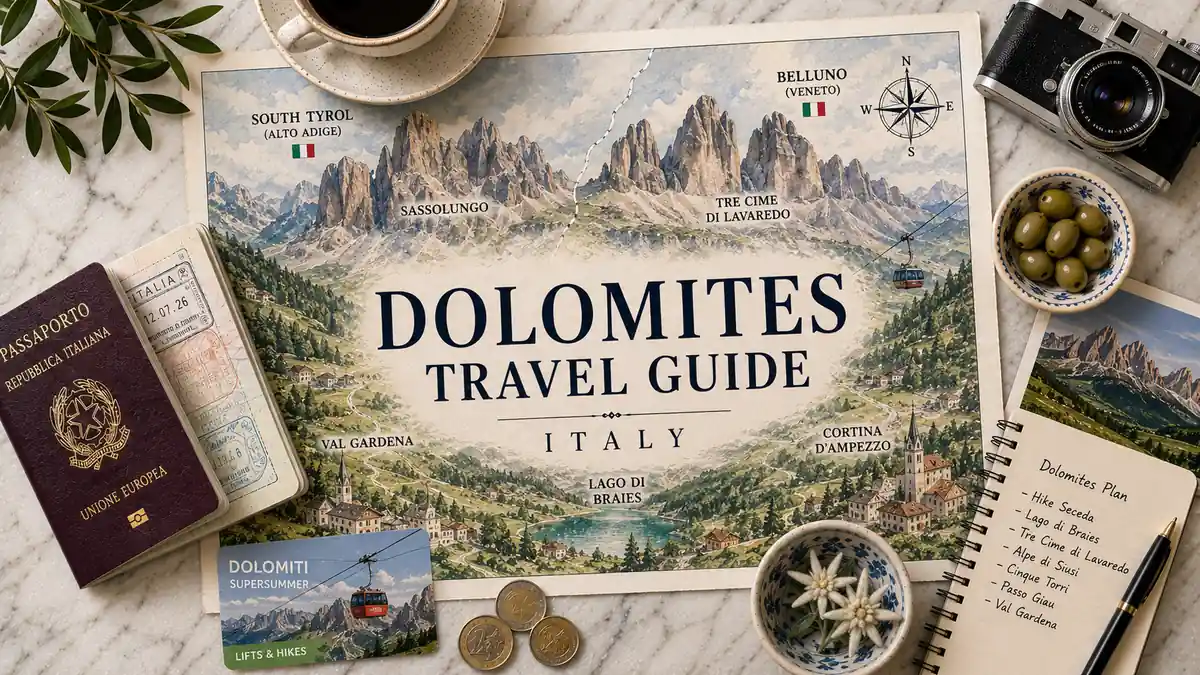
The Dolomites are not a single place you visit but a mountain region you piece together. Spread across two Italian provinces and threaded by dozens of valleys, the range has no central hub — no one town anchors the whole thing the way a capital anchors a country. That makes a first trip a base-and-orientation problem before it is anything else. Where you sleep decides what you can reach, and which side you choose shapes the culture, the scenery, and the airport you fly into. This guide walks through the full planning framework: where the region is and how it splits, when to go, how many days you need, how to get there and around, where to base, and how the Dolomites slot into a wider Italy trip.
Quick Answer
The Dolomites is Italy’s premier alpine region, ideal for hiking, dramatic scenery, and mountain-town basing. Trip length and whether you use one base or two — Ortisei in the west, Cortina in the east — drive the plan. It suits active travelers and scenery lovers, and a rental car unlocks most of it.
Trust Layer
Tripstou region guide for travelers planning a regional trip. Covers sub-areas, trip shape, base strategy, timing, and mobility tradeoffs.
Produced with AI assistance and reviewed by Alex Perrut, working in tourism since 2015, for the Tripstou editorial team. See our editorial process for details.
Last factual review: July 10, 2026.
Official sources consulted: italia.it, enit.it.
Key Takeaways
- The Dolomites split into two provinces — Tyrolean South Tyrol in the west and Italian Belluno in the east — shaping every choice.
- Base in Ortisei for the western valleys or Cortina for the east; split your stay only on longer trips.
- Four to six days is the sweet spot — enough to settle in, ride cable cars, and walk signature trails unhurried.
- Summer is best for a first visit, when trails, lifts, and rifugi run; winter serves skiers and shoulder weeks bring closures.
- Rent a car for most trips — valleys fan out with slow transit — unless you stay put in one resort town.
- Treat the Dolomites as a dedicated three-to-five-day northern leg off Venice or Verona, not a quick day trip.
Table of Contents
Where the Dolomites Are and How the Region Splits
The Dolomites are a UNESCO World Heritage mountain range in northeastern Italy, split across two provinces. South Tyrol (Trentino-Alto Adige) covers the west; Belluno (Veneto) covers the east. The region is a web of valleys with no single hub, so a first trip is a base-and-orientation problem, not a single-city stop.
The two-province divide is the first thing to grasp, because it shapes almost every later decision. The western half, in South Tyrol, is officially bilingual and culturally Tyrolean, with German widely spoken alongside Italian and the Ladin language surviving in valleys like Val Gardena and Val Badia. The eastern half, in Veneto, feels straightforwardly Italian and centers on Cortina d’Ampezzo.
Within those halves, you plan around valleys, not cities. Val Gardena, Alta Badia, Val di Funes, and the Alpe di Siusi plateau sit in the west; the Ampezzo basin, Val di Fassa, and the Cadore stretch across the center and east. Each valley is its own micro-base with its own cable cars and trailheads. There is no train line stitching them together.
The practical upshot is simple. You do not “see the Dolomites” from one spot — you choose a corner, settle in, and radiate out. The rest of this guide is about making those choices in the right order: when to come, how long to stay, and which corner earns your nights.
When to Visit the Dolomites
Summer is the best season for a first Dolomites trip, roughly from late spring through early autumn. Hiking trails, cable cars, and mountain huts are open, and the weather favors long days outdoors. Winter is for skiers. The shoulder weeks are quieter and cheaper but bring partial lift and rifugi closures.
Summer is the default answer for good reason. This is when the full mountain infrastructure runs: cable cars carry you up to trailheads, and the rifugi — the mountain huts that make long walks possible — serve food and beds. The high season concentrates around midsummer, when meadows are green and passes are clear of snow. It is also the busiest and priciest window, especially in the marquee valleys.
Winter flips the region into a ski destination. The Dolomiti Superski network links dozens of resorts, and towns like Cortina and Ortisei run at full tilt. If you are coming to hike rather than ski, winter is the wrong call — many summer lifts and huts sit closed.
The shoulder weeks — roughly late spring and early autumn — are the connoisseur’s choice, with thinner crowds and softer prices. The catch is timing risk: cable cars and huts open and close on staggered seasonal schedules, and an early or late trip can find a key lift already shut. Treat published opening dates as approximate ranges and confirm the specific lifts you need before you commit. For how Dolomites timing compares with the rest of the country, see our guide to the best time to visit Italy.
How Many Days You Need in the Dolomites
Plan four to six days for a satisfying first Dolomites trip. That gives you time to settle into a base, ride the major cable cars, and walk a few signature trails without rushing. Fewer than three days works only as a scenic taster; a week or more suits keen hikers and two-base itineraries.
Duration in the Dolomites buys reach, not just relaxation, because the mountains eat time through winding drives and cable-car queues. The tiers below map length to what it unlocks and who it fits:
- 2–3 days (scenic taster): one base, a couple of cable-car viewpoints, and one short walk. Best for travelers bolting the mountains onto Venice or Verona who accept they are sampling, not exploring.
- 4–6 days (the sweet spot): one well-chosen base, the headline viewpoints, and two or three proper trails at a relaxed pace. Best for first-timers who want the region to feel like a real leg of the trip.
- 7+ days (two-base or hiker’s trip): time to split east and west, or to go deep on hut-to-hut hiking from a single valley. Best for keen walkers and returning visitors.
One planning move matters more than the exact number: build in a flexible day. A single fogged-in morning can erase the ridgelines that justify the whole journey, and mountain weather turns fast at altitude — a spare day lets you wait out the cloud instead of losing your one shot at the view.
How to Get to the Dolomites
Venice Marco Polo is the most practical airport for the Dolomites, with Treviso, Verona, and Innsbruck as strong alternatives. Bolzano handles limited regional flights. From any of them you drive into the mountains, so the arrival plan is really a question of which valley you are basing in and which side you land nearest.
The airport you choose should follow the side you are basing on, because the drive is the real journey. Venice Marco Polo and Treviso sit closest to the eastern Dolomites and Cortina. Verona, Bolzano, and Innsbruck feed more naturally into the western valleys around Val Gardena and South Tyrol. Bolzano’s own airport is small with limited connections, so most travelers arrive via one of the larger gateways.
Expect a mountain drive of a couple of hours from the nearer airports and longer from the farther ones, with times stretching in summer traffic and on slow pass roads. Treat any drive-time estimate as a range, not a fixed figure — a scenic pass that looks quick on a map can take far longer in practice. There is no fast train into the heart of the range, which is why arrival almost always means a car or a transfer.
Hotels and flights
Compare hotels, apartments and flight options for your dates in one search.
Compare hotels and flights on expedia.com →
Tripstou may earn a commission if you book through this link, at no extra cost to you.
Do You Need a Car in the Dolomites?
Yes — a car is the best way to experience the Dolomites, and most first-timers should rent one. Valleys are spread out, and public transport between them is slow and indirect. The exception is basing in a single well-connected town like Ortisei or Cortina and relying on local buses and cable cars for a shorter, walk-focused trip.
A car turns the fragmented geography into a connected trip. Because the valleys fan out with no central rail line, moving between them by bus means slow, infrequent connections that eat half a day. Driving lets you chain viewpoints, chase good weather, and reach trailheads that timetables never touch.
The no-car version is genuinely viable, but only within limits. If you pick one resort town and stay put, local buses and cable cars can cover a surprising amount, and some areas offer guest cards or mobility passes that bundle regional transport for overnight visitors. Coverage and inclusions vary by valley and season, so check what your specific base actually offers rather than assuming a pass covers everything.
The real catch with driving is not the roads — it is the parking. Popular trailheads and honeypots like Lago di Braies cap or charge for cars and fill by mid-morning in peak summer. An early start beats any clever shortcut, and it buys you the quiet hour before the tour buses arrive.
Eastern vs Western Dolomites: Which Side to Choose
The west suits Ladin culture and Val Gardena scenery; the east suits Cortina’s glamour and iconic landmarks. The western side, in South Tyrol, leans Alpine-Austrian in food and language. The east, around Cortina and Ampezzo, sits closer to Tre Cime and Lago di Braies. Neither side is objectively better — they suit different travelers.
The choice comes down to character as much as scenery. The west feels Tyrolean: German on the menus, dumplings and speck on the table, and the striking Sassolungo and Sella massifs framing valleys like Val Gardena and Alta Badia. It reads as gentler and more storybook. The east, anchored by Cortina d’Ampezzo, carries an Italian resort polish and puts you within reach of the region’s most photographed landmarks. For the highlights clustered around each side — treat these as basing rationale, not a to-do list — see our roundup of things to do in the Dolomites.
| Factor | Western Dolomites (Val Gardena / South Tyrol) | Eastern Dolomites (Cortina / Ampezzo) |
|---|---|---|
| Culture and language | Tyrolean and Ladin, German widely spoken | Distinctly Italian in feel and food |
| Signature scenery | Sassolungo, Sella, Alpe di Siusi meadows | Tre Cime, Lago di Braies, Ampezzo peaks |
| Overall vibe | Storybook Alpine villages, gentler pace | Polished resort glamour, chic and lively |
| Nearest airports | Innsbruck, Verona, Bolzano | Venice Marco Polo, Treviso |
| Best for | Culture-curious first-timers and families | Travelers chasing iconic landmarks and style |
If you genuinely cannot decide, let logistics break the tie: match the side to your arrival airport. Landing at Innsbruck or Bolzano favors the west, while Venice or Treviso favors the east — choosing this way spares you a needless cross-region drive on day one.
Where to Base Yourself in the Dolomites
Base in Ortisei for the western Dolomites and Cortina d’Ampezzo for the east — the two anchor towns most first-timers choose. On a short trip, pick one. On a longer trip, split your stay to reach both sides without long daily drives. Each town is a full-service resort with transport, dining, and trailhead access.
These two towns dominate for a reason: both combine cable-car access, walkable centers, and a full range of places to eat and sleep, so you are never far from either a trail or a good dinner. One practical warning shapes the whole booking process — in peak season, the best-located hotels here often carry multi-night minimum stays and sell out months ahead. Treat your base town as the first reservation to lock, before flights or trains. Because this is a pricier alpine region, expect mountain-resort rates; for how that fits a whole-country budget, see our Italy trip cost breakdown. If you would rather trade convenience for quiet, the smaller valleys and villages beyond these two hubs get their own treatment in our guide to hidden gems in the Dolomites.
Ortisei / Val Gardena (western base)
Ortisei is the natural western base, a polished pedestrian town at the heart of Val Gardena. Cable cars climb directly from the center to the Alpe di Siusi plateau and the Sassolungo trails, so a car is optional for day one. The town keeps its Ladin identity in language, woodcarving, and food. Best for: first-time visitors who want scenery, culture, and easy lift access from a walkable base.
Cortina d’Ampezzo (eastern base)
Cortina d’Ampezzo is the eastern counterpart, a storied resort town ringed by dramatic peaks. It offers the region’s most stylish dining and shopping, plus quick reach to eastern icons like Tre Cime and Lago di Braies. It runs pricier and glossier than the western valleys. Best for: travelers after iconic landmarks, resort polish, and an unmistakably Italian mountain-town feel.
Hotels and places to stay
Compare hotels, apartments and stays for your dates in one search.
Search hotels and stays on hotels.com →
Tripstou may earn a commission if you book through this link, at no extra cost to you.
How the Dolomites Fit Into a Wider Italy Trip
The Dolomites work best as a dedicated three-to-five-day northern leg, not a quick side trip from Venice. The mountains sit far enough from the classic Italy circuit that a day visit wastes the drive. Bolted onto Venice or Verona, they add an alpine chapter that contrasts sharply with the cities and the coast.
The most natural pairing is with the northeast. Venice and Verona are the obvious gateways, and either makes a clean pivot point between city sightseeing and mountain air. Because the range is a real detour, not a stop along the way, it rewards travelers who give it its own dedicated block instead of trying to squeeze it between Florence and the lakes. For how to order the whole route, see our Italy itinerary guide; to weigh the Dolomites against other regions, browse the best places to visit in Italy.
One sequencing tip saves real friction: place the Dolomites at the start or end of an Italy trip. Slotting alpine hiking gear between city and coast forces an awkward mid-route gear swap, and the mountains reward either the fresh legs of an opening leg or the restful calm of a finale.
Frequently Asked Questions
What language do they speak in the Dolomites?
Both German and Italian, depending on the side. In the western Dolomites (South Tyrol), German is the everyday language alongside Italian, and the ancient Ladin tongue survives in valleys like Val Gardena and Val Badia. The eastern Dolomites around Cortina are predominantly Italian-speaking. English is widely understood across tourist areas.
Are the Dolomites worth visiting for non-hikers?
Yes. Cable cars lift you to high-altitude viewpoints and panoramic terraces without a single steep climb, so the scenery is accessible to almost anyone. Beyond the peaks, the region offers spa hotels, alpine dining, scenic drives, and pretty pedestrian towns like Ortisei and Cortina. Serious hiking rewards the fit, but it is never a requirement.
Why do Dolomites hotels have minimum-stay requirements?
Because demand far outstrips beds in a short, weather-dependent season. The best-located hotels sit in compact resort towns with limited capacity, so in peak summer and winter many impose multi-night minimums to fill rooms efficiently and avoid costly single-night turnovers. Booking several months ahead — and locking your base before flights — sidesteps most of the squeeze.
Is one base enough, or do you need two?
One base is enough for most trips of about a week or less. Splitting between a western and eastern base only pays off once you have seven or more days, since each move costs a half-day of packing and mountain driving. Below that, a single well-placed base and day trips beat the hassle.
Related Guides
- Italy travel guide — the complete country-level planning hub.
- Best places to visit in Italy — where the Dolomites rank among Italy’s regions.
- Things to do in the Dolomites — top hikes, viewpoints, and experiences.
- Hidden gems in the Dolomites — quieter valleys and towns beyond the two main bases.
- Italy itinerary — how to sequence the Dolomites into a full route.
- Italy trip cost — budgeting the mountains within a wider trip.
- Best time to visit Italy — country-wide month-by-month seasonality.
- Best Hikes in the Dolomites
Did this guide save you time or money? Tripstou is independent and reader-funded — if you'd like to give something back, you can support the site with a crypto contribution of any size.