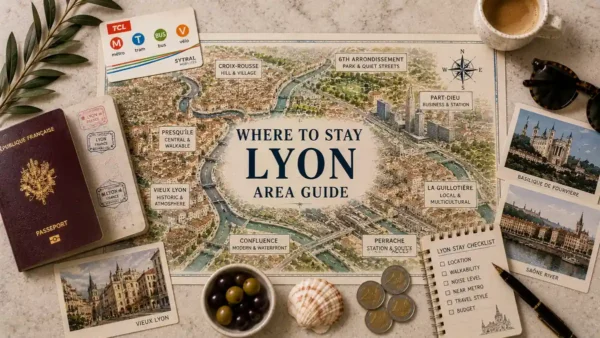
You have narrowed Lyon down to two areas, your dates are set, and the booking tab is still open. The choice comes down to one tension: the Presqu’île puts the city at your door, while Croix-Rousse trades that convenience for a quieter, cheaper, more residential life on the hill above it. Both are realistic bases. Only one is the right default, and the conditions that overturn it are specific, not vague.
This page resolves the choice dimension by dimension — location and the hill, cost, hotel supply, atmosphere, food and evenings — naming a winner in each. It also covers the middle ground most comparisons skip — the slopes between the two — and how trip length and traveler type shift the answer. It closes with a choose-if block so you can book without rereading anything.
Quick Answer
Book the Presqu’île: it is the default base for most Lyon trips. Croix-Rousse is the conditional pick for repeat visitors, longer stays, and apartment renters who want a residential neighbourhood. The tradeoff is daily convenience and hotel choice against quiet local life above the city, with the climb as the recurring cost.
Trust Layer
Tripstou comparison guide for travelers choosing between options. Covers tradeoffs, traveler fit, and decision logic.
Produced with AI assistance and reviewed by Alex Perrut, working in tourism since 2015, for the Tripstou editorial team. See our editorial process for details.
Last factual review: August 23, 2026.
Official sources consulted: France.fr, Atout France.
Key Takeaways
- Book the Presqu’île by default: it is flat, central, and carries the full range of hotels most Lyon trips need.
- Croix-Rousse earns its place on repeat visits, longer stays, and apartment bookings where residential calm outweighs daily convenience.
- The hill is a recurring daily cost, not a one-off, and thin hotel stock narrows the shortlist up there.
- Croix-Rousse generally costs less per night for a comparable room, though the best-value places on the plateau book out early.
- The Pentes, in the 1st arrondissement, split the difference: local texture without the plateau’s full climb.
- The classic mistake is booking the plateau for a two-night first visit, then paying the hill every evening.
Table of Contents
Presqu’île Is the Default Base for Most Lyon Trips
The Presqu’île is the default base for most Lyon trips. The peninsula between the Rhône and the Saône puts restaurants, shops, transport and sights within walking distance, so nothing about the day needs planning. Croix-Rousse asks you to trade that convenience for neighbourhood life.
The default holds for the profile that describes most visitors: a few nights booked, a hotel rather than an apartment, and a sightseeing-heavy first pass at the city. On the peninsula you drop your bags, walk out, and are somewhere useful in any direction. On a short trip that is worth more than any charm a neighbourhood can offer.
Two honest caveats before the dimensions. Lyon has other viable bases, and the full survey of them sits in our guide to where to stay in Lyon. The third contender readers most often weigh alongside these two is Vieux Lyon, the UNESCO-listed old town below Fourvière — worth knowing about, out of scope here.
The scoreboard below summarises the five dimensions the rest of the page argues out in full.
| Decision dimension | Winner | Why it wins |
|---|---|---|
| Location and the hill | Presqu’île, by a decisive margin | Flat, central, and no climb home at night |
| Nightly cost for a room | Croix-Rousse, consistently but not dramatically | Residential streets sit outside central pricing pressure |
| Hotel choice and supply | Presqu’île, and it is not close | Full hotel range across every category and style |
| Atmosphere, noise and crowds | Croix-Rousse for quiet-seeking travelers | Market-square calm against city-centre bustle |
| Food and evenings out | Split by the evening you want | Local bouchons up top, variety and late tables below |
How Hard Is the Hill if You Stay in Croix-Rousse?
Presqu’île wins on location, and the hill is the reason. Staying in Croix-Rousse means the climb is part of every single day: you walk down into the centre easily and you come back up the hard way, or you take the metro.
The walk down is the easy half. From the plateau you descend through the Pentes and land on the Presqu’île around Place des Terreaux, with the Hôtel de Ville and the Musée des Beaux-Arts right there — a genuinely pleasant way to open a day. The return is the other half, and it is a climb, taken at the end of the evening on tired legs.
Metro line C is the fix, and it is an unusual one: a rack railway that hauls itself up the hill, successor to the funicular that first tied the plateau to the centre. It removes the effort of the ascent. It does not remove the step of walking to a station, waiting, and riding.
How decisive the hill is depends entirely on you. For travelers with heavy luggage, limited mobility, small children, or a low tolerance for gradients, it settles the page on its own. For fit walkers who are happy using the metro daily, the margin narrows to a mild inconvenience they stop noticing.
The hill is not a one-time cost. You pay it on every return, and a short trip returns to base more often per night than a long one — which is why the climb punishes three-night stays far more than three-week stays.
Croix-Rousse Usually Wins on Price
Croix-Rousse generally costs less per night than the Presqu’île for a comparable room. It is residential, apartment-heavy, and under less tourist pressure, so the same standard of stay is priced more gently. The gap is real. It is not the whole decision.
The reason is structural. Croix-Rousse is a residential district first and a visitor destination second, its supply skews to apartments and small independent places, and it sits outside the zone where central demand sets the rate. The Presqu’île is where business travelers, weekenders and tour groups all compete for the same rooms.
The advantage has a limit worth naming. Because the hill’s stock is thin, the well-priced places go early, and readers who leave the booking late often end up choosing between a compromise up there and a decent room in the centre — at which point the saving has already evaporated. On the hill, the discount belongs to whoever books first.
If the decision is purely financial and the area is negotiable, our budget guide to staying in Lyon works through the cheaper options across the whole city, not only these two.
Presqu’île Wins on Hotels — Croix-Rousse Skews to Apartments
The Presqu’île wins on hotels, and it often settles the booking before preference enters. The peninsula carries a full range, from simple to high-end. Croix-Rousse has few hotels and leans towards apartments, short lets and small guesthouses, so the shortlist there is narrow by nature.
This asymmetry decides more bookings than atmosphere ever does. Hotel-dependent travelers — anyone who wants a front desk, daily housekeeping, a late arrival handled by a person, or loyalty points — end up on the Presqu’île almost automatically, because that is where the categories exist side by side.
Apartment renters are the group for whom Croix-Rousse genuinely competes. The kitchen is the point. Self-catering matches the hill’s rhythm — a market a few streets away, a longer stay, the same faces recurring — and that is the version of this comparison the plateau can win outright.
Property-level decisions belong elsewhere: our roundup of boutique hotels in Lyon handles named picks and what each one suits.
Hotels and places to stay
Compare hotels, apartments and stays for your dates in one search.
Search hotels and stays on hotels.com →
Tripstou may earn a commission if you book through this link, at no extra cost to you.
Is the Presqu’île Too Touristy to Stay In?
No — the Presqu’île is busy and central, but it is not a tourist trap. It is a working city centre where residents shop, commute and eat. Croix-Rousse wins for travelers who prioritise quiet and want a residential street to come home to.
Busy on the peninsula means something specific: pedestrianised shopping streets, wide open squares — Place Bellecour is one of the largest in Europe — and steady foot traffic well into the evening. The crowds mix visitors with locals going about ordinary business, which is what keeps the area from feeling staged. What it is not is quiet at night on the liveliest streets.
The plateau supplies the counterweight: a market square, cafés serving the same regulars, streets that empty after dinner. Neither is wrong. Travelers who sleep lightly, or who want the sensation of living somewhere for a week, notice the difference on the first night.
The full picture of the peninsula — its squares, streets and character in detail — sits in our Presqu’île area guide.
Bouchons, Markets and Evenings: Which Area Eats Better?
Both areas eat well, and the winner splits by what you want from the evening. Croix-Rousse wins for neighbourhood bouchons and its near-daily market, where you eat where people live. The Presqu’île wins for choice and for evenings that stay lively after dinner.
Croix-Rousse eats like a neighbourhood. Its bouchons serve a local crowd, the near-daily market shapes how people shop and cook up there, and dinner is usually somewhere down the street from your door. The pleasure is familiarity, and it builds over a stay.
The Presqu’île eats like a city centre. More places per street, more registers — bistros, bouchons, wine bars, tables still serving late — and no need to decide anything in advance, because something is always open when you walk out.
Evenings diverge on the same line. The plateau winds down; the peninsula keeps going, which reads as an asset or a problem depending on your sleeping habits and your plans for the night. Bar districts and late-night specifics sit outside this comparison — our Lyon nightlife stay guide covers where to base yourself for that.
The Pentes de la Croix-Rousse Are the Real Middle Ground
The Pentes de la Croix-Rousse are a different area from the plateau, and they are the honest middle ground. The slopes sit in the 1st arrondissement, closer to the centre than the plateau in the 4th, more local than the Presqu’île, and still uphill.
The slopes change the verdict for readers who are genuinely torn. They carry the lived-in texture that draws people to the hill in the first place, while cutting the climb down to a fraction of the plateau’s — you are walking up from Terreaux, not up the whole hill. The compromise is that the Pentes are steep, stepped and busy in their own right, so they deliver neither the flat convenience of the peninsula nor the calm of the plateau.
That is a real answer, not a fence-sit. If the Presqu’île feels too central and the plateau feels too far, the slopes are the address you have been looking for — and most competing guides never separate the two, which is why readers keep booking the wrong half of Croix-Rousse.
Everything the hill contains — the plateau, the Pentes, and the silk history that shaped both — is covered in our Croix-Rousse area guide.
First Trip or Short Trip? That Usually Settles It
For a first visit or a stay of a few nights, book the Presqu’île. Short trips have no slack: the climb and the thin hotel stock cost you daily. Croix-Rousse rewards repeat visitors and longer, slower stays that can absorb both and cash in the residential upside.
Trip length changes the maths in both directions. Over two or three nights, every disadvantage of the hill runs at full strength and almost none of the upside is collected — you climb home each night, you have booked from a narrow shortlist, and you have not been there long enough to become a regular anywhere. Over a week or more, the trade reverses: the climb becomes routine, an apartment starts to make sense, and the neighbourhood begins to feel like yours.
First visits work the same way. A first trip is spent covering ground across the whole city, which the peninsula supports and the plateau taxes. Return visits are spent going deeper into one part of it, which is precisely what Croix-Rousse repays.
The mistake that comes up most often is picking the plateau for a two-night first visit because of the village atmosphere, then spending both evenings negotiating the hill instead of enjoying the village.
The full first-timer recommendation across every Lyon area is in our first-time Lyon stay guide, and the wider trip — timing, how many days, what to see — belongs to the Lyon travel guide.
How to Choose Between Presqu’île and Croix-Rousse
Book the Presqu’île unless a specific condition points uphill. It is the stronger default on location, hotel choice and convenience, which is what most Lyon trips actually run on. Croix-Rousse wins on nightly cost and residential calm, and those two things matter most on longer, slower stays.
The conditions do not overlap. Read both lists and take the one you recognise yourself in.
Choose the Presqu’île if:
- This is your first visit to Lyon.
- Your stay is only a few nights long.
- You want a hotel and a real range of them to choose from.
- Luggage, mobility or steep streets are a concern for anyone in your group.
- You want everything at your door and no daily transport to plan.
Choose Croix-Rousse if:
- You are renting an apartment instead of booking a hotel.
- You have been to Lyon before and have already covered the centre.
- You are staying a week or longer at a slower pace.
- You want market-and-bouchon neighbourhood life over city-centre bustle.
- A lower nightly cost matters more to you than daily convenience.
If your real question turns out to be trip type instead of area, the traveler-specific picks resolve it faster — see where to stay in Lyon for couples, for families, or for a luxury stay.
Frequently Asked Questions
Which arrondissement are the Presqu’île and Croix-Rousse in?
The Presqu’île spans Lyon’s 1st and, mostly, 2nd arrondissements, sitting between the Rhône and the Saône. The Croix-Rousse plateau is the 4th arrondissement, north of the centre and uphill. The Pentes de la Croix-Rousse, the slopes below the plateau, are administratively in the 1st, alongside the northern Presqu’île.
Can you walk from the Presqu’île up to Croix-Rousse?
Yes, and the usual route climbs from around Place des Terreaux through the Pentes to the plateau. It is steep and stepped in places, which is why many travelers ride the rack-railway metro up and keep the walk for the easy downhill return. Either direction is a choice, not a requirement.
Is Croix-Rousse hard to reach with heavy luggage?
It is harder than the Presqu’île, and arrival day is when you feel it most. The plateau sits above the centre, so bags either ride the metro up or get dragged along sloping streets. Travelers with several suitcases usually find the peninsula’s flat approach worth more than the change of scene.
Is Croix-Rousse safe at night?
Croix-Rousse is a residential district, and its streets read as quiet, not threatening, after dark. The plateau empties once dinner ends, so late walks feel calm but unpeopled — the usual city-centre caution about deserted streets applies more than any specific concern. The slopes below stay busier, later.
Is the Croix-Rousse market worth staying nearby for?
For apartment stays, yes — the near-daily market is the clearest practical reason to base yourself on the plateau. It turns self-catering into the point of the trip instead of a compromise. For hotel guests eating out every night, it is a pleasant morning, not a reason to book uphill.
Should you split your stay between the Presqu’île and Croix-Rousse?
Rarely — on a trip of a few nights the move costs more than it returns. Changing hotels burns most of a morning on packing, checking out and waiting for a room. The two areas sit close enough that you can eat and wander in both from either base.
Related Guides
Next steps once the area is settled, and the deeper reading behind each verdict on this page.
- Where to Stay in Lyon — every area compared, if you want to reopen the shortlist.
- Presqu’île Area Guide — the peninsula in full detail.
- Croix-Rousse Area Guide — the plateau, the Pentes and the silk history.
- Vieux Lyon Area Guide — the third contender, if you want to weigh it.
- Where to Stay in Lyon for a First Visit — the full first-timer logic.
- Boutique Hotels in Lyon — named properties once the area is decided.
- Lyon Travel Guide — timing, days needed and what to see.
Did this guide save you time or money? Tripstou is independent and reader-funded — if you'd like to give something back, you can support the site with a crypto contribution of any size.