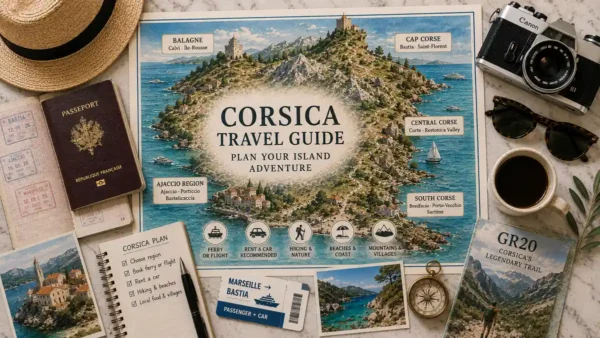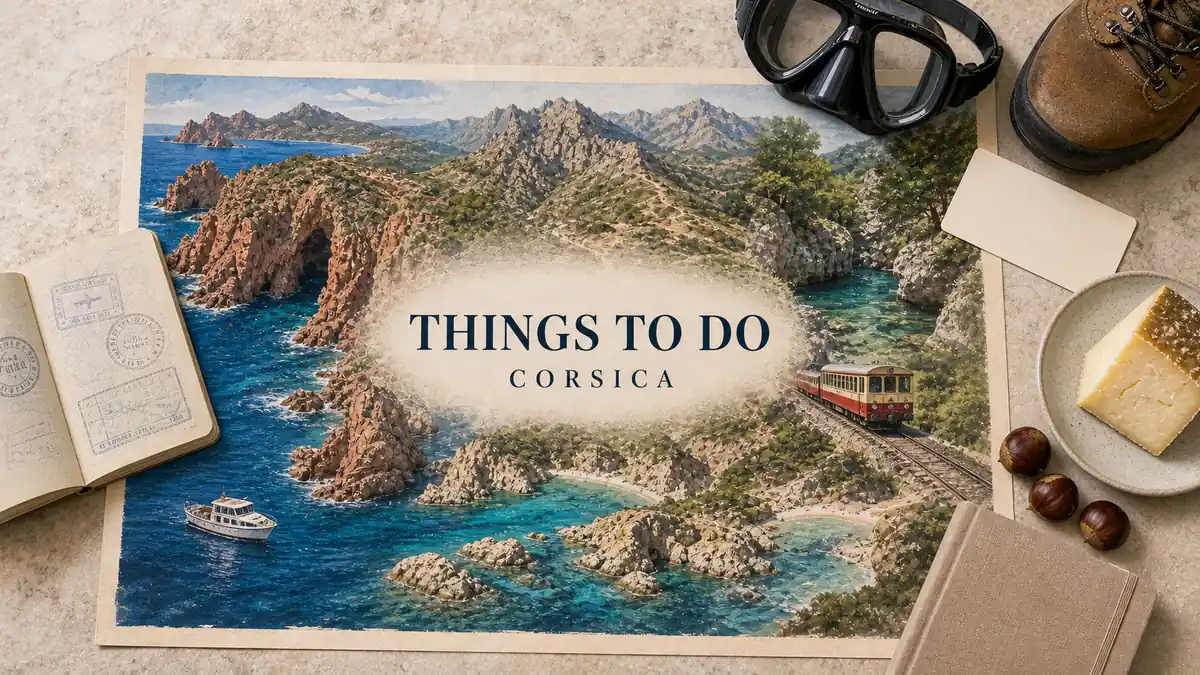
You will have a handful of days on Corsica, and the island’s headline experiences are big, discrete and mostly bookable — which means the planning problem is choosing among them, not collecting them. A boat day along the protected west coast, a crossing to clear-water islets in the far south, a stage of the island’s famously hard long-distance trail, a canyon swim in the interior: each eats most of a day, and each comes in two or three versions that suit very different travelers.
This page resolves those choices. Every experience gets a verdict, the traveler it fits, the honest tradeoff, and the version decision — which departure area, guided or self-skippered, one stage or the full trail. It also covers the access realities the long ranking lists skip: the coastline you cannot land on, the mountains that close on the worst fire-risk days, and the stretch of shore with no road at all. Places appear only as settings.
Quick Answer
Corsica’s best things to do are a few big sea and mountain experiences, not a town checklist. The real decision is which version of each you book — port, guided or self-skippered, one trail stage or the whole crossing. Book boat days ahead in peak summer; keep mountain days flexible for fire-risk closures.
Trust Layer
Tripstou attraction guide for travelers deciding whether an experience is worth doing and how to do it well. Covers value, booking versions, timing, access, and traveler fit.
Produced with AI assistance and reviewed by Alex Perrut, working in tourism since 2015, for the Tripstou editorial team. See our editorial process for details.
Last factual review: August 22, 2026.
Official sources consulted: France.fr, Atout France.
Key Takeaways
- Corsica rewards three or four big sea and mountain experiences far more than a long list of towns ticked off.
- The boat day along the protected west coast suits almost everyone; the full GR20 suits experienced mountain hikers only.
- Your real decision is the version: which harbour you leave from, guided or self-skippered, one trail stage or the whole crossing.
- Peak summer buys the fullest boat schedules but the worst crowding and the highest closure risk; the shoulder months invert both.
- You cannot land inside Scandola, and Corsican massifs can close on severe fire-risk days, so check official status first.
- Cluster experiences around one stretch of coast; every extra pole you add costs hours of mountain switchbacks, not kilometres.
Table of Contents
Corsica Is About Big Experiences, Not a Checklist of Towns
Corsica rewards a few big experiences — sea days, mountain days, wild swimming — more than town-hopping. The island’s distinct experience types are protected-coast boat trips, serious mountain hiking, coastal walking, river and canyon swimming, food and culture, and scenic driving or rail. Choosing three of those beats ticking off fifteen towns.
Corsica is famous for three things above all: the UNESCO-listed Scandola coast, the GR20’s reputation as a punishing mountain crossing, and Ajaccio as the birthplace of Napoleon Bonaparte. Two of those are experiences you book. The third is an afternoon.
The picking rule is easy to apply. Match each experience to the effort you will genuinely put in, then split your days between the coast and the interior so neither pole swallows the trip. Most travelers get the best return from one protected-coast boat day, one mountain or river day, and one slow day built around food and a drive.
Effort is the honest filter, and it sorts the island cleanly into three bands. There are sit-down days spent on the water, moderate days that ask for a few hours of walking or swimming, and full mountain days that take everything you have. Most trips can absorb one day from the top band. Almost none can absorb three, and the trips that try come home tired instead of satisfied.
The experiences that define Corsica are the ones no car can reach — the reserve coast, the roadless gulf, the ridge trail. Build your days around those first and let the drivable sights fill the gaps.
When to go, how to get around and where to base yourself are planning questions, and they belong to the Corsica travel guide. If you want to know how the island’s towns and beaches rank against the mainland’s, that comparison sits with the best places to visit in France, not here. This page stays on what you do once you have arrived.
A Scandola Boat Trip Is the Sea Day to Book First
The boat trip along the UNESCO-listed Scandola coast is Corsica’s one unmissable sea day. It is the only way to see the reserve at all: there is no road in and no walking route into its core, so the landscape is experienced entirely from the water. Almost every traveler should do it once.
What you get is a run along a reserve of red volcanic cliffs, sea caves and nesting colonies inside the Parc naturel régional de Corse, usually taking in the neighbouring gulf and its roadless fishing hamlet — a settlement reached only on foot or by boat, which is exactly why arriving by sea feels like part of the experience, not the commute.
The version decision has two parts: where you leave from, and whether someone else drives the boat.
- From Porto — the closest departure area to the reserve, so the least of your day is spent getting there. Best for travelers already based on the west coast. Tradeoff: it is a small harbour and the most contested boarding point in high summer.
- From Cargèse — a workable middle option a short way down the same coast. Best for travelers touring the west coast by car who do not want to reposition. Tradeoff: more open water before the scenery starts.
- From Ajaccio — the longest run, and the realistic choice if you are based in the south-west. Best for travelers without a car who want the whole thing as one organised excursion. Tradeoff: a large share of the day is transit.
- Guided group boat — a crewed trip with commentary and a fixed route. Best for first-timers and anyone who would prefer not to make decisions at sea. Tradeoff: set schedule, set stops, shared deck.
- Self-skippered hire — a small boat you handle yourself, where local rules allow it. Best for confident boat handlers in a pair or small group. Tradeoff: weather judgement, navigation and compliance with the reserve’s restrictions all become yours.
Budget roughly a half-day from the nearest harbours and a full day from further south. Operators run seasonally, and the shoulder months trade smaller crowds for thinner schedules — a real consideration if you only have one workable window.
Book this day early in your stay, never for your last afternoon. Wind cancels departures, and a trip with no spare days left has no second attempt.
Can You Land on Scandola Nature Reserve?
No. Scandola has no road access, no pedestrian route into the reserve core, and landing inside it is not permitted — the reserve is seen from the water. Activities within the protected area are restricted by the authorities and the rules are revised over time, so confirm current conditions with the Parc naturel régional de Corse before you book.
| Boat day | Departure area | Effort level | Best for | Time commitment |
|---|---|---|---|---|
| Scandola reserve run | West-coast harbours, or Ajaccio further south | Easy — seated, no swimming required | Anyone doing only one boat day | Roughly a half-day; longer from the south |
| Calanques de Piana leg | The same west-coast harbours, usually combined | Easy — normally an add-on leg | Travelers skipping the slow coast road | Folded into the same outing |
| Lavezzi islands crossing | Bonifacio, at the island’s southern tip | Easy crossing, active once ashore | Swimmers, snorkellers and families with children | Roughly a half-day, or a full day |
Tours and activities
Book skip-the-line tickets, day trips and local tours with free cancellation on most activities.
You can also browse everything on getyourguide.com.
Tripstou may earn a commission if you book through this link, at no extra cost to you.
Should You See the Calanques de Piana by Boat or by Road?
See the Calanques de Piana from the water if you can; drive the coast road when time is tight. The red granite towers read as far bigger from sea level, where the cliffs rise straight out of the gulf, and the road delivers the same rock in fragments, from laybys. Both are worth doing.
From the water, the formations arrive as a continuous wall between the gulf and the village that names them, and their scale is legible in a way no viewpoint reproduces. Most west-coast boat outings pass this stretch on the way to or from the reserve, which is why the two sea experiences usually resolve as one booking, not two — a point worth raising with the operator before you pay for anything separately.
From the road, you get repeated stops, control over your own timing, and the ability to be there at the end of the day when the granite goes deep orange. What the road cannot give you is vertical scale: you are always looking down or across at the rock, never up at it from its base.
That leaves three practical ways to book the stretch.
- Folded into a west-coast boat day — the formations pass on the run to or from the reserve. Best for travelers with only one sea day who want both landscapes inside it. Tradeoff: you see the coast on the operator’s clock, not your own.
- Driven at your own pace — the coast road, stopping where you like. Best for drivers already touring the west coast, and for anyone who wants the late light on the granite. Tradeoff: peak-season traffic and laybys that fill early.
- Both, on separate days — the sea version first, the road version on the way out. Best for travelers staying several days on this stretch of coast. Tradeoff: it spends two part-days on a single piece of shoreline.
The honest tradeoff is traffic. The coast road here is narrow, winding and slow, it is shared with coaches and campervans through the peak weeks, and parking at the best viewpoints fills early in the day. A boat departure costs you a fixed block of the day, but it costs you no queueing.
Drive this stretch in one direction only. Doing it out and back to “see it properly” burns the afternoon you could have spent on the water.
The Lavezzi Crossing Is Corsica’s Best Swim-and-Snorkel Day
The boat crossing to the Lavezzi islands is Corsica’s best clear-water swimming day. It is worth the trip for swimmers, snorkellers and families: the islets are low granite, the coves shallow and sheltered, and the water unusually clear. Non-swimmers get much less out of the day, and should weigh it against the west-coast run.
The day itself is simple. You cross from Bonifacio, at the island’s southern tip, and spend your time ashore moving between rock slabs, small beaches and shallow coves — this is a swimming and snorkelling day, not a sightseeing one. The islands lie in a protected marine area in the Bouches de Bonifacio; that protection is a large part of why the water looks the way it does, and it also means the area is actively managed, so check current visitor rules locally before you go.
Two things shape the version here: how long you stay ashore, and when in the season you cross.
- A half-day crossing — over, a few hours on the rocks, back. Best for travelers fitting the islets around other plans in the far south. Tradeoff: you get to know one cove, not the range of them.
- A full day ashore — the whole visit spent in and out of the water. Best for strong swimmers and families who will genuinely use every hour of it. Tradeoff: low granite islets offer little shelter, so heat or wind leaves you nowhere to retreat to.
- A shoulder-season crossing — the same islets outside the peak weeks. Best for anyone who values empty rock slabs over guaranteed sailings. Tradeoff: the water is cooler and fewer departures run, so a cancelled day is harder to replace.
Skip it if your trip is short and the west coast is already on your list. The reserve run delivers landscape you cannot get elsewhere; the crossing delivers water. A good swim is available all around the Corsican coast, and a roadless UNESCO-listed shoreline is not — that asymmetry decides it on a tight schedule.
What settles it is honest self-assessment. It is a day for people who will spend real hours in the water, because once the boat has dropped you there is nothing else on the islets to fill the time with. Whether you need to book ahead is answered in the FAQ below.
You Don’t Need the Full GR20 to Hike Corsica Well
Most visitors should hike one GR20 stage or a good day walk, not attempt the full crossing. The complete trail is a serious mountain undertaking for experienced, well-equipped hikers with time and refuge bookings in place. A single high stage delivers the same rock, exposure and views in one day.
The GR20 is a waymarked long-distance trail running between Calenzana and Conca, managed by the Parc naturel régional de Corse, which also operates the centralised booking system for the refuges along it. Those two facts shape everything: it is a mountain route with fixed overnight infrastructure, and that infrastructure has to be secured in advance.
- The full crossing — the whole waymarked route, refuge to refuge. Best for experienced mountain hikers with scrambling confidence, real fitness and a flexible calendar. Tradeoff: it consumes your trip entirely, and there is no sea day inside it.
- One stage — a single high section walked as a day, or as an overnight with one refuge. Best for fit hill walkers who want the trail’s character without the commitment. Tradeoff: transport at both ends needs planning, and the hardest sections are not the ones nearest the road.
- Day hikes off the trail — established walks in the same massifs and along the coast. Best for normal walkers, mixed-ability groups and anyone pairing hiking with beach days. Tradeoff: you trade the ridge-line drama for accessibility.
The catch with a single stage is that the trail runs point to point, so both ends need a plan — a lift, a second car, a shuttle — and the sections easiest to reach from a road are rarely the ones worth walking. Pick the stage for its terrain first, then solve the transport around it. Doing that in the opposite order is how people end up on the dull half of the mountain.
Beds matter too. Refuges on the route are held through the park’s own centralised system, and that applies just as much to a single overnight on one stage as it does to the full crossing: the beds are finite, and the park’s system is the only route to them. Treat the bed as the thing that fixes your date, not the weather forecast.
Altitude gain, not distance, is what breaks people on Corsican day walks. The trails climb in loose granite steps, and a route that looks modest on a map can still take a full day.
All three versions carry the same caveat: trails and massifs can be closed to the public on severe fire-risk days and under storm alerts, and high summer is when that happens most. Check official status on the morning of any mountain day — the access section below covers this in full.
What Are the Best Day Hikes for Normal Walkers?
The best Corsican day hikes for ordinary walkers fall into three types. Coastal-path walking on the island’s northern cape gives sea views and gentle gradients on marked paths. Forest and river-pool walks in the interior combine shade, a swim and low effort, which makes them the strongest hot-weather option. Balcony trails above the west-coast gulfs deliver the most reward for the most climb, and are the closest thing to a GR20 day without the trail itself. Check conditions and closures before setting out on any of them.
What Can You Do in Corsica Besides Beaches?
Beyond beaches, Corsica delivers canyoning, river swimming, a mountain railway, a distinctive food culture and dramatic drives. That non-beach layer is strong enough to fill half a trip, which is why the island holds up in shoulder season when swimming turns marginal and the mountains are at their best.
- Canyoning and river pools — guided descents and natural swimming holes in granite gorges. Best for active travelers and confident swimmers who want one adrenaline day. Tradeoff: canyoning is guided and seasonal, and water conditions govern when it runs at all.
- The mountain railway — a narrow-gauge line that climbs through the interior between the coasts. Best for non-drivers, families and anyone wanting a mountain day with no effort. Tradeoff: treat it as a scenic experience rather than practical transport, because it is slow by design.
- Food and cultural experiences — charcuterie, sheep’s- and goat’s-milk cheeses, chestnut-based baking, local wine, village markets, and the Napoleon Bonaparte sites in Ajaccio. Best for rest days and days the weather takes away. Tradeoff: much of the good produce is rural and seasonal, so it takes a drive.
- Scenic driving — the coast and mountain roads are themselves an attraction. Best for travelers happy with a slow half-day at the wheel. Tradeoff: these roads are genuinely slow, and map distances flatter them badly.
If you only add one of these, let the weather choose it. Hot, still days belong in a river gorge or a canyon. Grey or windy days belong on the railway or at a market, where nothing is spoiled by cloud. The drives work in almost any conditions, which also makes them the easiest thing to shorten when a day has run late.
Corsica’s interior is the reason to visit outside the peak weeks: the river pools, the forests and the mountain roads are at their best exactly when the beach season is not. That inversion is unusual for a Mediterranean island.
Set against the wider list of things to do in France, Corsica reads differently: the mainland’s headline experiences are museums, cities and châteaux, while almost everything worth doing here happens outdoors.
The Access Rules the Big Listicles Miss
Corsica’s headline sights carry real access rules: no landing inside Scandola, fire-risk trail closures, and roadless coastline. None of these appear in ranked lists of pretty places, and each can cancel a day you have already planned. Check official status before you commit to a mountain day.
- Scandola is sea-access only. No road reaches it, there is no walking route into the reserve core, and landing is not permitted. Activities inside the protected area are restricted, and the rules change — the Parc naturel régional de Corse is the authority to check.
- Mountains and trails close on severe fire-risk days. Forests and massifs can be shut to the public when fire danger is extreme, which happens most often across high summer, and storm alerts close routes too. The park publishes the current status; read it the morning you plan to walk.
- Parts of the coast have no road. The Girolata gulf is reached on foot or by boat only. That is the appeal — but it also means “we will just drive there instead” is not available as a fallback.
- The season cuts both ways. Peak summer brings the fullest boat schedules alongside the highest closure risk and the worst crowding; the shoulder months bring quiet trails and fewer departures.
How to Combine Sea and Mountain Without Living in the Car
Pair each boat day with a mountain or river day near the same coast, not across the island. Corsica’s roads are slow and mountainous, so clustering two or three experiences around one stretch of the island returns far more than chasing five spread across it. Distance on the map is not the constraint; terrain is.
The pairings that work are geographic. A west-coast boat day sits naturally alongside an interior canyon or river day and a balcony walk above the same gulfs. A far-south crossing pairs with coastal walking and the cliffs above the strait. Each cluster gives you a sea experience, a mountain or water experience, and a slow day, without the drive between them eating a morning.
The test for any pairing is the approach road, not the map. Two experiences that share a stretch of coast and the valley behind it run off the same roads, so the driving is short and familiar. Two that look close but sit either side of the island’s mountain spine do not, however encouraging the distance looks. Check what the road actually does between them before you assume they belong to the same day.
What catches almost everyone out is the arithmetic. Every extra experience added on a different part of the island costs a transfer, and transfers here are measured in hours of switchbacks, not kilometres. Two clustered experiences done properly beat four glimpsed through a windscreen.
On a genuinely short trip, drop a pole entirely. Pick the sea or pick the mountains, do that side well, and leave the other for a return visit — the island is not a place you finish. When you are ready to sequence what you have chosen, or to fit Corsica into a wider France itinerary, that ordering is a separate exercise from this one.
Choose the experiences no car can reach, book the water days early in your stay, and keep the mountain days loose enough to move. That order survives contact with Corsican weather. A fixed plan rarely does.
Frequently Asked Questions
Is Corsica Good for Non-Hikers?
Yes. Almost nothing on Corsica’s headline list requires hiking: the signature sea days are experienced sitting on a boat, the best swimming is reached by water, and the mountains open up by train or by car. Only the GR20 demands real mountain fitness, and it is entirely optional.
Can You Do Corsica Without a Car?
Partly. The big bookable experiences work without a car: boat trips leave from harbour towns, the mountain railway crosses the interior, and coastal paths start from settlements. What you lose is the interior, where trailheads, river pools and mountain villages mostly need driving. Getting-around depth belongs to the Corsica planning guide.
Is the GR20 Hard?
Yes — it is widely rated among Europe’s tougher waymarked long-distance trails. The difficulty is terrain, not navigation: loose granite, sustained climbs, exposed scrambling sections and long days between refuges. Fit hill walkers with no scrambling experience should take one stage as a day walk instead of committing to the crossing.
What Water Sports Can You Do in Corsica?
Snorkelling, sea kayaking and paddleboarding, scuba diving, canyoning and river swimming are the main options. Canyoning is guided and seasonal, governed by water conditions; snorkelling needs nothing but a mask and a sheltered cove. Choose by whether you want clear sheltered water or a guided adrenaline day inland.
Do You Need to Book Corsica Boat Tours in Advance?
In peak summer, yes. Demand for the west-coast reserve run and the southern crossing regularly outstrips the seats operators can sell, so booking before you arrive is the safe move. In the shoulder months you can usually decide closer to the day, but fewer sailings run.
Related Guides
- Corsica travel guide — the island’s planning hub: when to go, getting around, and where to base yourself.
- Best places to visit in France — where Corsica’s towns and coastline rank against the rest of the country.
- France itinerary planning — building these experiences into a route that actually works.
- Things to do in France — the national experiences page, for context beyond the island.
Did this guide save you time or money? Tripstou is independent and reader-funded — if you'd like to give something back, you can support the site with a crypto contribution of any size.