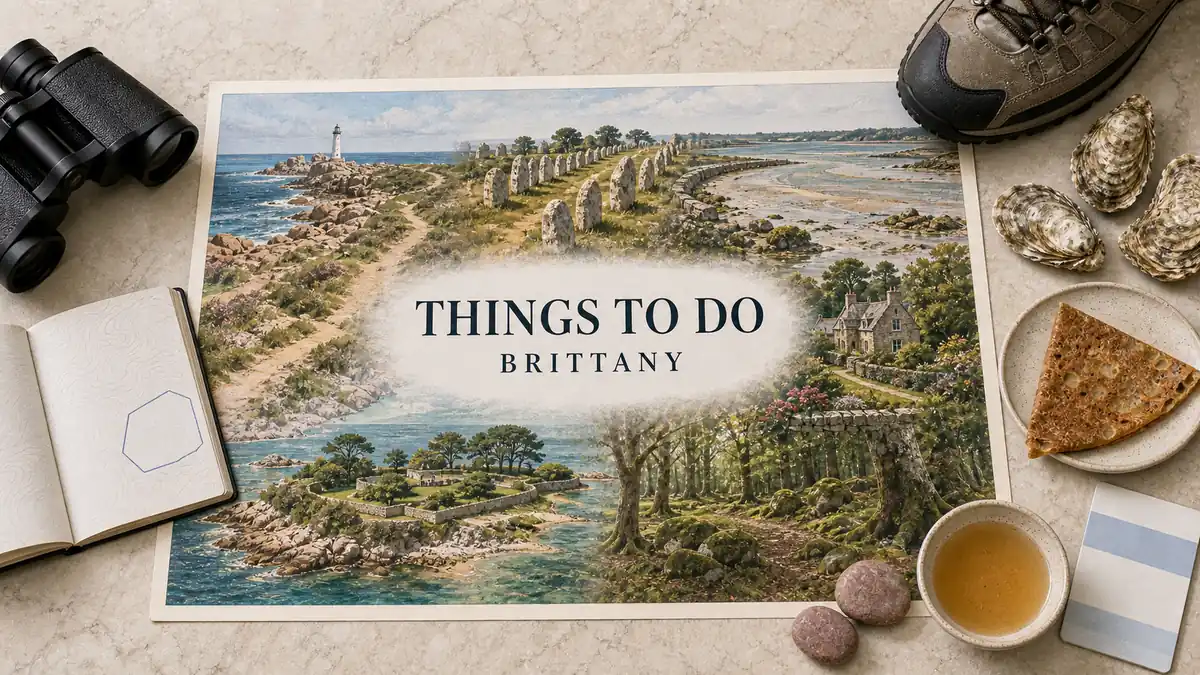
Brittany punishes checklist travel. The region hands you a coastline that takes far longer to cross than the map suggests, weather that rewrites the day, and tides that decide whether a beach path exists at all. Most “things to do in Brittany” lists answer with towns, which is the wrong unit — you cannot do a town, and the drive between two of them can eat the afternoon you meant to spend outdoors.
This page organises Brittany by experience instead. Each one gets the same treatment: what it actually is, who it rewards, the honest case for skipping it, and the one practical thing that changes it — a booking, a season, a tide, a forecast. The set is deliberately small, because Brittany goes better with fewer things done properly. At the end there is a picking rule for matching the set to your own trip.
Quick Answer
Brittany’s best experiences are coastal: walking the GR34 coast path, eating oysters at the source, and the Carnac megaliths. Which ones fit depends on traveler type and conditions, because tides and weather reshape coastal plans here. Anchor the trip on one or two coast experiences, add inland culture, and book seasonal water activities ahead.
Trust Layer
Tripstou attraction guide for travelers deciding whether an experience is worth doing and how to do it well. Covers value, booking versions, timing, access, and traveler fit.
Produced with AI assistance and reviewed by Alex Perrut, working in tourism since 2015, for the Tripstou editorial team. See our editorial process for details.
Last factual review: August 22, 2026.
Official sources consulted: France.fr, Atout France.
Key Takeaways
- Protect one GR34 coast-path walk above everything else; short headland stretches deliver more than a day driving between viewpoints.
- Carnac pays off only if you commit to a version — the guided walk among the stones, or the wider megalithic loop.
- Oysters eaten at the beds, buckwheat galettes and bowls of cider suit almost every traveler, whatever else you skip.
- Book island crossings, guided Carnac access and water-sport courses ahead in high season; the coast path needs no reservation.
- Check an official tide calendar before any foreshore walk, swim or paddle — the north coast’s tidal range is exceptional.
- Timing beats mileage here: the same cove at low and high water is effectively two different places.
Table of Contents
Walking the GR34 Coast Path Is Brittany’s Defining Experience
The GR34 coast path is Brittany’s defining experience, and the one to protect if you do nothing else. Brittany’s character lives on its shoreline, and the old customs path traces it from the Mont-Saint-Michel bay round to Saint-Nazaire. It suits walkers of every level, because it works in short day stretches.
You consume the GR34 in pieces. Pick a headland, walk out and back, or take a local bus one way and walk home. The route carries the red-and-white waymarks used across France’s long-distance network, and it is rarely far from a road or a village, so bailing out early is always an option. A morning on a good stretch delivers more than a full day of driving between viewpoints.
The tradeoff is exposure. The path runs along cliff edges and open headlands where Atlantic wind arrives without much warning, and some sections cross foreshore that only exists at low water. Check an official tide calendar before any stretch that drops onto sand or rock, and treat the forecast as part of the plan itself.
Long stretches are the wrong call if you are walking with small children, managing knees on uneven ground, or working with one fixed weather window. The coast path scales down well. A short, spectacular section on a clear afternoon is the better version for most travelers, and nobody hands out prizes for distance.
Three things decide whether a GR34 day goes smoothly:
- What to check: an official tide calendar for any foreshore section, plus the day’s wind forecast for cliff-top stretches.
- What to bring: a waterproof outer layer, shoes with grip for wet granite, and more water than the distance suggests.
- How to get back: the path is linear, so plan a bus, a taxi or a second car before you start — out-and-back doubles the walking.
On the GR34, the sections where the path leaves the road beat the sections with famous names almost every time. Choose by that and you rarely get a bad walk.
What to See Along the Pink Granite Coast
The Pink Granite Coast is the stretch to walk if you only walk one. Its draw is geological: rounded boulders in rose and amber tones piled along the shore, some of them balanced in shapes that look deliberate. The colour shifts through the day, and late light is when the whole coast earns its name.
The stretch runs broadly between Perros-Guirec, Ploumanac’h and Trébeurden, and the walking there is gentle by GR34 standards — short, well-surfaced, and scenic within minutes of setting off. That combination suits photographers, easy walkers and families with children who will not tolerate a long approach.
What you give up here is solitude. This is one of Brittany’s most photographed shorelines, and the central paths get busy through high season and on fine weekends. Walking early or late solves most of it, and the low sun on pink granite is the better photograph anyway.
Are the Carnac Standing Stones Worth Visiting?
Yes, the Carnac standing stones are worth visiting if you come for scale and mystery, not spectacle. Carnac holds the region’s largest concentration of megalithic standing stones, and the alignments are the headline site: rows of granite marching across open ground. Visitors expecting Stonehenge-style drama find something quieter and stranger.
Access at Carnac is conditional, so decide which version you want before you arrive. Rules change with the season, and the difference between them changes the visit considerably:
- Guided tour inside the alignments — around €13 per adult, and the only version that puts you among the stones with the archaeology explained. Best for anyone who wants context beyond the view. Treat the price as a range and confirm it on the official site before booking.
- Self-guided viewing from the perimeter — the low-effort version, walked from the paths and roads that edge the alignments. Access arrangements vary by season, so check the official site rather than assuming what you read elsewhere still applies.
- The wider megalithic landscape — dolmens, tumuli and smaller alignments scattered through the surrounding area, and the version that turns a quick stop into a proper visit for anyone genuinely interested in prehistory.
Photographs flatten the stones, and that is the honest catch. The alignments work through repetition and extent, with rows continuing well past where you expected them to stop, and that reads poorly on a screen and well on foot. Anyone who needs one dramatic monument will come away underwhelmed.
Skip Carnac if your interest in prehistory is thin and your days are short. It sits on the south coast and competes directly with beach and island time, so it deserves a deliberate decision either way. Carnac rewards the version you commit to — the guided walk among the stones and the slow loop around the wider landscape both deliver, and the drive-by delivers nothing.
Tours and activities
Book skip-the-line tickets, day trips and local tours with free cancellation on most activities.
You can also browse everything on getyourguide.com.
Tripstou may earn a commission if you book through this link, at no extra cost to you.
Eating Your Way Through Brittany: Oysters, Crêpes and Cider
Eating in Brittany counts as an activity in its own right. The region’s three signature things — oysters pulled from beds you can see, buckwheat galettes cooked on a cast-iron billig, and cider poured into a bowl — are consumed at their source. That proximity is the experience, and it suits almost every traveler.
Brittany’s table is built on what the Atlantic and the buckwheat fields give, which is why it feels different from the rest of France. Cider is the local drink here, and wine is the outsider. The instinct is to eat shellfish within sight of where it grew, and neither habit costs you a detour: both are woven into ordinary days on the coast.
Is Eating Oysters at the Source in Cancale Worth It?
Yes, if you eat raw shellfish at all. Cancale is Brittany’s oyster capital, and the experience there is unusually direct: you buy by the dozen from the stalls along the front, eat looking out at the beds the oysters came from, and drop the shells back towards the shore. The appeal is proximity — closer to foraging than to fine dining.
It suits seafood eaters, curious first-timers and anyone who likes food with a visible origin. It suits raw-shellfish sceptics and most young children considerably less, and there is no tactful workaround: order galettes and let the rest of the table have their dozen.
The stalls are walk-up by nature, which makes this an easy thing to slot into a coast day. Sit-down restaurants in town fill up in high season and at weekends, so reserve if you want a table with a view of the bay. Otherwise buy at the stalls and eat outside. That is the version most people remember.
Where Should You Try Crêpes and Cider?
Look for a crêperie that cooks to order on a visible billig and lists its cider by producer. That is the whole test, and it filters out almost everything worth avoiding.
The ritual has a shape: a savoury buckwheat galette first, a sweet wheat crêpe after, and cider drunk from a shallow bowl throughout. Ordering that way is simply how the meal is built locally, and following it makes the whole thing land.
Venue type matters more than location. Places on the busiest harbourfront strips, with laminated menus in four languages and pre-cooked stacks waiting under a lamp, are the ones to walk past. Back streets and inland market towns generally do it better, and a crêperie full of French families at lunchtime is a stronger signal than any review score.
Getting Out on the Water: Island Day Trips, Sailing and Surf
Go out on the water when the coast starts repeating itself. A crossing or a paddle changes your relationship with the shoreline — you see the granite from the side that shaped it — and Brittany’s islands and sheltered gulfs make that easy. Conditions decide everything here: tide, wind and season govern what runs.
Water-based activities are also the part of a Brittany trip most likely to fall through. Operators are seasonal, sailings are weather-dependent, and a plan built around one boat has no slack in it. That is worth knowing before you build a day around it.
Is a Brittany Island Day Trip Worth It?
Yes, and it is the strongest way to break up a coast-heavy trip. Each island holds a distinct character. Belle-Île is the big one, with cliffs, beaches and enough road to warrant wheels. Bréhat is small, car-free and heavily gardened, closer to a long walk than an expedition. Ouessant sits far out in Atlantic weather, bare and lighthouse-marked, and rewards travelers who like the edge of things.
Crossings are short as ferry journeys go, and that is as precise as it is useful to be — services run seasonally, timetables shift, and the return sailing is the one that ruins plans. Check the operator directly for the day you want, and book ahead in high season, when day-trip boats sell out and the last return fills first.
What an island costs you is the shape of your day. A crossing swallows the whole of it and fixes your return time in advance, so it is a poor fit when the forecast is unsettled or your days are already tight. Book the island for the settled day and keep the coast walk for the changeable one. The walk survives bad weather; the boat schedule does not.
Sailing, Kayaking and Surfing the Breton Coast
Each water sport here suits a different traveler, and picking the wrong one wastes a good day:
- Sailing suits travelers who want the region’s own idiom. The Gulf of Morbihan and the north coast are working sailing waters, with schools and charter operations running out of the main ports.
- Sea kayaking suits confident swimmers who want the coast at close range. Sheltered gulfs, bays and estuaries are the forgiving option; open Atlantic coast is no place to learn.
- Surfing suits the Atlantic-facing west and south beaches, where swell is dependable and the water stays bracing. A lesson is the sensible entry point, and boards and wetsuits come with it.
Conditions decide these plans, and they decide them on the day. The north coast has an exceptionally large tidal range, which moves a lot of water quickly across flat sand and around headlands. Check an official tide calendar before any independent paddle, and take the operator’s call as final when they cancel — local judgement on this coast is worth more than optimism.
Train and bus tickets
Compare routes, schedules and prices across rail and bus operators in one search, with mobile tickets on your phone.
New to Omio? Code NEW10 takes 10% off your first booking — or APPNEW10 if you book inside the Omio app. Both apply to bookings up to €80.
Search routes and compare prices on Omio →
Tripstou may earn a commission if you book through this link, at no extra cost to you.
Chasing the King Arthur Legend in Brocéliande Forest
Brocéliande is a legend landscape you walk, and it works only if you meet it halfway. The Forêt de Paimpont carries the Arthurian stories — Merlin’s tomb, the Fountain of Barenton, the Val sans Retour — as marked sites in woodland, with nothing reconstructed and no spectacle laid on. It is Brittany’s best inland counterweight to the coast.
The forest suits mythology readers, families with imaginative children, and walkers who want shade, soft ground and no wind. It also suits the days when the coast is simply unwalkable, because trees handle weather better than clifftops do. Marked trails link the sites, and the walking is undemanding.
The sites themselves are modest, which catches people out. Merlin’s tomb is a small arrangement of stones; the Fountain of Barenton is a spring in a clearing. What makes them work is the story attached, which means Brocéliande rewards preparation more than most attractions do. A few minutes with the legends before you park turns a modest clearing into the place something happened. Arrive cold and it stays a clearing.
Getting around the forest realistically favours having a car, since the sites are spread across the woodland and public transport into the interior is thin. Drop Brocéliande if the stories do nothing for you and your days are short — without the mythology it is pleasant woodland and little more, and Brittany’s coast is doing something the rest of France cannot match.
Experiencing Breton Culture: Fest-Noz, Festivals and Celtic Music
Breton culture is something you can attend, and the fest-noz is the way in. A fest-noz is a communal night of Breton dance to live music, held in village halls and squares, where lines and circles of dancers hold hands and the steps are taught as you go. Visitors are welcome and expected to be beginners.
The form is recognised by UNESCO as intangible cultural heritage, which tells you it is a living practice still danced by the people who live there. Most of the room is local. Somebody will pull you into the line early in the evening, and the steps for the common dances are simple enough to pick up by copying your neighbours.
The wider music scene runs on the same instruments you hear at a fest-noz: the bombarde and the biniou, often paired, plus the massed pipes and drums of a bagad. Brittany’s big festival season concentrates in summer, when Celtic music events draw crowds from across the Atlantic fringe. Those festivals need tickets and accommodation booked well ahead; a fest-noz usually needs nothing but turning up.
This suits curious travelers, music lovers and anyone tired of looking at things from behind a rope. Early sleepers fare worse, since a fest-noz starts late and builds slowly. The listing to look for is the local one: these nights are announced on village noticeboards and community pages far more reliably than on visitor sites, which is why travelers who ask at their accommodation find them and travelers searching in English often do not.
What Can You Do in Brittany When It Rains?
Rain does not cancel a Brittany day; it reorders it. The strong wet-weather set is the big aquarium at Brest, a long lunch in a crêperie, the region’s museums and walled-town interiors, and the forest, which handles grey skies better than the coast does. The mindset that works treats weather as windows.
Océanopolis in Brest is the region’s major aquarium and the most reliable indoor option for families, built around Atlantic, polar and tropical marine life. Check the official site for current opening arrangements and ticketing before you drive there, since these change with the season. It stands as a destination in its own right, and plenty of families plan a day around it deliberately.
The rest of the wet-weather set is already on this page. A long crêperie lunch is a legitimate way to spend a wet middle of the day. Brocéliande is arguably better in drizzle than in sunshine, with the canopy taking most of it. Walled towns, indoor markets and maritime museums absorb an afternoon comfortably. An evening fest-noz turns a written-off day into the one you talk about later.
Brittany’s weather moves fast, and that cuts both ways. A wet morning is a poor reason to abandon the coast walk you planned for the afternoon, so check the forecast again after lunch before committing the whole day to indoors. If Brittany is one leg of a longer French trip, the national picture of what is worth doing sits in our guide to things to do in France.
Which Experiences Work Best with Kids?
The aquarium, the beaches, a short island crossing and the legend forest carry children best. Each one gives them something to do instead of something to look at, which is the whole distinction that matters on a family trip.
Beaches on the north coast come with a caution attached. The tidal range is exceptionally large, water returns across flat sand faster than it looks, and sandbars and rock platforms cut off without drama. Check an official tide calendar before letting children roam a foreshore, and pick your spot with the incoming tide already in mind.
Bréhat works well with children because it is car-free and small enough to walk. Brocéliande works because the stories give the walk a purpose. Long GR34 stretches and the Carnac alignments work least well: one asks for stamina, the other asks for patience, and children rarely have a surplus of both on the same day.
How to Choose Which Brittany Experiences Fit Your Trip
Anchor the trip on one or two coast experiences and one inland counterweight. Let tide, weather and season make the daily call between them. That ordering works because the coast is Brittany’s strongest asset, and because conditions here change what is possible far more often than in inland France.
The coast-versus-inland split is the first decision. The coast holds the walking, the islands, the shellfish and the light, which is why most trips should sit there. Inland adds shelter, legend and a different pace — Brocéliande, market towns, and the crêperies that locals actually use — and it earns its place mainly as the answer to a bad forecast and to coastal fatigue.
| Experience type | Best for | Main tradeoff | Booking logic |
|---|---|---|---|
| Walking the GR34 coast path | Walkers of any level, photographers | Fully exposed to wind and tide | Walk up; check tide and forecast |
| The Carnac megalithic alignments | History and archaeology-minded travelers | Quiet impact; poor in photographs | Guided access varies; check official site |
| Oysters, galettes and cider | Almost everyone, especially food-led travelers | Raw shellfish divides the table | Stalls walk-up; restaurants book weekends |
| Island crossings and watersports | Active travelers and confident swimmers | Consumes a whole day; weather-dependent | Book ahead through the high season |
| Inland legend and Breton culture | Families, mythology and music lovers | Needs imagination and usually a car | Walk up; check local listings first |
The booking logic reduces to two lists. Book ahead for island crossings in high season, guided access at Carnac, sailing and surf courses, and weekend tables at popular seafood restaurants. Walk up for the coast path, crêperies outside peak hours, the forest, and most fest-noz. Everything in the first list has a fixed capacity; everything in the second does not.
Brittany also rewards a slower trip than the road-trip listicles imply. Two experiences done at the right tide beat five done at the wrong one, because timing here changes what an experience actually is. A cove at low water and the same cove at high water are two different places, and no amount of driving between headlands compensates for arriving at the wrong hour.
Once you know which experiences you want, three decisions sit outside this page. Which towns and coastal areas to base in is resolved in our Brittany travel guide. How to sequence these experiences across a wider trip belongs in our guide to planning a France itinerary. And if you are still weighing Brittany against other regions, the comparison sits in our roundup of the best places to visit in France.
Frequently Asked Questions
Is Brittany worth visiting?
Yes, Brittany is worth visiting if you want coastline, seafood and living Celtic culture instead of postcard France. It rewards walkers, food-led travelers and families who tolerate changeable weather. Sun-seekers and headline-monument hunters get less out of it, so match the region to what you genuinely enjoy doing outdoors.
How many days do you need in Brittany?
Allow a long weekend at the absolute minimum and closer to a week for the coast. Brittany’s distances read short on a map and drive long in practice, and tides and weather regularly force a swap. Fewer stops with more time at each beats a fast loop between headlands.
Do you need a car in Brittany?
A car is not essential, but it widens the region considerably. Trains and buses serve the main coastal towns, and a regional TER BreizhGo pass covers rail travel. Inland sites like Brocéliande, remote GR34 trailheads and small harbours are far harder without wheels, so decide by where your experiences sit.
When is the best time of year to visit Brittany?
Late spring and early autumn are the strongest windows, with long daylight, open coastal operators and thinner crowds than peak summer. Summer brings the warmest sea, the festival season and the busiest paths. Winter suits walkers and storm-watchers only, since many coastal and island operations run seasonally.
Is Mont-Saint-Michel in Brittany?
No, Mont-Saint-Michel sits in Normandy, not Brittany. The bay around it straddles the border, which is why it appears on so many Breton itineraries and why the GR34 coast path begins nearby. Visiting from eastern Brittany is easy, but the abbey itself belongs to its Norman neighbour.
What is Brittany known for?
Brittany is known for its Celtic identity, its enormous tidal coastline and its food. That means a living Breton language and music tradition, the megalithic monuments at Carnac, oysters and buckwheat galettes, pink granite headlands, and lighthouses standing in Atlantic weather. The region reads more Celtic than conventionally French.
Can you swim in Brittany?
Yes, you can swim in Brittany, though the Atlantic stays bracing even at the height of summer. Beaches on both coasts are excellent, and many are supervised in season. The north coast’s tidal range is the real caution: check an official tide calendar before swimming, and watch for sandbars that cut off.
Related Guides
These guides handle the planning decisions this page deliberately routes onward.
- Brittany travel guide — which coasts and towns to base in, how long to stay, and how to get around the region.
- France itinerary guide — how to sequence a national trip and where a Breton leg fits inside it.
- Best places to visit in France — how Brittany compares with the other regions competing for your days.
- Things to do in France — the national picture of experiences, from the Atlantic coast to the Alps.
Did this guide save you time or money? Tripstou is independent and reader-funded — if you'd like to give something back, you can support the site with a crypto contribution of any size.