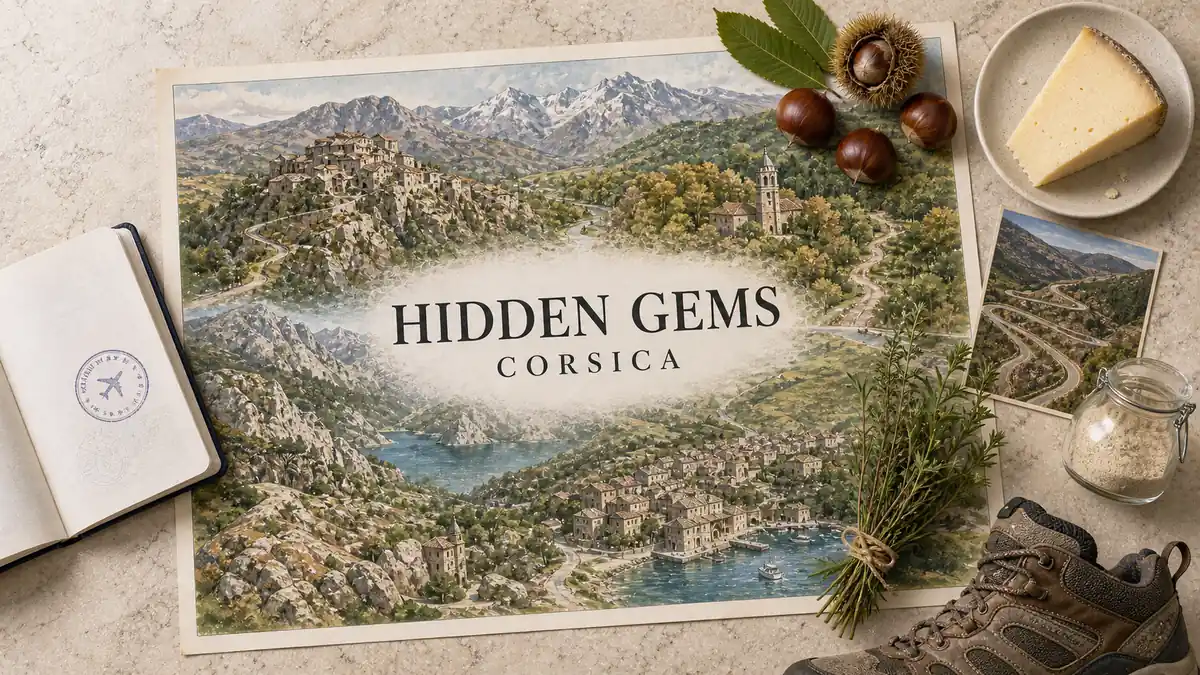
You can already name Bonifacio, Calvi and Porto-Vecchio. This page is for what comes after that list: the Corsican towns, villages and areas that never reach a first-time itinerary and reward the detour anyway.
Every entry here is a destination — a town, a village or a small inland area. No beaches, no hikes, no boat trips; those belong to a different page and a different decision. The picks are grouped by micro-region instead of ranked in a flat countdown, so the list doubles as routing. Choose the area nearest the coast you have already booked, and the detour more or less plans itself.
The shortlist leans on Corsican and regional sources — the island’s own tourist board, the Costa Verde office, the regional nature park — which is why several of the areas below, the Boziu pieve above all, appear in almost no English-language hidden-gems roundup.
Quick Answer
Corsica’s best hidden gems are inland villages, and the Boziu pieve near Corte leads the list. The shortlist below covers six micro-regions and destinations only, so each pick slots into a coast-anchored trip. Cap Corse’s small fishing villages are the alternative for travelers who want quiet without a long mountain drive.
Trust Layer
Tripstou selection guide for travelers choosing between multiple places. Covers selection criteria, traveler fit, and trip value.
Produced with AI assistance and reviewed by Alex Perrut, working in tourism since 2015, for the Tripstou editorial team. See our editorial process for details.
Last factual review: August 22, 2026.
Official sources consulted: France.fr, Atout France.
Key Takeaways
- The Boziu pieve inland of Corte is Corsica’s most overlooked area, profiled by the island’s own board and absent from English lists.
- Cap Corse gives you Corsica’s quietest coastal villages without committing a day to a mountain drive inland.
- Castagniccia’s chestnut-forest villages are the authenticity pick: an inhabited landscape running at half strength, best judged as a drive with stops.
- Pigna and Sant’Antonino are sold as hidden and are not; the genuinely quiet Balagne starts one ridge further inland.
- A car is the real cost of entry: interior villages combine into good days only if you can string them together.
- Attach one interior area to a coast-anchored trip; the Alta Rocca is the only one that needs no redesign.
Table of Contents
Corsica’s Real Hidden Gems Are Inland, Not on the Coast
The quiet Corsica is inland: the coast holds the fame, the interior holds the gems. Almost every crowded place on the island sits within sight of the sea, while the mountain pieves behind them stay quiet even in high season. Hidden here means a destination you could not have named before opening this page.
The famous circuit earns its reputation. Bonifacio, Calvi, Porto-Vecchio, Ajaccio, Bastia, Scandola, the Calanques de Piana and Palombaggia are why most people book Corsica in the first place, and they sit inside our shortlist of the best places to visit in France. This page is the complement to that circuit, not a substitute for it. If you have never seen Bonifacio’s cliffs, go and see them. If you have, keep reading.
Three things keep the interior overlooked. The roads are slow and narrow, so an inland detour costs more of the day than the map suggests. There are no headline sights up there — no lone monument a coach tour can be sold on. And the villages are small: a few dozen residents, one square, one church, not much else. That scale is the whole attraction, and it is also the reason mass tourism never arrived.
Be honest about the trade-off before you drive out. Interior villages carry few services, low-season hours are unpredictable, and a village you can cross on foot in minutes will not fill an afternoon by itself.
The area is the unit on this island, not the village. Three or four hamlets inside one pieve make a satisfying half-day; a single hamlet on its own rarely justifies the climb up to it. Every group below is built that way. The same famous-versus-quiet split runs through the mainland too, and our roundup of hidden gems in France applies it at national scale.
| Area | Character | Standout picks | Best for |
|---|---|---|---|
| Cap Corse | Working fishing villages on a dead-end peninsula | Centuri, Nonza, Pino, Barcaggio | Quiet coast without a mountain drive |
| Balagne back-country | Perched villages behind a busy tour circuit | Speloncato, Galeria and the Fango valley | Escaping the crowds near Calvi |
| Castagniccia | Chestnut forest and ambitious baroque churches | La Porta, Piedicroce, Nucariu, Cervione | Slow, lived-in inland Corsica |
| Boziu | Near-empty ridge hamlets inland of Corte | Sermanu, Tralonca, Bustanicu, Castellare | The island’s most overlooked corner |
| Niolu | High mountain basin reached only over passes | Calacuccia, Albertacce | Big landscapes and near-total quiet |
| Alta Rocca | Granite villages above the southern beaches | Levie, Zonza, Quenza | A cool detour from a beach-based trip |
Cap Corse Hides Corsica’s Quietest Coastal Villages
Centuri, Nonza, Pino and Barcaggio are Cap Corse’s quiet standouts, all on the peninsula north of Bastia. The cap stays under-visited for one structural reason: it is a dead end. Nobody drives its corniche on the way to somewhere else, so it never collects the passing traffic that fills the rest of the coast.
Two Cap Corse names have already been found. Erbalunga on the eastern shore and Patrimonio at the neck of the peninsula both draw steady day-trippers, and neither belongs on a hidden list. Everything further north thins out fast. The corniche is narrow, cut into the slope, and slow in both directions — which is precisely why the villages along it stayed small.
Drive the peninsula as a loop in one direction and stop often. Doubling back along that corniche is where a Cap Corse day quietly disappears.
Centuri
Centuri is Corsica’s best-known lobster fishing port, and it still works for a living. Boats come in, crates come off, and the harbour gets on with its business in front of you. What separates it from every other stop on the cap is that the activity is real: this is a place with a job, not a viewpoint with boats arranged in it. The harbour is tiny and the houses press right down to the water.
Pick this if: you want a working fishing port where the catch still comes ashore in front of you.
Nonza
Nonza sits high on the western side of the cap, above a dark-pebble beach at the foot of the cliffs. The contrast makes the village: a tight stack of tall houses on the clifftop, with the grey shore a long way below. Most visitors take the view from the road and drive on, which leaves the lanes themselves calm at almost any hour. Treat the beach as scenery seen from above, not as the reason to stop.
Pick this if: you want the most dramatic single view on the peninsula without leaving the village.
Pino
Pino is the Cap Corse village to choose when you want the peninsula with nobody in it. It spills down a wooded slope on the western coast, old stone houses scattered among the trees, with no harbour front to gather people and nowhere obvious for a coach to stop. Nothing in particular happens there. That is the entire proposition, and it is a better one than it sounds on a peninsula this quiet.
Pick this if: you are happy in a village with no attraction at all and no one else looking at it.
Barcaggio
Barcaggio is the end of the road at the northern tip of Cap Corse, past which there is only sea. Reaching it means a narrow lane down to a scatter of houses where the land simply runs out. The reward is positional instead of scenic: this is as far north as Corsica goes, and very few people drive the extra stretch to prove it. Go for the feeling of having run out of island.
Pick this if: you like reaching the physical end of a place and will drive a rough lane to do it.
The Balagne Back-Country Is Quieter Than Its Famous Villages
Speloncato is the Balagne pick the crowds miss, and it sits barely inland from the region’s busiest villages. Pigna and Sant’Antonino are sold as hidden and are anything but; both are fixed stops on the Balagne tour circuit. The genuinely quiet Balagne begins one ridge further in and runs to the wild western edge.
The trap here is specific. Pigna and Sant’Antonino are restored, well organised and pleasant, with craft workshops, marked parking and steady coach arrivals through the season — everything a hidden village is not. Nothing is wrong with visiting them. The mistake is expecting solitude there, then concluding the Balagne has none left.
Distance from Calvi predicts the crowd far better than the charm of the village does. The Balagne empties in direct proportion to how far the day-trip circuit has to drive.
Speloncato
Speloncato is a perched village on the Balagne’s inland ridge, looking back across the whole plain to the sea. It earns its place by what it lacks: no craft-shop row, no coach bay, no restored-for-visitors sheen. The lanes are steep and shaded, the square is somewhere people actually sit, and daily life is not organised around arrivals. It is a short drive and a complete change of atmosphere from the circuit below.
Pick this if: you want a perched Balagne village that is still lived in and not curated for visitors.
Galeria and the Fango Valley
Galeria and the Fango valley are the Balagne’s wild western edge, where the cultivated hills give out and the coastline turns empty. Galeria is a small settlement at a river mouth with very little built around it; the Fango runs inland behind it through a broad valley of bare rock and old forest. Of everything on this page, this is the entry that is an area more than a village. You come for the emptiness of the whole valley.
Pick this if: you want the least developed stretch of the northwest coast and a valley to drive into.
Castagniccia’s Chestnut Villages Are Corsica at Its Most Authentic
Castagniccia is the interior region most visitors never enter, and its villages reward slow detours. The Costa Verde tourist office counts 29 villages across this chestnut-forest interior of Haute-Corse, and almost none of them sees a tour group. La Porta, Piedicroce, Nucariu and the eastern gateways are where to start.
Chestnut is not decoration here; it was the economy. The forest fed the region for centuries, and the sheer density of villages, churches and stone paths across these ridges only makes sense once you know how many people that crop supported. Then the population left and the forest stayed. What remains is an inhabited landscape running at half strength — still lived in, with room to spare.
Roads through the pieve wind constantly and almost never run straight for long, so plan on the driving being a large share of the day. Villages sit close together on the map and much further apart in practice.
Castagniccia is the one area on this list where the road between the villages is as good as any village on it. Judge it as a drive with stops, and it makes immediate sense.
La Porta
La Porta is the baroque set piece of Castagniccia and the traditional centre of the pieve. Its church front and bell tower are the most ambitious architecture anywhere in the interior, built at a scale that looks improbable for a village this size — which is exactly the point, because chestnut money paid for it. Most other churches across the region are plainer versions of the same ambition.
Pick this if: you want to see what interior Corsica built when the chestnut economy paid for it.
Piedicroce and the Orezza Valley
Piedicroce sits at the heart of the Orezza valley and works best as the point you navigate from. It is where the roads through Castagniccia converge, which makes it the practical anchor for a day spent looping the pieve, and it looks straight across at the forested slopes opposite. On its own it is modest. As the fixed point for reaching La Porta, Nucariu and the villages beyond, it is the obvious choice.
Pick this if: you want one fixed point to loop the Orezza valley from in a single day.
Nucariu
Nucariu carries the region’s chestnut story in a form you can actually go and see: Casa Paoletti and a chestnut-grove interpretation trail are both Parc naturel régional de Corse sites. That makes it the village where the Castagniccia landscape is explained on the ground, instead of admired from a car window and left at that. Confirm current opening arrangements locally before you build a day around it.
Pick this if: you want the chestnut culture explained on site instead of left to guesswork.
Cervione and Vescovato
Cervione and Vescovato are the eastern gateways, sitting where the coastal plain lifts into the Castagniccia hills. Vescovato belongs properly to the eastern plain, and both are larger and easier to approach than the pieve villages behind them. Use them as the entrance to the region if you are coming up from the east coast — then keep driving inland, because the gateways are the least hidden thing in this section.
Pick this if: you are approaching Castagniccia from the eastern plain and want a graded introduction.
The Boziu Is the Hidden Corsica Even Guidebooks Miss
The Boziu is Corsica’s most underrated area: a pieve of near-empty hamlets inland of Corte. Corsica’s own tourist board profiles it, while English-language hidden-gems lists do not mention it at all. Expect ridge-top villages, polyphonic singing, revolt history and roads where you may not pass another car.
A pieve is the old parish district that organised Corsican life long before communes and departments, and the Boziu still reads as one. Its hamlets sit along the ridges inland of Corte, close enough to see each other and separate enough to have kept distinct identities. Corte is the natural gate into the whole group.
Two things give the Boziu weight far beyond its size. It is a reference area for Corsican polyphonic singing, the male multi-voice tradition that remains the island’s strongest cultural signature. It is also revolt country: the 1729 rising against Genoese rule has roots here, which is how a pieve of a few hundred residents ended up carrying this much of the island’s history.
What it does not have is infrastructure. There is no visitor centre, no signposted circuit and nothing that opens on a schedule you can plan around. Roads are single-track in places, and the island’s own tourist board warns that snow can make them impassable in winter, so check conditions before driving up in the cold months.
Nobody in the Boziu will point you at anything — no interpretive panel, no marked viewpoint, no suggested loop. The area only works for travelers comfortable arriving with no plan and letting the ridge roads decide the afternoon.
Tralonca
Tralonca is the gateway hamlet, the Boziu village closest to Corte and the simplest one to reach. It sits compact on a rounded spur with its houses turned inward around a single core, so it reads as one solid block from the approach road. That makes it the most striking arrival in the pieve. Being nearest to Corte, it is also the Boziu village you can see without committing a whole day to the area.
Pick this if: you want a first taste of the Boziu on a half-day out of Corte.
Sermanu
Sermanu is a reference point for Corsican polyphonic singing, and that is what lifts it above every other hamlet of its size. The tradition here is tied to the village’s church music and is treated on the island as a living lineage, not a folklore performance staged for visitors. There is no schedule to plan around and no ticket desk. The value is knowing exactly what the place means while you are standing in it.
Pick this if: Corsican polyphony matters to you and you want to stand where the tradition is anchored.
Bustanicu
Bustanicu is where the Boziu’s history sits: the village is tied to the 1729 revolt against Genoese rule, the rising that opened Corsica’s long fight for self-government. It is a plain hamlet to look at, and the architecture is not the reason to come. Standing on the ridge and grasping that the island’s defining political story began in villages exactly this small changes how you read the rest of the interior.
Pick this if: you travel for history and want the origin point of Corsica’s independence story.
Castellare di Mercuriu
Castellare di Mercuriu is the practical anchor of the pieve, because it has a grocery open year-round. In an area with no visitor infrastructure at all, that one detail shapes the whole day: this is the place to stock up before looping the smaller hamlets, and the only Boziu village where you should assume anything is open. The village itself is quiet and workaday. In this pieve, that is entirely normal.
Pick this if: you are spending a full day in the Boziu and need somewhere to buy food.
The Smaller Boziu Hamlets
Alandu, Mazzola, Santa Lucia di Mercuriu and Sant’Andria di u Boziu are the pieve’s deep end, and they string together into one short circuit of ridge roads. No one of them carries a headline reason to go. Taken as a set, they give the clearest picture available of what an emptied Corsican interior actually looks like. Drive them slowly in a single loop and expect chapels and cemeteries to be locked.
Pick this if: you want to drive a full circuit of near-empty hamlets and read the interior as a whole.
Niolu and the Central Mountains Feel Like Another Island
Calacuccia and Albertacce anchor the Niolu, Corsica’s high mountain interior, far from any coastal crowd. The Niolu is a broad basin held in by the island’s biggest peaks and reached only over passes. That enclosure is why it stayed pastoral, and why it still feels like nowhere else in Corsica.
Getting in is most of the character. Every approach climbs — up the gorge from the east, over the Col de Vergio from the west — and the landscape changes completely on the way, from maquis and chestnut to bare granite and pine. Arriving genuinely feels like crossing into another country. The Niolu is shepherding land and reads that way: stone hamlets, hard winters, a culture that faced its mountains and turned its back on the sea.
Snow closes the high passes in the cold months, which makes this the area on the page where seasonal access matters most. Check road conditions before setting out.
Here the approach outranks the destination. Drive in over a pass and straight back out again, and you have still had the best of the Niolu.
Calacuccia
Calacuccia is the Niolu’s main village and the natural stop in the valley, sitting beside the lake with the high peaks lined up behind it. It is the one settlement in the basin with a proper centre, which is why every route through the Niolu uses it as the reference point. The view across the water to the mountains is the reason it earns a place on this list at all.
Pick this if: you want one stop in the high mountains with a village centre and a big view.
Albertacce
Albertacce is the quieter neighbour a few bends further up the valley, and the pick for anyone who found Calacuccia already too organised. It is smaller, plainer and more purely pastoral, with the shepherding culture of the Niolu much closer to the surface. Nothing here is arranged for visitors. Choose it when the point of the day is to slow down rather than to see something specific.
Pick this if: you want the Niolu at its most pastoral and are not looking for a village centre.
The Alta Rocca Rewards the Drive into the Southern Interior
Levie, Zonza and Quenza hold the quiet granite south that most beach-bound visitors skip. The Alta Rocca sits directly above the southern coast, cooler and greener and far emptier than the shoreline below. It is the easiest interior detour in Corsica to attach to a trip already booked around the beaches.
Proximity is the argument. The southern coast fills hard in high season while the villages on the ridges above it stay comparatively empty, so this is the cheapest escape on the island in terms of effort. Granite, cork oak and pine replace the coastal maquis, and the temperature drops as you climb. Everything in this section is a place, not an outing — for hiking, boat trips and beach days near these villages, our guide to things to do in Corsica covers the experience side. Further west, the hinterland behind Sartène offers the same quiet in a rougher form if you are crossing the south anyway.
Add the Alta Rocca to a beach trip and nothing else has to change. Every other group on this page asks you to give up a coastal day to reach it.
Levie
Levie is the Alta Rocca’s main village, and the strongest reason to drive up sits just outside it: Cucuruzzu, a Bronze Age fortified site in the woods. That gives the area something no other pick on this page has — deep prehistory on the doorstep, in a region normally read through its medieval and Genoese layers. Confirm access arrangements locally before you plan a day around the site.
Pick this if: prehistoric Corsica interests you and you want an interior village with real substance.
Zonza and Quenza
Zonza and Quenza are the mountain-village pair above Levie, and they are where the Alta Rocca turns fully alpine. Both sit beneath the granite peaks that dominate the southern skyline, with the Coscione plateau spreading out behind them as their backdrop. Zonza is the busier of the two, Quenza the plainer and calmer. Together they make the most scenic short drive in the southern interior.
Pick this if: you want alpine scenery and cool air within reach of the southern beaches.
Do You Need a Car to Reach Corsica’s Inland Villages?
Yes — a car is the practical way into Corsica’s interior, and the roads demand patience. Nearly every village on this page sits at the end of a climbing mountain road with no obvious alternative. Without your own vehicle, the hidden Corsica described here is effectively out of reach on a short trip.
What a car really buys is combination. One inland village rarely fills a day, while four in the same pieve make a genuinely good one, and only driving lets you string them together. Distance is not the constraint here. Combining stops is.
Then drive the way these roads ask you to. Interior routes are narrow, frequently single-track, and they climb and turn far more than a line on a map suggests, so leave the schedule loose and avoid planning a tight sequence of stops. Snow can close interior roads outright in the cold months, and conditions are worth checking before you set off. Fuel and food are not things to assume inland either; sort both on the coast before you head up.
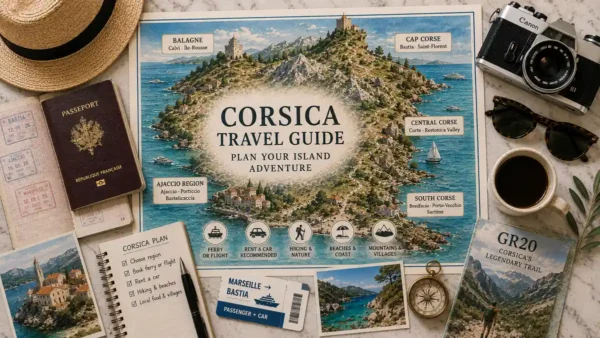
Island-level logistics — how long to give Corsica, when to come, which coast to base on, ferries and arrival — are resolved in our Corsica travel guide.
Train and bus tickets
Compare routes, schedules and prices across rail and bus operators in one search, with mobile tickets on your phone.
New to Omio? Code NEW10 takes 10% off your first booking — or APPNEW10 if you book inside the Omio app. Both apply to bookings up to €80.
Search routes and compare prices on Omio →
Tripstou may earn a commission if you book through this link, at no extra cost to you.
Frequently Asked Questions
What is the most underrated village in Corsica?
Sermanu, in the Boziu pieve inland of Corte, is the strongest single answer. It is a reference point for Corsican polyphonic singing, yet it appears in no English-language hidden-gems list. Nothing there is arranged for visitors, so the reward is entirely in knowing what the place carries.
Is Corsica too crowded in August?
The coast is, the interior is not. Crowding on Corsica concentrates on a short list of famous coastal towns and beaches, while the mountain pieves a short drive behind them stay quiet through high season. Basing near the coast and driving inland by day solves most of it.
Can you visit Corsica’s mountain villages in winter?
Often yes, but access decides it. Corsica’s own tourist board warns that snow can make interior roads impassable in the cold months, and the highest areas, including the Niolu, are the most exposed. Check conditions before setting out and leave the day loose enough to turn back.
Are there still authentic villages in Corsica?
Yes — the interior pieves still work as lived-in villages. Boziu’s hamlets and the Castagniccia chestnut villages run on their residents’ routines, not on visitor arrivals: no craft-shop row, no coach bay, no restored-for-photographs sheen. The trade-off is that little is open and few places explain what you are looking at.
Which Corsican villages are considered the most beautiful?
Sant’Antonino, Pigna, Nonza and Centuri are the names most often called Corsica’s most beautiful villages. The first two are firmly on the Balagne coach circuit, and beauty and crowds travel together here. The quieter picks grouped by area above trade some of that polish for solitude.
Related Guides
Once you have picked an area, these guides turn it into a trip — the island planning hub, the famous circuit this page complements, the experiences near your picks, and the same underrated axis at national scale.
- Corsica travel guide — how long to stay, when to go, where to base and how to get around the island.
- Best places to visit in France — the famous Corsican names and where they sit among France’s headline destinations.
- Things to do in Corsica — the hikes, boat trips and beach days that pair with the villages above.
- Hidden gems in France — the same famous-versus-quiet split applied across the mainland regions.
Did this guide save you time or money? Tripstou is independent and reader-funded — if you'd like to give something back, you can support the site with a crypto contribution of any size.