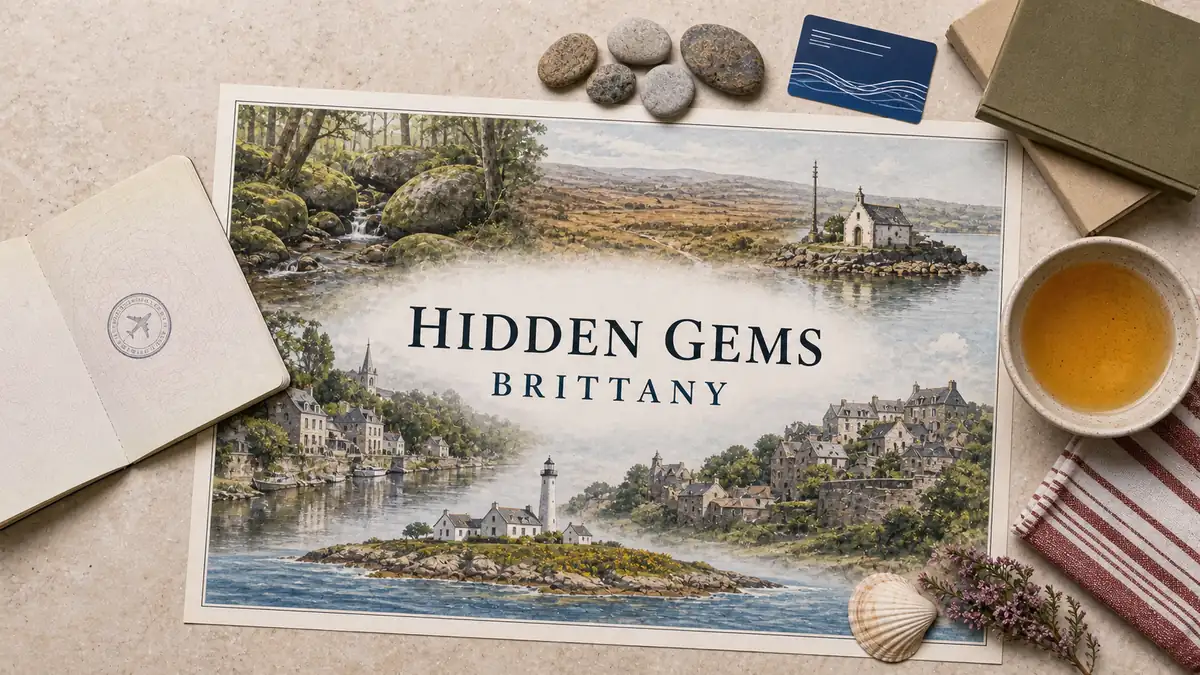
Search for hidden gems in Brittany and you get Saint-Malo, Dinan, Carnac and Quimper — the four names already on your itinerary. Some lists go further and hand you Mont-Saint-Michel, which is administratively in Normandy. The promise in the title breaks in the first paragraph, and you finish the page exactly where you started.
This page applies a harder test. Every pick below comes from the Breton tourist board’s own quiet-places material, from the Petites Cités de Caractère register, or from French-language regional sources — not the recycled English shortlist. The picks are grouped by department, because a village you cannot attach to your route is trivia, not a discovery. For each one you get where it sits, why it stayed overlooked, who it suits, and what reaching it actually involves.
Quick Answer
Brittany’s strongest overlooked places are Huelgoat, Saint-Cado, Pontrieux and Bécherel. Picks are grouped by department — Finistère, Morbihan, Côtes-d’Armor and Ille-et-Vilaine — so you can add the ones your route already passes. For quiet coast, the smaller islands — Bréhat, Ouessant and Houat — stay calmer than the famous beaches.
Trust Layer
Tripstou selection guide for travelers choosing between multiple places. Covers selection criteria, traveler fit, and trip value.
Produced with AI assistance and reviewed by Alex Perrut, working in tourism since 2015, for the Tripstou editorial team. See our editorial process for details.
Last factual review: August 22, 2026.
Official sources consulted: France.fr, Atout France.
Key Takeaways
- Brittany’s genuine hidden gems sit inland — the coast holds the crowds, and the interior holds the overlooked towns.
- Use the department grouping as routing logic: pick the group your existing Brittany route already passes, not the prettiest name.
- Huelgoat and Locarn are the two picks nobody on an English-language itinerary has already found.
- Skip Belle-Île for the smaller islands: Houat, Hoëdic, Ouessant and Molène stay quiet because reaching them takes effort.
- A heritage label signals architecture, not solitude — the most marketed labelled villages are also Brittany’s busiest.
- Most inland picks are car-first, so plan short loops of two and keep the islands for car-free days.
Table of Contents
Most ‘Hidden Brittany’ Lists Are Just the Famous Circuit
A hidden gem in Brittany is a place the English-language lists leave out entirely. Most sit inland, on secondary roads, or along a stretch of coast the coach circuit never reaches. Beauty is not the test on this page. Obscurity is, and Brittany still has plenty of it.
The English lists fail because they resell the famous circuit as a discovery. A page promising off-the-beaten-path Brittany opens with Saint-Malo, Dinan, Vannes and Quimper — towns that are excellent and heavily visited, which is the opposite of what the headline offered. The circuit is worth doing on its own terms, and our guide to the best places to visit in France covers Brittany’s headline names. This page is the complement.
Brittany stays quiet inland because almost everyone comes for the coast. Traffic lands in the north, runs west along the top edge or south to the megalith country, and rarely turns into the middle of the peninsula. Rail geography reinforces the pattern: the fast lines serve the big coastal cities, and the interior is left to secondary lines and roads. Nothing about the inland towns declined. The visitors simply never arrived.
The most-marketed “village de caractère” names are also the busiest, which is why Locronan and Rochefort-en-Terre are not picks here. A label pulls in coaches; it does not guarantee quiet. Every place profiled below either appears in the Breton board’s own quiet-places material or holds a Petites Cités de Caractère listing without the traffic that follows those two.
The same famous-versus-overlooked axis runs nationally in our guide to hidden gems across France. This page stays region-deep, at department level, because in Brittany the department is what decides whether a village is an easy detour or a lost afternoon.
Is inland Brittany worth visiting?
Yes — inland Brittany is the region’s most underrated half, and it holds most of the picks on this page. The Monts d’Arrée give the region its highest and emptiest ground. The Nantes–Brest canal strings together a line of small towns that were ports for a while and then were left alone. The legend forests of inland eastern Brittany carry the Arthurian material that the coast has no share of.
The interior suits travelers who have already done the coast, anyone travelling in high summer who wants space, and drivers who enjoy the road between places as much as the places. The trade-offs are real: fewer services, small sites with reduced winter opening, and almost no useful public transport.
| Area | Picks on this page | Best suited to | Access reality |
|---|---|---|---|
| Finistère, the far west | Huelgoat, the Monts d’Arrée, Pont-Croix, Le Conquet, Sainte-Marine | Landscape, capes and the Atlantic edge | Car for the interior, ports for the islands |
| Morbihan, rias and canal | Saint-Cado, Le Faouët, Malestroit, La Roche-Bernard, Port-Louis | Small water towns away from the gulf | Mostly driving, with Port-Louis the exception |
| Côtes-d’Armor, the inland north | Locarn, Pontrieux, Quintin, Moncontour, Lac de Guerlédan | Heritage towns and inland lake country | Car country once you leave the coast road |
| Ille-et-Vilaine, the quieter east | Bécherel, Saint-Just, Bazouges-la-Pérouse, Île-aux-Pies, Léhon | Books, standing stones and river valleys | Easiest group to add to a northern trip |
| The smaller islands | Bréhat, Batz, Ouessant, Molène, Houat, Hoëdic | Travelers chasing the quietest coast available | Boat from a mainland port, weather permitting |
Hidden Gems in Finistère: Brittany’s Wild West and Interior
Finistère’s strongest overlooked picks are Huelgoat, the Monts d’Arrée, Pont-Croix, Le Conquet and Sainte-Marine. The department covers Brittany’s far west and its emptiest interior — chaos forests, moorland, cape villages and quiet ria banks. It is the region at its most extreme, and its least crowded.
Finistère stays quiet because it is the end of the line in every direction. Visitors coming from Paris or from the Channel run out of appetite somewhere short of the far west, and everything past that point — the capes, the western tip, the moorland spine down the middle — absorbs whoever keeps going. Distance alone keeps it empty.
Huelgoat: the forest of collapsed granite
Huelgoat is the most striking inland place in Brittany and still barely known outside France. It is a small lake town in central Finistère wrapped in a forest where the ground is a jumble of enormous granite boulders, with a river running underneath them. The Breton tourist board lists it among its own quiet places.
What separates it from every other pick here is that the landscape does the work, not the architecture. The town is modest; the chaos is why you came. Paths run between and over the boulders, so the visit is physical in a way none of the village picks are — and wet granite punishes the wrong shoes.
Pick this if: you want one inland stop that looks like nowhere else in France.
The Monts d’Arrée and the Armorique park: Brittany’s high, empty middle
The Monts d’Arrée hold Brittany’s highest ground and its emptiest landscape. They run across inland Finistère inside the Armorique regional natural park: moorland, peat, rock crests and long views over a region most people picture entirely as coastline. The scale surprises anyone who arrived expecting cliffs and crêperies.
This is an area pick, not a village, and that changes how you use it. There is no centre to park in and walk around. You drive a road across the moor, stop where the view opens, and the weather decides the day. In cloud you see almost nothing. On a clear afternoon it is the widest horizon in the region.
Pick this if: you are travelling by car and want landscape instead of another old town.
Pont-Croix: the tiered town above the Goyen
Pont-Croix carries the Petites Cités de Caractère label and is the quietest way into the Cap Sizun. It stands above the Goyen in western Finistère, with stepped lanes running down towards the water and a church out of all proportion to the size of the town around it.
Its distinction here is position. It sits just inland of the cape road, so traffic heading for the western headlands passes close by without stopping, which is precisely why the town kept its own rhythm. Treat it as the base or the pause on a cape day, not as the destination itself.
Pick this if: you are driving the Cap Sizun and want a real town at either end of it.
Le Conquet: the working port at the western tip
Le Conquet is a Petites Cités de Caractère port at Brittany’s far western edge, and it is a working harbour before it is a view. Stone houses, a sheltered inlet, boats that go out for fish and not for passengers, and the open Atlantic immediately beyond the entrance.
It earns its place as the mainland pick that feels like an island. It is also the natural embarkation point for the far-western islands covered further down, which means many visitors only ever see it as a departure lounge. Staying to walk it is the whole trick.
Pick this if: you want the Atlantic edge without committing to a sea crossing.
Sainte-Marine: the quiet bank of the Odet
Sainte-Marine is the calm side of a busy estuary. It sits on the western bank of the Odet facing Bénodet, with a small harbour, a short quay and a clear view across to the resort town that everybody else chose instead.
That contrast is the point, and it is what keeps this pick working in high summer when little else on the south coast does. The hotels, the traffic and the crowds are on the far bank; the near bank keeps a village scale. It is small. An hour or two, not a day.
Pick this if: you are on the south coast in peak season and need calm within sight of the crowds.
If you have more time in the department, five more names are worth the detour:
- Le Faou — a Petites Cités de Caractère town on the way into the Monts d’Arrée.
- Quimperlé — a river town in the south-east that the coastal traffic bypasses.
- Audierne and the Cap Sizun coast — the working end of the cape, beyond Pont-Croix.
- Daoulas — a small town on the inner shore of the Rade de Brest.
- Guerlesquin — a Petites Cités de Caractère town on the Finistère and Côtes-d’Armor border.
Hidden Gems in Morbihan: Ria Villages and Canal Towns
Morbihan’s strongest overlooked picks are Saint-Cado, Le Faouët, Malestroit, La Roche-Bernard and Port-Louis. The gulf and the megalith coast take almost all of the department’s visitors. The rias to the west and the canal towns inland keep the quiet, and they hold the better small places.
Morbihan concentrates its crowds into a small area. The gulf, the megalith country and the southern beaches sit close together, which leaves the western rias and the whole canal corridor comparatively empty. Two landscapes do the work here: tidal inlets that cut deep inland, and a waterway that briefly turned a line of interior towns into ports and then left them behind.
The Nantes–Brest canal is the department’s most useful routing line. Everything strung along it stayed quiet, and none of it appears on an itinerary built around the gulf.
Saint-Cado: the chapel islet in the Ria d’Étel
Saint-Cado is a tiny islet in the Ria d’Étel, joined to the shore and instantly recognisable once you have seen it. It sits in western Morbihan, in a tidal inlet that branches inland away from the open coast, and it stays off English-language itineraries almost completely.
It is the smallest pick on this page and makes no pretence otherwise. A chapel, a handful of houses, water on every side; the visit is short and mostly about looking. The ria changes character entirely with the state of the tide, so photographers plan around it and everyone else arrives by chance.
Pick this if: you collect small, strange places and are happy with a very short stop.
Le Faouët: the market hall and the chapel nobody mentions
Le Faouët has one of Brittany’s great covered market halls and a chapel most visitors have never heard of. It sits inland in western Morbihan, well north of the coast road, and the Breton tourist board lists it among its own quieter places.
Two buildings of that quality in a town with almost no visitors is an unusual combination, and it is what separates this pick from the canal towns nearby. The market hall dominates the centre; the Saint-Fiacre chapel stands apart from the town and is the reason many French visitors come at all. Both keep reduced winter opening — check before driving out.
Pick this if: you would go out of your way for one exceptional building.
Malestroit: the canal town in the middle of the department
Malestroit is a Petites Cités de Caractère town on the Nantes–Brest canal and the easiest introduction to inland Morbihan. Carved old houses face a small square, the canal runs through the town, and the whole centre is walkable well inside a short visit.
Its value here is as a hinge, not a headline. It sits in the middle of the department, which makes it the natural break between the coast and the eastern forests, and the towpath gives it a reason to hold you longer than the square alone would.
Pick this if: you are crossing Morbihan and want a canal stop with something to look at.
La Roche-Bernard: the river port on the southern boundary
La Roche-Bernard is a Petites Cités de Caractère town set on a rock above the Vilaine, at the department’s south-eastern edge. It was a river port, it still has the marina below and the old town above, and almost nobody driving past stops for it.
It is the pick for travelers arriving from the south or leaving that way, because it sits where Brittany ends. The split-level layout is the distinguishing feature — old streets on top, water below — and it makes a far better break than anything on the main road nearby.
Pick this if: you are entering or leaving Brittany from the south-east and want one good stop.
Port-Louis: the walled town facing Lorient
Port-Louis is a walled Petites Cités de Caractère town facing Lorient across the water, and the citadel is why it looks the way it does. It stands at the mouth of the Blavet in southern Morbihan, with ramparts, a compact grid of streets and beaches immediately outside the walls.
Sitting next to a large working city is exactly why it stays overlooked: visitors write off the whole Lorient area and never notice the fortified town on the other side of the harbour. It is the most substantial coastal pick in this department — walls, streets, sand and somewhere to eat, all in one small place.
Pick this if: you want a fortified coastal town without the Saint-Malo crowds.
Also in Morbihan, if the trip allows more inland time:
- Pont-Scorff — a Petites Cités de Caractère town on the Scorff, north of Lorient.
- Locuon, in Ploërdut — a Gallo-Roman granite quarry site the Breton board lists among its secret places.
- Lizio and Le Gorvello — two small inland villages French-language sources return to repeatedly.
- Guémené-sur-Scorff and La Gacilly — further inland again, on opposite sides of the department.
- The Gâvres peninsula — a long sand spit and the department’s quiet-beach answer; see the coast section below.
Hidden Gems in Côtes-d’Armor: The Overlooked North and Lake Country
Côtes-d’Armor’s strongest overlooked picks are Locarn, Pontrieux, Quintin, Moncontour-de-Bretagne and Lac de Guerlédan. Almost everyone crosses this department on the way to the Pink Granite Coast and sees none of it. The inland north and the lake country behind it hold the quietest towns.
Côtes-d’Armor is a drive-through department, and that is the entire explanation. Its famous stretch is the pink granite shore in the north-west, so traffic runs along the top edge and turns for the sea. Everything in the middle — the weaving and linen towns, the river valleys, the reservoir country on the southern border — was never on the route to begin with.
Locarn and the Corong valley: the river that vanishes under granite
Locarn is the least-known name on this page and one of the Breton tourist board’s own picks. It is a small commune in inland Côtes-d’Armor beside the Corong gorges, where the river disappears beneath a field of enormous granite blocks and can be heard rather than seen.
This is the closest thing Brittany has to a genuine secret, and it does not appear on the English lists at all. The site is natural, not built, so there is nothing to open and no queue to join. The trade-off is the ground itself: rough underfoot, dark under the trees, and unpleasant after heavy rain.
Pick this if: you want the one place nobody you know has already visited.
Pontrieux: the washhouse town on the Trieux
Pontrieux is a Petites Cités de Caractère town on the Trieux, inland from the north coast, and its riverside washhouses are what make it. The old town runs along the water, houses backing straight onto the river, in a valley the coastal traffic crosses without pausing.
No other pick sits this close to a famous stretch of coast while taking such a small share of its visitors. The riverside is best appreciated from the water itself, and access to the washhouses is small-scale and seasonal, so confirm what is running before you build a morning around it.
Pick this if: you are heading for the north coast and want one inland stop on the way.
Quintin: the linen town that never rebuilt itself
Quintin is a Petites Cités de Caractère town that grew rich on linen and never remodelled afterwards. It sits inland in central Côtes-d’Armor, with granite merchant houses stacked on a slope, a château at the top and a basilica that outsizes the place around it.
The old wealth is the distinguishing feature. This is not a fishing village that turned pretty, it is a former industrial town with the architecture to prove it — which makes it the most substantial inland stop in the department, and the one most likely to have something open when the smaller picks do not.
Pick this if: you want an inland town with proper streets and a working centre.
Moncontour-de-Bretagne: the walled town on the ridge
Moncontour-de-Bretagne is a walled Petites Cités de Caractère town on a hilltop, and the setting is the whole argument. It stands inland in the east of the department, ramparts tracing the ridge, with steep lanes inside and open countryside falling away on every side of it.
Next to Quintin this is the picturesque option and the smaller one. You walk the walls, you walk the streets, and you are finished — but it photographs better than anything else inland here, and it is close enough to Quintin that the two make one loop instead of two separate outings.
Pick this if: you want the best-looking small town in the Breton interior.
Lac de Guerlédan and Bon-Repos abbey: the inland water
Lac de Guerlédan is a long reservoir in deep wooded country, with the ruins of Bon-Repos abbey beside it. It lies on the Côtes-d’Armor and Morbihan border, on the old canal line, and the landscape around it — steep, forested, entirely inland — looks nothing like the Brittany on the postcards.
This is the department’s area pick, and it functions as a base more than a stop. The shore and the abbey together fill a day for travelers who have had enough of town centres. The abbey is a partly ruined site with seasonal opening, so check before planning the day around it.
Pick this if: you want a day of woodland and inland water in the middle of a coastal trip.
Pair the inland picks into loops of two — Quintin with Moncontour, Pontrieux with a north-coast day — because each is a short visit on its own and the driving between them is the real cost.
Three more Petites Cités de Caractère towns sit in this department if you are already inland: La Roche-Derrien above the Jaudy, Châtelaudren in the north, and Jugon-les-Lacs in its own lake country on the eastern side.
Hidden Gems in Ille-et-Vilaine: Brittany’s Quieter East
Ille-et-Vilaine’s strongest overlooked picks are Bécherel, Saint-Just, Bazouges-la-Pérouse, Île-aux-Pies and Léhon. Brittany’s eastern department empties the moment the Saint-Malo traffic turns for the coast. What stays behind is a country of book towns, river cliffs and megalithic moorland with barely a visitor on it.
The east is the half of Brittany people cross without noticing. Arrivals from Paris and from the Channel go through it at speed on the way to the sea, and the department’s own attractions — inland, small, spread thinly — never interrupt that momentum. It is also the most addable group on this page for anyone whose trip already includes the famous northern towns.
Bécherel: the hilltop book town
Bécherel is a Petites Cités de Caractère hilltop town that reinvented itself around books, and the bookshops are the reason to come. It stands on high ground in the north of the department, a former linen town of grey granite streets now lined with secondhand dealers and small presses.
No other pick here has a reason to exist beyond its own architecture, which is what makes this one different: you go for what is inside the buildings. It rewards browsing time, and it rewards French readers most, since the stock is overwhelmingly French. Opening days are not uniform across the shops, so check before making the trip.
Pick this if: you read French and can happily lose an afternoon in secondhand bookshops.
Saint-Just: the megalithic moor almost nobody visits
Saint-Just sits on a heath of standing stones that receives a tiny fraction of Brittany’s megalith traffic. The site is open moorland in the south of the department, alignments and stone rows spread across rough ground, with almost no infrastructure built around any of it.
The contrast with Brittany’s famous alignments is the entire case for coming: no fencing, no coach park, no queue. Nothing is explained on site either, so it suits travelers who are content to walk into a landscape and work it out for themselves. Bring the right shoes; the moor is exposed and often wet.
Pick this if: you want standing stones without the crowds of the famous alignments.
Bazouges-la-Pérouse: the village the artists took over
Bazouges-la-Pérouse is a Petites Cités de Caractère village that filled its old houses with artists, galleries and workshops. It sits in the far north of the department, inland from the bay, a granite village built along one long street with studios scattered behind it.
It is the quietest of the eastern picks and the most seasonal, since the art side of the village is busiest in the warmer months and thins out afterwards. Position is the practical argument for it: it is close to the main route running south from the north coast, so it costs a trip almost nothing.
Pick this if: you like villages that have been taken over by artists and workshops.
Île-aux-Pies: the river cliffs on the Oust
Île-aux-Pies is a stretch of river cliffs on the Oust and another of the Breton board’s own quiet places. It sits in the south of the department where the valley narrows, rock walls standing above the water and wooded banks below, in a landscape far more dramatic than the farmland around it.
This is an area pick, and its distinction is being proper river country in a region that sells sea. It has the same appeal as the inland lakes further west, at a smaller scale and closer to the regional capital — which also makes it busiest on warm weekends, when locals arrive long before visitors do.
Pick this if: you want river scenery on a warm day and can go midweek.
Léhon: the priory village on the Rance
Léhon is a Petites Cités de Caractère village on the Rance and the easiest pick on this page to attach to the famous northern circuit. It lies just upstream of a walled town almost every Brittany trip already includes, with an old priory, a small bridge and a riverbank that stays calm.
Proximity is its entire value. A village this close to a major stop would normally be overrun, and it is not, because visitors arrive for the big name and leave straight from it. The village is small; the visit is short. Treat it as an add-on to a day you were spending on the Rance anyway.
Pick this if: you are already on the Rance and want a quiet half hour the crowds skip.
Three more Petites Cités de Caractère towns ring the department east of the regional capital: Châteaugiron, where castle towers stand over a small centre; Saint-Aubin-du-Cormier, built beneath a ruined fortress; and La Guerche-de-Bretagne, an old market town near the eastern border.
The Smaller Islands Are Brittany’s Quietest Coast
Brittany’s smaller islands, not its famous beaches, are where the coast still stays genuinely quiet. A crossing filters out day traffic in a way no headland can, and the smallest islands filter it hardest. On the mainland, only a handful of coastal picks come close.
Those mainland exceptions are already named above: Le Conquet at the western tip, Sainte-Marine across the water from a busier resort, Saint-Cado tucked into its ria, and the Gâvres peninsula in Morbihan, a long sand spit with a road down it and very little else. All four work for the same reason: the crowd went somewhere adjacent.
Belle-Île is the island everyone books, and that is the problem with it. It is large, well served and busy in season. The three pairs below are the alternatives, and each is quieter for a specific, checkable reason. What to actually do on and around this coast is covered in our guide to things to do in Brittany.
Bréhat and Batz: the short-crossing pair in the north
Bréhat and Batz are the easiest of Brittany’s small islands to reach, both a short crossing off the north coast. Bréhat is car-free and the better known of the two. Batz lies off the north Finistère coast and is lower, quieter and more worked than visited, with market gardens where Bréhat has villas.
They stay calmer than Belle-Île because both are small enough to walk and too small to hold an overnight crowd — most people come for the day, and the islands empty in the evening. Bréhat is the busier of the pair in high season, so if quiet is the objective, Batz is the safer choice. Check the day’s sailings and the weather before committing.
Pick this if: you want an island day without giving up an entire travel day.
Ouessant and Molène: the far-west pair the weather controls
Ouessant and Molène lie furthest out in the Atlantic, west of Finistère, and the sea decides who reaches them. Ouessant is the larger, treeless and wind-shaped, with lighthouses and low stone houses. Molène is smaller again — a village-sized island with almost nothing built on it.
They beat Belle-Île for quiet because the crossing is longer and openly weather-dependent, which removes casual visitors entirely. That is also the catch. A day trip out here can be shortened or cancelled outright, and both islands repay an overnight far more than a rushed few hours ashore. Treat any same-day return as provisional.
Pick this if: you want genuine remoteness and can absorb a change of plan.
Houat and Hoëdic: the southern pair that replaces Belle-Île
Houat and Hoëdic are the direct alternatives to Belle-Île, sitting in the same southern waters and taking a fraction of the visitors. Both are small, low and sandy, with one village apiece, no real road network, and beaches that stay empty even when the mainland coast fills up.
They outdo Belle-Île for quiet for the plainest reason available: there is nothing on them to build a resort around. That is the trade — beaches, walking and very little else, with limited beds if you want to stay over. Crossings run from the southern Morbihan ports and thin out in the colder months.
Pick this if: you want Belle-Île’s coastline with none of its infrastructure.
Crossing length is the real filter out here. The longer and more exposed the boat, the emptier the island — which is why Ouessant holds its calm on a hot August weekend and Bréhat does not.
Tours and activities
Book skip-the-line tickets, day trips and local tours with free cancellation on most activities.
You can also browse everything on getyourguide.com.
Tripstou may earn a commission if you book through this link, at no extra cost to you.
Do You Need a Car to Reach Brittany’s Hidden Gems?
For most of the inland picks on this page, yes — you will need a car. A minority sit on or near a served line, and the islands are reached from mainland ports you can get to by train and bus. The interior is where the network thins out.
Brittany’s rail geography explains the split. Main lines serve the large coastal cities, and regional TER and BreizhGo services extend from them along the coasts and out to the bigger inland towns. The small places profiled above are mostly not on that map: a moorland road in the Monts d’Arrée, a canal village, a heath in the south-east of Ille-et-Vilaine. Those have always been driving destinations.
- Reachable without a car: coastal and larger inland towns near served stations, plus the islands, whose crossings leave from ports on the network.
- Reachable with effort: places close to a served town, where a bus link or a short taxi ride closes the gap — workable for one pick, tiring across several.
- Car-first: the moorland, the gorges, the canal villages and the small heritage towns, which is the majority of this page.
The practical consequence is about sequencing, not access. With a car, the department groups above turn into half-day loops and the whole page becomes usable. Without one, choose a served base, treat one or two picks as day trips from it, and let the islands carry the trip while the inland towns wait.
The common mistake is hiring a car for the coast and going without one inland, when the map argues for the opposite: the famous coastal towns are the ones already on a train line. Bases, timing and getting around are resolved in full in our Brittany travel guide.
Train and bus tickets
Compare routes, schedules and prices across rail and bus operators in one search, with mobile tickets on your phone.
New to Omio? Code NEW10 takes 10% off your first booking — or APPNEW10 if you book inside the Omio app. Both apply to bookings up to €80.
Search routes and compare prices on Omio →
Tripstou may earn a commission if you book through this link, at no extra cost to you.
Frequently Asked Questions
What are the Petites Cités de Caractère in Brittany?
Petites Cités de Caractère is a French heritage label given to small historic towns that have preserved their built character. Brittany’s members include Pontrieux, Quintin, Moncontour-de-Bretagne, Malestroit, Le Conquet, Pont-Croix, Bécherel and Léhon. Membership is set by the awarding body and revised over time, so the register itself is the place to confirm it.
Is Brocéliande forest worth visiting?
Yes, if Arthurian legend is the draw. Brocéliande — the forest of Paimpont, in inland eastern Brittany — is the region’s legend country, with woodland, lakes and named legendary sites. Go for the atmosphere and the stories; the scenery alone is gentler than Huelgoat or the Monts d’Arrée.
Are Brittany’s small villages open in winter?
The villages themselves stay open — people live in them — but much of what you would visit does not. Chapels, abbeys, châteaux and small museums cut their hours or close outside the warmer months, and cafés and shops thin out with them. Confirm anything specific before driving out for it.
Which Brittany department has the most overlooked places?
Côtes-d’Armor, because almost every visitor crosses it for the Pink Granite Coast and stops nowhere inland. Finistère hides more dramatic landscape, Morbihan holds the best small water villages, and Ille-et-Vilaine is the easiest to add to a trip that already includes the northern towns.
Do you need to speak French in Brittany’s smaller villages?
Not to travel, but expect less English than on the coast. Signage and menus inland are usually French, sometimes French and Breton, and rarely English. Older residents may speak little English. A translation app covers most situations, and a few words of French noticeably changes the welcome in a village that sees few visitors.
Are Brittany’s hidden gems a good choice with children?
Some are, and the split is landscape versus architecture. Huelgoat’s boulder forest, Île-aux-Pies, the Guerlédan shore and the smaller islands give children something physical to do. The heritage towns — Quintin, Moncontour, Bécherel — are short adult visits, so pair one with a beach or a lake the same day.
Related Guides
- Brittany travel guide — when to go, how long to stay, where to base yourself and how to get around the region.
- Things to do in Brittany — the experiences behind the places, from the coast path to megaliths and island days.
- Hidden gems across France — the same famous-versus-overlooked axis at national scale.
- Best places to visit in France — the famous circuit, including Brittany’s headline names.
Did this guide save you time or money? Tripstou is independent and reader-funded — if you'd like to give something back, you can support the site with a crypto contribution of any size.