You have already chosen Strasbourg. The open question is which district to book with children in tow, and that decision looks nothing like the one a couple makes. Families filter for different things: quiet nights, a park within stroller-pushing distance, short walks a five-year-old can finish without a meltdown, and a room that genuinely sleeps four. Sight proximity, the variable most stay guides optimise for, slides down the list.
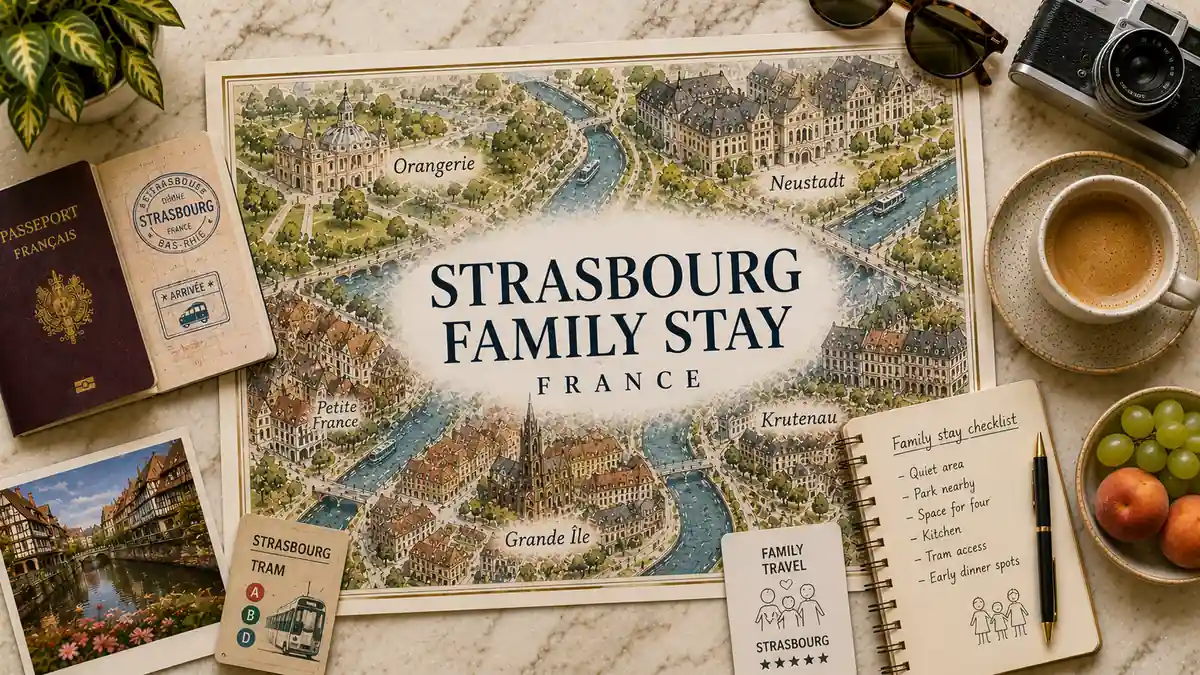
This guide gives you one default area for most families, then a straight family verdict on each of the five districts travelers keep comparing: Neustadt, Orangerie, the Grande Île, Petite France, and Krutenau. It also covers how the answer shifts with your children’s ages, when an apartment beats a hotel room, and why the Christmas-market season flips the usual advice. Areas only — no property names, no rates.
Quick Answer
Neustadt is the best all-round base in Strasbourg for families: quiet, residential, and within easy reach of the centre. Central districts put you beside the sights, but you pay for that in calm, space, and sleep. Families with toddlers should choose Orangerie instead, anchored by the city’s largest park.
Trust Layer
Tripstou stay guide for travelers choosing where to base. Covers area atmosphere, budget, convenience, noise, and traveler fit.
Produced with AI assistance and reviewed by Alex Perrut, working in tourism since 2015, for the Tripstou editorial team. See our editorial process for details.
Last factual review: August 15, 2026.
Official sources consulted: France.fr, Atout France.
Key Takeaways
- Neustadt is the default family base in Strasbourg — quiet residential streets, roomier flats, and a walkable centre for school-age legs.
- Choose by your children’s ages: Orangerie for toddlers and strollers, Neustadt for school-age kids, Krutenau for teenagers.
- Park proximity beats sight proximity under about four years old, which is why Orangerie outperforms the historic centre.
- A central island base pays off on two nights and stops paying on five, once crowds and tight rooms accumulate.
- Book an apartment when the trip runs long and a hotel room when it is short and service matters.
- During the Christmas market the usual logic inverts: a quiet tram-linked base outside the island sleeps better and costs less.
Table of Contents
Neustadt Is the Best All-Round Base for Families
Neustadt is the default family pick in Strasbourg: calm streets, space, and the centre close at hand. The German-built quarter north and east of the old town is residential, not touristic, so evenings stay quiet — and the walk into the centre is short enough for school-age legs.
The atmosphere is wide boulevards, tall stone façades, and front doors belonging to people who actually live here. Bars and late-night noise concentrate elsewhere, so an early bedtime is realistic. Mornings work too: bakeries, supermarkets, and pharmacies here are ordinary neighbourhood infrastructure, priced and stocked for residents.
Convenience holds up in both directions. The centre is walkable from most of the quarter, and the tram network reaches the rest of the city, so no family needs a car to make the base work. Strollers do better here than on the island — pavements are wide, the ground is flat, and crowds thin out fast once you leave the tourist core.
On spend, Neustadt sits mid-range. It is rarely the cheapest bed in the city, and consistently better value per square metre than an equivalent central room. Families who need two bedrooms feel that gap most sharply.
Neustadt’s real advantage is invisible on a map. The quarter was laid out later than the old town and built to a bigger scale, so its flats and rooms tend to be roomier than anything inside the water — which is precisely what a family of four is short of.
If you are travelling without children, or want the same districts ranked on general criteria, the broader where to stay in Strasbourg overview covers the unfiltered picture.
Best for: families with school-age children who want quiet nights and a walkable centre.
Orangerie Is the Strongest Pick for Toddlers and Strollers
With a toddler, Orangerie wins: the city’s big park matters more than the sights. Parc de l’Orangerie sits inside the district, and the residential streets around it stay calm all day. You trade proximity to the cathedral for daily access to grass, shade, and space to run.
Park proximity outranks sight proximity for children under about four, and Orangerie is the only Strasbourg district where that is a genuine strength. A morning at the park, lunch back at the flat, a nap, then one gentle outing is the realistic shape of a day with a two-year-old. Basing beside the cathedral does nothing for that rhythm. Basing beside the park changes it completely.
The district sits east of the centre, further out than any other area on this page, and it is tram-served — a short ride, not a walk, gets you to the old town. That distance is the honest trade-off. If your plan is four sights a day, you will resent it; if your plan is one outing and an early dinner, you will barely notice.
Orangerie is residential, so its spend positioning is mid-range and quieter than the centre’s, with apartment stock aimed at people staying a while. Evenings are genuinely still. There is no nightlife to speak of, which is exactly the point.
Best for: families with toddlers and strollers who need a park more than a view.
Grande Île Puts You in the Middle of Everything — at a Cost
Grande Île works for families who value steps-from-everything over quiet evenings and space. The island historic centre puts the cathedral, the main squares, and most restaurants within a short walk, which shortens the day for tired children. The cost is crowds, evening noise, older buildings, and rooms that are often tight for four.
“Walkable” means something specific with children. In a pedestrian centre it means you can abandon the plan at any moment, carry a sleeping child back without a tram, and return for a second attempt after a nap. On a two-night trip that flexibility is worth real money. On a five-night trip it stops paying, because the crowds, the noise, and the tight rooms keep charging you every day.
The island’s stock is historic, which cuts both ways for a family. Buildings are old, lifts are not guaranteed, and family-sized configurations are the scarcest thing on the island. Spend positioning is the highest in the city, driven by demand for the address, and the premium buys location — not space.
Older children get the most out of it. A ten-year-old who can walk all day and put themselves to bed while the square below is still busy makes the island’s trade-off look sensible. Toddlers make it look expensive. For the district in full, including its quieter corners, read the Grande Île area guide.
Best for: short stays where a step-out-the-door location settles the argument.
Petite France Is Beautiful, but a Trade-Off With Young Kids
Petite France charms adults more than it serves small children — book it with eyes open. The half-timbered lanes at the island’s western end are the most photographed corner of Strasbourg, and they draw the crowds to match. Cobbles, canal edges, narrow staircases, and small rooms are the family reality.
The practical friction is constant, never dramatic. Cobbled lanes make a stroller hard work, the pavements narrow to single file when tour groups pass, and canal water runs alongside the walkways — manageable with a child who holds a hand, tiring with one who bolts. Rooms sit inside centuries-old buildings, so lifts are rare and family configurations rarer. Mornings and late evenings, once the crowds go, are lovely.
Spend positioning is high-end for the setting. You pay for the postcard, and the room you get for it is usually smaller than a Neustadt equivalent. Families with independent walkers absorb that comfortably; families with a stroller and a nap schedule generally do not.
If your shortlist has narrowed to this quarter and the wider island, the Petite France vs Grande Île comparison resolves that head-to-head properly. For the quarter itself, street by street, see the Petite France area guide.
Best for: families with independent walkers who will trade space for the postcard setting.
Krutenau Suits Families With Older Kids and Teens
Krutenau is the lively pick — great with teens, thinner on parks for little ones. The quarter sits just south-east of the island across the water, with a student flavour, good casual food, and tram lines connecting it to the centre and the main station. Evenings are busier than in Neustadt.
The character is young and unpolished, and teenagers respond to that. Casual restaurants, cheap eats, and a general sense that something is happening make it the easiest area on this page for a fifteen-year-old to be given an hour of independence. Younger children get less from it: green space is limited, evening noise carries, and the streets are not built around strollers.
Connections are the quarter’s practical strength. It sits on or beside tram lines running to the centre and out to the main station, so arrival and departure days stay simple even with luggage and children. The old town is a short walk across the water.
Spend positioning is mid-range and gentler than the island’s, which is why families needing two rooms often find better options here than inside the historic centre. The full profile lives in the Krutenau area guide.
Best for: families with teenagers who want food, buzz, and an easy tram ride to everything.
Best Areas by Family Type
Match your family shape to a district — each type below gets one clear pick. The variables that decide it are your children’s ages, how many nights you are staying, and whether your days need a park more than a cathedral view. The table compresses all five verdicts into one scan.
| District | Best for | What it feels like | Main trade-off |
|---|---|---|---|
| Neustadt | Most families, especially school-age children | Wide residential boulevards, quiet after dark | No postcard setting outside the window |
| Orangerie | Toddlers, strollers, and longer stays | Green, residential, genuinely still in the evening | Furthest from the sights; a tram ride in |
| Grande Île | Short stays with older children | Busy pedestrian centre, sights outside the door | Crowds, evening noise, tight rooms, top prices |
| Petite France | Families with confident independent walkers | Postcard lanes, canals, heavy daytime foot traffic | Cobbles and small rooms punish stroller families |
| Krutenau | Families travelling with teenagers | Young, casual, lively food streets | Little green space and louder evenings |
Read the table by age first, then by trip length. A family with a toddler and a five-night stay lands on Orangerie almost automatically; the same family on two nights with a twelve-year-old can justify the island. Neustadt is the answer whenever those two signals disagree.
Should You Book an Apartment or a Hotel Room?
For most families staying more than a couple of nights, an apartment beats a hotel room. Space, a kitchen, laundry, and a separate bedroom solve the problems that make family trips exhausting. A hotel room wins on short stays, arrival-night simplicity, and daily service you do not have to organise.
The space-for-four problem is the real driver. European hotel rooms are built around two adults, so a family of four is often pushed into two rooms, a sofa bed, or a cramped quad — and in Strasbourg’s historic buildings, genuinely large rooms are scarce. An apartment or aparthotel converts that into one booking with a door between the adults and the children. That door is worth more than any amenity list.
Hotels still win in specific cases. One or two nights, no cooking planned, an early train out, a teenager old enough to share a twin — in those conditions the service and simplicity outweigh the extra square metres. Book the space when the trip is long; book the service when it is short.
What Should You Check Before Booking a Family Stay?
Check these before you confirm anything, whichever format you choose:
- Real beds for everyone. “Sleeps four” often means a sofa bed; confirm the actual bed configuration.
- A separate bedroom or a door. One open-plan room means the whole family goes to bed at the same time.
- The street, not just the building. Ask whether the windows face a bar, a square, or a quiet side street.
- A lift, if there is one. Historic buildings often have none — check the floor and the stairs with a stroller in mind.
- Distance to a park or a tram stop. Both matter more day to day than distance to the cathedral.
- Kitchen and laundry reality. A hotplate and a kettle are not a kitchen; confirm what is actually installed.
Once the area is settled, choosing the property itself is your next decision — a separate exercise, judged on the checklist above and not on district character.
Hotels and places to stay
Compare hotels, apartments and stays for your dates in one search.
Search hotels and stays on hotels.com →
Tripstou may earn a commission if you book through this link, at no extra cost to you.
Where Should Families Stay for the Christmas Market?
During the market, skip the centre — a quiet tram-linked base beats sleeping beside the crowds. The market fills the Grande Île’s central squares, so island accommodation is at its most in-demand and least restful exactly when families need calm evenings. Neustadt and Orangerie stay easy to reach.
The season inverts the usual advice. Central bases normally earn their premium by saving you walking; in market season they charge a much steeper premium and hand back crowds, noise, and a pedestrian centre that is hard work with a stroller after dark. A quiet base a short tram ride out costs less, sleeps better, and still puts you at the stalls in the early evening while children are still cheerful.
Book earlier than you would for any other season — market-period demand tightens family-sized rooms first, because there are fewest of them. For the wider trip around the market itself, start from the Strasbourg travel guide.
Frequently Asked Questions
Which Strasbourg neighbourhood is quietest at night for families?
Orangerie and Neustadt are the quietest family bases in Strasbourg, both residential with almost no nightlife. Krutenau is the loudest of the five after dark, and the island squares carry noise late. Wherever you book, ask which way the windows face — the street matters more than the district.
Do Strasbourg hotels have family rooms for four people?
Yes, but supply is thin. Family rooms and connecting rooms exist across Strasbourg and are scarcest inside the historic centre, where old buildings were never laid out for them. Message the property directly instead of trusting a search filter, and confirm the real bed layout. Apartments remove the problem entirely.
Is an aparthotel a good middle ground for a family in Strasbourg?
An aparthotel is usually the best compromise for a family. You get a kitchen and a separate sleeping area, plus reception, cleaning, and simple check-in. It suits stays of three nights or more, where you want to cook breakfast without managing keys, laundry, or a private host.
Should a family split their stay between two Strasbourg areas?
No. Strasbourg’s districts all sit within a short tram ride of one another, so a second check-in buys nothing and costs a family a morning of packing. Pick one base for the whole trip, and choose it for sleep and space, not for the view.
Is it worth staying near Strasbourg train station with kids?
It works for logistics, not for the trip. The station area is convenient for arrival, departure, and luggage, and trams run from there into the centre in a few minutes. For a stay of more than one night, Neustadt, Orangerie, or Krutenau give a family a better base.
Can you drive to your hotel in central Strasbourg during the Christmas market?
Do not assume you can. Vehicle access to parts of the centre can be restricted while the market is running, so a central booking may not mean a car can reach the door. Confirm arrival and parking arrangements directly with your accommodation before you book, or choose a base outside the island.
Related Guides
- Where to Stay in Strasbourg — the full area-selection decision, without the family filter.
- Grande Île Area Guide — the island historic centre in full.
- Petite France Area Guide — what the canal quarter is really like to stay in.
- Krutenau Area Guide — the lively quarter just across the water.
- Petite France vs Grande Île — the direct head-to-head between the two central options.
- Strasbourg Travel Guide — broad trip planning for the city.
Did this guide save you time or money? Tripstou is independent and reader-funded — if you'd like to give something back, you can support the site with a crypto contribution of any size.