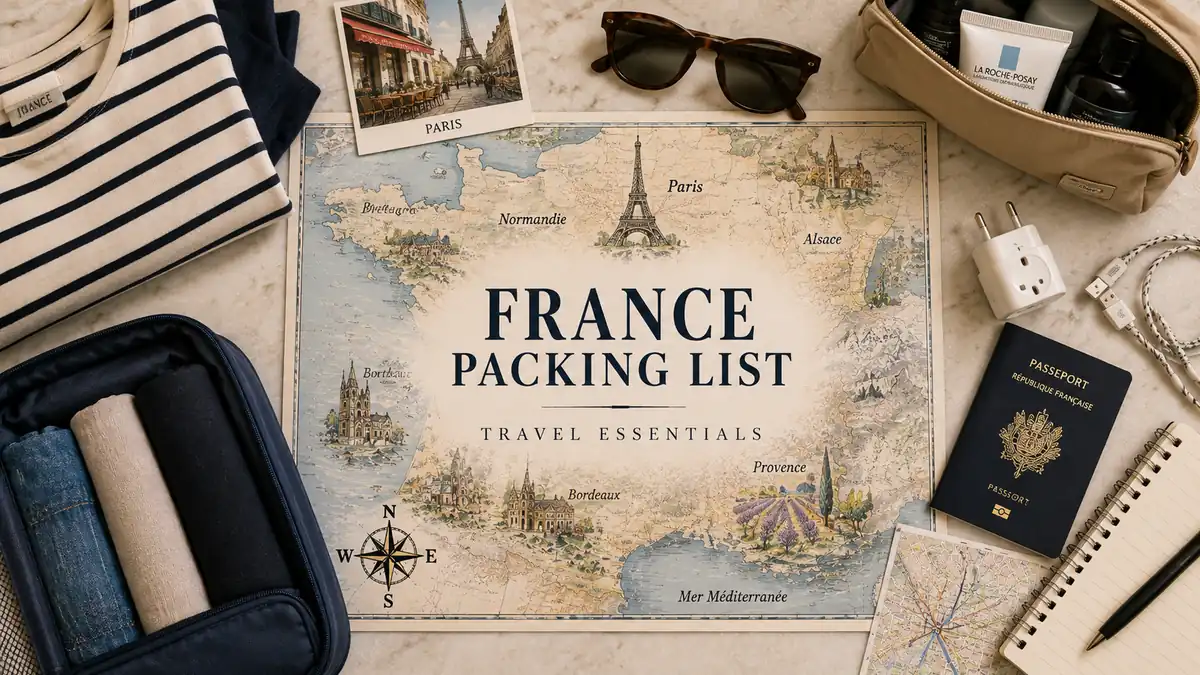
The dates are booked, the route is set, and the suitcase is still empty on the bed. Most packing lists solve that moment badly: they hand you a generic checklist that would work equally well for Portugal, Poland, or Peru, then bury the two things that actually change in France. The first is dress. French cities read smarter-casual than most visitors expect, and a handful of everyday items mark you out instantly. The second is geography. France spans four broad climate zones, so a list built for Paris fails on the Atlantic coast in October and in the Alps in January. This guide runs on categories, not on seasons or regions, so you pack once and adjust, never restart. It covers the core clothing capsule, shoes, power, toiletries, the day bag, what to leave at home, and how to flex the list for ski, beach, wine, or road-trip travel.
Quick Answer
Pack France as a small capsule of smart-casual layers, one tested pair of walking shoes, and a Type E adapter. Season and which climate zone you visit change the outer layers, not the core list. Choose neutral pieces that mix, stay carry-on where the trip allows, and add one dressier option for city evenings.
Trust Layer
Tripstou planning guide for travelers resolving one travel decision. Covers the main variable, traveler context, and practical tradeoffs.
Produced with AI assistance and reviewed by Alex Perrut, working in tourism since 2015, for the Tripstou editorial team. See our editorial process for details.
Last factual review: August 16, 2026.
Official sources consulted: France.fr, Atout France.
Key Takeaways
- Pack a small capsule of neutral, layerable pieces: everything mixes with everything, and one dressier option covers city evenings.
- France spans four climate zones, so pack for the coldest and wettest point on your route, then subtract layers.
- Smart-casual neutrals blend in; full athletic kit worn as daywear is the clearest tourist marker in French cities.
- Walking surfaces decide the shoe choice, so bring one broken-in comfortable pair and one smarter pair that still walks.
- France uses Type E sockets at 230 V, so check every device for a 100–240 V label before packing a converter.
- Read your baggage allowance off your own booking, and pack liquids as though the 100 ml rule always applies.
Table of Contents
Carry-On or Checked Bag for France?
Carry-on is the stronger default for most France trips, and the itinerary should decide it, not the airline. Trains, station stairs, cobbled streets, and walk-up apartments all punish a heavy case. Check a bag when the trip is long, ski-based, or ends with a single hotel you never leave.
Read your allowance off your own booking confirmation before you pack anything. Cabin baggage sizes and weights are set per airline and often per fare, so a rule you read in an article can be wrong for the ticket you are actually holding. On a mixed-carrier trip, pack to the smallest allowance on the itinerary and stop thinking about it. Low-cost carriers also enforce the gate sizer far more consistently than legacy carriers, so a slightly overstuffed bag carries more risk on a budget flight than on a full-service one.
The route matters more than the flight. A France trip that moves between cities by rail — the shape most France itineraries take — means lifting your bag onto luggage racks, up station stairs, and along platforms several times a week. A single-base trip never asks that of you. Check how much moving your plan involves in the France travel guide and the France train itinerary before you choose the bag, and see the France travel budget guide for how baggage choices land on the trip total.
- Carry-on wins when: you change cities more than twice, travel mainly by train, stay in apartments or small hotels without lifts, or fly with more than one carrier.
- Checked earns its place when: the trip runs longer than two weeks, involves ski or winter sports kit, is based in one place with a car, or crosses two very different climate zones.
Count how many times your route makes you lift the bag. A case that feels fine at check-in is a different object on the fourth flight of stairs to a walk-up apartment in Paris, and that number — not the airline’s rules — is what most travelers get wrong.
The Core France Clothing List: Capsule Over Quantity
A small capsule of neutral, layerable pieces covers a France trip better than a full wardrobe. Everything should combine with everything else, in dark or muted colours that hide a day’s wear. Add one dressier option for restaurants and evenings. This base list works in every region and every season before adjustment.
Layering beats packing for a forecast. French weather moves within the day in most of the country, and three thin layers you can add and remove handle a wider range than one thick garment ever will. The capsule logic also solves the quantity question on its own: for a week, most travelers do well with three or four tops, two lower-half options, one mid-layer, one outer layer, and one dressier set, because every piece works with every other piece. Wherever your route runs — and the best places to visit in France guide is a good place to shape it — the base stays identical.
- Tops that layer: plain T-shirts or fine-knit tops in neutral colours, each one able to sit under a jacket.
- Two lower-half options: dark trousers or jeans plus one alternative — chinos, a skirt, or lighter trousers in summer.
- A mid-layer: a light knit, fleece, or cardigan that carries evenings in any season.
- An outer layer chosen by season: a packable waterproof shell is the year-round default, with a warm coat replacing it in winter.
- One dressier outfit: a shirt, a dress, or a smarter knit for restaurants and city evenings.
- Underwear and socks for roughly half the trip, plus a laundry plan — apartment machines and laundrettes are easy to find.
- Sleepwear, and swimwear if the route touches the coast, a lake, or a hotel pool.
- A scarf: warmth in winter, sun cover in summer, and it smartens a plain top in seconds.
Colour discipline does the heavy lifting here. A capsule built in two or three neutrals produces far more outfits from fewer items than a bag where each garment only matches one other thing.
What Should You Wear in France as a Tourist?
Wear smart-casual neutrals and you will blend in almost anywhere in France. Athletic-leisure worn as daywear is the clearest tourist marker in French cities, where people dress a step more deliberately than most visitors expect. Nothing here requires formality — it requires clothes that look chosen instead of thrown on.
French cities read dressier because daily life happens in public. People walk to work, eat on terraces, and spend their evenings outside, so everyday clothing is chosen to be seen rather than to be comfortable in a car. That is the whole difference. It shows most in Paris, but the same instinct runs through Lyon, Bordeaux, and every mid-sized city, and it softens noticeably in beach towns and the countryside.
A short list of items reads as visiting instead of living there:
- Full athletic kit as daywear — leggings, gym shorts, running shoes and a sports top outside a gym or a trail.
- Branded souvenir clothing and slogan T-shirts.
- Bright white trainers and a baseball cap worn as a matched set.
- Shorts in cities outside high summer, and in restaurants at any point in the year.
- Flip-flops away from the beach or the pool.
- A large backpack worn on both shoulders inside a restaurant.
One dressier outfit handles the evening problem completely. Very few French restaurants enforce a dress code, but the room you walk into for dinner is dressed a level above the street, and arriving in walking clothes is the moment most visitors feel it. Dining conventions beyond clothing are set out in the France food guide, and the wider etiquette picture — greetings, language, tipping — sits in our France travel tips.
French cities read intention more than formality. The same jeans land completely differently with trainers and a hoodie than with leather shoes and a jacket, which is why the fix is almost never buying new clothes.
What Shoes Should You Pack for France?
Pack one broken-in pair of comfortable walking shoes and let everything else follow. Walking surfaces decide this choice: cobbles in old towns, long metro corridors, hill streets, and stairs almost everywhere. Two pairs suit most trips — the walking pair plus something smart enough for dinner. Leave brand-new shoes at home.
The surfaces are the argument. Medieval centres are cobbled and uneven, older metro stations have long stair runs and no lift, and sightseeing days in French cities routinely run to several hours on foot. Hills add to it in places like Lyon, where the old town sits at the foot of two steep slopes, while the flat cobbled lanes of Strasbourg punish thin soles in a different way. Support and a real sole matter more than the shoe’s category.
- One comfortable walking pair: low-profile trainers, leather lace-ups with a cushioned sole, or light walking boots in winter — worn in at home first.
- One smarter pair that still walks: loafers, ankle boots, or clean leather shoes for restaurants and evenings.
- Sandals in summer only, and only a pair you can walk in for a couple of hours.
- Skip: brand-new shoes, thin-soled flats on cobbles, and heels unless a taxi covers both ends of the evening.
Feet set the ceiling on a France trip. The parts of any old town worth seeing are the parts you reach on foot, and a blister on day two quietly shortens every day after it.
How Your France Packing List Changes by Season and Region
The core list holds year-round; season and region change only the outer layers and quantities. France spans four broad climate zones, so a Paris-calibrated bag underperforms on the Atlantic coast, in the mountains, and in the south. Adjust the shell, the warm layer, and the sun kit.
Four broad zones cover the country, and each one changes a different part of the bag.
| Climate zone | Winter reference band | Summer reference band | What changes in the bag |
|---|---|---|---|
| Oceanic west (Brest as reference) | Around 6 °C daily maximum in January | Around 16 °C daily maximum in July | Waterproof shell in every month; wettest around October and November |
| North and Paris (Paris as reference) | Around 6 °C daily maximum in January | Around 26 °C daily maximum in August | Mid-weight layers year-round, one proper coat in winter |
| East and mountains (Briançon as reference) | Around −2 °C mean temperature in January | Around 17 °C mean temperature in July | Genuinely cold-rated layers, gloves, and boots with grip |
| Mediterranean south | Mild winters, more often rainy than cold | Regularly above 30 °C at the height of summer | Full sun kit and light fabrics; a light rain layer off-season |
The Atlantic west is the wettest zone in France and stays cool even in summer. A waterproof shell belongs in the bag in every month for trips through Brittany and Normandy, and this is the part of the country where an umbrella loses to a hood.
Paris and the north sit in the middle of the national range, which is exactly why a Paris-calibrated bag feels almost right everywhere and precisely right nowhere. Mid-weight layers and one warm coat in winter cover the Paris region comfortably.
The east and the mountains swing further in both directions than the coast does. Alsace in December wants a genuinely warm coat, gloves, and boots with grip — the same layers that turn into dead weight on the Mediterranean coast.
The Mediterranean south is the outlier at both ends of the year: hot enough in summer to need a dedicated sun kit, mild enough in winter that a heavy coat is wasted space. Routes through Provence, the French Riviera, Marseille, or Corsica want sun cover and one light rain layer outside summer. Choosing when to travel is a separate decision, handled in the best time to visit France guide.
Pack for the coldest and wettest zone on your route, then subtract. A Paris-to-Riviera trip is far easier to fix with one layer too many than with one shell missing on a wet Atlantic afternoon.
What changes in summer?
Summer trades the warm layer for sun protection. The Mediterranean south regularly climbs above 30 °C, and shade disappears in the middle of the day, so add a wide-brim hat, sunglasses, high-factor sun cream, and one loose long-sleeved layer for sun cover. Breathable fabrics matter more than extra outfits. Keep a light knit for evenings anywhere north of the Mediterranean, where nights cool down quickly, and keep a compact rain layer if the route touches the Atlantic coast.
What changes in winter?
Winter adds one properly warm coat, a warm mid-layer, and accessories that pack flat. Paris and the north are cold and damp without being severe, which makes a waterproof insulated coat more useful than a thick unlined one. The Alps are the exception, sitting below freezing on an average January day and asking for thermal base layers, gloves, a hat, and boots with real grip. Mediterranean winters stay mild and often rainy, so a light waterproof layer beats bulk down there.
What changes in spring and autumn?
Spring and autumn are the layering peak, and this is where the rain-jacket question gets a clear yes. Bring a packable waterproof shell for any shoulder-season trip, especially in the west and the north, where the Atlantic zone is the rainiest in France and wettest around October and November. Pack a warm mid-layer you can strip off by midday, closed shoes that cope with wet pavements, and one extra pair of socks.
Toiletries: Pack Light and Buy the Rest in France
Pack only what is personal or prescription; everything generic is easy to buy once you arrive. French pharmacies and supermarkets are dense in every town of any size, so full-size bottles carried from home are weight spent on nothing. Bring the formulas your skin, hair, or health actually depends on.
The buy-it-there principle is simple to apply. If a product is sold in any supermarket, it is not worth the space or the liquid allowance — buy a small bottle on your first afternoon and leave it behind at the end. Pharmacies handle the rest, and French pharmacists are used to advising on minor complaints in person. What genuinely has to travel with you is the short list below.
- Prescription medication in its original packaging, with enough for the whole trip.
- Anything your skin, scalp, or allergies specifically need and you cannot substitute.
- A small decant of your usual shampoo or shower gel to cover the first days.
- Toothbrush, contact lenses and solution, glasses, a razor.
- A basic first-aid handful — blister plasters above all, plus painkillers and any personal remedy.
Liquids are the only part of the toiletry bag with an airport rule attached. Pack as though the 100 ml per-container limit applies on every flight of your route, and security never has a surprise for you.
Do You Need a Power Adapter for France?
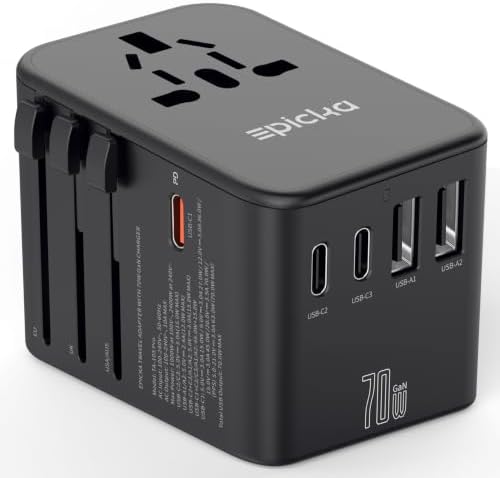
Yes, unless your plugs are already European. France uses Type E sockets running at 230 V and 50 Hz, so most visitors need only a plug adapter. Type C plugs fit Type E sockets. The one thing worth checking before you buy anything is the voltage label on each device.
Read the small print on the charger or the appliance itself. Anything marked 100–240 V is dual-voltage and needs nothing more than a plug adapter to work in France, which covers phones, laptops, tablets, cameras, and most modern chargers. Devices built only for 110–120 V — typically heat appliances such as hairdryers, straighteners, and travel kettles — need a voltage converter, and the honest answer for almost every traveler is to leave them at home, since accommodation supplies a hairdryer. A compact universal adapter is the simplest purchase, and one is usually enough for a couple sharing a room.
Travelers arriving from the UK, North America, or anywhere outside continental Europe all need an adapter. Visitors from most of the rest of the EU do not, because Type C plugs slot straight into French sockets. Connectivity is a separate purchase decision entirely, covered in our guide to getting a France SIM card.

Day Bag and Anti-Theft Essentials for French Cities
A zipped crossbody bag worn in front is enough for French cities. Pickpocketing is an opportunistic crime concentrated in crowded tourist areas and busy metro lines, and a bag that closes properly removes most of the opportunity. A money belt is a comfort choice, not a requirement.
Is a money belt necessary in Paris? No. Almost nobody who lives there wears one, and the practical problem is that you have to reach into your clothing every time you buy a metro ticket, which defeats the point in public. A zipped bag kept in front of you in crowds does the same job with none of the friction. If wearing one genuinely helps you relax, treat it as a place to stash a spare card and emergency cash that you never open during the day.
- A crossbody bag or small backpack that zips fully closed, worn in front on busy transport.
- One payment card and a small amount of cash for the day; the rest stays at your accommodation.
- A refillable water bottle — public drinking fountains are common in French cities.
- A folding rain layer in any season outside high summer.
- A power bank, because sightseeing days drain a phone used for maps and tickets.
The bag is the gear answer, not the whole answer. Which areas warrant more attention, how the common scams actually work, and the broader safety verdict all sit in our France safety guide.
What Not to Pack for France
Leave behind anything heavy, single-use, or easily bought in France. The trains-and-stairs reality of a French itinerary punishes bulk harder than the airline does, and most of what people overpack is either replaceable locally or never used. A few items belong to other decisions entirely.
- More than a week of clothing. Apartment washing machines and laundrettes are widely available, and the capsule reuses everything anyway.
- Full-size toiletries. Pharmacies and supermarkets are everywhere, and the bottles cost you both liquid allowance and weight.
- Hairdryers, straighteners, and travel irons. Accommodation supplies most of them, and 110–120 V models need a converter to work at all.
- Formal wear packed “just in case”. French restaurants read smart-casual, and one dressier outfit already covers it.
- Heavy guidebooks and paper maps. Your phone carries both, and offline maps cover the gaps in coverage.
- Valuable jewellery and watches. Nothing is gained, and they are exactly what draws attention in a crowded metro carriage.
- Large amounts of cash. Card payment is standard across France and cash machines are easy to find.
- In-car safety equipment. France has legal requirements for vehicles, but that is a hire-car conversation, not a suitcase one — see the France road trip guide.
The useful test for anything borderline is whether France sells it. If a pharmacy or supermarket two streets from your accommodation stocks the item, the space in your bag is worth more than carrying it across a border.
How to Adjust Your Packing List by Trip Type
Trip type adds a handful of items to the core list; it never replaces it. Ski, beach, wine-country, and road-trip travel each change two or three categories and leave the rest untouched. Work out which of the four your trip leans towards, then add only what that lean requires.
Ski and alpine trips. Cold-rated layers are the addition the rest of France never asks for: thermal base layers, an insulated jacket, gloves, a hat, and goggles if you own them. Skis, boots, and technical outerwear are all rentable at resort, which usually beats flying with a ski bag. Resort choice and mountain logistics are covered in the French Alps guide.
Beach and Mediterranean trips. Add swimwear, a quick-dry towel, and the sun protection you would not otherwise carry — hat, sunglasses, high-factor cream. Sandals that can also walk a promenade earn their space. See France’s best beaches for coast selection, and the Nice guide if the Riviera is your base.
Wine-region trips. Wine country is the one context where French dress leans country-casual instead of city-smart. Cellars are cold year-round, so bring closed shoes for damp floors and a layer for tastings underground. Route planning sits in the French wine regions guide, with regional depth in the Bordeaux region guide, the Bordeaux city guide, and the Lyon region guide.
Road trips. Driving loosens the rules, because the car absorbs a bigger bag, a cool box, and walking gear a rail trip would never justify. Keep one small day bag for the stops. Château routes such as the Loire Valley reward that flexibility, and the legal equipment French law requires in the vehicle is covered on the road-trip page linked above.
Frequently Asked Questions
How many outfits do you need for a week in France?
Fewer than a week’s worth. Four tops and two lower-half options in matching neutrals produce eight distinct combinations before the dressier option, which covers seven days comfortably. Plan one laundry reset instead of extra clothes — apartment machines and laundrettes are easy to find across France.
Can you buy toiletries in France?
Yes, easily. Supermarkets stock shampoo, shower gel, toothpaste, razors, and sun cream in every town of any size, and pharmacies cover medicines, skincare, and minor-ailment advice in person. Carry only prescription items and the specific formulas your skin, scalp, or allergies depend on; buy the rest on arrival.
How much cabin baggage can you take to France?
Only your own ticket can answer that. Allowances attach to the fare, not just the airline, so a chart you find online or a previous trip with the same carrier is not a reliable guide. Check both legs of your booking separately, because outbound and return fares can differ.
Can you take liquids in hand luggage to France?
Yes, in containers of 100 ml or less, presented together in one resealable transparent bag. Pack to that rule and you cannot be caught out at any airport on your route. Medicines, baby products, and special dietary items are handled separately, so keep them accessible and declare them at security.
What should you pack in your carry-on if you check a bag?
Anything the trip cannot continue without. That means prescription medication, chargers and a power bank, your travel documents, valuables, and one change of clothes with clean underwear. Keep your adapter there too, so a delayed case never leaves you unable to charge a phone on your first evening.
Are packing cubes worth it for a France trip?
Yes, if your route moves between cities. Cubes keep a capsule wardrobe sorted when you are living out of the bag in three or four places, and they make repacking in a small hotel room quick. On a single-base trip they add little beyond tidiness.
Related Guides
These pages resolve the decisions that sit either side of packing. Timing, budget, and route all change what goes in the bag, and the region guides carry the local conditions this page compresses into four climate zones. Start with the parent guide if your itinerary is still open.
- France travel guide — the parent planner for the whole trip.
- Best time to visit France — decide the season before you pack for it.
- France itinerary ideas — how much moving your route actually involves.
- France travel budget — what the trip costs, baggage decisions included.
- France safety guide — the full picture behind the day-bag advice.
- France travel tips — etiquette, language, and the habits that smooth the trip.
Did this guide save you time or money? Tripstou is independent and reader-funded — if you'd like to give something back, you can support the site with a crypto contribution of any size.