Nice is the French Riviera’s big city: a real Old Town, a long seafront and a rail station that puts the whole coast within a short train ride. Most visitors from outside Europe fly into Nice Côte d’Azur with one connection, while travelers already in Paris can take the TGV south in under six hours. Tram line 2 runs from both terminals into the centre for a €1.70 single. Give the city 2–3 days, or longer if you want to use it as a base. Go in May–June or September. Budget about €50–€85 per person per day travelling lean and €150–€190 mid-range, flights excluded.
This guide is for a first trip, often one stop on a longer France or Europe itinerary. It settles the planning frame: arrival, length, season, where to sleep, what the city is known for, day trips, cost and the handful of local rules that catch first-timers out. Prices and opening days were checked on the operators’ own pages. Each deeper decision has its own guide, linked where you need it.
Quick Answer
Yes, Nice is worth it for a first trip: it pairs a walkable city and Old Town with a seafront and easy train day trips, Monaco about 25 minutes away. Plan 2–3 days for the city alone, or 4–5 days to add coast towns by train. It suits first-timers who want city, sea and day trips without a car.
Nice Trip at a Glance
- Most long-haul visitors reach Nice on a flight with one connection into Nice Côte d’Azur, while the fastest train from Paris Gare de Lyon takes 5h42 and most direct TGVs just under six hours, centre to centre.
- Tram line 2 runs from both airport terminals into the city centre in under 30 minutes: an ordinary €1.70 Solo ticket covers the ride, and the €10 AERO ticket is a return with the second leg left open. A taxi to the centre is a flat €32.
- Two to three days covers the city itself; four to five days or more turns Nice into a base for coast towns by train.
- May, June and September bring swimming weather without the July–August peak in crowds and room prices; Carnival fills the city for three weeks in February.
- Sleep central, between the Old Town, the Promenade des Anglais and Nice-Ville station, so the sights and the coastal train are both on foot.
- Plan on about €50–€85 per person per day travelling lean and €150–€190 mid-range, flights excluded, with rooms driving most of the gap. The big sights are free; the two main art museums cost €10 and €12.
In This Guide
Getting to Nice From Abroad, and Around It Without a Car
Most long-haul visitors reach Nice on a flight with one connection into Nice Côte d’Azur airport. From Paris, the choice is the train (5h42 at the fastest, just under six hours on most direct TGVs) or a short domestic flight. Tram line 2 links both terminals to the city centre in under 30 minutes, and once you are in Nice you do not need a car.
Flying in from the US, India or Australia
Expect one connection on the way to Nice. The usual routing runs through a major European hub or through Paris, then on to Nice Côte d’Azur. Nice is often one stop of a multi-city trip, so it pays to price an open-jaw ticket: fly into one city, out of another, and cover the middle by train.
If Paris is already on your route, landing there and finishing the journey by rail turns the transfer into part of the trip. A rail-based France itinerary shows how Nice slots in at the southern end of the line.
Paris to Nice: train or flight?
SNCF runs about 14 trains a day from Paris Gare de Lyon to Nice-Ville. The fastest direct service takes 5h42; most direct TGV INOUI departures take between 5h48 and 6h00, and the low-cost OUIGO also runs direct in a little under six hours. Trains with a change can take seven hours or more, so filter for direct services. The route runs centre to centre, and the last stretch follows the coast. A flight is shorter in the air but adds the trip out to a Paris airport, security and the ride in from Nice airport.
The train suits travelers already staying in central Paris with a day to spare. The flight suits a tight schedule. Door to door, the gap is narrower than the flight time suggests.
From the airport to the centre
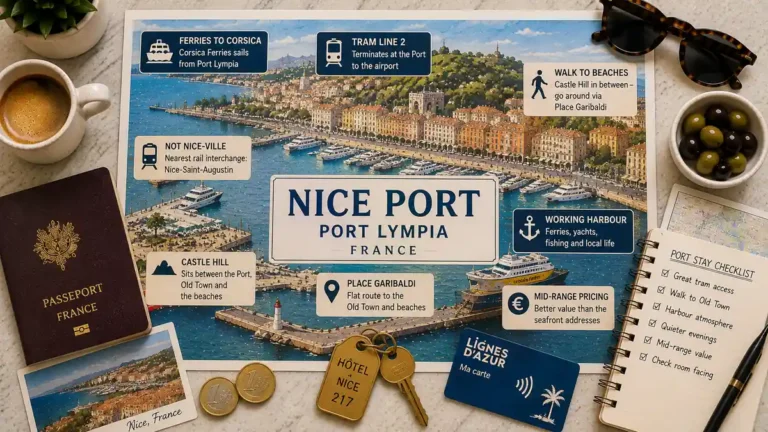
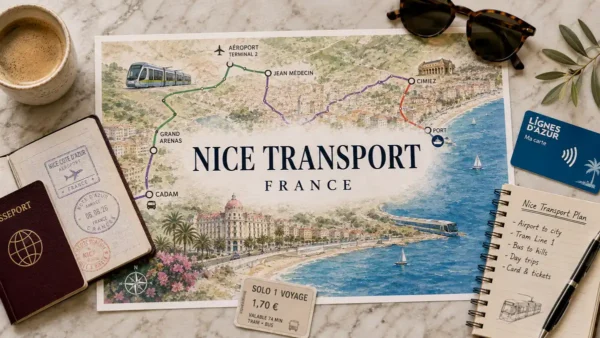
Tram line 2 (direction Port Lympia) stops at both Terminal 1 and Terminal 2 and reaches the centre in under 30 minutes, every 7–8 minutes on weekdays. Get off at Jean-Médecin for the central hotels and the Old Town; Nice-Ville station is about 800 m from there, or one tram-1 stop to Gare Thiers. The ride between the two terminals and Grand Arénas is free.
Tickets are the point to get right. The ordinary Lignes d’Azur Solo ticket (€1.70, transfers allowed for 74 minutes) is valid from the airport stops, so a one-way arrival costs €1.70. The €10 AERO ticket sold at the airport is a return, with the second leg left open for the trip back. Buy before boarding: nothing is sold on the airport buses. A licensed taxi from the airport to central Nice is a flat €32 before supplements, and the same flat-rate scheme prices Antibes at €72, Cannes at €85 and Monaco at €95. The other routes into town, and how to use the ticket machines, are covered in the guide to every way from Nice airport to the centre.
Getting around without a car
Central Nice is walkable, and the Lignes d’Azur tram and bus network covers the rest of the city on one fare system. The coast towns sit on the regional train line from Nice-Ville. Fares, passes and how to validate are in the guide to Nice tram and bus tickets; the headline figures are below.
| Ticket | Price | What it covers |
|---|---|---|
| Solo | €1.70 | One trip with transfers for 74 minutes; no return; valid from the airport |
| Multi (1–12 trips) | €1.70 per trip | Shareable card; the per-trip price only drops from 13 trips upwards |
| Pass 1 jour | €7 | Unlimited urban travel for 24 hours from first validation |
| Pass 2 jours | €13 | Unlimited urban travel for 48 hours |
| Pass 7 jours | €20 | Unlimited urban travel for 7 days |
| AERO | €10 | One airport return, second leg open |
Two readings of that table matter. A day pass pays off only from a fifth ride, and most first-timers walk more than they ride, so Solo tickets usually win. Trains to the coast towns are a separate, distance-based regional fare (ZOU), not covered by these passes.
A car only earns its cost for the inland hill villages, which the train does not reach. Inside the city it mostly sits parked, and parking is scarce and metered. If driving is the point of your trip, plan it as a France road trip and pick the car up on the day you leave Nice.
Is Nice, France worth visiting?
Yes, Nice is worth visiting for travelers who want a real city with a seafront, a lively Old Town and easy coast day trips. It is less suited to anyone set on sandy beaches or quiet streets in high summer.
Nice works because it is a working city first and a resort second. Markets, offices and neighbourhood cafés keep running year-round, so the place does not empty out once the beach season ends.
- It suits: first-timers, travelers moving by rail, food-led trips and couples who want a city break with the sea at the end of the street.
- Think twice if: you want soft sand (the city beaches are pebble), or you can only travel in July–August and dislike crowds and peak room prices.
The airport and the coastal rail line are what make Nice the practical place to sleep on this coast. You land a tram ride from the centre, and the coast towns run off one station in both directions: Monaco in about 25 minutes, Cannes in about half an hour. That saves a hotel change every night or two. The wider comparison sits in France’s best places to visit.
Safety is ordinary big-city awareness. Pickpockets work Place Masséna, the Old Town lanes, tram line 2, the trains and Nice-Ville station, and the beach while swimmers are in the water. The detail is in how safe Nice is, with the patterns to recognise in common scams in France and specific advice on solo female travel in France.
How many days do you need in Nice?
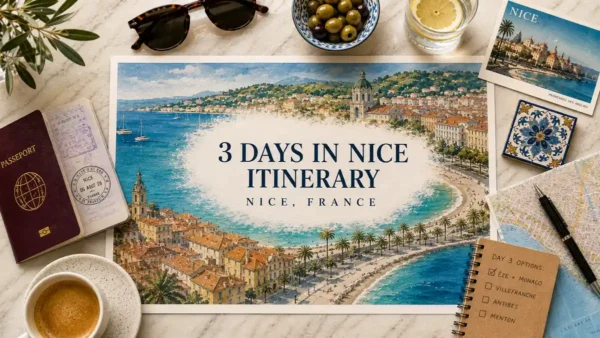
Two to three days covers Nice itself: the Old Town, the Promenade, Castle Hill and a museum or market. Four to five days or more lets you use the city as a base and add coast towns by train.
- Day 1: Vieux Nice and the Cours Saleya market in the morning, Castle Hill for the view over the Baie des Anges, the Promenade des Anglais at sunset.
- Day 2: the Cimiez hill for the Musée Matisse or the Musée Chagall (both closed on Tuesdays), then the Port Lympia quarter in the evening.
- Day 3: one coast town by train, Villefranche-sur-Mer or Monaco to the east, Antibes to the west, back in Nice for dinner.
The extra days buy day trips and slow beach time. Two days is enough for a city break; a third day adds one train trip along the coast. Beyond that, each added day is another town or a lazy afternoon on the pebbles. Ready-made plans are in 2 days in Nice and the 3-day Nice itinerary.
On a multi-city France trip, Nice usually takes the southern end. In 10 days in France it earns two or three nights; in two weeks in France it can carry four or five, with day trips doing the work of extra hotel moves.
Nights matter more than days here. Arriving late from a long-haul connection eats most of the first day, so count nights on the ground when you decide.
May, June and September Are the Months to Pick for Nice
May, June and September are the best months for Nice: the weather is warm enough to swim and eat outside, without the July–August peak in crowds and room prices.
- Late spring (May–June): long days, the sea warming up and the city at full speed before the summer rush. Watch two neighbours’ events: the Cannes Film Festival and the Monaco Grand Prix both fall in May and push room prices up along the whole coast for their weeks.
- Summer (July–August): the hottest, busiest and most expensive stretch, with full beaches and booked-out rooms. The Nice Jazz Festival is the summer’s big ticket and sells out well ahead.
- Early autumn (September): the sea is still warm after summer, and prices and crowds ease once school holidays end. October brings the wettest weeks of the year.
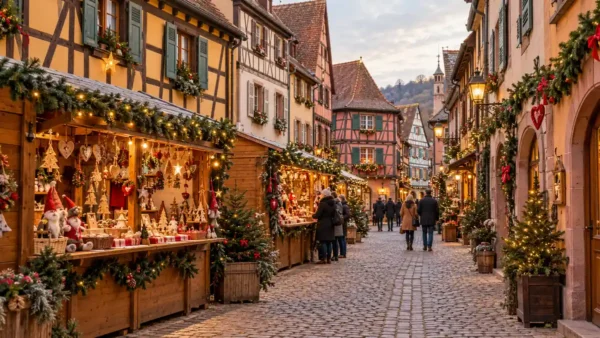
- Winter: a quiet city-break season of museums, markets and seafront walks, with cooler days and no beach life. The Christmas village on Place Masséna runs from late November to just after New Year, and the Nice Carnival takes over the seafront for three weeks in February, with ticketed stands for the parades and flower battles. Book rooms early for Carnival.
If summer is your only window, book rooms early and do your day trips on weekdays, when the coastal trains are less crowded. For how Nice fits the national calendar, see the best time to visit France; if beaches drive your dates, compare France’s best beaches before you commit.
Where to Stay in Nice on a First Trip
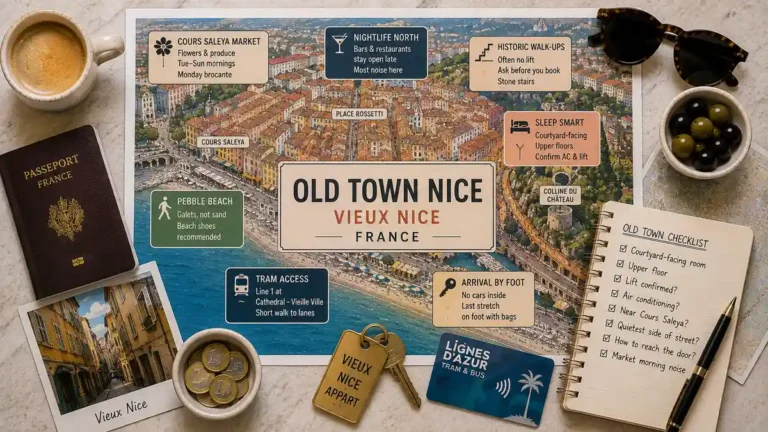
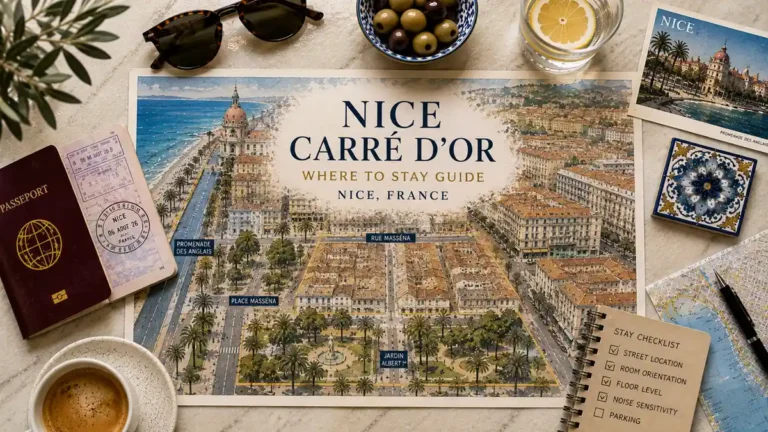
Most first-timers do best staying central, in the triangle between the Old Town (Vieux Nice), the Promenade des Anglais seafront and the streets leading up to Nice-Ville station. From there you walk to the sights and to the train.
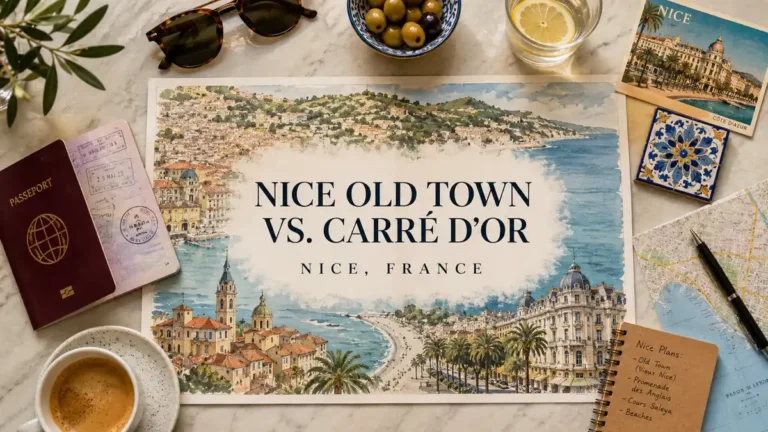
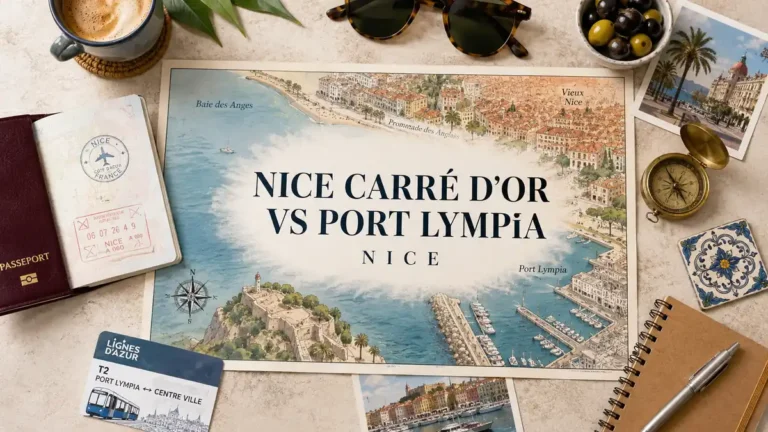
That central zone is compact, so the choice is mainly about trade-offs inside it. Vieux Nice puts you in the lanes and the evening noise, in old buildings that often have no lift: Hôtel La Pérouse, tucked under Castle Hill, and Palais Saleya, on the market square, are the classic addresses. The seafront and the Carré d’Or behind it trade value for views and polish: Le Negresco is the landmark, with the Hyatt Regency Palais de la Méditerranée a few doors along. The streets around Nice-Ville and Avenue Jean Médecin are the cheapest central option and make early day trips easy, though the station blocks feel less polished at night; Hôtel Nice Excelsior and Hotel Rossetti are the sort of mid-range stays there. Port Lympia, at the end of tram line 2, is a calmer harbour-side option with the best bars for an evening. Neighbourhood by neighbourhood, the full breakdown is in where to stay in Nice.
- First trip and want everything on foot: where to stay in Nice for a first visit.
- Keeping the room cost down: budget areas to stay in Nice.
- Travelling as a couple: romantic places to stay in Nice.
- With children in tow: family-friendly areas in Nice.
- Splurging on the stay: luxury stays in Nice.
- Out late most nights: where to stay in Nice for nightlife.
- Want the sea outside the window: beach hotels in Nice.
Hotels and places to stay
Compare hotels, apartments and stays for your dates in one search.
Search hotels and stays on hotels.com →
Tripstou may earn a commission if you book through this link, at no extra cost to you.
What Nice Is Known For: Old Town, Promenade and Socca
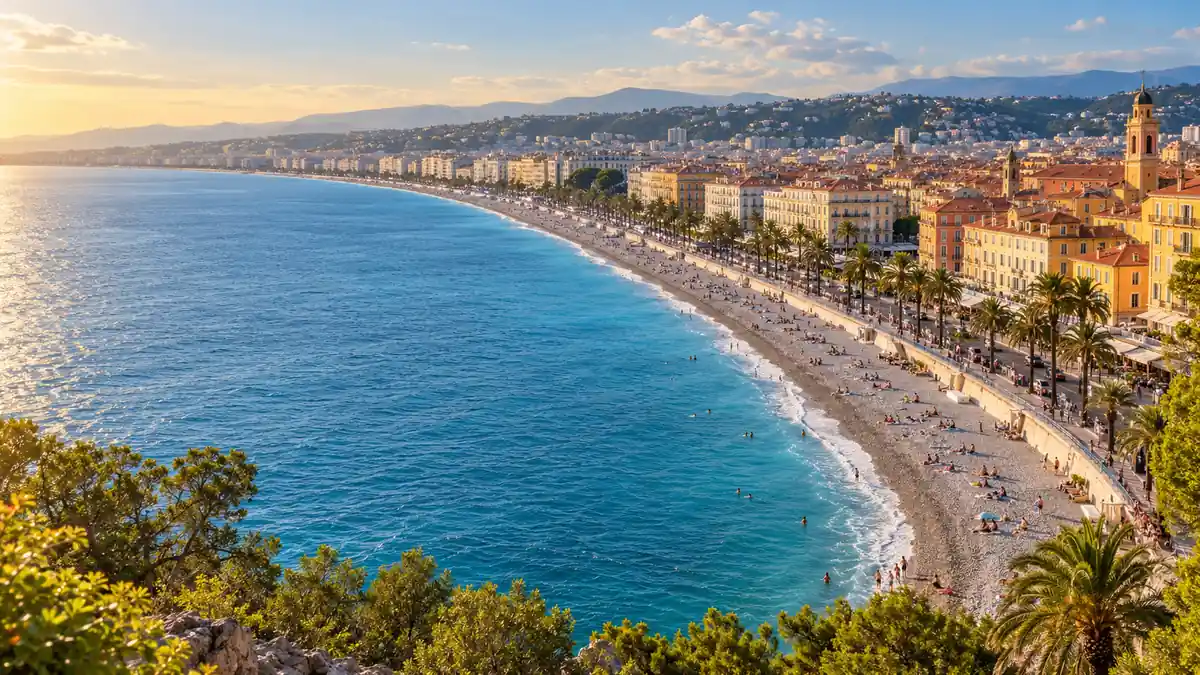
Nice is known for the Promenade des Anglais curving along the Baie des Anges, the lanes and markets of Vieux Nice, the view from Castle Hill, the Matisse and Chagall museums on the Cimiez hill and its own food: socca, pissaladière and salade niçoise.
Most of that costs nothing and needs no booking. The Promenade, the Old Town and the beaches are free and open to walk into. Castle Hill (Colline du Château) is a free public park, open daily from 8:30 to 18:00 between October and March and until 20:00 from April to September, with a lift and stairs up from the seafront end of the Old Town. Cours Saleya runs the flower market and the fruit, vegetable and fish market from Tuesday to Sunday, 6:00 to 13:30, and turns into an antiques market every Monday from 7:00 to 18:00. That makes Nice an easy city to see on a loose plan.
The paid sights are the museums, and they share one rule: closed on Tuesdays. The Musée Matisse in Cimiez costs €10 (10:00–18:00 April to October, 10:00–17:00 November to March). The Musée National Marc Chagall nearby costs €12 at full price during exhibitions, with a lunch closure from 13:00 to 14:30. The Nice Museums Pass, €15 for four days, covers the municipal museums such as the Matisse, Palais Lascaris and Villa Masséna; it does not cover the Chagall, which is a national museum. MAMAC, the modern-art museum by the Promenade du Paillon, is closed for a long renovation. The French Riviera Pass from the tourist office (€30 for 24 hours, €45 for 48, €65 for 72) bundles sixty-odd sites and tours but does not include city transport, so it only pays for a museum-heavy day or two.
The beach is pebble, with smooth grey stones all along the Promenade. Water shoes and a thick towel or mat make it comfortable; the private beach clubs along the seafront, Castel Plage under Castle Hill among them, rent loungers for the day if you would rather not lie on stones. The sea drops off steeply a few steps in, which suits swimmers more than paddling children.
The food is Niçois before it is French. Socca, a chickpea pancake from the street stalls, and pissaladière, an onion tart with anchovies, show the Italian-border side of the city’s cooking. Salade niçoise is a local dish here, not a menu cliché, and the same kitchens turn out pan bagnat (the salad in a bun), petits farcis (stuffed vegetables) and tourte de blettes, a sweet chard tart. A market lunch in the Old Town is the cheapest good meal you will eat. For the regional context, read the French food guide and France’s wine regions.
Museums, viewpoints and neighbourhoods are covered in full in things to do in Nice. For markets, opening habits and how the city runs day to day, read the practical Nice tips.
Nice’s Easiest Day Trips All Run on the Coastal Train
The best day trips from Nice run on the regional (TER) coastal line from Nice-Ville, with dozens of trains a day in each direction. Villefranche-sur-Mer is the first stop east, under ten minutes away; Monaco takes about 25 minutes and Menton 40–50. Westward, Antibes is 20–30 minutes and Cannes 30–40.
| Town | Train from Nice-Ville | Side | Why go |
|---|---|---|---|
| Villefranche-sur-Mer | Under 10 min | East | Small harbour town on a deep bay; half-day or a swim |
| Monaco | About 25 min | East | The harbour, the old town on the rock and the casino quarter |
| Menton | 40–50 min | East | Gardens and a pastel old centre, the last French town before Italy |
| Antibes | 20–30 min | West | Walled old town and a busy port |
| Cannes | 30–40 min | West | The Croisette seafront and its own old quarter |
Regional fares are set by distance, with children under four free and ages four to eleven at half price; buy on the SNCF Connect app or at the station machines, and activate an e-ticket before you board. Each town works as a half or full day out and back, with no hotel change. Pairing two towns in one day only works on the same side of the line. Villefranche can also be reached on foot along the coastal path from the Port, a pleasant morning walk with little shade. The inland hill villages are a different trip: they are far easier by car. Two still work by public transport. Èze, a hilltop village crowned by the ruins of a medieval fortress, has bus 82 from Nice Vauban up to the village, while the train only reaches its seaside station on the Lower Corniche far below; a guided half-day trip that pairs Èze with Monaco is the no-planning alternative (book the half-day trip). Saint-Paul-de-Vence, the ramparted art village inland of Cagnes-sur-Mer, means a train to Cagnes-sur-Mer and then bus 655, about 15 minutes up to the village.
Choosing a base or comparing the towns themselves is a separate question, answered in the French Riviera guide.
Tours and activities
Book skip-the-line tickets, day trips and local tours with free cancellation on most activities.
You can also browse everything on getyourguide.com.
Tripstou may earn a commission if you book through this link, at no extra cost to you.
How much does a trip to Nice cost?
A trip to Nice costs about €50–€85 per person per day on a budget and €150–€190 per person per day mid-range, flights excluded. Rooms drive most of the difference; the fixed costs of seeing the city are small.
Add up the sights and transport for a typical two-day first visit and the ledger is short: a €1.70 tram ride in from the airport (€32 by taxi), a handful of Solo tickets or a €7 day pass, €10 for the Musée Matisse and €12 for the Chagall, or €15 for the four-day Museums Pass if you add a second municipal museum. Castle Hill, the Promenade, the Old Town, the market and the beaches cost nothing. Day trips add a regional train fare each way.
The budget style means a hostel bed or a simple room away from the seafront, socca and market food for lunch, and walking, tram and train to get around. The mid-range style buys a comfortable central hotel, sit-down restaurant meals and the odd paid museum or longer day trip. A high-end trip moves to seafront hotels, long lunches and private transfers, and Nice has no shortage of places to spend at that level.
Nice is kind to budget travelers in what they eat and how they move: street food is cheap, and with no car you skip parking and fuel. It punishes spending on rooms in July–August, during Carnival and the May event weeks, and on anything with a sea view. Moving the same trip to May, June or September, or one street back from the Promenade, does more for the total than any saving on meals.
Line-by-line figures are in the Nice trip cost breakdown; if Nice is one stop of a bigger trip, compare what a France trip costs.
What to Know Before a First Trip to Nice
Nice has a handful of local habits that first-timers trip over: late dinners, Tuesday museum closures, strict ticket validation and a beach that is not for taking home.
- Eat on local time. Kitchens close in the afternoon and dinner service starts around 19:30–20:00; restaurants fill after 20:00, so book for the evening or eat early. Skip the “menu touristique” boards on the main squares and head one street back.
- Tuesday is museum day off. The Matisse, the Chagall and the municipal museums all close on Tuesdays, and the Chagall also shuts for lunch. Plan the Cimiez hill for another day.
- Monday changes the market. Cours Saleya sells flowers and food from Tuesday to Sunday mornings and antiques on Mondays. Markets and small shops take cash more readily than cards.
- Validate everything. Tram and bus tickets must be validated on every ride, transfers included, and inspectors fine on the spot. Regional train e-tickets need activating before you board.
- Leave the pebbles and the blue chairs. The smooth galets are topped up every year and taking them is frowned on; the blue chairs belong on the Promenade, not on the beach. Watch for jellyfish warnings in late summer.
- Pickpockets have a map. Place Masséna, the Old Town lanes, tram line 2, Nice-Ville station and the trains to Monaco are their patch; so is a bag left on the beach while you swim. Keep the phone in a front pocket and the bag in your lap at café tables.
- Say bonjour first. Every shop, café and ticket window starts with a greeting; English is fine afterwards in the centre.
- Sundays and lunchtimes close. Many shops shut on Sunday and some close for a long lunch; the markets, museums and restaurants keep going.
- Drink like a local. Pastis is ordered by brand, Ricard or Pastis 51, and rosé comes with every lunch; a cappuccino after dinner marks you out. Maison Auer on Rue Saint-François-de-Paule has sold candied fruit since the early nineteenth century if you want an edible souvenir.
- Tap water is fine. Carry a bottle and refill it; the fountains along the Promenade work.
For restaurants, the Old Town and the Port carry the names most visitors end up at: La Route du Miam and Le Séjour Café for a proper Niçois dinner, Les Amoureux at the Port for pizza, La Vigna in the Old Town for the regional dishes. Book ahead for all of them in summer.
How This Guide Was Checked
This is a first-trip planning guide to Nice covering arrival, trip length, timing, where to base yourself, the budget frame and the local rules; it is not a things-to-do list, a stay guide by neighbourhood, a day-by-day itinerary or the airport-transfer page.
Drafted with AI assistance; the tram fares, train times, museum prices and closing days on this page were checked on the operators’ own pages by Alex Perrut, in tourism since 2015, for the Tripstou editorial team. See our editorial process.
Official sources consulted: Lignes d’Azur, Nice Côte d’Azur Airport, SNCF Connect, Musée Matisse, Musée National Marc Chagall, Explore Nice Côte d’Azur, Nice Carnaval.
Quick Questions Before You Book
Are Nice’s beaches sand or pebbles?
Pebble. The city beaches along the Promenade des Anglais are smooth stones, not sand, so water shoes and a thick beach towel or mat make a day by the sea far more comfortable. Pack them from home with the rest of your France packing list.
How do I get from Nice airport to the city centre?
Take tram line 2 from either terminal towards Port Lympia and get off at Jean-Médecin, under 30 minutes away. An ordinary €1.70 Solo ticket covers it; the €10 AERO ticket is a return. A taxi to the centre is a flat €32.
Do I need a visa to travel to Nice, France?
Check the entry rules that apply to your passport before booking. Nice follows France’s rules, and France is part of the Schengen area. Short stays are capped at 90 days in any rolling 180-day period across the Schengen area as a whole, not per country.
Is the French Riviera Pass worth buying?
Only for a museum-heavy day or two. It costs €30, €45 or €65 for 24, 48 or 72 hours and does not include city transport, while Nice’s headline sights (the Promenade, the Old Town, Castle Hill and the market) are free. For two or more municipal museums, the €15 four-day Nice Museums Pass is the better buy.
Is Nice or Cannes better to stay in?
Nice is the better pick for transport links, city life and day trips; Cannes suits travelers who want a smaller resort feel and is about 30–40 minutes away by train. How the coast towns compare as a place to sleep is covered in the French Riviera guide.
Keep Planning Your France Trip
- French Riviera guide: compare Nice with the other coast towns as a base.
- France travel guide: the country-level planning frame for your whole trip.
- France itinerary planner: how to route Nice together with Paris and the regions.
- 7 days in France: a one-week route for a shorter trip.
Did this guide save you time or money? Tripstou is independent and reader-funded — if you'd like to give something back, you can support the site with a crypto contribution of any size.