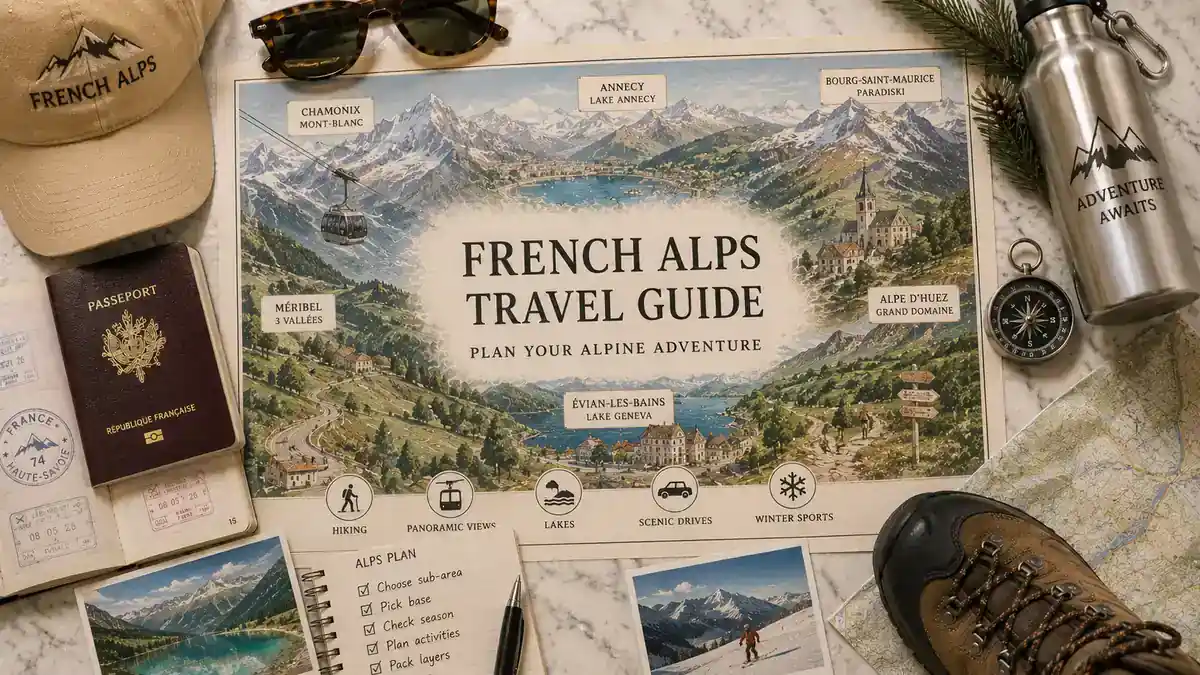
Travel to the French Alps splits in two before you book anything. In winter, France’s Alpine belt is a snow-sports region organised around lifts, altitude and snow cover; in summer, the same valleys become a hiking, lake and pass-road region with a completely different rhythm. Both are real. They just answer to different travelers, and a plan built for one of them resolves almost nothing for the other.
This guide handles the four structural decisions in order: which slice of the Alps fits your trip, how many days that slice actually needs, whether to settle into one base or move between valleys, and which season you are really planning for. It also covers the honest access reality — which valleys the trains reach, and what a car buys you once you leave them — plus a plain word on where ordinary walking stops and high-mountain terrain begins.
Quick Answer
The French Alps are worth a dedicated leg for travelers who want mountains at the centre of the trip. Season decides everything else: winter is a snow-sports region, summer a hiking-and-lakes region. Pick one sub-area and one base for 2–3 days, and allow a week to combine two.
Trust Layer
Tripstou region guide for travelers planning a regional trip. Covers sub-areas, trip shape, base strategy, timing, and mobility tradeoffs.
Produced with AI assistance and reviewed by Alex Perrut, working in tourism since 2015, for the Tripstou editorial team. See our editorial process for details.
Last factual review: August 5, 2026.
Official sources consulted: France.fr, Atout France.
Key Takeaways
- The French Alps reward travelers who make mountains the point of the trip, and frustrate anyone passing through briefly.
- Your season picks the region: winter is snow sports and lifts, summer is hiking, lakes and open pass roads.
- Choose one of five sub-areas before choosing a town — Chamonix for altitude, Annecy for lake-town comfort, Tarentaise for skiing.
- Budget 2–3 days for one sub-area, 4–6 days to absorb a bad-weather day, and 7–10 days for two.
- One base beats two up to a week; rail-served Chamonix, Annecy and Grenoble also make the trip workable car-free.
- Waymarked valley hiking suits ordinary visitors; glacier and high-alpine terrain requires current conditions information and a qualified mountain guide.
Table of Contents
Are the French Alps Worth Visiting?
The French Alps are worth visiting when mountains are the point of the trip, in either season. They deliver Europe’s highest terrain, serious walking, big ski country and lake towns within a compact area. They reward travelers who commit days to them and frustrate anyone passing through.
The region suits four groups particularly well:
- Skiers and snowboarders — the Alpine valleys hold France’s highest and most extensive ski terrain, and a winter trip here is built around it.
- Hikers — waymarked valley and mid-altitude routes run everywhere, including long-distance options such as the Tour du Mont Blanc and the wider GR network.
- Lake-and-town travelers — Annecy and the Haute-Savoie lakeshore give you mountain scenery with cafés, promenades and short, easy days.
- Families in summer — lake beaches, valley walks and cable-car viewpoints make a workable mix when the high passes are open.
Three travelers should think twice. The non-skier arriving in deep winter finds a region where much of the visible infrastructure exists for snow sports, with the walking terrain snow-covered and the pass roads shut. The traveler with 3 days and no car ends up confined to whichever valley the train reaches. And anyone hoping to combine the Alps with the coast in a single week is planning two trips with one budget of days — our French Riviera guide covers what that second half actually asks for.
On cost, the Alps sit among France’s more expensive regions during peak ski weeks, when demand for beds concentrates into the same valleys at the same time. Summer and shoulder periods are noticeably easier on the budget, and high-altitude lifts and major resort passes remain a significant, front-loaded expense in winter regardless of where you stay. For how the region compares with the rest of the country, see our France travel budget guide.
Among France’s regions, the Alps are the one that asks you to build the trip around a landscape instead of a city. That is a different planning exercise from the wine country, the coast or the cathedral towns, and our guide to the best places to visit in France shows where the region sits against the alternatives.
The Alps punish short visits harder than most French regions, because a two-night stop buys you one valley and one roll of the weather dice. Add the third night before you add the second base.
Where Are the French Alps and What Do They Cover?
The French Alps run along France’s eastern border with Switzerland and Italy, from Lake Geneva south towards the Mediterranean hinterland. Mont Blanc, the highest peak in the Alps and in western Europe, stands above the Chamonix valley near the northern end. Most trips use only a fraction of that span.
When travelers say “the French Alps,” they usually mean the northern half — the Mont Blanc massif, Lake Annecy and the big ski valleys of the Savoie departments. That is where the flights, the trains and the best-known names concentrate. The southern Alps are quieter, drier and less trafficked by international visitors, and they follow different planning logic.
As a map in words, the region resolves into five planning units: the Mont Blanc massif around Chamonix, Lake Annecy and its town, the Tarentaise–Vanoise ski valleys, the Écrins massif on the Grenoble side, and the Haute-Savoie lakes along the French shore of Lake Geneva. Each is a separate decision, not a stop on a loop.
The region also sits at the far edge of the country, which matters for route planning. Anyone still assembling the national picture will find the context in our France travel guide; the practical consequence here is that the Alps rarely work as a casual detour from the middle of a France itinerary.
Summer vs Winter: Two Different French Alps
In winter the French Alps are a ski region; in summer they are a hiking, lake and pass-road region. The terrain is the same and the trip is not. Lifts, valleys, road access and the reason to be there all change with the snow, so plan them as separate trips.
The winter product is snow sports and the valley life around them. Resorts run, beds fill, and the day is shaped by lift hours and conditions. Towns like Annecy still work as winter town trips, but the region’s centre of gravity moves uphill, and travelers who do not ski will find fewer reasons to be in a high valley.
The summer product is walking, water and roads. Valley and mid-altitude trails open up, lake towns turn into their warm-weather selves, and the high pass roads become drivable once crews have cleared them. Long-distance routes such as the Tour du Mont Blanc belong to this half of the year, as does most of the region’s family-friendly, non-technical outdoor time.
What disappears in each season is the part people underestimate. In winter, the high pass roads are shut and the through-routes across the range simply do not exist. In summer, a good deal of the ski infrastructure sits idle, and resort villages that look busy in photographs can be quiet, with a reduced set of services open.
Mountain weather does not follow the season label either. Valley warmth and altitude cold can occur on the same day, and conditions change fast with height — our France packing list covers what that variability asks you to bring.
Booking a summer trip on winter photographs is the most common Alpine planning error. The lifts in those images are largely idle in the warm months, and the terrain they serve is not walk-up country.
The Best Areas of the French Alps and Where to Base
Five sub-areas cover almost every French Alps trip, and each one plans differently. They are the Mont Blanc massif, Lake Annecy, the Tarentaise–Vanoise, the Écrins and the Haute-Savoie lakes, each with its own natural base town. Choose the sub-area first; the town follows from it.
Mont Blanc massif — base in Chamonix
The Mont Blanc massif is the region at its most vertical: glaciers, rock spires and Europe’s highest peak directly overhead. Its anchor experience is the Aiguille du Midi cable car, which lifts visitors from the valley floor into high-mountain air. Chamonix itself is a working mountain town with a year-round population, keeping hotels, shops and services open at the foot of the lifts. Best for: travelers who want high-mountain scenery without driving to reach it.
Lake Annecy — base in Annecy
Lake Annecy is the soft counterweight to the high massifs: clear water, mountains framing the far shore, and a canal-laced old town at the northern end. Its anchor experience is the lakeside path circling the water, walkable and cyclable in easy sections. Annecy is the region’s most comfortable base for non-mountaineers, with restaurants, markets and services that stay open through the year. Best for: travelers who want alpine views with town comforts and short, easy days.
Tarentaise–Vanoise — base in Val d’Isère, Tignes, Courchevel or Méribel
The Tarentaise valley and the neighbouring Vanoise are France’s big-ski country, with high-altitude resort villages sitting beside a large national park. The anchor experience in winter is the linked lift terrain above the valley; in high summer, the same slopes turn into alpine walking country. Val d’Isère and Tignes sit high in the Tarentaise, while Courchevel and Méribel anchor the Trois Vallées side. Best for: skiers who want altitude and lift-linked terrain above everything else.
Écrins massif — base on the Grenoble side
The Écrins is the quiet one: a large national-park massif of long valleys and thin crowds, well south of the Mont Blanc traffic. Its anchor experience is unhurried valley walking, with high peaks visible and no resort machinery around them. Grenoble works as the practical base and gateway, a full-sized city with rail access on the edge of the massif. Best for: walkers who want quiet mountain country with a city gateway attached.
Haute-Savoie lakes — base in Évian-les-Bains
The Haute-Savoie lakeshore runs along the French side of Lake Geneva, where spa towns and gentle terrain replace the high peaks. Its anchor experience is the lakefront itself, with promenades, water views and the thermal tradition the area built its name on. Évian-les-Bains is the natural base, small, walkable and well placed for arrivals through Geneva. Best for: slow trips built around lake days, spa time and minimal driving.
These profiles are orientation, not an activity list. For what to actually do in each area — including whether the big lift trips earn their day — see things to do in the French Alps. The quieter corners such as the Écrins valleys and the Vercors reward a second visit, and our guide to hidden gems in the French Alps covers them properly.
Season columns describe what each area is set up for, not guaranteed conditions.
| Sub-area | Character | Base town | Best for | Stronger season |
|---|---|---|---|---|
| Mont Blanc massif | Glaciers, alpinism and Europe’s highest peak overhead | Chamonix, a working mountain town with rail access | High-mountain scenery without driving to reach it | Both seasons, with entirely different terrain |
| Lake Annecy | Turquoise lake, canal old town, mountain backdrop | Annecy, the region’s most walkable lake town | Alpine views with town comforts and easy days | Summer above all, with workable shoulder months |
| Tarentaise–Vanoise | High-altitude ski valleys beside a national park | Val d’Isère, Tignes, Courchevel or Méribel | Skiers wanting altitude and lift-linked terrain | Winter for skiing, high summer for walking |
| Écrins massif | Quiet national-park country with long empty valleys | Grenoble, a city gateway on the massif edge | Walkers seeking quiet country and city access | Summer and early autumn for walking |
| Haute-Savoie lakes | Lake Geneva’s French shore, spa towns, soft terrain | Évian-les-Bains, a small lakeside spa town | Slow trips built around lake and spa days | Summer and shoulder months on the lakeshore |
Chamonix or Annecy: Which Base Fits You?
Choose Chamonix to be inside the mountains, and Annecy to look at them from a comfortable town. Chamonix suits travelers whose days are built around altitude, glacier scenery and walking or skiing from the valley floor upward. Annecy suits travelers who want lake swims, flat cycling, restaurants and a base that stays pleasant when the weather turns. The tradeoff is straightforward: Chamonix gives you proximity to serious terrain and a narrower range of bad-weather options, while Annecy gives you an easier trip and puts the high mountains an excursion away.
Chamonix sells the mountain and Annecy sells the view of it. Travelers who mainly want alpine scenery in the frame — not underfoot — are usually happier in the lake town.
Hotels and places to stay
Compare hotels, apartments and stays for your dates in one search.
Search hotels and stays on hotels.com →
Tripstou may earn a commission if you book through this link, at no extra cost to you.
How Many Days Do You Need in the French Alps?
Plan 2–3 days for one sub-area at highlight pace, and 7–10 days to pair two. The region rewards depth over coverage, and valley-to-valley moves eat more time than distances suggest. Anything under 2 nights works only as a bolt-on to a wider France route.
- 2–3 days — one sub-area, one base, headline experiences only. This is the add-on tier: it fits travelers slotting the Alps into a broader France trip, and it works best in a rail-served valley where no rental car is needed.
- 4–6 days — one sub-area properly, with a spare day for weather. This is the first tier where a bad-conditions day does not wreck the trip, and it suits travelers who came for the mountains but are not committing a whole holiday to them.
- 7–10 days — two sub-areas, or one sub-area plus a ski week or multi-day walking segment. This tier fits travelers making the Alps the trip itself, and it is the shortest length at which moving base is comfortably worth the overhead.
Where the Alps sit inside a wider route is a separate question, and one the itinerary pages own. Our France itinerary guide covers route construction across the country, with worked shapes at 7 days, 10 days and 14 days — the last of which is where mountains and coast in one trip stop being a squeeze.
The common wish is the Alps and the Riviera inside a single week. It is doable on paper and thin in practice, since each region needs its own base and its own travel day; give that combination more time, or pick one.
One Base or Several in the French Alps?
One base wins for most French Alps trips up to a week. Valleys are separated by winding roads and indirect rail links, so moving between them absorbs a travel day more often than travelers expect. Two bases pay only when the trip spans two sub-areas or two genuinely different products.
A single base also gets more out of bad weather. When cloud sits on the high ground, a familiar valley gives you fallback options — a lower walk, a town day, a lake — while a transfer day spent in poor conditions costs you the drive and buys nothing.
Multi-base trips earn their keep in two situations. The first is a season-spanning combination, such as a ski week paired with a few days in a lake town on the way out. The second is a genuine two-product trip: high mountains at one end, water and easy days at the other. Both are worth the overhead, and the overhead is real — repacking, checkout timing, and a transfer that lands you in a new place with the afternoon half gone.
Distance is not what makes Alpine moves expensive; altitude is. Getting from one valley to the next usually means descending most of the way out of the first before climbing into the second, which is why the short hop on the map is rarely a short hop in practice.
Getting to the French Alps and Getting Around
Geneva, Lyon and Grenoble are the practical gateways to the French Alps. Rail reaches Chamonix, Saint-Gervais, Annecy and Grenoble directly, which makes a car-free trip realistic in those valleys. Beyond the rail-served towns, buses and transfers thin out and a car starts to matter.
Each gateway has a natural catchment. Geneva sits closest to the Mont Blanc valley, Lake Annecy and the northern ski valleys, and it is the usual arrival point for travelers flying in. Grenoble is the southern gateway, on the Écrins side. Lyon is the strongest rail hub of the three and works as the connecting point for travelers arriving from elsewhere in France — it is a gateway to the Alps rather than part of them, and our Lyon region guide covers the city and its surroundings in their own right.
Coming from Paris, rail is the standard approach, usually with a change onto a valley line at the mountain end. That last leg is the part worth checking when you book, since the valley services run to their own schedules. For building a whole trip around trains, see our France train itinerary guide.
Inside the Chamonix valley, mobility is unusually good for a mountain area: a valley train runs the length of it, and local buses within the valley are free for visitors. That combination is what makes Chamonix the easiest Alpine base to use without a car. Annecy and Grenoble are proper towns with their own local networks, and the Haute-Savoie lakeshore is served along its length.
Driving buys freedom and costs simplicity. Road-trip construction across France is its own exercise — see our France road trip guide — and in the Alps specifically, winter driving carries seasonal equipment requirements, so check the current rules for your route and vehicle before setting off.
Do You Need a Car in the French Alps?
You do not need a car if your trip stays in a rail-served valley. Chamonix, Annecy and Grenoble all work car-free, and within the Chamonix valley the train-and-bus combination covers most of what a visitor needs. Point-to-point trips beyond the rail network run on buses and take a few hours between valleys, which is workable but inflexible.
A car buys two things specifically: movement between valleys on your own schedule, and access to the high pass roads in summer, which no scheduled service replicates. It buys much less inside a single valley, where parking and winter road conditions turn it into a liability.
The car question here is really a valley question. Inside a rail-served valley the car sits parked; between valleys, it is the entire reason you rented one.
When to Go: Ski Season and Mountain Pass Reality
Ski-season openings stagger by altitude and depend entirely on snow, not on a fixed calendar. The highest resorts open first, and closings through spring are equally snow-dependent. The high mountain passes run the other way: shut all winter, cleared and reopened in late spring or early summer.
That staggering is the whole planning point. High-altitude resorts can be running while lower villages in the same valley are still waiting, and the resorts’ own published opening dates carry an explicit condition — they are subject to weather and snow conditions. Treat any date you see as an intention, and confirm it with the resort before you commit to travel around it.
Peak weeks are a separate pressure. French school-holiday ski weeks concentrate demand into the same valleys at the same time, pushing up both crowding and price, and the pattern repeats every winter. The national mechanics behind those weeks — how the holiday zones work and how they shift the whole country’s travel calendar — belong to our guide on the best time to visit France.
The pass roads are simpler and stricter. The Col de l’Iseran, at roughly 2,764 m the highest paved pass in the Alps, and the Col du Galibier at roughly 2,642 m are closed by snow all winter and reopen once crews have cleared them in late spring or early summer. The Route des Grandes Alpes, which strings the high passes together into a through-route, is realistically a high-summer proposition. Reopening timing moves from one year to the next, so never build a route on the assumption a pass is open.
Lifts follow their own pattern. The Aiguille du Midi cable car operates through most of the year, with longer hours in summer, an annual autumn maintenance closure of roughly two to three weeks, and suspensions in severe weather. Check its status before you plan a day around it.
Snow opens the season, not the calendar — which is why booking a ski trip on the earliest possible week is a bet on weather. Travelers who need certainty should aim for the deep-winter middle of the season instead of its edges.
Is Hiking in the French Alps Safe for Ordinary Visitors?
Waymarked valley and mid-altitude hiking in the French Alps is accessible to ordinary visitors with normal fitness. Glacier terrain, off-piste snow and high alpine routes are a different activity with a different risk class. The distinction matters more here than almost anywhere else in France.
Waymarked trails in the valleys and at mid altitude are signed, mapped and walked by ordinary visitors throughout the summer. They are the region’s mainstream walking product, and they are what most people mean when they talk about hiking in the Alps.
Glaciers, off-piste and backcountry snow, and high alpine routes are not an extension of that. They require current conditions information, and for glacier and off-piste travel, a qualified mountain guide. This is not terrain a visitor improvises onto after a cable-car ride.
The region has official bodies whose job is exactly this information, and they are the source of truth. In Chamonix, the Office de Haute Montagne / La Chamoniarde publishes conditions, hut and lift access and avalanche-risk information, and asks users to register their route and dates before heading out. Météo-France issues the avalanche bulletin. Consult them directly; this page does not substitute for either.
The Aiguille du Midi deserves its own note, because it moves visitors from the valley to 3,842 m in about twenty minutes with no acclimatisation. The summit can be below freezing even in summer, walking slowly up there helps limit mountain-sickness symptoms such as headache and breathlessness, and official guidance prohibits the site for children under 3 and does not recommend it under 5. Whether the trip is worth doing at all is an activity decision, covered in things to do in the French Alps.
Everyday travel safety is a separate subject from mountain terrain, and neither of the guides below covers the mountains. For city-level and personal safety across the country, see our guides to common scams in France and solo female travel safety in France.
Frequently Asked Questions
Can you visit the French Alps if you don’t ski?
Yes. Summer is the non-skier’s season: waymarked valley walks, lake swimming at Annecy, cable-car viewpoints and open pass roads. Winter is harder without skis — much of the visible infrastructure exists for snow sports — but lake towns like Annecy and Évian-les-Bains still work as ordinary winter town trips.
Are the French Alps expensive?
They are among France’s pricier regions during peak ski weeks, when demand concentrates into the same valleys at once. Lifts and resort passes are the front-loaded costs. Summer and shoulder months are noticeably easier, especially away from the big resorts. Our France travel budget guide sets the national baseline.
Can you walk on a glacier in the French Alps without a mountain guide?
No — glacier terrain is a different activity from valley hiking and calls for a qualified mountain guide plus current conditions information. In Chamonix, the Office de Haute Montagne / La Chamoniarde holds that information and asks users to register their route beforehand; Météo-France issues the avalanche bulletin.
Does the Aiguille du Midi cause altitude sickness?
It can. The cable car lifts you to 3,842 m in about twenty minutes with no acclimatisation, and official guidance is to move slowly at the summit to limit headaches and breathlessness. The summit can be below freezing even in summer. The site is prohibited under 3 and not recommended under 5.
Is Annecy in the French Alps?
Yes. Annecy sits in Haute-Savoie, at the northern end of Lake Annecy, with Alpine ridges rising directly behind the lake. It is an Alpine town, not a high-mountain one, which is exactly why it works as the region’s easiest base for travelers who want scenery without altitude.
What should you pack for the French Alps?
Layers, and more of them than the season suggests. Valley warmth and altitude cold can occur on the same day, and conditions change quickly with height. High viewpoints stay cold even in summer, and sturdy footwear matters on valley walks. Our France packing list covers the rest.
Are the French Alps a good add-on to a Paris trip?
Yes, if you can spare at least 3 days including travel. Rail from Paris reaches the valleys with a change at the mountain end, so the leg costs real hours. With fewer days you get one valley and one chance at the weather; with a week you get a proper Alpine leg.
Are the French Alps good for families?
In summer, yes — lake beaches at Annecy, valley walks, and cable-car viewpoints make an easy mix without long drives. Winter suits families who ski, and less so those who do not. Altitude is the limit worth knowing: the Aiguille du Midi carries official age restrictions for the youngest children.
Related Guides
These guides cover the planning layers this page routes out to.
- Paris region guide — the country’s most common first leg, and the usual starting point for an Alpine add-on.
- Alsace travel guide — the other eastern-border region, with villages and vineyards instead of altitude.
- Normandy travel guide — coast and history in the north, for trips that trade mountains for memory.
- Bordeaux region guide — the southwest’s wine and coast combination, and an easy contrast to Alpine pacing.
- France wine regions — the national wine map, useful when tastings shape where you travel.
- Best beaches in France — where the coast delivers, for travelers weighing water against altitude.
- France food guide — what to eat across the country, including how mountain cooking differs from the rest.
Did this guide save you time or money? Tripstou is independent and reader-funded — if you'd like to give something back, you can support the site with a crypto contribution of any size.