Ten days is the sweet spot for a first trip to Italy, and it forces one clear question: how do you fit Rome, Florence and Venice into the window without spending it on trains? The pressure is real. Try to bolt on Tuscany, the Amalfi Coast and the lakes as well, and the trip collapses into a blur of check-ins and check-outs. This guide commits to one route instead of handing you a menu. It runs south to north — Rome, then Florence, then Venice — on fast trains, with no backtracking and no wasted transfers. Below you get the nights-per-city split, the fly-in and fly-out airports, a day-by-day plan for all ten days, and clear rules for when to add Cinque Terre or the Amalfi Coast, or trim the route if you have fewer days. It is a plan you can book, not a wish list.
Quick Answer
Rome, Florence and Venice is the strongest 10-day Italy route. Fly into Rome, out of Venice, and split the trip roughly four nights in Rome, three in Florence, three in Venice, all linked by train. It suits first-timers wanting the classics without backtracking; add Cinque Terre or Amalfi only by trimming a city.
Trust Layer
Tripstou itinerary guide for travelers planning a route. Covers pacing, stop count, stop order, base logic, and trip length.
Produced with AI assistance and reviewed by Alex Perrut, working in tourism since 2015, for the Tripstou editorial team. See our editorial process for details.
Last factual review: July 3, 2026.
Official sources consulted: Italia.it, ENIT.
Key Takeaways
- Rome, Florence and Venice line up south-to-north on fast trains, giving the strongest 10-day route with no backtracking.
- Split the ten days roughly four nights in Rome, three in Florence and three in Venice for an unhurried pace.
- Fly into Rome and out of Venice on an open-jaw ticket so your last train still moves you forward.
- Use the train for every leg — a single morning departure links each city centre to centre, skipping airport transfers.
- Ten days comfortably covers these three cities; adding Cinque Terre or Amalfi means trimming a city, not stretching the days.
- First-timers should keep the classic spine; returners can swap one city for a region like Amalfi or the lakes.
Table of Contents
Rome, Florence and Venice is the strongest 10-day Italy route
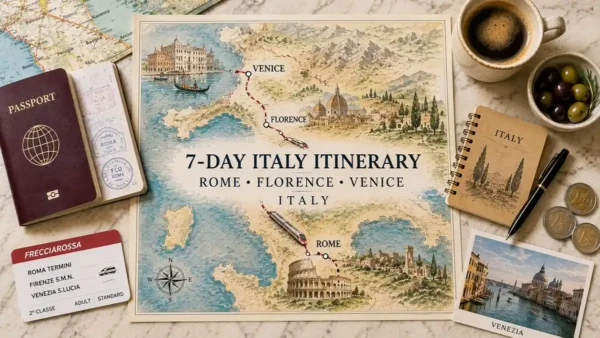
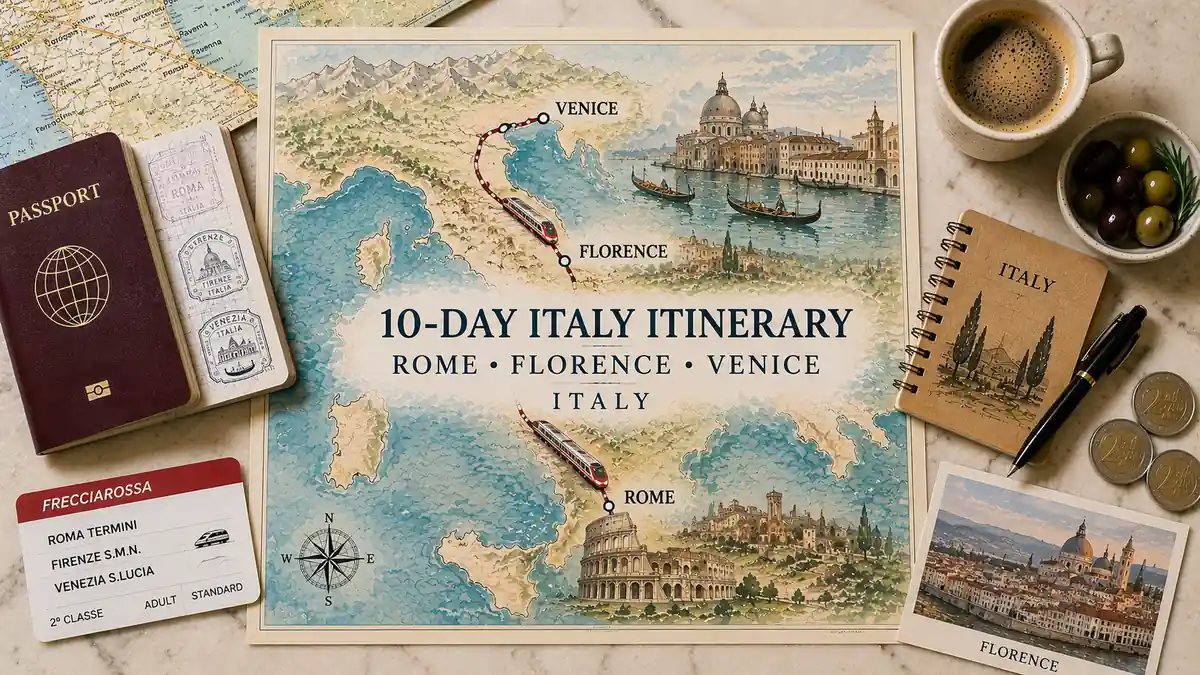
Rome, Florence and Venice is the best 10-day Italy route for first-time visitors. The three cities line up on a single south-to-north spine, so you never double back. Fast trains connect them in a straight sequence, which turns transit into short hops and leaves the bulk of your ten days for the cities themselves.
The route works because geography does the planning for you. Rome sits in the south, Venice in the north, and Florence falls almost exactly between them, so a straight line up the country reaches all three. Each leg is a short train ride, not a travel day.
Here is the shape at a glance:
- Days 1–4: Rome — the classical core
- Days 5–7: Florence — Renaissance art and Tuscany’s gateway
- Days 8–10: Venice — canals and the lagoon finale
Adding a fourth marquee city to ten days does not add a place — it subtracts a day from each of the other three, and Rome is the stop that punishes rushing most.
How Many Nights to Spend in Rome, Florence and Venice
Spend about four nights in Rome, three in Florence and three in Venice. The split matches how much each city asks of you: Rome is dense and sprawling, Florence is compact but art-heavy, and Venice rewards a slower pace once the day-trippers leave. It keeps every stop unhurried across the full ten days.
Rome earns the extra night because it carries the heaviest sightseeing load — the ancient core and the Vatican sit on opposite sides of the city, and each swallows the better part of a day. Our Rome city guide breaks down what to prioritise inside those four days.
Florence is walkable end to end. Three nights cover its museums and still leave one day for a Tuscany trip. Venice is smaller than it feels; three nights let you experience it after the cruise crowds thin, which is when it is at its best.
| City | Nights | What the time buys you |
|---|---|---|
| Rome | Four nights | Ancient core, the Vatican, and unhurried evenings |
| Florence | Three nights | Renaissance museums plus one Tuscany day |
| Venice | Three nights | Early canals, lagoon islands, and a slow finish |
The fourth night belongs in Rome, not spread evenly across the three — it is the only base where a jet-lagged arrival day still leaves time to see the essentials.
Where to Fly In, Fly Out, and What Order to Visit
Fly into Rome and out of Venice, visiting the cities in that order. A multi-city or open-jaw ticket lets you enter in the south and exit in the north, so you cross the country in one direction. You never retrace a leg, and no time is lost returning to your arrival airport.
The order follows the map, not preference. Rome’s airports handle the most long-haul routes, which makes the city the natural entry point for travellers arriving from outside Europe. Venice sits at the northern end of the line, so ending there means your last train ride still moves you forward.
An open-jaw ticket — arriving in one city, departing from another — usually costs about the same as a round trip and saves a whole day of backtracking. Compare it against a standard return before you book.
Starting in Rome front-loads the trip’s heaviest sightseeing while your energy is highest, and saves Venice as a slower reward for the end. Reversing the route to fly into Venice works too, but only if flight prices clearly favour it.
Your 10-Day Italy Itinerary, Day by Day
The ten days break into three blocks that map onto the three cities. Days one to four cover Rome, days five to seven Florence, and days eight to ten Venice. Each block front-loads the big sights and leaves room to wander, so the plan stays firm on structure but flexible hour to hour.
Days 1–4: Rome
Rome fills four days without strain. Spend the first two on the ancient core — the Colosseum, Roman Forum and Palatine Hill — then give a full day to Vatican City for St. Peter’s and the Vatican Museums. Book the major sites ahead, since entry slots for the Colosseum and Vatican sell out and queues run long. Use the fourth day loosely for Trastevere, the Pantheon and the piazzas, or hold it as a recovery buffer against jet lag.
Days 5–7: Florence
Take a morning train to Florence and drop your bags by lunch. The Uffizi and the Accademia — home to Michelangelo’s David — anchor the first day and a half, and reserving both in advance saves you the worst of the queues. Give the Duomo, Ponte Vecchio and the Oltrarno an unhurried second day. Our Florence guide covers what to see and where to base yourself. Save day seven for Tuscany — Siena, San Gimignano or a wine valley — before the next morning’s train.
Days 8–10: Venice
An easy train north brings you into Venice by midday. Spend the first afternoon around San Marco and the Rialto, then head out early the next morning before the day-trippers arrive, which is when the quiet canals are yours. Give a full day to the lagoon islands of Murano and Burano, and let the final morning drift before you make for the airport. The Venice guide has the neighbourhood detail this route leaves out.
Tours and activities
Book skip-the-line tickets, day trips and local tours with free cancellation on most activities.
You can also browse everything on getyourguide.com.
Tripstou may earn a commission if you book through this link, at no extra cost to you.
How Do You Get Between Rome, Florence and Venice?
Take the train — it is the fastest and simplest way between all three cities. Italy’s high-speed lines link Rome, Florence and Venice city-centre to city-centre, so you skip airport transfers entirely. A single morning train handles each leg, leaving most of the day for the city you arrive in.
Book a day or two ahead for the best fares and to lock in a morning departure, since seats on the fast trains are reserved. Both legs — Rome to Florence, Florence to Venice — run frequently through the day, so a missed connection is rarely a crisis. Skip the car. On this route it would only add parking headaches and cost.
Train and bus tickets
Compare routes, schedules and prices across rail and bus operators in one search, with mobile tickets on your phone.
New to Omio? Code NEW10 takes 10% off your first booking — or APPNEW10 if you book inside the Omio app. Both apply to bookings up to €80.
Search routes and compare prices on Omio →
Tripstou may earn a commission if you book through this link, at no extra cost to you.
Can You See Rome, Florence and Venice in 10 Days Without Rushing?
Yes — ten days is comfortably enough to see all three cities without rushing. The trip uses only three bases, so you unpack three times and spend your days sightseeing, not in transit. That pacing leaves slack for long lunches, repeat visits and the odd wasted afternoon, which is exactly what a first trip should have.
The pace holds because the route obeys one rule: fewer bases, more nights in each. Cramming a fourth or fifth city into the same ten days is what turns a good trip into a checklist. If you have only seven days, drop Venice and give the time to Rome and Florence; with fourteen, add a region rather than a rushed extra city. Our Italy itinerary hub lays out the shorter and longer builds.
Ten days is not enough to “see Italy” — no trip is. It is enough to see these three cities properly, and that trade is the whole point of committing to one route.
First-Timer vs Returner: How to Adjust the Route
First-timers should keep the classic Rome–Florence–Venice spine exactly as it is. It delivers Italy’s headline sights in the most logical order, with no planning risk. Returners who have already done the big three can swap one city for a region — the Amalfi Coast, the lakes or Puglia — and reuse the same ten-day frame.
The instinct to “see more” on a first trip is the mistake to resist. The classic route is popular because it works, not because it lacks imagination. First-timers gain nothing from swapping Florence for somewhere less connected; they just add planning friction.
Returners have earned the freedom to break the line. Trade Venice for the Dolomites, or Florence for a slow week in the south, keeping Rome as the anchor if it is a genuine first visit for anyone in the group. The route’s bones — south to north, three bases, train between — survive almost any single substitution.
How to Adapt This Route: Adding Cinque Terre, Amalfi, or Time
Add a region only by trimming a city — ten days cannot absorb both. Cinque Terre slots naturally after Florence, since the trains run west from Tuscany; the Amalfi Coast pairs with Rome at the southern end. Either addition means dropping a night or two from Venice or Florence to keep the pace unhurried.
When time grows, add in this order:
- Cinque Terre first — the shortest detour, reachable from Florence, and happy with a day or two.
- The Amalfi Coast next — it deserves three-plus nights and works best bolted onto the Rome end, not squeezed between cities.
- A Tuscany base last — only if slowing down appeals more than covering new ground.
When time shrinks, cut in this order:
- Venice goes first — furthest north and the easiest single city to save for another trip.
- Then trim Florence to two nights before you touch Rome.
- Rome stays to the end; it carries the sights most first-timers refuse to miss.
| Route shape | Best for | The trade-off |
|---|---|---|
| Rome–Florence–Venice | First-timers wanting the classics | The balanced default, nothing cut |
| Rome–Florence–Cinque Terre | Coast and scenery over canals | Drops Venice for the Ligurian shore |
| Rome–Amalfi–Florence | Southern coast and a slower pace | Trims Venice; more time down south |
Which region to add depends on what you came for — dramatic coastline, slower food-and-wine days, or more cities. Our guide to the best places in Italy helps weigh the regions against each other. Budget shifts too whenever you flex the route; the 10 days in Italy cost guide shows how adding a coastal leg changes the total.
Cinque Terre and Amalfi solve opposite problems — one is a quick scenic detour, the other a destination in its own right — so never treat them as interchangeable swaps.
Frequently Asked Questions
Is 10 days enough time for Italy?
Ten days is enough to see one region of Italy well, not the entire country. It comfortably covers the classic Rome, Florence and Venice route at an unhurried pace, with room for a day trip. Trying to add the south, the lakes and the islands in the same window only rushes everything.
Do I need a rental car for a 10-day Italy trip?
No — you do not need a rental car for this route. Rome, Florence and Venice are connected by fast trains and are best explored on foot, so a car sits unused and costs you parking and city-access fees. Save the rental only for a rural Tuscany or coastal detour.
Can you add a Tuscany day trip to a 10-day Italy itinerary?
Yes — a Tuscany day trip fits neatly on day seven from Florence. Siena, San Gimignano or a wine valley are each reachable as a full-day outing before your morning train to Venice. Keep it to one day; turning Tuscany into an overnight base means dropping a night from another city.
Can you see both the Amalfi Coast and Venice in 10 days?
Not comfortably — the Amalfi Coast and Venice sit at opposite ends of the country. Fitting both means long transit days and too little time in each, which defeats the point of a relaxed trip. Pick one: pair Amalfi with Rome in the south, or keep Venice for the northern finish.
How far in advance should you book the major sites for this trip?
Book the headline sites as soon as your dates are fixed. Timed-entry tickets for the Vatican Museums, the Colosseum and Florence’s Uffizi and Accademia sell out fastest, especially in the peak spring and summer months. High-speed trains are cheaper booked ahead too, though they rarely sell out entirely.
Related Guides
- Rome Travel Guide — what to do and where to stay across your four Rome days.
- Florence Guide — museums, neighbourhoods and Tuscany day trips.
- Venice Guide — canals, islands and where to base yourself.
- Italy Itinerary Hub — shorter and longer routes, including 7- and 14-day builds.
- Best Places in Italy — compare regions before you adapt the route.
- 10 Days in Italy Cost — what the trip adds up to and where the money goes.
- Italy Travel Guide — the hub-level overview for planning the wider trip.
Did this guide save you time or money? Tripstou is independent and reader-funded — if you'd like to give something back, you can support the site with a crypto contribution of any size.