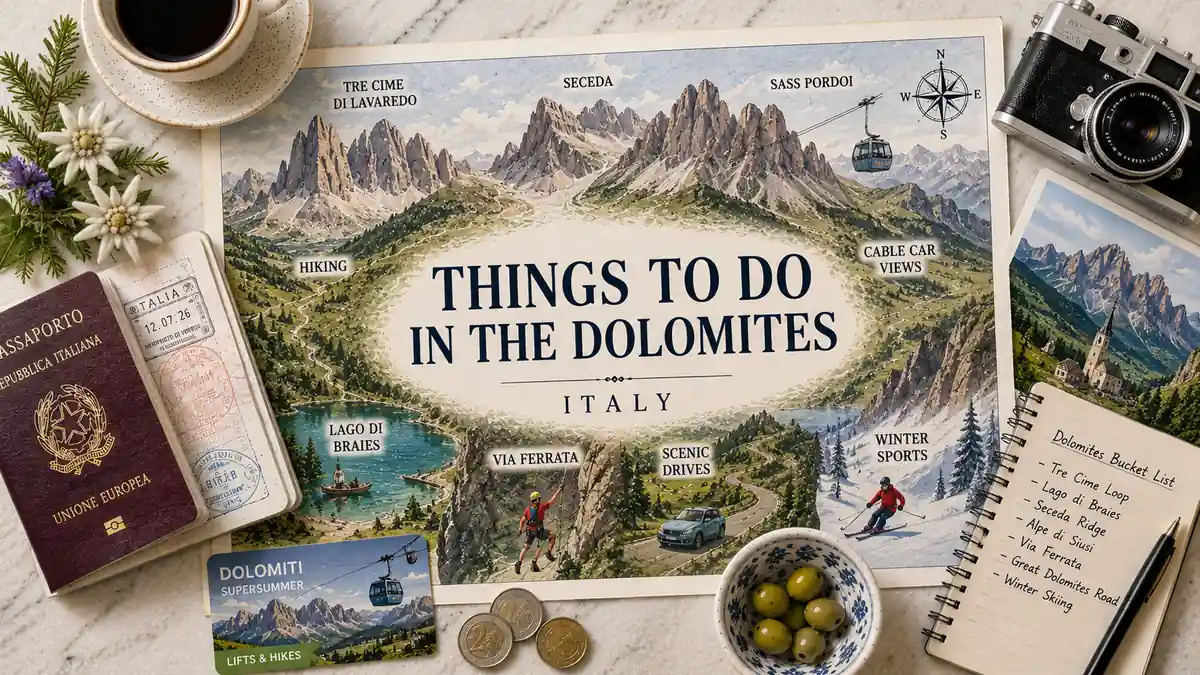
The Dolomites pack more distinct experiences into one mountain range than almost anywhere in the Alps, and no single visit covers them all. You could ride a cable car to a panorama in the morning, circle a turquoise lake in the afternoon, or spend a full day on an exposed via ferrata cabled to the rock. The right choices come down to three things: how much effort you want to spend, who you are traveling with, and the season you arrive in. A confident hiker in high summer and a family riding gondolas are looking at two different Dolomites. This guide groups the best things to do by experience type — marquee hikes, cable-car views, easy non-hiking options, alpine lakes, adventure, scenic drives, and winter sports — so you can pick fast and build a shortlist that fits.
Quick Answer
The headline things to do are iconic hikes and cable-car viewpoints, with alpine lakes and via ferrata close behind. What suits you depends on your effort appetite — hikers versus non-hikers — and the season you visit. Non-hikers ride cable cars for the same views; winter swaps trails for skiing and snowshoeing.
Trust Layer
Tripstou selection guide for travelers choosing between multiple places. Covers selection criteria, traveler fit, and trip value.
Produced with AI assistance and reviewed by Alex Perrut, working in tourism since 2015, for the Tripstou editorial team. See our editorial process for details.
Last factual review: July 10, 2026.
Official sources consulted: italia.it, enit.it.
Key Takeaways
- The Tre Cime di Lavaredo loop is the best hike for most visitors, circling the range’s signature peaks on a moderate path.
- Non-hikers get the same summit views by riding cable cars like Sass Pordoi, then walking the level ground along the top.
- Lago di Braies is the standout alpine lake, but arrive early or late to beat peak-season crowds and access limits.
- Via ferrata is accessible to first-timers with a certified guide, who supplies the gear and the safety judgment beginners lack.
- Your best options split by season: summer favors hikes, lakes, and pass drives, while winter swaps them for skiing and snowshoeing.
- A guided day trip’s real value is the transfer, not the guiding, when slow valley transport could otherwise strand a car-free traveler.
Table of Contents
Best hikes in the Dolomites, from easy to expert
The Tre Cime di Lavaredo loop is the best hike for most visitors. It circles the range’s signature trio of peaks on a moderate, well-marked path. Beyond it, the range spreads across every effort level — from a short ridge walk on Seceda to the demanding Lago di Sorapis trail — so you can match the hike to your legs.
Effort is the fastest way to narrow the list. Pick your tier, then pick your peak.
| Hike | Effort | What makes it distinct | Best for |
|---|---|---|---|
| Adolf Munkel Trail | Easy | Near-level path beneath the Odle spires | First-timers and families wanting big scenery |
| Tre Cime di Lavaredo loop | Moderate | Full circuit of the range’s most famous peaks | Reasonably fit walkers after the classic |
| Seceda ridge | Moderate | Tilted grass ridge with jagged peaks behind | Photographers, lift-assisted ridge walkers |
| Lago di Sorapis | Hard | Longer approach with exposed sections to a milky lake | Confident hikers with a head for heights |
Most marquee hikes start from a lift or cable-car station, so your real decision is often whether to walk up or ride up. Riding the first ascent turns several routes that read as expert into moderate half-days. The Dolomites are the strongest hiking region in the country, and they anchor most serious lists of things to do in Italy for walkers. The tradeoff is crowds: the famous loops fill fast in peak months, so start early or aim for shoulder hours.
Best cable cars and viewpoints worth riding
The best cable-car view is Sass Pordoi. Its station opens onto a stark high-altitude plateau locals call the terrace of the Dolomites. The rest earn their fare too — Alpe di Siusi, Seceda, Sassolungo, and the Cinque Torri chairlift each deliver summit-level panoramas without the climb.
Each ride suits a different mood:
- Sass Pordoi — the highest and most dramatic, a moonscape of rock at the top.
- Alpe di Siusi — a vast high-alpine meadow, gentle and family-friendly up top.
- Seceda — the tilted grass ridge with the Odle behind it, the postcard shot.
- Sassolungo — a slow, old-school two-person basket lift for the adventurous.
- Cinque Torri — a short chairlift into a cluster of climbing towers and WWI trenches.
A lift ticket and a hiking day are not either-or here. The smartest move is to ride up, walk the level ground along the top, and ride down, which is exactly why Seceda and Alpe di Siusi work equally well for hikers and non-hikers. Fares and operating windows shift by lift and season, so treat any figure as a range and confirm before you ride. For current fares, seasonal opening windows, and where to base for lift access, the Dolomites guide is the planning hub.
What can you do in the Dolomites without hiking?
Yes — the Dolomites reward non-hikers as much as walkers. The best low-effort option is a cable car to a mountaintop café and its view. Beyond the lifts, you can stroll a lakeshore in flat shoes, wander a car-free gondola village, soak at an alpine spa, or ride an e-bike along the valley floor.
The full low-effort set is wider than the marquee view rides:
- Lakeside strolls — the flat loops at Lago di Braies or Carezza need only comfortable shoes.
- Car-free villages — places you reach by gondola let you wander mountain lanes with no ascent.
- Alpine wellness — many valley hotels and day spas lean into thermal and sauna culture.
- Alpine coasters and toboggan runs — gravity does the work, and kids love them.
- Valley e-biking — flat cycle paths follow old railway lines, with pedal assist for any rise.
This low-effort set doubles as your bad-weather plan. Spas, coasters, and gondola villages stay rewarding when cloud swallows the high peaks and the ridge hikes turn pointless. The one trap for non-hikers is picking the wrong mountain: Alpe di Siusi and Seceda drop you onto near-level ground up top, while a lake like Sorapis punishes anyone expecting a gentle walk.
Best alpine lakes to visit in the Dolomites
Lago di Braies is the best alpine lake to visit. It is an emerald basin ringed by cliffs, with wooden rowboats for hire on the water. Lago di Carezza wins for effort-free beauty beside the road, while Lago di Sorapis rewards hikers with a milky-blue color at the end of a real trail.
Treat each lake as an experience, not a destination to build a trip around. What to actually do at each:
- Lago di Braies — hire a rowboat, walk the flat shoreline loop, shoot the boathouse at first light.
- Lago di Carezza — a quick stop and short loop for mirror reflections of the Latemar; no hiking needed.
- Lago di Sorapis — earn it on foot, where the color is the reward rather than the walk.
Braies is a victim of its own fame. Arrive early or late and it is a serene rowboat morning; arrive mid-day in high summer and access roads, parking, and even timed-entry shuttles can turn the visit into a queue. Access, parking, and shuttle rules at Braies change through the year, so check the approach in advance and keep any published limit as a moving target, not a fixed rule.
Via ferrata and adventure experiences, by skill level
Via ferrata suits first-timers — with a guide. It means climbing a mountain route protected by fixed steel cables, rungs, and ladders, using a harness and lanyard clipped to the line. Beginner routes exist across the range, and a certified guide supplies the gear and the judgment.
Match the route to your experience, not your ambition:
- Guided beginner — short, well-protected routes with a guide handling the ropework; no prior experience needed.
- Intermediate — longer routes with sustained cabling and real exposure for the reasonably fit and unafraid of heights.
- Expert — committing alpine lines that demand technique, stamina, and self-reliance.
The cables can lull you. A via ferrata is only as safe as your clip-in discipline, and the Dolomites’ historic WWI routes mix easy walking with sudden exposure — which is why a first outing with a guide is worth far more than the gear it saves you. Beyond via ferrata, the adventure set stretches to rock climbing, glacier walks, and paragliding off the high meadows for those chasing a bigger thrill.
Travel medical insurance
SafetyWing Nomad Insurance provides travel medical coverage designed for travelers and digital nomads, with flexible Monthly and Annual plans.
Check Nomad Insurance coverage and current pricing →
New Nomad Insurance Essential members can get 8 weeks of electronic theft coverage free with reward code TRIPSTOU8.
Apply the reward before creating your SafetyWing account by looking for the pink camera icon on the Nomad Insurance page.
Tripstou may earn a commission if you purchase through this link, at no extra cost to you.
Best scenic drives and mountain passes
The Great Dolomites Road is the best scenic drive. It is a serpentine route linking Bolzano to Cortina past the range’s headline peaks. The high passes are the real draw — Passo Sella, Passo Gardena, and Passo Giau string together hairpins, meadows, and rock walls that make the drive an experience in itself.
The routes worth building a day around:
- Great Dolomites Road — the classic Bolzano-to-Cortina run, the biggest names in sequence.
- Sella Ronda pass loop — four connected passes circling the Sella massif in a single day.
- Passo Giau — the photographer’s pass, isolated hairpins under Ra Gusela.
The drive rewards a slow loop over a straight line. The Sella Ronda links four passes in a day, but you will share every hairpin with cyclists and motorbikes, so an early start buys you the empty road. Passes close in winter and reopen in spring, so the driving season runs roughly late spring to autumn; treat exact opening and closing windows as seasonal ranges that shift with the snow.
Winter activities: skiing, snowshoeing, and tobogganing
The best winter thing to do is ski the Dolomiti Superski network. It is one of the largest linked ski areas on earth. When snow covers the trails, the experience set flips — hiking gives way to downhill and cross-country skiing, snowshoe walks through silent forest, and floodlit toboggan runs after dark.
The core winter picks:
- Downhill skiing — one Dolomiti Superski pass covers a dozen linked valleys and hundreds of runs.
- Cross-country and snowshoeing — quiet valley-floor tracks and forest routes for non-skiers.
- Tobogganing — prepared sledge runs, some floodlit for night descents.
Winter is when the Dolomites’ UNESCO scenery does double duty. You ski between the same limestone towers people hike to in summer, which is why even intermediate cruisers here get world-class views that stronger resorts elsewhere cannot match. In any ranking of the best places in Italy for winter, the Dolomites lead on scenery-per-run. Lift seasons and passes vary by resort and snowfall, so treat any fare or opening window as a range and confirm close to your dates.
Best guided tours and day trips in the Dolomites
Book a guided tour if you want via ferrata, off-trail terrain, or a base too far to reach solo. Guides earn their fee where stakes or logistics run high — cabled climbing routes, glacier walks, sunrise photography, and full-day trips from nearby cities. Confident hikers on marked trails rarely need one.
The tour types that deliver the most:
- Hiking guides — local route knowledge, weather calls, and access to quieter trails.
- Via ferrata guiding — gear, ropework, and safety judgment for first-timers.
- Photography tours — timed for sunrise and the best light on the peaks.
- Day trips from cities — full-day coach or minibus runs from bases outside the range.
The real value of a Dolomites day trip is not the guiding — it is the transfer. Public transport between valleys is slow, and a single road closure can strand a car-free traveler, which is what makes organized day trips from Venice or Bolzano punch above their price. To slot these experiences and day trips into a wider route, plan around your Italy itinerary. Tour prices swing widely by type and group size, so compare ranges rather than fixate on one quoted figure.
Tours and activities
Book skip-the-line tickets, day trips and local tours with free cancellation on most activities.
You can also browse everything on getyourguide.com.
Tripstou may earn a commission if you book through this link, at no extra cost to you.
Frequently Asked Questions
Are the Dolomites good for kids and families?
Yes, the Dolomites are excellent for families. Cable cars deliver big views without a climb, and gentle options like lakeside strolls, alpine coasters, and toboggan runs suit young legs. Choose near-level mountaintops such as Alpe di Siusi over demanding lake trails, and most children stay happily engaged all day.
Is the Dolomites worth visiting?
Yes, the Dolomites are worth visiting for their sheer range of experiences. Few mountain areas pack iconic hikes, cable-car panoramas, turquoise lakes, via ferrata, scenic drives, and world-class skiing into one UNESCO landscape. Whether you hike hard or ride gondolas, the payoff in scenery per effort is exceptional year-round.
Do you need to book Dolomites cable cars in advance?
Usually not for cable cars themselves, which sell tickets at the station on the day. Advance planning matters more for popular access points like Lago di Braies, where seasonal parking and shuttle limits apply in peak months. Check each lift’s current operating window before you travel, since seasons vary by resort.
Can you swim in the Dolomites’ alpine lakes?
Generally no — most famous Dolomites lakes prohibit or discourage swimming to protect fragile ecosystems, and the glacial water stays cold even in summer. At Lago di Braies you can hire a rowboat instead, while Carezza is a look-only reflection stop. Enjoy the lakes for photos, strolls, and boating, not bathing.
Do you need special gear to try via ferrata in the Dolomites?
Yes, via ferrata requires a helmet, harness, and a via ferrata lanyard set with shock absorber to clip into the fixed cables. Beginners rarely own this, so guided outings include it, and mountain-sports shops rent full kits. Never attempt a cabled route with improvised gear or without clip-in discipline.
What is the best thing to do in the Dolomites for a first-timer?
Ride a cable car to a marquee viewpoint, then walk the level ground at the top. Sass Pordoi, Seceda, or Alpe di Siusi deliver the range’s signature scenery with minimal effort, making them the ideal first taste. From there, add a lakeside stroll or an easy hike as confidence grows.
Related Guides
- Dolomites guide — the planning hub: when to go, where to base, and how to get there.
- Italy itinerary — how to fit the Dolomites into a full route through the country.
- Things to do in Italy — the best experiences across the whole country.
- Best places in Italy — how the Dolomites rank among Italy’s regions.
- Best Hikes in the Dolomites
- Hidden gems in the Dolomites — the quieter valleys and villages beyond the busiest trailheads.
- Best time to visit Italy — national seasonality, and how mountain timing differs.
Did this guide save you time or money? Tripstou is independent and reader-funded — if you'd like to give something back, you can support the site with a crypto contribution of any size.