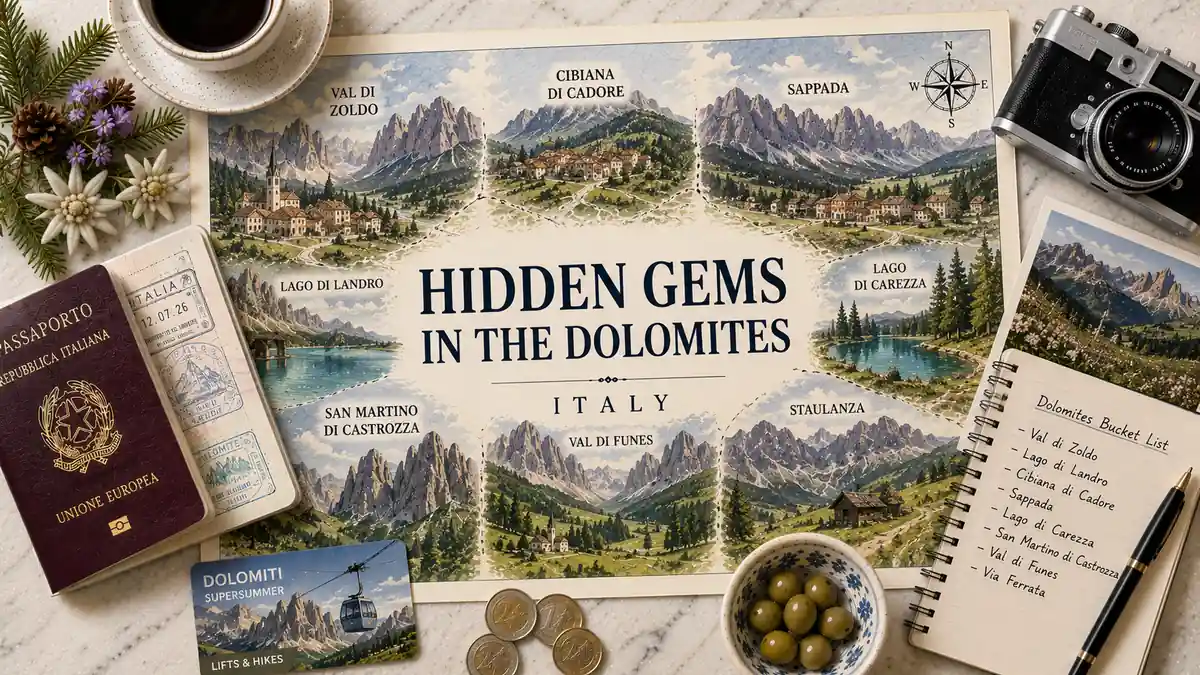
The Dolomites’ most famous sights now come with queues — the Lago di Braies boardwalk, the Tre Cime car parks, the Seceda ridgeline at golden hour. The reward for looking past them is real: a short list of lesser-known valleys, villages, and lakes that deliver the same jagged skylines, Ladin culture, and turquoise water without the crush. This guide is a curated, honest shortlist of genuinely underrated Dolomites places — not famous icons visited off-peak, and not activity roundups. Each pick is organized by place type so you can self-select: underrated valleys for scenery, quiet villages for culture, hidden lakes for the Braies experience minus the crowds. Every entry explains why it stays overlooked, what you actually get, who it suits, and one honest caveat — because some of these spots are only quiet if you time them right.
Quick Answer
The Dolomites’ quietest hidden gem is Val di Zoldo, a valley with Pelmo scenery and almost no traffic. The shortlist splits three ways — underrated valleys, quiet Ladin and mountain villages, and hidden lakes. For a Lago di Braies alternative, choose roadside Lago di Landro over the famous crowds.
Trust Layer
Tripstou selection guide for travelers choosing between multiple places. Covers selection criteria, traveler fit, and trip value.
Produced with AI assistance and reviewed by Alex Perrut, working in tourism since 2015, for the Tripstou editorial team. See our editorial process for details.
Last factual review: July 10, 2026.
Official sources consulted: italia.it, enit.it.
Key Takeaways
- Val di Zoldo is the strongest all-round hidden gem — big Pelmo and Civetta scenery with real village life and almost no traffic.
- Choose by place type: underrated valleys for scenery, quiet Ladin villages for culture, and roadside lakes for effortless reflections.
- The core trade-off is simple: you swap marquee recognition for space, authenticity, and quiet a few switchbacks past the crowds.
- For a crowd-free Lago di Braies alternative, roadside Lago di Landro delivers a full Dolomite reflection with no hike or fee.
- Pick by pace, not by mountain — decide whether you’ll drive to the view or walk an hour to earn it.
- Some “hidden” spots stay quiet only if you time them right — Sorapis went viral, so go early or skip it.
Table of Contents
Skip the Icons: How the Hidden Dolomites Beat the Crowds
Going hidden in the Dolomites buys you space, authenticity, and quiet in exchange for marquee recognition. Hidden gems here means genuinely lesser-known places — quiet valleys, working villages, and overlooked lakes — not the famous icons visited off-peak. You trade the name everyone recognizes for terrain almost nobody photographs.
The famous-versus-hidden logic is simpler than it looks. The Dolomites’ icons are concentrated at a handful of named viewpoints, and that is exactly where the traffic pools. Step away from the postcard frame and the same massifs stand over empty meadows and quiet lanes. If you want to see the marquee names on their own — Braies, Tre Cime, Seceda — read up on the famous Dolomites icons and treat them as the contrast, not the itinerary.
The crowd owns the viewpoint, not the valley. Twenty minutes past any Dolomites tripod line, the same skyline stands over hay meadows nobody bothers to walk into. That is the whole selection strategy on one page: chase terrain, not named frames.
This page stays on places — where to go to escape the crowds. For when to visit, where to base yourself, and how to string the region together, use the full Dolomites guide.
The Dolomites’ Most Underrated Valleys
The Dolomites’ best underrated valley is Val di Zoldo, quiet terrain beneath Pelmo and Civetta. Valleys are the easiest hidden win because their scenery matches the famous names while the traffic drops off fast a few switchbacks in. Each one below trades a household name for room to breathe.
Valleys reward you precisely where icons punish you: at the scale of a whole landscape instead of a single frame. Once you have picked a valley, plan what to do there with things to do in the Dolomites — this page keeps to the where, not the what.
Val di Funes
Val di Funes is the South Tyrol valley behind the famous church of Santa Maddalena, set beneath the sawtooth Odle (Geisler) peaks. What makes it distinct is the split between its two crowded church viewpoints and the working farm valley around them — the photo spots draw the buses, the meadows above stay empty. It is underrated because visitors treat it as one picture and leave.
- Pick this if: you want the postcard Dolomites view but will walk ten minutes past the tripods to have it to yourself.
Honest caveat: the two church viewpoints get genuinely busy at sunrise and sunset — go midday or climb higher for space.
Eggental (Val d’Ega)
Eggental is the quiet South Tyrol gateway under the Latemar and the Rosengarten (Catinaccio), the range famous for its rose-pink alpenglow. It is distinct because most people drive straight to Lago di Carezza, photograph the lake, and leave — so the villages of Nova Levante and Nova Ponente keep a slow, un-resort-like pace. That drive-through habit is exactly why the valley stays overlooked.
- Pick this if: you want the Rosengarten’s evening glow from an easy base with no resort scene.
Honest caveat: Lago di Carezza itself is busy in daylight — the surrounding valley is where the quiet lives.
Val di Zoldo
Val di Zoldo is a working Belluno valley of ice-cream-making villages, ringed by Monte Pelmo and Civetta. What sets it apart is that it is lived-in, not staged — this is the historic home of the Zoldani gelato makers, not a purpose-built resort. It stays underrated because it has big-peak scenery without a single headline attraction to put it on the tour map.
- Pick this if: you want major-massif views and real local life without a tour bus in sight.
Honest caveat: quiet means fewer services — expect thinner dining and lift options outside the main seasons.
Val di Fanes
Val di Fanes is a high plateau inside the Fanes-Sennes-Braies park, wrapped in Ladin legend as the mythical Kingdom of Fanes. It is distinct because it sits directly behind crowded Lago di Braies yet feels remote — you reach the plateau on foot or by seasonal shuttle, not by parking beside it. That effort barrier is what keeps it wild while its neighbour overflows.
- Pick this if: you will trade easy road access for a genuinely wild high plateau.
Honest caveat: access is restricted and seasonal — vehicle rules and shuttle timing shift through the year, so treat any figures as ranges and confirm before you go.
Quiet Villages and Authentic Ladin Towns
The most rewarding quiet village is Sappada, a German-speaking mountain island under the Sesto Dolomites. These villages deliver Ladin and Alpine authenticity without the resort-town polish of Ortisei or Cortina — old timber houses, living local culture, and space to wander. Recognition is the only thing they lack.
The Ladin villages aren’t hidden by distance — they’re hidden by their famous neighbours. Santa Cristina sits between Ortisei and Selva and keeps most of the culture with a fraction of the crowds, simply because day-trip itineraries skip the middle stop.
Sappada (Plodn)
Sappada is a German-speaking linguistic island near the source of the Piave, tucked under the Sesto (Sexten) Dolomites. It is distinct because its old borgate of timber Blockhaus houses preserve a Germanic dialect and building style found almost nowhere else in the range — neither Ladin nor lowland Italian. That singular culture, far from the main valleys, is exactly why it stays off the standard loop.
- Pick this if: you want a living mountain culture and old-town timber over ski-resort gloss.
Honest caveat: it is genuinely remote — reaching it takes longer than the marquee valleys, so it rewards those who plan a night, not a stop.
Cibiana di Cadore
Cibiana di Cadore is a small Belluno village painted with open-air murals, watched over by Monte Rite above it. What makes it distinct is that the murals tell the village’s own history across its house walls — an outdoor gallery almost nobody stops for. It stays hidden because it sits between bigger names and asks visitors to slow down for something quiet.
- Pick this if: you like a village with a story to read and near-zero crowds.
Honest caveat: it is small — plan an hour or two, not a full base.
Glorenza (Glurns)
Glorenza is one of the smallest fully walled towns in the Alps, its medieval ramparts and arcades intact on the western Vinschgau approach to the range. It is distinct because a complete circuit of town walls is rare here — this is a compact medieval core, not a mountain hamlet. It stays overlooked because it sits west of the classic Dolomites and few day-trippers reach it.
- Pick this if: you want intact medieval architecture on the quiet western edge of the region.
Honest caveat: it lies well west of the core Dolomites — pair it with a Vinschgau route, not a Cortina day.
Santa Cristina
Santa Cristina is the genuinely Ladin middle village of Val Gardena, sitting between busy Ortisei and Selva beneath the Sassolungo. It is distinct because it holds real Ladin language and culture with a fraction of Ortisei’s foot traffic — same valley, quieter address. It stays underrated because visitors default to the two better-known towns at either end.
- Pick this if: you want authentic Ladin Val Gardena without staying in its busiest town.
Honest caveat: it shares Val Gardena’s lifts and roads, so peak-season day-trippers still pass through.
Hidden Lakes Quieter Than Lago di Braies
The best quiet swap for Lago di Braies is roadside Lago di Landro, empty and free to reach. These lakes give you the mirror-still water and peak reflections that made Braies famous, without the boardwalk queue. Sorapis delivers the strongest turquoise, but you have to earn it on foot.
Water goes viral faster than it empties out — Sorapis is proof, now nearly as busy as the icon it was meant to replace. The genuinely quiet Dolomite lakes are the roadside ones like Landro and Antorno, ignored precisely because there is no hike to brag about afterward. If you still want to see the crowded original for contrast, Braies sits among the best places in Italy for a reason — it is simply not where the quiet is.
Lago di Sorapis
Lago di Sorapis is a milky-turquoise glacial lake beneath the Sorapis massif, reached by a mountain trail with cabled sections from Passo Tre Croci. It is distinct as the most Braies-like colour in the range — but earned on a real half-day hike, not viewed from a car park. Its honest problem is that it went viral, so “hidden” now means early-morning only.
- Pick this if: you will hike a few hours for the most intense turquoise in the Dolomites.
Honest caveat: it is popular now and the trail has exposed, cabled stretches — start early and treat any timings as ranges to confirm locally.
Lago di Landro (Dürrensee)
Lago di Landro is a roadside lake on the Cortina–Dobbiaco road, mirroring Monte Cristallo and the Cadini peaks. What makes it distinct is a full Dolomite reflection with zero effort — and the fact that most drivers speed past it toward Tre Cime. That habit of racing to the icon is exactly why it stays quiet.
- Pick this if: you want a great reflection shot with no hike and no trailhead fee.
Honest caveat: it is roadside — atmosphere over solitude, and the light is best early before through-traffic builds.
Lago d’Antorno
Lago d’Antorno is a small reflective lake on the approach toward the Tre Cime, quieter than the crowds climbing to the peaks above it. It is distinct because it sits right on a famous route yet nearly everyone rushes past it to the headline attraction. Its proximity to a bucket-list icon is precisely what makes it overlooked.
- Pick this if: you want an easy, reflective lake minutes from a famous trailhead.
Honest caveat: it is close to a toll road and a busy area, so quiet is relative and best claimed early.
Which Hidden Gem Suits Your Travel Style?
For most travelers, Val di Zoldo is the best default hidden gem — big scenery, real village life, low effort. The right pick depends on what you’re chasing: Ladin culture, a quiet hiking base, an easy scenic detour, or crowd-free photography. Match the place to the priority and the shortlist sorts itself.
Use this as a traveler-type ladder — start from what you care about most, and the map narrows to one or two options:
- First authentic culture: Santa Cristina for living Ladin Val Gardena, or Sappada for a rare Germanic mountain island.
- Quiet hiking base: Val di Zoldo for services with space, or Val di Fanes for a genuinely wild plateau.
- Easy scenic detour: Eggental for the Rosengarten glow, or roadside Lago di Landro for a reflection with no hike.
- Crowd-averse photographer: Val di Funes past the church viewpoints, or Lago d’Antorno at dawn.
The common mistake is picking by mountain instead of by pace. Every place here is quiet; what actually differs is whether you want to drive to the view or walk an hour to earn it. Decide that first. Then the shortlist collapses to two names, and either one beats the icon on crowds.
Frequently Asked Questions
How do you avoid the crowds in the Dolomites?
Go early, go midweek, and step away from the named viewpoints. The crowds pool at a handful of famous frames — Braies, Tre Cime, Seceda — so arriving before mid-morning or choosing an overlooked valley nearby empties the scene fast. Roadside lakes and working villages stay quiet almost any time.
What’s the best time to visit the Dolomites to avoid crowds?
Aim for the shoulder months — early summer or early autumn — over the July–August peak. Late June and September broadly deliver open trails with thinner crowds, though exact conditions shift year to year. For a full month-by-month breakdown, plan with the Dolomites guide before you lock dates.
Do you need a car to reach the hidden Dolomites villages?
Mostly yes — a car is the practical way to reach places like Val di Zoldo, Sappada, or Cibiana di Cadore. Public transport does serve the main valleys, but the quietest villages sit off the through-routes and connections thin out fast. Some trailheads add seasonal shuttle or parking rules, so confirm access locally.
Is Lago di Sorapis better than Lago di Braies?
For colour, Sorapis wins; for ease, Braies wins. Lago di Sorapis has the most intense milky-turquoise water in the range, but you earn it on a cabled half-day hike. Braies is roadside and effortless but heavily crowded. If quiet is the goal, neither beats a roadside lake like Landro.
Are the hidden Dolomites worth the detour?
Yes, if you value space over marquee names. The hidden Dolomites deliver the same jagged skylines, Ladin culture, and turquoise water as the icons, minus the queues and car-park scrums. The trade is recognition and a little extra driving — a fair price for having the scenery largely to yourself.
Which hidden Dolomites village makes the best quiet base?
Val di Zoldo is the best all-round quiet base — big scenery, real village life, decent services. Sappada suits travelers wanting a remote cultural island, while Santa Cristina keeps you in Val Gardena without its busiest town. For where-to-stay logistics and timing, see the Dolomites guide.
Related Guides
- Plan your Dolomites trip — when to go, where to base yourself, and how to string the region together.
- Things to do in the Dolomites — hikes, viewpoints, and experiences once you have chosen a place.
- Best places in Italy — the famous headline destinations these hidden gems quietly rival.
- Hidden gems in other Italian regions — underrated places beyond the Dolomites.
- Best hikes in the Dolomites — the trails to pair with these quieter valleys and villages.
- Best time to visit Italy — national seasonality, and how mountain timing differs from the cities.
- Italy itinerary — fitting a mountain leg into a wider route through the country.
Did this guide save you time or money? Tripstou is independent and reader-funded — if you'd like to give something back, you can support the site with a crypto contribution of any size.