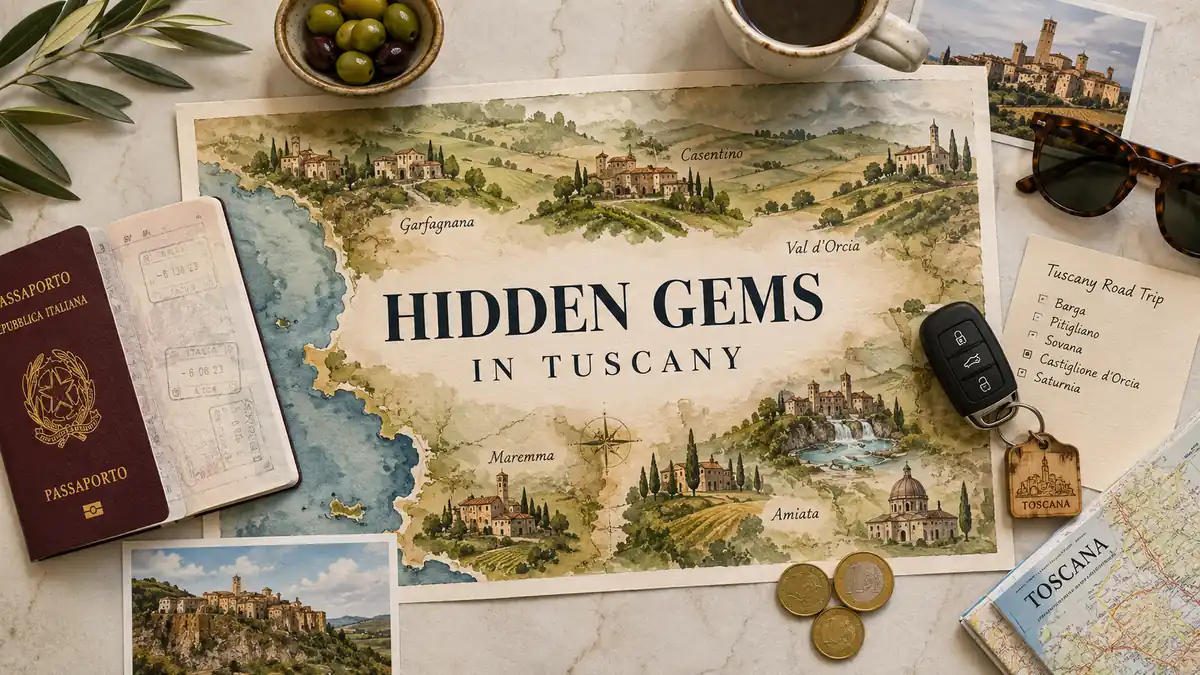
Nearly every English guide to Tuscany recycles the same short list of names, and those names now carry the crowds. The genuinely quiet borghi sit in the sub-regions those lists skip: the mountain valleys of the north and the tufa-and-thermal country of the deep south. This guide is a curated set of lesser-known Tuscan towns organized by pocket, so you can pick the corner that fits your trip instead of queuing behind the same tour buses. Each pick comes with the real reason it stays overlooked and an honest note on how you actually reach it. No vineyard postcards, no famous circuit. Just the villages most itineraries drive straight past, grouped so you can find your own pocket of the region.
Quick Answer
Tuscany’s best hidden gems cluster in the sub-regions the famous circuit skips: the southern Maremma and the northern mountain borghi. Choose by pocket, not by ticking names — the south delivers dramatic tufa towns and thermal springs, the north and east forested castle villages. A car unlocks the most, though Barga and Castelnuovo di Garfagnana stay train-reachable.
Trust Layer
Tripstou selection guide for travelers choosing between multiple places. Covers selection criteria, traveler fit, and trip value.
Produced with AI assistance and reviewed by Alex Perrut, working in tourism since 2015, for the Tripstou editorial team. See our editorial process for details.
Last factual review: July 4, 2026.
Official sources consulted: italia.it, enit.it.
Key Takeaways
- Tuscany’s quietest borghi cluster in two skipped pockets — the northern mountains and the southern tufa-and-thermal Maremma — not the famous circuit.
- Pick your pocket by trip style: forested castle villages north and east, dramatic volcanic tufa towns and thermal springs south.
- A rental car unlocks nearly every rural borgo, though Barga and Castelnuovo di Garfagnana stay reachable by train.
- Let your travel month choose altitude: high Garfagnana and Monte Amiata stay cool when the tufa towns bake in August.
- Use famous Pitigliano only as a gateway, then sleep deeper into Sorano, Sovana and Vitozza for the same drama, minus crowds.
- Base in one hub per pocket instead of one central base; north and south sit a long transfer apart.
Table of Contents
Why Tuscany’s Hidden Gems Beat the Famous Circuit
Tuscany’s crowds concentrate on roughly ten famous names, which leaves dozens of equally characterful borghi almost empty. The famous circuit — Florence, Siena, San Gimignano, the Val d’Orcia — earns its fame, but it also absorbs the tour buses. Choose the overlooked towns and you trade the icon for the same medieval streets without the queue.
The trade-off is real but small: you swap a handful of marquee sights for space, silence and lower prices. The famous circuit — best planned through our guide to Italy’s headline destinations — still deserves a day or two on a first trip. The hidden towns simply give you the medieval Tuscany the brochures promise, minus the crush.
Hidden in Tuscany rarely means deserted — it means Italian. The quietest borghi here still fill their trattorias and run summer festivals, because domestic visitors keep them alive long after the international circuit has moved on. You are choosing a different audience, not a lesser town.
If your trip reaches beyond the region, the same logic scales up to underrated spots across the rest of Italy.
How to Choose Your Pocket of Tuscany
Tuscany’s least-touristy pockets are the northern mountains — Lunigiana and Garfagnana — and the inner south around the Maremma and Monte Amiata. Pick by trip style, not by reputation. The mountainous north suits forest-and-castle wanderers; the volcanic, tufa-carved south suits travelers chasing drama and thermal water.
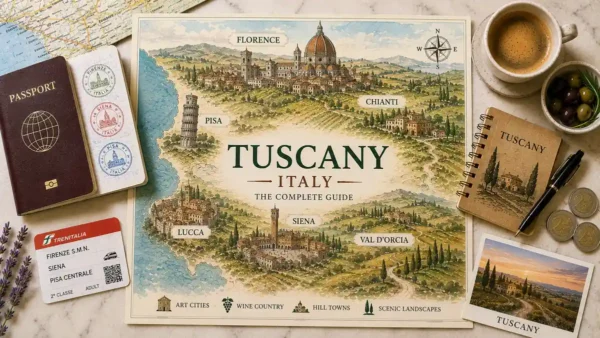
Two questions settle the choice fast: how much you plan to drive, and what landscape you want to wake up to. The north and east reward travellers who want forest, castles and cool air. The south rewards those chasing volcanic scenery and thermal springs. The west is for anyone who simply wants to be alone. Where these pockets sit within a fuller trip — when to go, how long to stay — is mapped in our complete Tuscany guide.
The lever most people miss is elevation. The high pockets — Garfagnana and Monte Amiata — stay green and cool through a heat-wave August, while the tufa towns bake, so let your travel month pick the altitude before the scenery does.
| Sub-region | What defines it | Best for | Getting there |
|---|---|---|---|
| Lunigiana & Garfagnana (north) | Forested mountain valleys, castle borghi | Hikers, castle-hunters, cool-summer escapes | Car; Barga and Castelnuovo reachable by train |
| Casentino (east) | Apennine forest, medieval castles, pilgrim sites | Slow travelers and forest walkers | Car essential; deep rural valley |
| Maremma & tufa towns (south) | Etruscan rock towns, thermal springs | Drama-seekers and thermal bathers | Car essential; long transfer from north |
| Monte Amiata (south) | Volcanic slopes, chestnut villages, cool air | Off-season quiet and autumn colour | Car essential; mountain roads |
| Val di Cecina & Colline Metallifere (west) | Old mining hills, hinterland borghi | Crowd-avoiders and least-listed spots | Car essential; thin public transport |
Northern Tuscany: Lunigiana and Garfagnana’s Mountain Borghi
Tuscany’s least-visited corner is its mountainous north, a land of a hundred castles far from the vineyard postcard. Lunigiana and Garfagnana wrap stone borghi in chestnut forest and Apennine ridgelines. They stay overlooked because they hold no wine-country icon, and because the roads simply take longer to drive.
This is the pocket for cool summers and long forest walks, and one of the few where a train still reaches the villages. Keep winter in mind: mountain access can be limited by snow, so late spring through autumn is the reliable window. The picks below run from valley hubs to standalone anchor sights.
Pontremoli
Pontremoli anchors the Lunigiana at the valley’s northern gateway, where the old pilgrim road crossed the Apennines. Its standout is a small museum of prehistoric stele statues — carved stone figures found almost nowhere else — displayed inside a riverside castle. The town itself is all bridges, arcades and a slow Sunday-market rhythm.
Pick this if: you want a walkable valley base with a genuinely unusual museum and easy road access from the north.
Bagnone, Filetto and Filattiera
This cluster of Lunigiana borghi packs three distinct villages into a short drive: Bagnone with its stream-cut ravine and castle tower, Filetto’s near-perfect fortified square, and Filattiera on its pilgrim-road ridge. Together they show the “land of a hundred castles” at its densest, each hamlet built around a Malaspina stronghold.
Pick this if: you like hopping between tiny fortified villages in a single afternoon with nothing booked in advance.
Castelnuovo di Garfagnana
Castelnuovo di Garfagnana is the Garfagnana’s natural hub, a compact town gathered under the Rocca Ariostesca fortress once governed by the poet Ariosto. It works as the practical base for the whole valley, with shops, a weekly market, and one of the region’s few rail links. Forested peaks rise on every side.
Pick this if: you want a train-reachable mountain base rather than a car-only village.
Barga
Barga is the Garfagnana’s prettiest hill town, an Orange Flag borgo whose steep lanes climb to a hilltop cathedral with wide valley views. A long Scottish-Italian emigration history gives it an unexpected cultural streak you can still hear at local festivals. A rail link on the Lucca line makes it one of the easier mountain towns to reach without a car.
Pick this if: you want polished mountain-village character with a train station and a walkable centre.
Fortezza delle Verrucole
Fortezza delle Verrucole is a restored medieval fortress crowning a ridge above San Romano, the most complete stronghold in the northern mountains. Costumed history programmes bring the ramparts alive, and the panorama over the Apennines is the reason to climb. It is a fortress to visit for an afternoon, best paired with a nearby Garfagnana village.
Pick this if: you’re travelling with kids or history buffs who want ramparts to actually walk and explore.
Eastern Tuscany: Casentino’s Forest Castles
The Casentino is Tuscany’s forested castle valley, tucked into the Apennines east of Arezzo. Medieval strongholds and stone hamlets sit wrapped in beech and chestnut woods, minutes from famous pilgrimage sites yet skipped by nearly every itinerary. It stays quiet because the crowds treat it as scenery on the drive, never a destination.
This upper Arno valley pairs walkable castle towns with deep, monastic forest, which makes it a natural fit for slow travellers. Castle and abbey opening hours shift with the season, so confirm times before you set out. The three picks below range from a postcard borgo to the most forgotten hamlet on this list.
Poppi
Poppi crowns the Casentino with the Castello dei Conti Guidi, a strikingly intact 13th-century castle that clearly inspired Florence’s Palazzo Vecchio. Its arcaded main street and Orange Flag status make it the valley’s most complete borgo. Inside the castle, a frescoed chapel and old library reward the climb; hours change by season, so check before arriving.
Pick this if: you want one postcard-perfect castle town as your Casentino centrepiece.
Anghiari
Anghiari is a walled hilltop borgo overlooking the Tiber plain, its warren of steep medieval lanes almost unchanged. It is known for the battle Leonardo painted and never finished, and for a cluster of artisan workshops that still work by hand. The ramparts open long views toward Umbria.
Pick this if: you love intricate walled villages and slow wandering with no fixed sights to tick off.
Raggiolo
Raggiolo is a tiny stone village buried in the chestnut forests of the Pratomagno slope, one of Italy’s officially certified “most beautiful villages.” Almost nothing has been modernised — mills, stone roofs, and a chestnut-flour tradition still celebrated each autumn. Nearby, the forest sanctuaries of La Verna and Camaldoli add a deep-woods, spiritual dimension worth the detour.
Pick this if: you want the quietest, most forgotten stone hamlet on this entire list.
Southern Tuscany: Maremma, Monte Amiata and the Tufa Towns
Southern Tuscany’s tufa towns and inner Maremma are its most dramatic hidden gems. Etruscan settlements carved into volcanic rock and the wooded slopes of Monte Amiata give the south an atmosphere the vineyard country cannot match. This pocket rewards drivers who want scenery with an edge and thermal water within easy reach.
The south is the most cinematic corner in this guide, and also the furthest from the northern pockets. Thermal access varies by site — some springs are free to bathe in, others sit inside paid spa resorts — so treat any cost as a range and confirm before you go. The picks below build from a refined walled village to the raw tufa landscapes most day-trippers never see.
Pitigliano gets the postcards, but Sorano and Sovana a few kilometres away deliver the same tufa drama with a fraction of the day-trippers. Use the famous one as your gateway, then sleep deeper into the trio to have the cliffs almost to yourself.
Montemerano
Montemerano is a perfectly preserved Orange Flag walled village in the inner Maremma, its concentric lanes opening onto a hushed central piazza. It is overlooked because travellers rush past toward the tufa towns, yet its intact medieval fabric and a celebrated village dining scene make it worth the stop. Small, walkable, and genuinely calm.
Pick this if: you want a refined, well-kept walled village away from the tufa-town day-trip trail.
Santa Fiora, Arcidosso and Seggiano
This trio rings the wooded cone of Monte Amiata, Tuscany’s old volcano. Santa Fiora has spring-fed pools and a Renaissance heart; Arcidosso guards an Aldobrandeschi fortress; Seggiano looks across to the mountain over ancient olive groves and a hillside sculpture garden. Cool summers and blazing autumn colour set the Amiata apart from the lowlands.
Pick this if: you want cool-climate mountain villages and forest walks in the deep south.
Sovana, Sorano and Vitozza
Sovana, Sorano and the Vitozza rock settlement form the deeper tufa trio beyond the famous gateway. Sovana is a tiny Etruscan-Romanesque jewel with rock-cut tombs; Sorano tumbles dramatically down a tufa cliff; Vitozza is an abandoned cave city of hundreds of hewn dwellings. Together they out-drama the postcard town with almost none of its crowds.
Pick this if: you want raw Etruscan tufa landscapes and cave-carved history over polished streets.
Pitigliano
Pitigliano, the tufa town nicknamed “Little Jerusalem” for its old Jewish quarter and synagogue, is the pocket’s recognizable gateway, and its cliff-top skyline is genuinely spectacular. Treat it as your orientation point and your arrival, then push on to the quieter trio nearby. It earns a visit; it just no longer earns a whole day to itself.
Pick this if: you want one famous, photogenic tufa town as an easy entry before going deeper.
Western Tuscany: Val di Cecina and the Colline Metallifere
Tuscany’s least-listed borghi sit in the western Val di Cecina and the old mining hills of the Colline Metallifere. This is the hinterland behind the Etruscan Coast, where hill villages perch on rock above empty valleys well off the English-language radar. You come here for silence and unpolished towns that almost no guide bothers to name.
These hills are the surprise of this guide: a grand cathedral town and a scatter of rock-perched villages that see barely a fraction of the visitors they deserve. Public transport is thin, so a car is effectively required. Base centrally and you can reach the whole pocket in short, quiet drives.
Massa Marittima
Massa Marittima is the unsung star of the Colline Metallifere, an old mining town with a cathedral square that rivals anything on the famous circuit. Its Romanesque-Gothic Duomo stands on a theatrical sloping piazza, and a medieval mining heritage runs beneath the streets. It draws only a trickle of the visitors its beauty warrants.
Pick this if: you want one genuinely grand hill-town square without the coach parties.
Montescudaio and Montecatini Val di Cecina
These two Val di Cecina hinterland villages sit above the Etruscan Coast: Montescudaio a compact wine-country borgo with sea-facing views, Montecatini Val di Cecina a hill town above a historic copper mine you can still descend into. Both are quiet enough that you will often have the lanes entirely to yourself.
Pick this if: you want inland calm within easy reach of the coast.
Roccatederighi and Roccastrada
Roccatederighi and Roccastrada are rock-perched borghi built straight onto volcanic outcrops in the Colline Metallifere, their houses growing out of the grey stone. The views over the Maremma plain are enormous and almost entirely un-photographed by visitors. Nearby Civitella Marittima makes a quiet, central base for exploring this pocket.
Pick this if: you want dramatic rock-top villages that no English guide has discovered yet.
Where to Base Yourself in Rural Tuscany (and Getting Around)
Base yourself in one well-connected hub per pocket, and rent a car — it unlocks nearly every rural borgo. Hidden Tuscany has no single centre; the northern mountains and the southern tufa country sit a long transfer apart. Choose your base by the pocket you most want, then treat the car as the real key to the region.
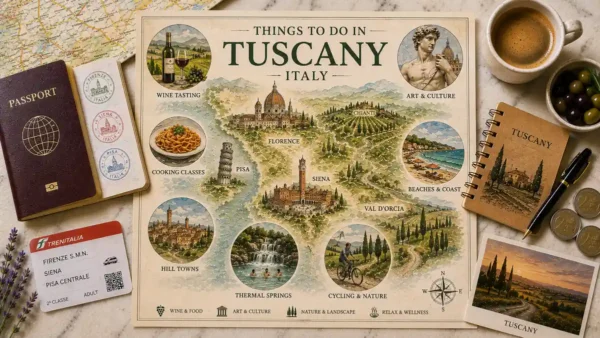
Rent a car for anything beyond the two rail-served northern towns; most borghi in the south and west have thin or no bus service, and timetables thin further on Sundays. Treat winter with caution — mountain villages in the Garfagnana, Casentino and on Monte Amiata can see snow and reduced access, so late spring through autumn is the safe window. Where to actually stay across a wider Tuscan trip is resolved in our Tuscany guide, and what to do once you have settled in — tastings, walks, workshops — routes to things to do in Tuscany.
One hub per pocket beats one hub for everything. The north and the deep south are a long transfer apart, and basing centrally to “do it all” just means long daily drives that erase the quiet you came for. Commit to a pocket, settle in, and let the villages come to you.
Hotels and places to stay
Compare hotels, apartments and stays for your dates in one search.
Search hotels and stays on hotels.com →
Tripstou may earn a commission if you book through this link, at no extra cost to you.
Frequently Asked Questions
Can you visit Tuscany’s hidden gems without a car, by train?
Partly. Most rural borghi are car-only, but the Garfagnana’s Lucca rail line reaches Barga and Castelnuovo di Garfagnana, making a train-based mountain trip realistic. The southern tufa towns and western hill villages have thin or no rail service, so a carless trip means committing to the northern mountain pocket.
Is Saturnia hot springs free to visit?
Partly. The natural Cascate del Mulino waterfalls near Saturnia are free to bathe in year-round, while the adjacent Terme di Saturnia is a paid spa resort with a separate entry fee. Access rules and any charges can change seasonally, so confirm both before planning a visit around the springs.
Is Pitigliano worth visiting for its “Little Jerusalem” quarter?
Yes. Pitigliano’s cliff-top tufa skyline and historic Jewish quarter make it genuinely spectacular and an easy introduction to southern Tuscany. Treat it as your gateway, not the whole trip, though — the quieter tufa towns of Sorano, Sovana and Vitozza nearby deliver similar drama with far fewer day-trippers.
When is the best time to visit Tuscany’s hidden villages?
Late spring through autumn is the reliable window. Mountain borghi in the Garfagnana, Casentino and on Monte Amiata can see snow and reduced access in winter, so those months keep roads open. High-altitude pockets also stay cool through a hot August, while the southern tufa towns bake — let your month pick the elevation.
Which part of Tuscany is best for a first hidden-gems trip?
The southern tufa country. For a first trip escaping the crowds, the Maremma’s Etruscan rock towns — Pitigliano, Sorano, Sovana — deliver the most immediate wow, pair naturally with thermal springs, and still feel worlds away from the famous circuit. Save the subtler northern mountains for a return visit once you know the region.
Are Tuscany’s hidden gems worth it if you’ve already seen Florence and Siena?
Absolutely. Florence and Siena show you Tuscany’s monumental side; the overlooked borghi show you its lived-in one — quiet piazzas, working trattorias and landscapes the icons can’t offer. Because they cluster in sub-regions the day-trip crowds skip, they’re the natural second act for anyone who has already ticked off the marquee cities.
Related Guides
- Tuscany Guide — the full region: when to go, how to base yourself, and where these hidden pockets fit into a wider trip.
- Best Places to Visit in Italy — the famous circuit these underrated towns complement, and how to balance both.
- Things to Do in Tuscany — the tastings, walks and workshops to fill your days once you have chosen a base.
- Hidden Gems in Italy — underrated towns and villages beyond Tuscany, across the rest of the country.
- Pisa Travel Guide — the city many Tuscany trips pass through, and what is worth stopping for.
- Siena Travel Guide — the walled hill town in full, and how to give it more than a day trip.
- Best Time to Visit Italy — the national seasons behind when these smaller towns are at their calmest.
- Italy Itinerary — how to build these detours into a wider route without losing days.
Did this guide save you time or money? Tripstou is independent and reader-funded — if you'd like to give something back, you can support the site with a crypto contribution of any size.