The Amalfi Coast is a string of clifftop towns along southern Italy’s Sorrentine Peninsula, and the hardest part of a trip is rarely deciding what to see — it’s deciding how to plan it. Which town you base in shapes everything that follows: your daily commute, your budget, and how much of the coast you actually experience. This guide is built around those planning decisions instead of a sights checklist. It covers where to stay, when to go, how to move between towns, how many days the coast really needs, and how the region slots into a wider Italy trip. For deep attraction lists, day-by-day sequencing, and detailed budgets, it routes you to dedicated pages. The goal here is a confident planning framework — the difference between a rushed, expensive visit and a smooth one you would happily repeat.
Quick Answer
The Amalfi Coast rewards visitors with dramatic coastal scenery and distinct towns, and where you base matters most. Choose your base by priority: central Amalfi for connections, Positano for scenery, or Sorrento for convenience and value. Plan three to four days and move by ferry and bus instead of a car.
Trust Layer
Tripstou region guide for travelers planning a regional trip. Covers sub-areas, trip shape, base strategy, timing, and mobility tradeoffs.
Produced with AI assistance and reviewed by Alex Perrut, working in tourism since 2015, for the Tripstou editorial team. See our editorial process for details.
Last factual review: July 4, 2026.
Official sources consulted: Italia.it, ENIT.
Key Takeaways
- Choose your base by priority — central Amalfi for connections, Positano for scenery, Sorrento for value — because it shapes every day.
- Rely on ferries and the SITA bus, not a car — parking, ZTL zones, and the narrow coast road make driving a liability.
- Visit in the shoulder months — May, June, or September — for warm seas, full ferry service, and thinner crowds than peak summer.
- Plan three to four days to base once and day-trip two or three towns; add depth, not more villages, beyond that.
- Treat the coast as a three-to-four-day leg of a wider southern-Italy trip, pairing it naturally with Naples, Pompeii, and Rome.
Table of Contents
What the Amalfi Coast Is and How Its Towns Differ
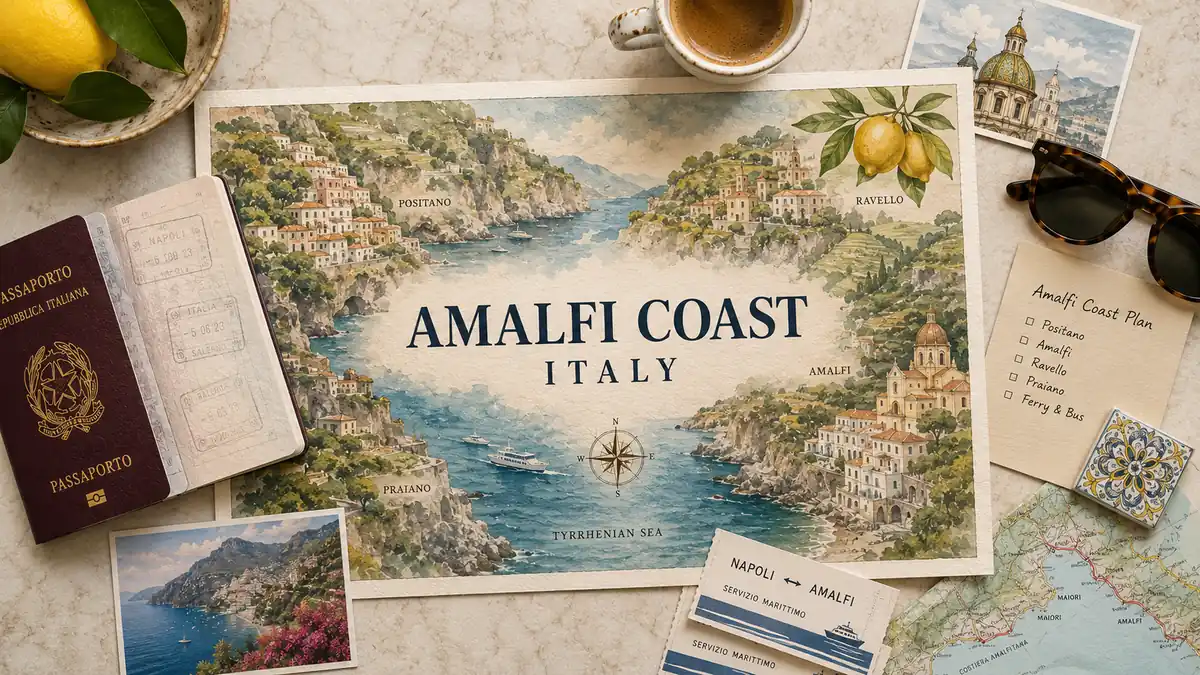
The Amalfi Coast is a compact stretch of contrasting towns, each suiting a different kind of traveler. Along a short ribbon of cliff-hugging shoreline, Positano, Amalfi, Ravello, Praiano, and Sorrento each trade on a distinct character — glamour, centrality, calm, quiet, or convenience. Knowing how they differ is the first real planning move.
The towns line up by personality more than by distance, and their character tends to track their elevation: the higher and harder to reach a town sits, the quieter and more refined it usually feels. Read the profiles below as a shortlist, then match one to how you like to travel.
- Positano — the vertical, photogenic showpiece, its pastel houses cascading to a small beach. Glamorous, walkable only by stairs, and the priciest address on the coast. Best for: travelers who want the postcard and accept paying and climbing for it.
- Amalfi — the historic, central hub around a striped cathedral and the busiest ferry dock. Flatter and better connected than its neighbours. Best for: first-timers who want easy access to everywhere.
- Ravello — perched high above Amalfi with no direct beach, known for the gardens of Villa Rufolo and Villa Cimbrone and a summer music festival. Calm and cultured. Best for: couples who prize quiet, gardens, and long views over beach access.
- Praiano — a quieter, more residential village between Positano and Amalfi, angled toward sunset. Fewer crowds, small coves. Best for: repeat visitors wanting calm within reach of both hubs.
- Sorrento — technically on the peninsula rather than the coast proper, but the practical gateway: flat, train-connected to Naples, and rich in accommodation. Best for: value-focused travelers relying on public transport.
Quieter alternatives sit beyond these headline names, and each town rewards more than a photo stop. For the beaches, the Path of the Gods hike, and the villa gardens that fill each town’s days, see our guide to things to do on the Amalfi Coast.
Where to Base Yourself on the Amalfi Coast
Base in central Amalfi for balance, or trade convenience for scenery or value elsewhere. Amalfi town sits at the coast’s midpoint with the busiest ferry dock, making day trips in either direction simple. Positano wins on looks but costs more and climbs harder; Sorrento offers the widest value and the easiest arrivals.
Where you sleep quietly decides how much you spend on movement. A Ravello or Positano base means climbing back up by bus or taxi every night, while an Amalfi or Sorrento base keeps the ferry dock at your feet. Pick the base that shortens your commute, not just the one with the best view.
Price feel is directional and shifts sharply by season — treat it as a starting point, not a quote.
| Town | Best for | Price feel | Beach & transport note |
|---|---|---|---|
| Amalfi | First-timers wanting easy access everywhere | Mid-to-high, but fairer than Positano | Central ferry hub, small town beach |
| Positano | Travelers chasing the postcard view | Highest on the coast | Scenic beach, steep stairs, ferry stop |
| Sorrento | Value seekers relying on public transport | Widest range, often gentler | No coast beach, train and ferry gateway |
| Ravello | Couples wanting quiet, gardens, and views | Mid-to-high, boutique-leaning | No direct beach, hilltop bus to coast |
| Praiano | Repeat visitors wanting calm between hubs | Often gentler than its neighbours | Small coves, midway ferry and bus access |
Prices swing hard by town and season, so treat any band as directional and check current rates against a full Italy trip cost breakdown before booking. If the headline towns feel too busy or too dear, quieter bases exist just off the main run — see our roundup of quieter Amalfi Coast towns.
Hotels and places to stay
Compare hotels, apartments and stays for your dates in one search.
Search hotels and stays on hotels.com →
Tripstou may earn a commission if you book through this link, at no extra cost to you.
When to Visit the Amalfi Coast
Late spring and early autumn balance good weather with thinner crowds, making them the sweet spot on the Amalfi Coast. May, June, and September deliver warm seas and full ferry service without July and August’s peak density and prices. Winter is quiet and cheap but strips the coast of its main draw.
The season splits cleanly into three windows, and each buys something different:
- Shoulder (May–June, September–early October): warm, swimmable, full ferry timetable, and softer prices — the coast at its best value.
- Peak (July–August): hottest, busiest, and priciest, with packed boats and towns. Book far ahead or expect thin choice.
- Low (November–March): many hotels, restaurants, and ferry routes close down. Calm and inexpensive, but a large share of the coast simply pauses.
The ferry timetable, not the thermometer, is the real seasonal lever here. When the boats thin out at the edges of the season, you fall back on the slow coast road — so the tail of shoulder season punishes car-free travelers first. For how Amalfi’s calendar lines up with the rest of the country, cross-check the best time to visit Italy.
How to Get Around the Amalfi Coast
Ferries are the fastest, most scenic way between towns in season, and they should anchor your daily movement. The coast road is narrow, winding, and slow, so boats routinely beat buses and cars along the same stretch. Use the SITA bus as an all-weather backup and skip driving almost entirely.
Each mode has a clear job. Match it to your day rather than committing to one for the whole trip:
- Ferry — best for hopping between coastal towns in fair weather. Quick and spectacular; the tradeoff is that it runs seasonally, pauses in rough seas, and cannot reach hilltop Ravello.
- SITA bus — best for budget travelers and off-season or wet days. It reaches inland and hilltop spots ferries miss; the tradeoff is crowding, slow going, and traffic on the narrow road.
- Car or private transfer — best for door-to-door needs, heavy luggage, or a remote stay. Flexible, but expensive by taxi and a parking-and-ZTL headache if you self-drive.
Match the mode to the weather, not to the map. A rough sea can cancel ferries with little notice, so the traveler who has already scouted the bus stop nearest their hotel loses no day when the boats stop running.
Train and bus tickets
Compare routes, schedules and prices across rail and bus operators in one search, with mobile tickets on your phone.
New to Omio? Code NEW10 takes 10% off your first booking — or APPNEW10 if you book inside the Omio app. Both apply to bookings up to €80.
Search routes and compare prices on Omio →
Tripstou may earn a commission if you book through this link, at no extra cost to you.
Do You Need a Car on the Amalfi Coast?
No — a car is more liability than asset on the Amalfi Coast. The narrow coast road is congested and lined with restricted ZTL zones and scarce, costly parking. Ferries and buses reach the main towns without any of that stress, so most visitors are better off car-free.
A car earns its keep only in narrow cases:
- You are staying in a remote hillside villa poorly served by bus or ferry.
- You are continuing to inland Campania or the Cilento, where public transport thins out.
- You are travelling off-season, when ferries pause and bus frequency drops.
Even then, park once at your accommodation and rely on boats and buses for day trips. The road is no place for a daily commute. ZTL rules, parking fees, and access hours change, so verify current restrictions before you decide to drive.
How Many Days You Need on the Amalfi Coast
Three to four days covers the main towns without rushing the Amalfi Coast. That window lets you base once, day-trip by ferry to two or three towns, and keep an afternoon for a hike or the beach. Less than two days means picking a single town; a week suits slow travelers.
Read the tiers in ascending order and stop at the one that matches your pace:
- 1–2 days: one town and its immediate surroundings — a taste, not the coast. Fits travelers on a Naples or Rome side-trip.
- 3–4 days: the comfortable sweet spot — one base, two or three towns by ferry, plus a hike or beach day. Fits most first-time visitors.
- 5–7 days: room to add Ravello’s gardens, a Capri or Pompeii excursion, and unhurried beach time. Fits slow travelers and returning couples.
Add days by adding depth, not more towns. A fourth or fifth day is better spent lingering in one place or on a boat to Capri than checking a sixth village off a list you will barely remember. For how to sequence these days alongside Naples, Rome, or the south, hand the day-by-day build to our Italy itinerary.
How the Amalfi Coast Fits Into a Wider Italy Trip
The Amalfi Coast works best as a leg of a wider southern-Italy trip. Few travelers fly in for the coast alone; its natural pairings — Naples, Pompeii, and Rome — sit close enough to fold into one route, and a three-to-four-day coastal leg slots in cleanly. On its own it can feel short and pricey.
How you frame the coast depends on the trip around it:
- As an add-on: pair it with two or three days in Naples and Pompeii, then continue to Rome by train — the classic southern loop.
- As a standalone: workable for a short beach-and-scenery escape, though you pay peak coastal prices without cheaper inland days to balance them.
- As a first taste of Italy: better slotted after a city or two, so the coast reads as a reward instead of your only reference point.
This coast is one stop among many. See how it ranks against the country’s other regions in our guide to the best places to visit in Italy, and frame the whole trip with our Italy travel guide.
Frequently Asked Questions
Is the Amalfi Coast expensive?
Yes, the Amalfi Coast ranks among Italy’s pricier regions, especially in peak summer and in Positano. Accommodation, restaurants, and ferry hops all cost more than inland Campania. You can soften the bill by basing in Sorrento or Praiano, travelling in shoulder season, and booking well ahead.
How do you get to the Amalfi Coast from Naples or Rome?
From Naples, take the Circumvesuviana train or a ferry to Sorrento, then continue by ferry or SITA bus into the coast. From Rome, ride a high-speed train to Naples first, then transfer the same way. Sorrento and Salerno are the two practical gateway hubs.
Which Amalfi Coast town has the best beaches?
Positano has the most famous beach, Spiaggia Grande, right below its cascading houses, while Amalfi and Praiano offer smaller, quieter coves. True sandy beaches are rare on this coast — most are pebble or platform beaches reached by steps or by boat, so pack sandals and manage expectations.
When does the Amalfi Coast ferry season run?
Ferries generally operate from around April to October, peaking in the warm summer months and thinning out at the shoulders. Outside that window, most coastal routes pause and you fall back on the SITA bus. Rough seas can also cancel sailings mid-season, so keep the bus as a backup.
Is the Amalfi Coast a good first trip to Italy?
It can be, but the Amalfi Coast suits first-timers best when paired with Naples or Rome rather than visited alone. The seasonal ferries, hilly towns, and higher prices make it a fiddly solo introduction. Slotting it after a city or two gives easier logistics and a better sense of Italy’s range.
Related Guides
- Best places to visit in Italy — where the Amalfi Coast sits among the country’s top regions.
- Italy travel guide — the wider planning hub for a full Italy trip.
- Things to do on the Amalfi Coast — beaches, hikes, and villa gardens in depth.
- Quieter Amalfi Coast towns — lesser-known bases and escapes from the crowds.
- Italy itinerary — day-by-day routes that fold the coast into a longer trip.
- Where to Stay on the Amalfi Coast
Did this guide save you time or money? Tripstou is independent and reader-funded — if you'd like to give something back, you can support the site with a crypto contribution of any size.