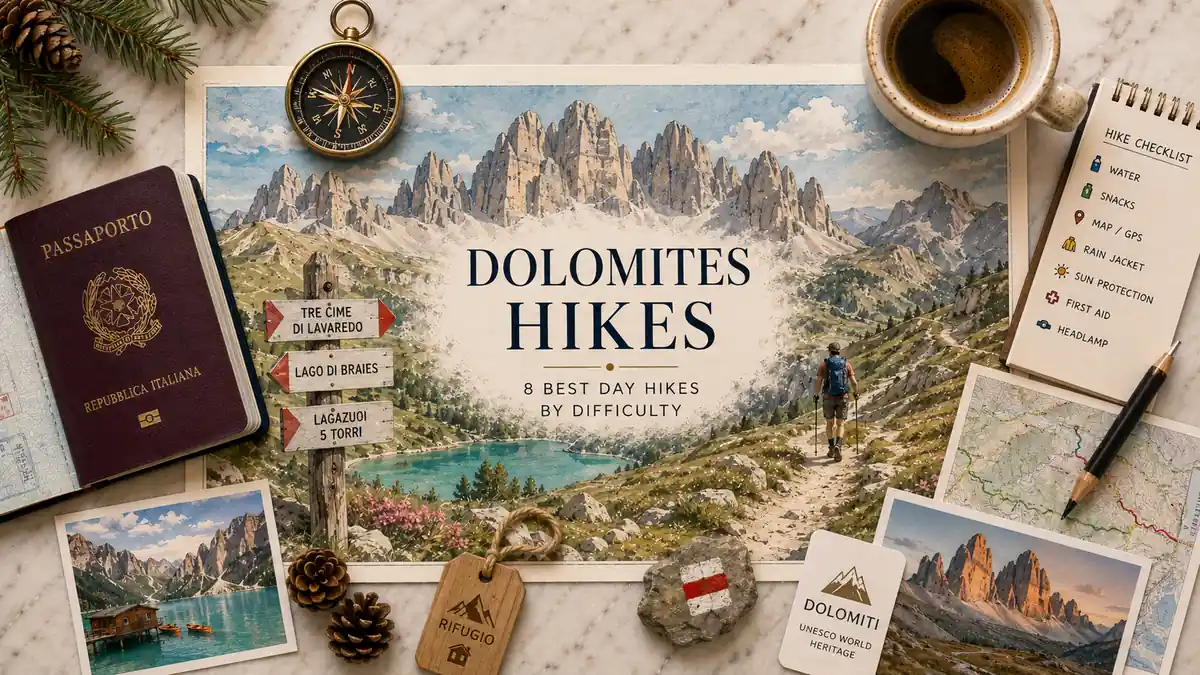
The Dolomites are the easy decision. Which trail to walk on which day is the hard one. Two things settle it, and neither is the number of kilometres printed on the signpost: what your legs can take on exposed ground, and whether you can physically reach the trailhead that morning. Exposure hurts more people here than length does — a short path on a narrow cabled ledge asks far more of you than a long, level one. And three of the region’s most photographed trailheads now sit behind a road restriction or a parking reservation, which means part of your choice is made at the booking stage, days before you lace your boots. This guide covers day hikes only. Eight named routes follow, grouped by effort, each with an honest difficulty range, its exposure stated plainly, and the access rule you will actually meet at the trailhead.
Quick Answer
Tre Cime di Lavaredo is the strongest all-round Dolomites day hike, with Seceda the best lift-assisted alternative. Eight picks below are grouped by effort, from short lakeside walks to long exposed mountain days. For an easy half-day, choose Lago di Braies or Cinque Torri, and book road or parking access before fixing the day.
Trust Layer
Tripstou selection guide for travelers choosing between multiple places. Covers selection criteria, traveler fit, and trip value.
Produced with AI assistance and reviewed by Alex Perrut, working in tourism since 2015, for the Tripstou editorial team. See our editorial process for details.
Last factual review: July 28, 2026.
Official sources consulted: Italia.it, ENIT.
Key Takeaways
- Tre Cime di Lavaredo is the strongest single day hike: postcard peaks the whole way round, on a broad, non-technical loop.
- Lago di Braies and Cinque Torri deliver real Dolomites scenery in a half-day, with no exposure and modest climbing.
- Lago di Sorapis is a hard, exposed day on cabled ledges — not the family lake walk it is often called.
- Seceda is the best lift-assisted pick, though its ridge edge rules it out for anyone uneasy with height.
- Book road or parking access before choosing your hike: Tre Cime, Alpe di Siusi and Lago di Braies all restrict arrival.
- Start at dawn: afternoon thunderstorms build fast over these ridges, and a late start is the most common way a day fails.
Table of Contents
How to Choose a Dolomites Day Hike: Effort, Exposure and Access
Three variables decide a Dolomites hiking day: effort, exposure and trailhead access. Exposure is the variable that catches people out, and distance rarely is. A short trail on a cabled ledge demands more than a long valley path, and several of the best trailheads cannot be reached without a booking.
Effort is the easiest of the three to judge, and the one most walkers overestimate themselves on. Read it as hours on your feet plus metres climbed, then add an hour for photographs, lunch at a hut and the descent you always forget. A five-hour route is a seven-hour day in practice.
Exposure is the field that actually disqualifies people. It describes ground where a slip has consequences — narrow traverses cut into rock, fixed cables bolted to a wall, a path edging a long drop. Fitness does not help you there. Sure-footedness and comfort with height do, and they are not the same thing as being strong.
Access has quietly become the third gate. Several flagship trailheads now sit behind a toll road with timed entry, a mandatory parking reservation or a seasonal valley restriction. Book the access before you fall in love with the hike. In these mountains the reservation calendar decides your morning as often as the forecast does.
Weather is the fourth variable, and it behaves predictably enough to plan around. Thunderstorms build fast over these ridges through the summer, usually in the afternoon, and a late start is the most common way a good day goes wrong. Start early. A dawn departure buys stable air, an empty trail and a parking space in one move.
Times are ranges and access rules shift between seasons — confirm the current rule with the operator before you drive.
| Hike | Effort tier | Rough time on trail | Access constraint |
|---|---|---|---|
| Lago di Braies | Easy, level lakeshore half-day | About 1 to 1.5 hours around the lake | Valley restricted in high summer; reservation or transit permit |
| Alpe di Siusi | Easy plateau walking, self-paced | Roughly 1 to 3 hours on linked plateau paths | Uphill driving restricted by time; parking must be reserved |
| Cinque Torri | Easy to moderate half-day | Roughly 2.5 to 3.5 hours with a steady climb | No restriction and no reservation at the trailhead |
| Adolf Munkel Trail | Moderate, gentle full morning | Roughly 3 to 4 hours below the Odle walls | Ordinary road and car park, no reservation gate |
| Tre Cime di Lavaredo | Moderate full-day loop, no scrambling | Roughly 3 to 4 hours, longer with detours | Toll road with mandatory advance online booking |
| Seceda ridge | Moderate with lift, hard on foot | Roughly 3.5 to 5 hours from the top station | Lift ride; book online in advance, slots may apply |
| Lago di Sorapis | Hard and exposed full day | Roughly 5 to 6 hours round trip | No reservation required at the trailhead |
| Puez-Odle Altopiano | The hardest day listed here | Roughly 6 to 7 hours at altitude | Lift-assisted starts available; otherwise no reservation |
If your real question turns out to be where to base yourself, how the valleys connect or how many days the region needs, that is trip shape and it belongs elsewhere — our Dolomites travel guide handles the region overview, getting there and where to sleep. This page stays on the trails.
Easy Dolomites Hikes for Beginners and Families
Lago di Braies, Alpe di Siusi and Cinque Torri give real Dolomites scenery for a half-day of walking. All three keep the climbing modest and the ground broad. They are still mountain trails, though, with mountain weather and thin air, so boots, layers and an early start still apply.
All three suit children, on conditions that differ by hike. Lago di Braies is the one that works with small kids and even a sturdy pushchair on the boardwalk side. Alpe di Siusi works for mixed-age groups because you decide when to turn around, and the terrain never forces a commitment. Cinque Torri asks for a genuine climb, so it suits older children who already walk uphill without negotiation.
One flagship hike does not belong on a family day, whatever you have read: Lago di Sorapis. It is a long walk with narrow cabled sections above a drop, and it sits in the hard tier of this page for that reason. A widely shared framing calls it kid-friendly. The exposure says otherwise.
Two of these three trailheads sit behind an access rule — Lago di Braies and Alpe di Siusi both restrict daytime driving in season and require a booking to arrive by car. Cinque Torri does not. Plan the reservation first and the walk second.
Lago di Braies
Lago di Braies is a level loop around the most photographed water in the Dolomites, and it is the shortest real walk on this list. The circuit is the whole hike — there is no climb to earn the view, which is exactly why it works as a first morning or a rest day.
- Honest effort: roughly 1 to 1.5 hours for the full circuit, about 3 to 4 kilometres of near-level path. The far shore is rougher, rootier and slower than the boardwalk side, so take the upper end of that range if you have small children.
- Exposure: none. The loop stays at lake level throughout, with no drop-offs, no cables and no narrow ground.
- Access: the valley is restricted through the high-summer weeks, when daytime arrival by car requires an online reservation or a valid transit permit; outside that window there is no restriction at all. Arriving on foot, by bike or by public transport stays open. Confirm the current rule with the local tourism operator before you drive.
What separates it from the rest of the list is that the payoff arrives in the first five minutes. Every other pick here makes you work for the view; this one hands it over at the car park and then improves slightly as you walk.
Pick this if: you want the classic Dolomites view with small children, tired legs or only a half-day free.
Alpe di Siusi
Alpe di Siusi is a broad high plateau of meadow and farm tracks above Val Gardena, and it is the one pick where you set your own distance. A network of gentle paths links huts and viewpoints, so the same trailhead produces an hour’s stroll or a full day of walking depending on how many you string together.
- Honest effort: gentle throughout, with loops running from roughly an hour to a full day. Gradients are steady and rolling, there is no scrambling anywhere, and the upper bound is set by how far you choose to go before turning back.
- Exposure: none. Wide tracks and open pasture, nothing narrow, nothing above a drop.
- Access: private cars may only drive up to the plateau early in the morning and again late in the afternoon; through the middle of the day the road is closed to uphill traffic, and plateau parking must be reserved online in advance. The cable car from the valley is the alternative when the driving window does not fit. Check the operator for current hours and reservation rules.
Its distinguishing value is elasticity. Every other hike here commits you to a route once you start, while this one lets you shorten or extend on the day without spoiling the outing — useful with a mixed group or an uncertain forecast.
Pick this if: you are walking with mixed abilities and want to lengthen or shorten the route as you go.
Cinque Torri
Cinque Torri is a circuit around five free-standing rock towers, and it is the easy-tier pick with no access gate of any kind. The towers stay in view for most of the loop and change shape completely as you go round them, which is rarer than it sounds on a short walk.
- Honest effort: roughly 2.5 to 3.5 hours for the circuit, in the region of 9 to 11 kilometres with a steady climb of several hundred metres. The ascent is the only demanding part; treat the upper end as your planning figure if you are not used to sustained uphill.
- Exposure: minimal. Broad, well-graded paths with no cabled sections and no narrow traverses above steep ground.
- Access: no restriction, no reservation, no timed entry. You drive to the trailhead area and park, which makes it the most spontaneous option on the page.
That freedom is the point. When a booked slot elsewhere falls through, or the forecast rewrites your plan the night before, Cinque Torri is the hike you can still do tomorrow without asking anyone’s permission.
Pick this if: your reserved access for another trail collapsed and you need a good hike you can start today.
Full-Day Dolomites Hikes: Tre Cime, Seceda and Adolf Munkel
Tre Cime di Lavaredo, Seceda and the Adolf Munkel Trail are the three hikes worth building a whole day around. Each sits in the three-to-five-hour bracket of steady walking on good paths, with moderate climbing. None requires scrambling, but all three reward an early start and a full water bottle.
A full day here means the walking fills the day, not that the trail is punishing. Add the drive, the access queue and a hut stop, and each of these swallows the daylight from breakfast to mid-afternoon. Plan one of them per day and nothing else.
Tre Cime di Lavaredo
The Tre Cime loop circles the three towers that put these mountains on postcards, and it delivers more scenery per hour than any other moderate route in the range. The path is wide, well built and busy, and it never asks for a technical move.
- Honest effort: roughly 9 to 11 kilometres and about 3 to 4 hours at a steady pace, with modest climbing spread thinly around the loop. Allow closer to 5 hours if you stop at the huts or add the saddle detour on the far side.
- Exposure: low but not absent. Most of the loop is a broad track; a couple of stretches traverse open slope above a drop, comfortable in dry weather and distinctly less so in wind or wet rock.
- Access: the toll road up to the Auronzo hut requires advance online booking for a timed entry, and it opens only once the snow clears — roughly late May to late October, moving year to year. A seasonal bus (line 444) also serves the trailhead. Book through the official service and confirm the current season before you commit the day.
No other pick keeps the same three peaks in view for an entire circuit while completely rearranging their shape as you walk. That transformation is the hike. It also means the loop is worth doing in full even when the light is flat at the start.
Pick this if: you have exactly one hiking day in the Dolomites and want the definitive one.
Seceda
You do not need the cable car to hike Seceda, but skipping it changes the day entirely. The lift from Ortisei via Furnes puts you on the ridge and turns Seceda into a manageable high walk of a few hours; on foot from the valley it becomes a long, sustained climb before the ridge even begins.
- Honest effort: roughly 3.5 to 5 hours for the ridge circuit starting from the top station, on good paths with rolling ascent. Walking up from the valley instead adds several hours of continuous climbing and moves the day firmly into the hard tier.
- Exposure: real and close. The ridge drops away sharply on one side, and while the path itself is broad, the edge is never far. It is a poor choice for anyone uneasy with height, and dogs and fast-moving children need holding.
- Access: the Ortisei–Furnes gondola and the Furnes–Seceda cable car run through the summer season. Book online in advance; timed slots may apply. Check the operator’s current season, hours and fares, and note the last descent before you plan the walk.
Seceda is the one hike on this page where a ticket, and not your training, sets the difficulty tier. The same summit is an easy afternoon or a hard day depending on a decision you make in the valley.
Pick this if: you want a famous ridge without paying for it in ascent, and you are comfortable near an edge.
Adolf Munkel Trail
The Adolf Munkel Trail runs along the foot of the Odle north walls and offers the best effort-to-scenery ratio on this list. You walk through forest and pasture with a wall of jagged rock directly overhead the whole way, for a fraction of the climbing the views suggest.
- Honest effort: roughly 8 to 10 kilometres and about 3 to 4 hours, with gentle climbing spread over the route. It is the easiest of the three full-day picks by a clear margin, and the most forgiving on a second or third consecutive hiking day.
- Exposure: none worth naming. Forest paths and open pasture, no cables, no narrow ledges, nothing above a drop.
- Access: an ordinary mountain road and a car park at the trailhead, with no reservation and no restricted window. That is its quiet advantage — it stays available on a day when everything else is booked out.
Being low and sheltered gives it a second use. When cloud sits on the high ridges and Seceda or Tre Cime would be a walk inside a grey box, this trail still works, because its scenery is above you and close rather than distant.
Pick this if: you want serious Dolomites walls overhead on a day your legs are not up to a climb.
The Hardest Dolomites Day Hikes — and Who Should Skip Them
Lago di Sorapis and the Puez-Odle Altopiano are the genuinely hard days on this list. What makes them hard is length combined with exposure, not distance alone. Anyone unsure on narrow ground above a drop, or unused to five-plus hours of mountain walking, should choose from the easier tiers.
Exposure is the real gate here, and it has very little to do with fitness. These routes put you on ledges cut into rock, on fixed cables bolted to a wall, and on narrow paths where the ground falls away a step from your boot. A strong runner who freezes on a traverse is in far more trouble than a slow walker who is steady on their feet. Sure-footedness and a head for heights are the qualifications that matter.
Lago di Sorapis is widely described as an easy lake walk. It is not one. The photographs circulate faster than the trail description, and the softer framing has followed them, but the route reaches its lake along exposed cabled sections and it is a five-to-six-hour day. This page grades it at the harder edge on purpose. Where published ratings disagree, the cautious one wins.
On Sorapis in particular, the first cabled traverse is a decision point and not an obstacle. If it feels wrong there, everything beyond it feels worse, and walking back to the car costs you nothing but the drive.
Footwear decides more on these two routes than people expect. Stiff-soled boots with ankle support and a grippy tread turn a nervous traverse into a routine one, and trail runners on wet limestone do the opposite. Add a rain shell and a warm layer — weather at altitude changes faster than you can descend. Our Italy packing list covers the boots, layers and shell in detail.
Lago di Sorapis
Lago di Sorapis ends at a milky blue-grey lake beneath the Sorapis massif, reached by a path that runs along exposed ledges with fixed cables. Those cabled traverses, cut into rock above steep ground, define the day. The lake is the reward, the ledge is the actual hike, and no honest description separates the two.
- Honest effort: roughly 12 to 14 kilometres and 5 to 6 hours round trip, with a few hundred metres of climbing. Plan for the upper end of that range — photo stops, lingering snow patches and queues at the narrow sections all push the day longer.
- Exposure: significant, and the reason this pick sits where it does. Several narrow cabled traverses above steep drops, with short rocky steps between them. Nothing technical, and nothing comfortable if height unsettles you.
- Access: no reservation, no toll road and no timed entry. The gate on this hike is your own footing and the weather, and neither can be booked in advance.
It is the only pick on this page whose difficulty is genuinely disputed in print, which makes it the one where reading a second opinion matters most. Treat the cautious rating as the real one and the day works out fine.
Pick this if: you are sure-footed, at ease on cables above a drop, and hiking without young children.
Puez-Odle Altopiano
The Puez-Odle Altopiano is the biggest day on this list — a long crossing over a stony high plateau, mostly above the treeline, with few places to cut it short once you have started. It feels like a mountain traverse in a way that none of the loops here do.
- Honest effort: roughly 15 to 17 kilometres and 6 to 7 hours, with a long descent at the end that punishes tired knees harder than any of the climbing does. Take the upper figure and add a margin; this is the one route where running late has real consequences.
- Exposure: moderate but sustained. There are no long cabled traverses, though sections of narrow path run above steep ground, and the plateau is high, open and remote with no shelter if weather closes in. Altitude compounds it — you spend most of the day up there.
- Access: lift-assisted starts from the valley remove the first climb and shorten the day meaningfully; done entirely on foot it becomes a very long outing. Check the lift operator’s current season and last descent before you commit to the crossing.
Remoteness is what distinguishes it. Within an hour of the start you have left the day-tripper zone entirely, and the plateau stays empty in a way the famous loops never manage — which is also precisely why it demands more planning than they do.
Pick this if: you want a genuine mountain crossing with real distance and can commit to finishing it.

Which Dolomites Hikes Can You Do With a Cable Car?
Seceda, Alpe di Siusi and Puez-Odle are the three picks on this list served by a lift. A lift buys altitude and saves hours of climbing, and it costs you a fare, a queue at peak times and a fixed last descent you have to walk back to.
The choice is not simply lift or no lift. There are three usable shapes for a lift-served hiking day, and each one suits a different traveller:
- Lift up, walk down. Suits walkers who want the high scenery and a long day on their feet without the grind of the ascent. The tradeoff: the descent does the damage, and once you commit to walking down you are locked into a route that has to finish in the valley.
- Lift both ways. Suits families, mixed-ability groups and anyone working around a short weather window or a late arrival. The tradeoff: you pay twice for the shortest day, and you see the top station’s surroundings more than the mountain.
- Full ascent on foot. Suits strong, experienced walkers who want the whole mountain from the valley floor. The tradeoff: it moves a moderate hike into the hard tier, and you arrive at the top when the lift crowds are at their thickest.
The constraint most people ignore is the last descent. Plan the walk backwards from it. If the arithmetic only works at a fast pace with no stops, you have picked the wrong route for that day, and no amount of hurrying on a high ridge is worth the saving.
Do You Need to Book Parking or Road Access in Advance?
Yes, for three of the flagship trailheads: Tre Cime di Lavaredo, Alpe di Siusi and Lago di Braies. Each sits behind a road restriction, a parking reservation, or both. Access is now the binding constraint on a Dolomites hiking day, ahead of fitness and weather.
- Tre Cime di Lavaredo: the toll road to the Auronzo hut requires advance online booking for a timed entry, and it opens only once the snow clears. Book through the official service, or use the seasonal bus.
- Alpe di Siusi: uphill driving is barred through the middle of the day, and plateau parking must be reserved online before you arrive. The cable car is the fallback when the driving window does not fit your plan.
- Lago di Braies: through the high-summer weeks, daytime car access to the valley requires an online reservation or a valid transit permit. Arriving on foot, by bike or by public transport stays unrestricted.
Confirm every one of these with the official operator before you drive, because the rules move between seasons and secondhand pages go stale quickly. If you are covering the region by car, our guide to driving in Italy handles the roads, tolls and mountain-driving practicalities around these restrictions.
Train and bus tickets
Compare routes, schedules and prices across rail and bus operators in one search, with mobile tickets on your phone.
New to Omio? Code NEW10 takes 10% off your first booking — or APPNEW10 if you book inside the Omio app. Both apply to bookings up to €80.
Search routes and compare prices on Omio →
Tripstou may earn a commission if you book through this link, at no extra cost to you.
When Is the Best Time of Year to Hike in the Dolomites?
The reliable Dolomites hiking window runs from early summer, once the snow clears, into early autumn. Snow lingers on the high traverses well after the valleys turn green. Midsummer is the most dependable and the most crowded stretch, and early autumn usually brings the most stable weather of the season.
Snow is the variable that decides the high routes. A plateau crossing or an exposed ledge that is straightforward in high summer can hold hard old snow weeks after the lower trails have dried out, and a cabled traverse under snow is a different proposition entirely. Low, sheltered routes come into condition first. Save Puez-Odle and Sorapis for the settled middle of the window.
Afternoon storms shape the day more than the month does. Through the warm weeks they build quickly over the ridges, which is what makes an early start the most useful habit you can adopt here. In early autumn the air is often more settled and the trails quieter, at the cost of shorter daylight and colder mornings.
Lift and road seasons bracket the walkable period at both ends, so the hiking window in practice is defined as much by operators as by snow. Confirm those before fixing dates. For seasonality across the country as a whole, see our guide to the best time to visit Italy, and if the Dolomites are one leg of a longer trip, our Italy travel guide sets the wider context.
Frequently Asked Questions
Do you need hiking boots for the Dolomites?
Yes for anything beyond the easy tier. Stiff-soled boots with ankle support and a grippy tread are what keep you steady on wet limestone and loose ground. Level lakeshore loops like Lago di Braies are fine in trainers, but every full-day or exposed route earns proper boots.
Are Dolomites trails marked, and can you hike without a guide?
Yes, and yes for the routes on this page. Dolomites trails are waymarked with numbered signs at every junction, and the eight hikes here are well-trodden enough to follow unguided. Carry an offline map anyway. What you judge for yourself is exposure and weather, not navigation.
What time should you start a Dolomites hike?
Start at first light, and on long routes no later than mid-morning. Afternoon thunderstorms build quickly over these ridges through the warm months, and being high on an exposed traverse when one arrives is the failure mode to avoid. An early start also buys parking and an empty trail.
Can you hike the Dolomites without a car?
Yes, for most of these hikes. Seasonal buses serve the main trailheads from valley towns, and lifts like the Ortisei gondola start in the villages themselves. Public transport also sidesteps the Braies and Alpe di Siusi driving restrictions entirely. Services thin outside the summer weeks, so check the current timetable first.
Are the mountain huts open when you hike?
Generally yes through the summer walking season, when most rifugi on these routes serve food and drink. Opening and closing depend on the hut and on snow, and shoulder-season dates move year to year. Never plan a day around one being open — carry your own water and lunch.
Is via ferrata the same as hiking, and can a beginner do one?
No — via ferrata is protected climbing on fixed cables and rungs, not hiking, and it sits outside the scope of this page. It requires a certified via ferrata set, a harness and a helmet, plus training in how to use them. If you want to try one, go with a certified mountain guide.
Related Guides
These guides cover the planning layers this page deliberately leaves out — where to base yourself, when to come, how to drive the region and what to bring.
- Dolomites travel guide — the region overview: how the valleys connect, how to get there, where to base yourself and how many days to allow.
- Best time to visit Italy — country-level seasonality, so you can fit the hiking window into a wider trip.
- Italy road trip guide — driving routes, tolls and practicalities, useful once mountain road restrictions are in play.
- Italy packing list — boots, layers and rain shells, plus what to leave behind for a mixed city-and-mountain trip.
- Italy travel guide — the full country overview if the Dolomites are one stop on a longer itinerary.
Did this guide save you time or money? Tripstou is independent and reader-funded — if you'd like to give something back, you can support the site with a crypto contribution of any size.