Tuscany is a region, not a single destination — and planning it well means deciding how its pieces fit together. Its art cities, wine hills, and golden countryside each pull a trip in a different direction, so the choices that shape your visit come before any list of sights. This guide handles those choices: when to go, how many days to give it, where to base yourself, whether you need a car, and how Tuscany slots into a wider Italy trip. Think of it as orientation and routing. You get the planning logic here — the trip-shaping decisions answered fast — then follow the links to the specialized guides where each area, cost, and route gets full depth. Read it top to bottom and you will know the shape of your Tuscany trip before you book a thing.
Quick Answer
Tuscany rewards a multi-day regional trip built around a base plus day trips. Trip length drives the shape: a few days from one base gives a first taste, while a week with a second base reaches the countryside. Base in Florence for train-first travel, or the countryside with a car for Chianti and Val d’Orcia.
Trust Layer
Tripstou region guide for travelers planning a regional trip. Covers sub-areas, trip shape, base strategy, timing, and mobility tradeoffs.
Produced with AI assistance and reviewed by Alex Perrut, working in tourism since 2015, for the Tripstou editorial team. See our editorial process for details.
Last factual review: July 3, 2026.
Official sources consulted: Italia.it, ENIT.
Key Takeaways
- Give Tuscany three to four days for one base and day trips; add a week and a second base for countryside depth.
- Choose your base before your transport — basing in Florence means no car, while a countryside base for Chianti or Val d’Orcia requires one.
- Visit in late spring or early autumn for warm days, thinner crowds, and a countryside that is actively working the harvest.
- See Florence, Siena, Pisa, and Lucca by train, but rent a car only for the wine country and hill towns.
- Treat Tuscany as a standalone week or slot Florence’s two city days into a wider Rome–Florence–Venice route without breaking rhythm.
Table of Contents
Tuscany’s Main Areas and What Each Offers
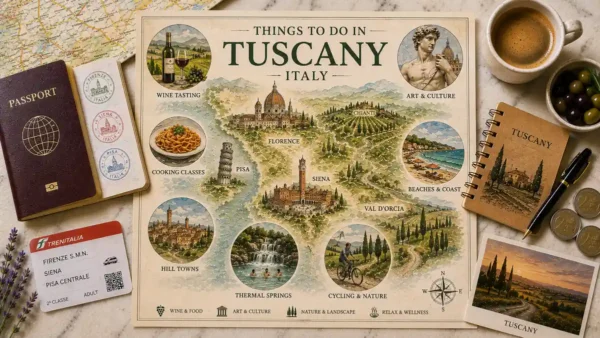
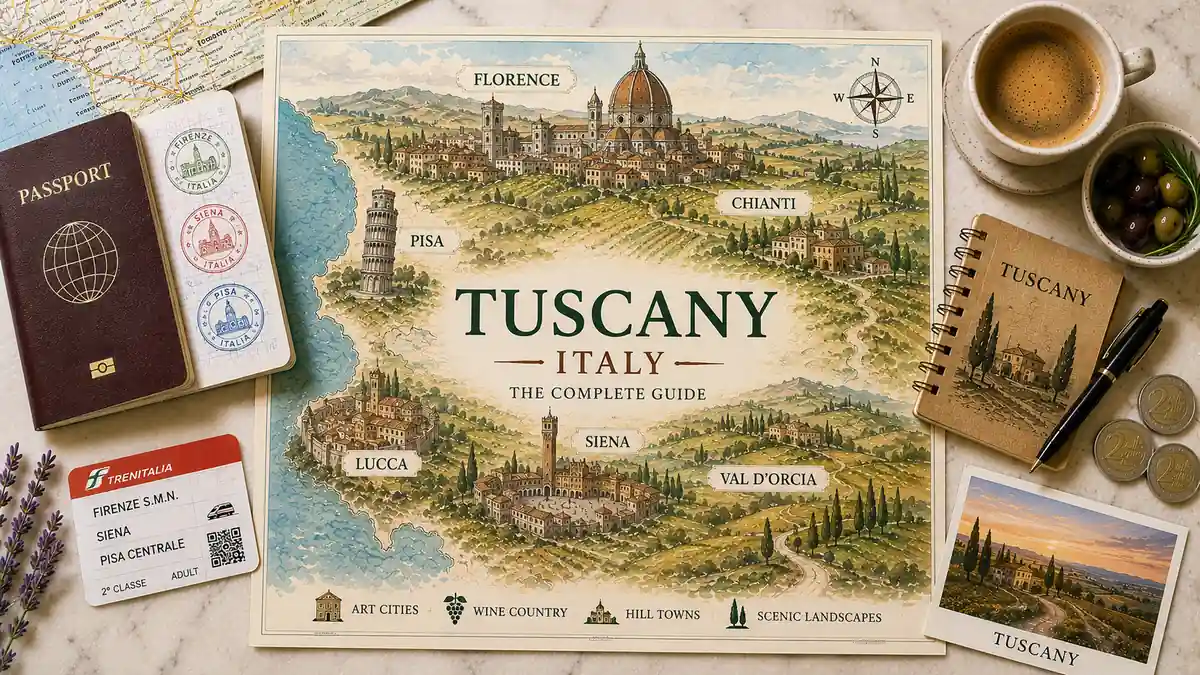
Tuscany splits into a handful of distinct areas — the art cities, the wine hills, and the classic countryside. Florence anchors the art and Renaissance side, Siena and the Val d’Orcia hold the postcard countryside, Chianti covers the vineyards between them, and Pisa, Lucca, and the coast sit to the west. Each suits a different kind of day.
Keep these as orientation, not a to-do list. The point is to recognize which areas match the trip you want, then go deep on the ones that do:
- Florence — the Renaissance art capital, dense with galleries and churches. Its anchor draws are the Uffizi and the Duomo, and the city itself is the natural base. Best for: first-timers who want major art plus easy train day trips.
- Siena — a compact Gothic city wrapped around the shell-shaped Piazza del Campo. The square and the striped Duomo are the pull, with Siena itself as the base. Best for: travelers who want a walkable historic city quieter than Florence.
- Chianti — rolling vineyard country strung between Florence and Siena. Winery visits and hilltop hamlets are the draw, with Greve in Chianti a handy base. Best for: wine-focused travelers who have a car.
- Val d’Orcia — the cypress-lined countryside of every Tuscany postcard. Hill towns like Pienza and Montalcino are the anchor, and Montepulciano makes a scenic base. Best for: slow, view-first countryside stays.
- San Gimignano — a skyline of medieval stone towers, often called a walled Manhattan. The towers and local Vernaccia wine are the draw; most people visit by day. Best for: a half-day highlight slotted between other stops.
One quiet truth shapes how people use these areas. San Gimignano and much of the Val d’Orcia photograph better than they sleep — many travelers see them by day and base somewhere with more evening life. For the full slate of sights across every area, see our guide to things to do in Tuscany, and for the quieter corners that rarely make the shortlist, browse the hidden gems in Tuscany.
How Many Days You Need in Tuscany
Give Tuscany at least three to four days; a week lets you add the countryside without rushing. Three or four days covers one base and a couple of day trips — enough for Florence plus Siena or San Gimignano. A week opens a second, rural base so you reach Chianti and the Val d’Orcia at their own pace.
Match the length to the depth you want, not to a checklist. These tiers show what each length realistically buys:
- 2 days — one city at highlight pace, essentially Florence alone. Right as an add-on to a wider Italy trip.
- 3–4 days — one base plus one or two day trips, such as Florence with Siena or San Gimignano. The sweet spot for a first regional taste.
- 5–7 days — two bases, one urban and one rural, reaching the countryside properly. Right for travelers who came for Chianti and the Val d’Orcia, not just the cities.
- 8+ days — a slow single-region trip, or Tuscany as the anchor of a longer Italy route. Right for repeat visitors and unhurried travelers.
The number that actually changes a Tuscany trip is not day three or four. It is the move to a second base — without it, the countryside stays a rushed day trip instead of the slow heart of the visit. If you only have a long weekend, spend it well in one place and save the hills for next time.
When to Visit Tuscany
Late spring and early autumn are the sweet spot — warm, quieter, and best for the countryside. May, June, September, and October bring comfortable days, working vineyards, and thinner crowds than peak summer. July and August are hot and busy, especially in Florence. Winter is quiet and cheap but shortens daylight and closes some rural spots.
Season shapes more than weather here; it changes what the landscape is doing. Time a countryside stay to late September or early October and you land in the grape and olive harvest — the one window when the working land, not just the scenery, is the attraction. Spring greens the hills; high summer bleaches them gold and fills the cities. For a month-by-month view across the whole country, see our guide to the best time to visit Italy.
Where to Base Yourself in Tuscany
Base in Florence for train-first ease, or the countryside for Chianti and Val d’Orcia depth. Florence gives the best public-transport reach and city life, making it the default for a first trip. Siena offers a quieter walkable base with good bus links. A rural agriturismo trades convenience for scenery and needs a car.
Here is the lever most people miss: where you base sets whether you need a car, not the other way round. Choose the base first, and the transport decision follows from it. Use the comparison below to match a base to your traveler type.
| Base | Character | Getting around | Best for |
|---|---|---|---|
| Florence | Big-city art capital, lively evenings | Main rail hub, no car needed | First-timers wanting maximum day-trip reach |
| Siena | Compact medieval city, calmer pace | Strong bus links, weaker rail | Travelers who want atmosphere over connectivity |
| Chianti (Greve) | Vineyard hamlets between the cities | Car essential, limited transit | Wine-focused stays with a rental |
| Val d’Orcia (Montepulciano) | Postcard hills and hilltop towns | Car essential, scenic driving | Slow, view-first countryside trips |
Countryside lodging swings widely. Agriturismi — converted farmhouse stays — and rural villas span a broad price range that rises in peak season, while city hotels in Florence and Siena hold steadier. Treat any figure you see as a moving range and confirm before booking. For how lodging fits an overall trip budget, see our breakdown of Italy trip cost.
Florence vs Siena as Your Base
Choose Florence for connectivity and day-trip reach; choose Siena for a quieter, more distinctly Tuscan-town base. Florence sits on the main rail lines, so day trips to Pisa, Lucca, and beyond run effortlessly without a car. Siena is smaller, calmer, and more medieval in feel, but its rail links are thinner and most connections come by bus. First-timers chasing maximum reach lean Florence; travelers who prize atmosphere over access lean Siena. Many split the difference — a few Florence nights first, then a countryside base second.
Hotels and places to stay
Compare hotels, apartments and stays for your dates in one search.
Search hotels and stays on hotels.com →
Tripstou may earn a commission if you book through this link, at no extra cost to you.
Getting Around Tuscany: Do You Need a Car?
You can see the cities by train, but the countryside really needs a car. Florence, Siena, Pisa, and Lucca connect by frequent trains and buses, so a city-only trip works fine without driving. The vineyards of Chianti and the hill towns of the Val d’Orcia have sparse public transport, where a car turns half-day expeditions into easy afternoons.
The honest test is your itinerary’s center of gravity. If it tilts toward wine estates and hilltop hamlets, rent the car; if it stays inside walled cities, driving them is a parking headache you do not need. Florence and Siena are linked by frequent train and bus connections and sit about an hour apart by car. Weigh the three realistic setups:
- Train and bus only — best for city-focused trips across Florence, Siena, Pisa, and Lucca. Tradeoff: the countryside stays largely out of easy reach.
- Base in Florence, day-trip out — best for a first taste without ever driving. Tradeoff: rural depth is limited to organized tours.
- Rent a car — best for Chianti and the Val d’Orcia. Tradeoff: cities are better parked-and-walked, and restricted ZTL zones catch out unwary drivers.
Most first trips land in the middle: cities by rail, one or two countryside days by car or tour. You rarely need a car for the whole trip. Pick it up only for the rural stretch and drop it before the cities.
Train and bus tickets
Compare routes, schedules and prices across rail and bus operators in one search, with mobile tickets on your phone.
New to Omio? Code NEW10 takes 10% off your first booking — or APPNEW10 if you book inside the Omio app. Both apply to bookings up to €80.
Search routes and compare prices on Omio →
Tripstou may earn a commission if you book through this link, at no extra cost to you.
How Tuscany Fits Into a Wider Italy Trip
Tuscany works as a standalone regional trip or as one leg of a wider Italy route. As a standalone, it fills a week comfortably with cities and countryside. As a leg, it slots neatly between Rome and the north, since Florence sits on the main high-speed line. Which fits depends on how much of Italy you want to see.
Florence’s place on the Rome–Milan high-speed spine is what makes Tuscany such an easy add-on — you can drop in for two city days without a car and never break the wider route’s rhythm. A standalone trip suits travelers who want to slow down and reach the countryside; a leg suits first-time Italy visitors stitching together Rome, Florence, and Venice. For a full sequenced route through the country, see our Italy itinerary. To weigh Tuscany against other regions, start with the roundup of the best places to visit in Italy, or step up to the whole-country Italy travel guide.
Frequently Asked Questions
Is one base enough for Tuscany, or should you split your stay?
One base is enough for a short, city-focused trip; split your stay only to reach the countryside. Up to about four days, Florence alone works well with train day trips. Beyond that, add a rural base for Chianti or the Val d’Orcia — but budget half a day for the move.
What is an agriturismo, and is staying in the countryside worth it?
An agriturismo is a working farm or converted farmhouse that offers lodging, often with vineyards, olive groves, and home-cooked meals. Staying in the countryside is worth it if you want slow, view-first days and have a car. Without a car, the isolation that makes it special becomes a logistical burden.
Is Tuscany worth visiting in winter?
Tuscany is worth visiting in winter if you prioritize low prices, thin crowds, and city culture over countryside scenery. Florence, Siena, and the museums stay fully open and feel calmer. The trade-off is short daylight, bare vineyards, and some rural restaurants, wineries, and agriturismi closing for the season.
Can you see Tuscany as day trips from Florence?
Yes, you can reach much of Tuscany on day trips from Florence, especially the cities. Siena, Pisa, and Lucca all connect by direct, frequent trains, making them easy carless day trips. The wine country of Chianti and the Val d’Orcia are harder without a car and usually need an organized tour.
Is Tuscany a good choice for a first trip to Italy?
Tuscany is an excellent first trip to Italy, whether as the whole trip or one leg. Florence delivers headline Renaissance art, and the region pairs cities with countryside at an easy pace. Because Florence sits on the Rome–Milan high-speed line, it also slots cleanly into a wider first-time Italy route.
Related Guides
- Best places to visit in Italy — see where Tuscany sits among the country’s regions.
- Italy travel guide — the whole-country planner above this region hub.
- Italy itinerary — sequenced routes that fold Tuscany into a wider trip.
- Things to do in Tuscany — the full slate of sights across every area.
- Hidden gems in Tuscany — quieter corners beyond the headline towns.
- Best time to visit Italy — month-by-month seasonality for the whole country.
- Italy trip cost — how lodging, transport, and days add up on a budget.
Did this guide save you time or money? Tripstou is independent and reader-funded — if you'd like to give something back, you can support the site with a crypto contribution of any size.