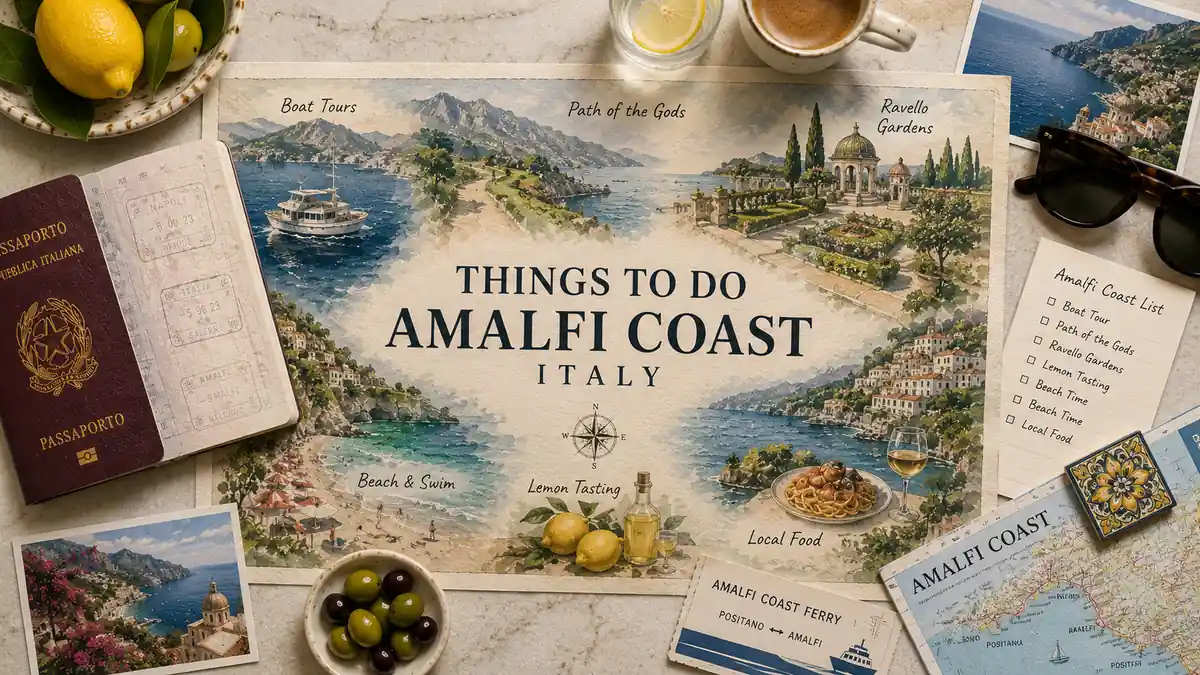
The Amalfi Coast packs more signature experiences into a short stretch of cliff than most trips can fit. You could spend a week here and still leave with a list of things you didn’t do. So the real job isn’t finding things to do — it’s choosing what to prioritize before the days run out. This guide skips the town-by-town roundup and organizes the coast the way travelers actually experience it: by activity. You’ll find the boat days, the ridge hike, the garden villas, the food rituals, and the swim stops that earn their place, plus a plain read on who each one suits. Use it to build a shortlist that matches your pace, your energy, and the number of days you’ve got.
Quick Answer
The Amalfi Coast’s best experiences are a boat tour, the Path of the Gods hike, and Ravello’s gardens. Choose by experience type — on the water, on foot, or around food — rather than by town. Short on time, prioritize a boat day and one hike, then add food tastings and beaches with more days.
Trust Layer
Tripstou selection guide for travelers choosing between multiple places. Covers selection criteria, traveler fit, and trip value.
Produced with AI assistance and reviewed by Alex Perrut, working in tourism since 2015, for the Tripstou editorial team. See our editorial process for details.
Last factual review: July 4, 2026.
Official sources consulted: italia.it, enit.it.
Key Takeaways
- Prioritize a boat day above everything else — it delivers the coast’s signature views and reaches several towns from the water at once.
- The Path of the Gods is the best active experience — a moderate ridge walk with nonstop coastline views for most fit travelers.
- For food and culture, choose a hillside lemon-grove tasting over harbor-front counters to reach the real Sfusato limoncello experience.
- When days are limited, trade land-heavy sightseeing for water time — one unhurried boat day beats three towns rushed by ferry.
- Ravello’s clifftop gardens suit slower travelers and photographers, but require an uphill bus or taxi since ferries don’t reach them.
Table of Contents
What Are the Best Things to Do on the Amalfi Coast?
The best things to do on the Amalfi Coast split into three experience layers: water, foot, and food. A boat tour, the Path of the Gods, and Ravello’s clifftop villas anchor most trips. Organize your days by experience type — that beats trying to tick off every town.
Towns matter mainly as containers for these experiences, not as a checklist. Positano, Amalfi, Ravello, and Praiano each hold something worth doing, but you’ll enjoy the coast far more if you decide what kind of day you want first, then let the town follow. The coast rewards depth over coverage: one unhurried boat day teaches you more about this shoreline than three towns rushed back-to-back by ferry.
How you prioritize depends mostly on how many days you have. Use experiences, not distance, as your unit of planning:
- One day: pick a single boat tour — it delivers the coast’s signature view and hits several towns from the water.
- Two to three days: add the Path of the Gods and an afternoon in Ravello’s gardens.
- Four or more days: layer in a lemon-grove tasting, a beach or two, and a Capri day trip.
The at-a-glance table below sorts the main experiences by effort and fit so you can build a shortlist fast.
| Experience | Effort | Time needed | Best for |
|---|---|---|---|
| Boat tour or day cruise | Low, relaxed | Half to full day | First-timers wanting the signature view |
| Ferry hopping | Low, flexible | Slots through the day | Independent travelers avoiding the road |
| Path of the Gods | Moderate hike | Half day | Active walkers chasing panoramas |
| Ravello garden villas | Easy, some climbing | Half day | Photographers and slow-travel couples |
| Lemon and food tastings | Easy | Couple of hours | Food lovers and rainy-day plans |
This page owns the WHAT — the experiences themselves. For the broader picture of things to do across Italy, or for help fitting the coast into a wider Italy itinerary, follow those guides instead of trying to resolve route and pacing here.
Get Out on the Water: Boat Tours, Ferry Hopping and Capri
The water is the Amalfi Coast’s signature experience, and the best way to see it. From the sea, the cliffs, pastel towns, and hidden coves line up the way the photos promise. Three on-water options differ mainly by control: a chartered boat tour, scheduled ferry hopping, and a full Capri day trip.
On the Amalfi Coast the boat is transport and attraction at once — a ferry between two towns you’d visit anyway often earns its fare in views before you’ve stepped onto the pier. If you do only one thing here, do something on the water.
Boat Tours and Day Cruises
A boat tour or day cruise puts you on the water for a half or full day, shared or private. Shared group cruises are cheaper; private charters cost more but let you set the stops and swim when you like. Fares swing widely by season, boat, and length, so treat any quote as a range and confirm before you book.
Pick this if: you want the coast’s best views and swim stops without steering the boat yourself.
Ferry Hopping Between the Coastal Towns
Ferry hopping is the cheapest, most flexible way to move between Positano, Amalfi, and beyond by sea. It doubles as sightseeing and skips the coast road’s traffic and ZTL restrictions entirely. Ferries run mainly in the warmer months and thin out or stop in the off-season, so check current timetables before you count on one. For how ferries fit with buses and where to base yourself, see the Amalfi Coast guide; to decide which towns are worth a stop as you hop, the best places to visit in Italy guide covers the WHERE.
Pick this if: you want to combine transport and sightseeing and stay flexible day to day.
A Capri Day Trip From the Amalfi Coast
A Capri day trip swaps the mainland for the island’s Blue Grotto, Faraglioni rocks, and cliff-top gardens. Boats leave from several coastal towns; crossings are short but vary by port and operator. Go early. Capri fills fast in peak season, and the last returns leave mid-evening, so watch the clock.
Pick this if: you have a spare day and want a distinct island contrast to the coast.
Tours and activities
Book skip-the-line tickets, day trips and local tours with free cancellation on most activities.
You can also browse everything on getyourguide.com.
Tripstou may earn a commission if you book through this link, at no extra cost to you.
Hiking the Path of the Gods
The Path of the Gods is the Amalfi Coast’s best hike and its best free view. The Sentiero degli Dei runs along the ridge high above the sea, linking Bomerano and Nocelle near Positano. It delivers nonstop panoramic coastline for a moderate effort most reasonably fit walkers can manage.
The trail is largely a traverse rather than a relentless climb, which is why it suits far more people than its dramatic photos suggest. Duration and difficulty vary with your pace and the exact route, so plan in ranges and check trail conditions locally before setting out. Wear proper shoes — the path is uneven, exposed, and hot at midday.
Walk it westbound, from Bomerano down to Nocelle: the sea stays in front of you the whole way and the steepest climbing disappears. The sting in the tail is the long staircase down to Positano at the end — knees feel it, so many walkers grab a local bus from Nocelle instead.
Who it suits: active travelers, view-chasers, and anyone wanting one big outdoor day. Less ideal for those with limited mobility or a fear of exposed edges.
Ravello’s Gardens: Villa Cimbrone and Villa Rufolo
Ravello’s two garden villas offer the Amalfi Coast’s most famous clifftop views. Villa Cimbrone’s Terrace of Infinity and Villa Rufolo’s tiered gardens sit high above the sea in Ravello, a quieter hill town. Both reward the climb with photography, greenery, and a calm the busier coastal towns rarely offer.
The two are distinct enough to justify seeing both. Villa Rufolo pairs medieval architecture with formal gardens and hosts open-air concerts; Villa Cimbrone is wilder and greener, ending at the balustraded Terrace of Infinity that hangs over the sea. Opening hours and entry fees shift by season, so treat them as ranges and confirm on the day.
Ravello sits well above the coast road, so this is the one signature experience you can’t reach by ferry alone — budget the extra bus or taxi leg up from Amalfi and give it a relaxed half day.
Who it suits: photographers, couples, and slow-travel visitors wanting a break from the coastal crowds. Less rewarding for those unwilling to make the detour uphill.
Lemon Groves, Limoncello and Food Experiences
The coast’s lemon culture turns into a hands-on food experience. The giant Sfusato Amalfitano lemon anchors tastings, terraced-grove walks, limoncello sampling, and cooking classes in towns like Amalfi and Minori. These experiences suit slower travelers and food lovers who want the coast’s flavor, not just its views.
The range runs from a quick harbor-side limoncello sample to a half-day on a working terraced grove with a tasting and a meal. Grove tours explain how the lemons are grown on the cliffs and usually finish with food; cooking classes hand you the recipes to take home. Prices and durations vary by operator, so plan in ranges and book the popular grove experiences ahead in high season.
Skip the harbor-front limoncello counters if you want the real thing — a tasting up in a working hillside grove is where the Sfusato lemon story actually lives, terraces, nets, and all.
Who it suits: food-focused travelers, couples, and anyone wanting a good rainy-day or slow-afternoon option.
Beaches and Swimming Spots Worth the Stop
Amalfi Coast beaches are small, pebbly, and often best reached by boat. Don’t expect wide sandy stretches; the appeal is dramatic cliffs, clear water, and tucked-away coves. Positano’s Spiaggia Grande is the easy classic, while quieter swim stops like Fornillo or boat-only coves reward a little extra effort.
Most beaches mix free public areas with paid sunbed-and-umbrella sections run by lidos, and prices climb in peak summer — treat sunbed costs as a range and expect the best spots to fill early. Access to the smaller coves is often easiest by boat, which ties this experience back to a day on the water. Bring water shoes. The pebbles are hard on bare feet.
The best Amalfi swims often aren’t off a beach at all — a boat tour that anchors in a cove gives you clearer water and no scramble for a sunbed, which is why the water day so often doubles as the best beach day.
Who it suits: swimmers and sunbathers who value scenery over sand, and anyone happy to reach the water by boat.
Frequently Asked Questions
How many days do you need on the Amalfi Coast?
Three to four days suit most travelers, enough for a boat day, the Path of the Gods, and Ravello’s gardens without rushing. Two days cover the highlights if you focus on one water day and one hike. Add days for food experiences, beaches, or a Capri trip.
When is the best time of year to visit the Amalfi Coast?
Late spring and early autumn offer the best balance — warm weather, sea swimming, and full ferry service without peak-summer crowds. Midsummer brings the hottest days, busiest towns, and highest prices. The off-season is quiet and cheaper, but many ferries, tours, and beach lidos scale back or close.
Do you need to book Amalfi Coast tours in advance?
Yes, book popular experiences ahead in high season — private boat charters, well-known cooking classes, and grove tours fill quickly from late spring through summer. Ferries and shared group cruises are usually easier to catch day-of, though timetables thin in shoulder months. Booking early also locks in better prices and departure times.
Is the Amalfi Coast worth it, and who is it best for?
Yes, the Amalfi Coast rewards travelers who value dramatic scenery, slow days, and time on the water over convenience or budget. It suits couples, photographers, walkers, and food lovers especially well. It’s less ideal for those needing wide sandy beaches, easy driving, or crowd-free peak-season visits along the narrow coast road.
How do you get around the Amalfi Coast?
Ferries, local SITA buses, and boats are the main ways to move along the coast; most travelers skip driving. The narrow coastal road brings traffic, tight parking, and ZTL restrictions, so ferries often win in the warmer months. Ravello and inland spots need a bus or taxi, since ferries only reach coastal towns.
How much does an Amalfi Coast boat tour cost?
Boat tour prices vary widely by type, season, and length, so treat any quote as a range. Shared group cruises are the most affordable option; private charters cost considerably more but let you set the route and swim stops. Peak-summer demand pushes prices highest, so book early and compare operators for the best value.
Related Guides
Use these guides to turn your experience shortlist into a full trip — the WHERE, the route, and the wider context this page deliberately leaves out.
- Amalfi Coast guide — getting around, where to base yourself, and full trip logistics for the region.
- Best places to visit in Italy — decide which towns and destinations are worth your stops.
- Italy itinerary ideas — fit the Amalfi Coast into a longer route with sensible pacing.
- Things to do in Italy — the national picture of experiences beyond the coast.
- Hidden gems on the Amalfi Coast — the quieter corners to add once the headline stops are booked.
Did this guide save you time or money? Tripstou is independent and reader-funded — if you'd like to give something back, you can support the site with a crypto contribution of any size.