Cinque Terre is a string of five rail-linked villages on a protected stretch of the Ligurian coast in northwest Italy, where pastel houses stack above tiny harbors and terraced vineyards climb the cliffs behind them. This guide is built for travelers who have already chosen it and now need a plan. It answers the practical questions that shape the trip: when to go, how many days it takes, which village to base in, how to move between them, and how to get there. It stays at planning altitude — orienting the five villages and the core logistics — and hands the deeper detail to focused guides where it belongs. By the end you will know the shape of your visit and the few decisions that matter.
Quick Answer
Cinque Terre is five car-free coastal villages linked by train and best explored from one compact base. Most visitors need two to three days and one village to stay in, or La Spezia for better value and connections. Move between villages by train or boat, use the Cinque Terre Card, and leave the car behind.
Trust Layer
Tripstou region guide for travelers planning a regional trip. Covers sub-areas, trip shape, base strategy, timing, and mobility tradeoffs.
Produced with AI assistance and reviewed by Alex Perrut, working in tourism since 2015, for the Tripstou editorial team. See our editorial process for details.
Last factual review: July 4, 2026.
Official sources consulted: Italia.it, ENIT.
Key Takeaways
- Five villages — Monterosso, Vernazza, Corniglia, Manarola, Riomaggiore — line the same short rail route, so one base covers them all.
- Budget two to three days so you can see the harbors before day-trippers arrive and after they leave.
- Base in Monterosso for beach and easy access, or in La Spezia when value and connections matter more.
- Move by train for speed, boat for views, and trails on foot — leave the rental car behind entirely.
- Buy the Cinque Terre Card only if you ride the train often or walk the paid coastal trails.
- Shoulder-season months give open trails and running boats, while warm swimming lands in the crowded peak.
Table of Contents
How to Plan a Cinque Terre Trip
Plan a Cinque Terre trip around four decisions: days, base, movement, and arrival. Pick one base, budget two to three days, ride the train or boat between villages, and skip the car. The compact geography rewards an unhurried structure over a packed checklist.
The whole area is small. The five villages sit within roughly a 20-minute train ride end to end, so a second base rarely saves time — it mostly costs you a re-pack and a morning. That single fact drives most of the good decisions on this page: one base, short hops, and no rental car to park.
The rest of this guide takes those four decisions in order. First get oriented across the five villages so a base choice makes sense, then settle timing and duration, choose where to sleep, and finally sort movement on the ground and arrival from Italy’s gateways. If Cinque Terre is one stop on a larger trip, the closing section covers how it slots into a wider route.
The Five Villages of Cinque Terre and What Each Offers
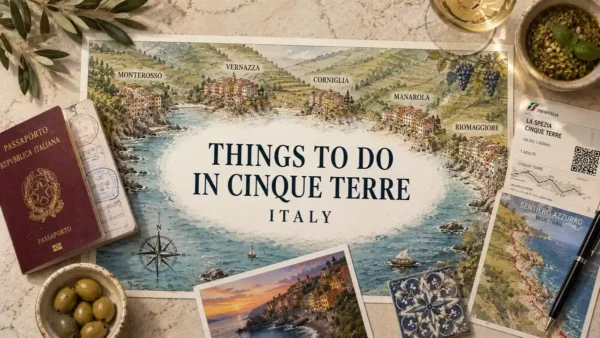
Cinque Terre’s five villages run north to south: Monterosso, Vernazza, Corniglia, Manarola, and Riomaggiore. Each is walkable in under an hour, yet they differ in character — beach town, postcard harbor, quiet hilltop, sunset cliffs, and lively gateway. Knowing those differences is what makes choosing a base easy.
Every village is also its own base town, with a station on the same line and at least some rooms to rent, so the profile below doubles as a first cut for the base decision in a later section.
| Village | Character | Anchor experience | Best for |
|---|---|---|---|
| Monterosso al Mare | Largest and flattest, resort feel | The area’s only real sand beach | Beach days and easy walking |
| Vernazza | The classic postcard harbor | Small natural harbor and piazza | First-timers wanting the iconic view |
| Corniglia | Quiet hilltop, no harbor | Clifftop terraces above the sea | Calm evenings away from crowds |
| Manarola | Vineyards tumbling to the water | Famous sunset over the cliffs | Photographers and slow evenings |
| Riomaggiore | Lively southern gateway village | Steep lanes down to the marina | Nightlife and quick La Spezia links |
Keep this at orientation level and let the villages set the mood of your stay rather than a day plan. For a full breakdown of walks, viewpoints, and things to book, see our guide to the best things to do in Cinque Terre. If you want the corners most day-trippers miss, our Cinque Terre hidden gems guide points to the quieter trails and terraces.
When to Visit Cinque Terre
Late spring and early autumn are the best times to visit Cinque Terre. These shoulder months bring warm-enough weather, open hiking trails, and running boats without peak-summer crowds. July and August deliver the best swimming but the heaviest crowds and strongest heat, while winter is quiet with reduced services.
Season changes what the area actually offers, so match the month to what you came for. The passenger ferry runs roughly from spring into autumn and stops for the winter, so a boat-based visit needs warmer months. Coastal hiking trails open and close with weather and maintenance, and some paid sections carry fees or closures at short notice — treat any specific trail as something to check before you commit a day to it. Swimming is comfortable mainly in high summer, exactly when the villages are busiest.
The trap is that the two headline draws peak at opposite ends of the season. Clear hiking and open harbors favor the shoulder months, while warm-enough sea for real swimming lands in the crowded peak — you rarely get both at their best in one trip. For how Cinque Terre’s timing fits the country as a whole, see our guide to the best time to visit Italy.
How Many Days You Need in Cinque Terre
Most travelers need two to three days to experience Cinque Terre well. That gives time to sleep in the villages, walk at least one trail, and see the harbors after the day crowds thin. A single day works only as a fast highlights loop between train stops.
Match the length to how much of the atmosphere you want, not just the sights:
- Day trip (a few hours): a train hop through two or three villages for the views. Fits travelers already based in La Spezia, Genoa, or on a tight Italy schedule.
- Two to three days: the sweet spot — one base, a full trail or two, boat time, and quiet mornings and evenings. Fits most first-time visitors.
- Four or more days: room to slow right down, add day trips to Portovenere or Lerici, and wait out a rainy stretch. Fits travelers who want a genuine coastal break, not a checklist.
The gap between a day trip and a two-night stay is not really distance covered — both cross the same short line. What changes is timing: staying over is what lets you see the villages before the first trains arrive and after the last ones leave. If you are still shaping the wider trip, our Italy itinerary guide shows where a Cinque Terre stop fits in a longer route.
Which Village to Base In (and When La Spezia Wins)
Base yourself in Monterosso for the easiest all-round stay, or in La Spezia when value matters most. Monterosso has the beach, the most rooms, and step-free access, while the cliff villages trade convenience for atmosphere. La Spezia sits one stop away with cheaper rooms and mainline train links.
Each base suits a different priority, and rooms inside the villages tend to run smaller and pricier than the same money buys just outside:
- Monterosso: the most practical village base — flat ground, sand beach, widest range of hotels and restaurants. Best if you want convenience and easy access with luggage.
- Manarola: the most scenic evenings, with the signature sunset and a relaxed pace. Best if photography and atmosphere outrank amenities.
- Corniglia: the quietest base, precisely because it sits up a long stairway with no harbor. The same feature that keeps day crowds away also deters late arrivals with heavy bags.
- La Spezia: the value and connections play — a proper town with cheaper rooms, more choice, and frequent trains into the villages. Best for budget travelers and anyone arriving late or leaving early.
Keep cost thinking qualitative here: village rooms sit at the higher end and book up early in peak months, while La Spezia and Levanto ease both. For how accommodation fits a full trip budget, see our guide to Italy trip costs.
Hotels and places to stay
Compare hotels, apartments and stays for your dates in one search.
Search hotels and stays on hotels.com →
Tripstou may earn a commission if you book through this link, at no extra cost to you.
How to Get Around Cinque Terre
Get around Cinque Terre by train, by boat, or on foot — no car needed. The regional train is the fastest link, connecting all five villages in minutes; the seasonal ferry offers the best views from the water; the coastal trails connect several villages on foot. Most visitors combine all three.
Each mode does one job best, so pick per outing instead of committing to one:
- Train: the backbone. Frequent local trains link every village in a few minutes each. Best for speed, bad weather, and moving with luggage. Note Corniglia’s station sits below the village, up a long stairway or a shuttle.
- Boat: the scenic option, running in the warmer months and skipping Corniglia, which has no harbor. Best for photos and a slower arrival; weather can cancel sailings.
- Hiking: the immersive option, on coastal and higher trails between villages. Best for walkers with time and decent footwear; open trails and any fees change with the season and conditions.
What the Cinque Terre Card Covers
The Cinque Terre Card is a national-park pass that bundles the paid coastal trails with other visitor services, and comes in tiers. The train version adds unlimited rides on the local La Spezia–Levanto line for its validity period. Prices and validity windows shift, so treat any figure as a range and confirm at the point of sale.
Broadly, there are two tiers: a trekking card that covers the paid trail network and park services, and a train card that adds unlimited local rail on top. The park sells one- and multi-day versions, and the paid trail sections and their fees open and close with the season, so what your card unlocks on a given day is not guaranteed.
The card only pays off if you ride the train three or more times a day, or plan to walk the paid coastal trail. A visitor who takes two short train hops and sticks to the free upper paths often comes out ahead on single tickets — do the quick sum for your own day before buying the pass by reflex.
How to Get to Cinque Terre from Florence, Milan, and La Spezia
Reach Cinque Terre by train, changing at La Spezia or Levanto for the local line. From Florence and Milan, direct or one-change trains run to La Spezia Centrale, where you switch to the frequent Cinque Terre service. La Spezia is the natural southern gateway; Levanto anchors the northern end.
The pattern is the same from most Italian cities: reach a mainline hub, then join the local line that threads the five villages. From Florence, trains head northwest via the coast or with a change toward La Spezia. From Milan, mainline services run down to La Spezia or Levanto. From La Spezia itself, you are already on the doorstep — the local train reaches the first village in minutes. Exact fares, journey times, and schedules move with the timetable and ticket type, so check current connections when you book instead of relying on fixed numbers. Arriving without a car is the norm here; the villages are closed to through traffic and parking is scarce and costly.
Train and bus tickets
Compare routes, schedules and prices across rail and bus operators in one search, with mobile tickets on your phone.
New to Omio? Code NEW10 takes 10% off your first booking — or APPNEW10 if you book inside the Omio app. Both apply to bookings up to €80.
Search routes and compare prices on Omio →
Tripstou may earn a commission if you book through this link, at no extra cost to you.
How Cinque Terre Fits into a Wider Italy Trip
Cinque Terre works best as a two-to-three-day stop inside a wider Italy itinerary. It slots neatly between Florence, Pisa, and Genoa, and pairs well with a Tuscany or Ligurian leg. Treat it standalone only if you want a dedicated coastal break rather than a touring trip through several regions.
For most travelers, Cinque Terre is a change of pace between bigger stops — a couple of slow coastal days after the cities, easy to reach by the same rail network that carries the rest of the trip. Because it sits on the Tyrrhenian side between Tuscany and Genoa, it drops logically into a northern loop without a long detour. Keep the stop short and let the villages be the rest, not another dense sightseeing block.
To place it in a full route, our Italy itinerary guide shows how the days connect end to end. To weigh it against other destinations, see our best places to visit in Italy shortlist, and for the wider national picture start with our Italy travel guide.
Frequently Asked Questions
Do you need a car in Cinque Terre?
No, you do not need a car in Cinque Terre, and it is easier without one. The five villages are closed to through traffic, parking is scarce and costly, and a frequent local train links them in minutes. Arrive by train and move on foot, rail, or boat.
Do you need to book Cinque Terre in advance?
Yes, book accommodation early for peak summer, when village rooms are limited and fill fast. The villages themselves need no entry ticket, but the Cinque Terre Card and popular trails see heavy demand in high season. Outside summer you can travel more spontaneously, though weekends still get busy.
Can you swim, and are there beaches in Cinque Terre?
Yes, you can swim in Cinque Terre, though real sand is limited. Monterosso has the only proper sand beach; the other villages offer small rocky coves, harbor swims, and swimming platforms. The sea is warmest and most comfortable in high summer, which is also the busiest stretch of the year.
Is Cinque Terre worth visiting?
Yes, Cinque Terre is worth visiting for its rare mix of colorful cliffside villages, coastal trails, and car-free calm. It rewards travelers who slow down and stay overnight more than rushed day-trippers. Set expectations for crowds in peak months, and it delivers one of Italy’s most distinctive coastal experiences.
Is Cinque Terre suitable for travelers with limited mobility?
Partly — Cinque Terre is challenging for limited mobility, though not impossible. Monterosso is the flattest village with step-free access and a sand beach, while Corniglia sits atop a long stairway. Trains connect every village, but steep lanes, steps, and hilly trails make full exploration difficult for some visitors.
Is Cinque Terre a good destination for families with children?
Yes, Cinque Terre suits families who base in Monterosso and keep the pace relaxed. Its sand beach, short train hops, and boat rides work well for children, while the steeper cliff villages and long trails demand more care. Pack for walking, and favor the flatter village and easy rail connections.
Related Guides
- Best Places to Visit in Italy — where Cinque Terre sits among the country’s top destinations.
- Italy Travel Guide — the national overview for planning a wider trip.
- Italy Itinerary Guide — build the route your Cinque Terre stop fits into.
- Italy Trip Cost — budget the accommodation, transport, and daily spend.
- Best Time to Visit Italy — national seasonality behind the regional timing.
- Best Things to Do in Cinque Terre — trails, viewpoints, and activities in depth.
- Cinque Terre Hidden Gems — the quieter corners beyond the main sights.
- Genoa Travel Guide — the Ligurian capital up the coast, and how it compares as a base or a stopover.
Did this guide save you time or money? Tripstou is independent and reader-funded — if you'd like to give something back, you can support the site with a crypto contribution of any size.