Choosing a town is the decision that shapes an Amalfi Coast trip more than anything else you book. The coast trades scenery and prestige against ease of movement, cost and physical effort, and the town you sleep in decides how much of each you feel. Book the postcard view and you accept stairs, higher prices and slow departures. Book the practical town and you give up some drama for a flat centre, better value and a short walk with your suitcase. Neither choice is wrong. They suit different travelers.
This guide resolves that choice. It names one default base and who it suits, compares Amalfi, Positano, Sorrento and Ravello on the same criteria of atmosphere, convenience, relative cost and effort, then covers the cheaper, quieter bases most guides skip. A traveler-type map routes you to a single town, and the final sections settle what usually decides the rest: staying without a car, and whether to split your stay.
Quick Answer
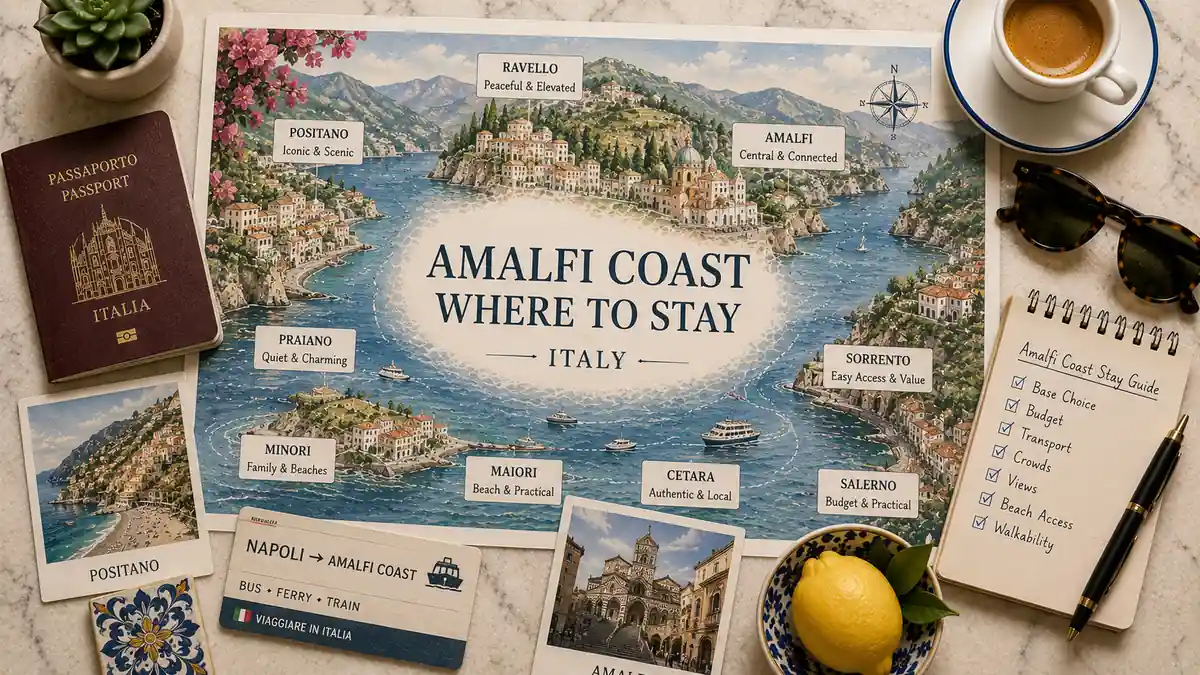
Amalfi town is the best base for most first visits, because it is central and best connected. Positano is the more spectacular base, but it is steeper, higher-end and harder to move around from. Sorrento suits travelers wanting better value, easier transport and less climbing, if you accept it is not on the coast proper.
Trust Layer
Tripstou stay guide for travelers choosing where to base on the Amalfi Coast. Covers town atmosphere, budget, convenience, noise, and traveler fit.
Produced with AI assistance and reviewed by Alex Perrut, working in tourism since 2015, for the Tripstou editorial team. See our editorial process for details.
Last factual review: July 28, 2026.
Official sources consulted: Italia.it, ENIT.
Key Takeaways
- Base in Amalfi town for a first visit: it sits centrally, and the main bus routes interchange there.
- The Amalfi Coast trades scenery and prestige against ease of movement, cost and physical effort; every town gives something up.
- Positano and Ravello sit high-end, Amalfi and Sorrento mid-range, and the eastern beach towns carry the budget end.
- Without a car, base where transport already stops — Amalfi or Sorrento — instead of a town perched above the route.
- Booking Positano with heavy luggage is the common mistake; the stairs are constant and every departure is a climb.
- Treating Sorrento as a downgrade costs you: it is the most practical base, just not on the coast proper.
Table of Contents
Amalfi town is the best base for a first visit
Amalfi town is the best base for a first visit to the Amalfi Coast. It sits at the centre of the coastline and works as the interchange where the main bus routes meet, which means less of your day is spent getting to the places you came to see.
Amalfi is a working town with a real centre rather than a viewpoint with hotels attached. The cathedral steps and the main street fill with day visitors, then empty in the evening, leaving a seafront and a set of restaurants that still function after dark. That evening life matters when you are sleeping somewhere for several nights.
Convenience is the reason it wins. The core is flat and walkable, the harbour and the bus stops sit next to each other, and neighbouring towns are the easiest to reach from here of anywhere on the coast. You still deal with crowded buses and a busy coast road in high season — that is the price of the coast itself, not of this town.
On relative cost, Amalfi sits mid-range, and it holds more choice at that level than the high-end towns above and west of it. You are not competing for a thin band of rooms.
Basing where the buses interchange means you never plan a day around one connection. You can change your mind at lunch and still get home comfortably — which is exactly what a base is for. This page decides the town; for when to come and how the region fits together, the Amalfi Coast guide covers the planning layer.
Best for: first-time visitors who want one central base and the shortest daily travel.
Positano is the icon, and the hardest base to move around from
Positano is worth basing in for the setting, if you can handle the stairs. The town is built vertically into the cliff, so almost every trip between your room, the beach and the bus stop is a climb. You pay for that view in effort as well as in price.
The atmosphere is the most polished on the coast and the most crowded for it. Pastel houses stack down to the water, the boutiques are expensive, and the beach clubs set the tone of the day. It is genuinely beautiful and genuinely busy, and both are strongest in the middle of the day.
Convenience is where it costs you. Nothing is level, luggage is a real problem on arrival and departure, and leaving town means climbing back up to the road or waiting for a boat. Check where your room sits on the hill before you book — an upper-town address adds a climb to every outing, and lower-town rooms disappear first.
Relative cost is high-end, with less at the affordable end than anywhere else covered here.
Positano or Amalfi as a base comes down to what you want to do after breakfast. Choose Positano if the setting is the point of the trip and you will spend most days in and around the town itself. Choose Amalfi if you plan to move — day trips, boats, buses, neighbouring towns — because leaving Positano is a small expedition and leaving Amalfi is a walk to the seafront.
Best for: couples and view-first travelers with light luggage and no mobility limits.
Sorrento is the easiest base if you want convenience over coastline
Sorrento is a good Amalfi Coast base and the most practical one for most travelers. It is a full-sized town with a flat centre, real services and the widest choice of onward connections. The honest caveat: it sits on the Sorrentine peninsula, facing the bay, not among the Amalfi cliffs.
The feel is different from the coast towns. Sorrento is a proper town with pharmacies, supermarkets, a wide range of restaurants and enough streets to wander without repeating yourself. It is less dramatic and more liveable, and it stays open and busy in the evening.
Convenience is its whole argument. It has the broadest day-trip reach of any base here, a rail connection running toward Naples, and the easiest arrivals if you are coming with luggage or landing late. Most travelers reach the coast through Naples, and Sorrento is the simplest place to land from there — our Naples guide covers the city itself if you add a night at either end.
On relative cost it is mid-range and the best value of the four full options, with a deeper mid-range supply than the coast towns.
The downside is honest and worth stating. You look out at the bay and Vesuvius, not at the Amalfi cliffs, and you commute to the coast on the days you want it. Travelers who prioritise waking up inside the scenery will feel that; travelers who prioritise sleeping well, eating well and moving easily rarely do.
Best for: travelers who value easy transport, flat streets and value over a cliff-edge address.
Ravello is worth staying in only if you want quiet over convenience
Ravello is worth staying in for quiet and views, not for beach access or convenience. The town sits inland and high above the coast, which buys silence, gardens and long views over the water. Everything else — beaches, boats, evening bustle — means a descent and a climb back.
The atmosphere is the calmest on this list. Ravello is a hilltop town of villas, gardens and terraces where the day visitors arrive, look, and leave by late afternoon. Evenings go quiet early, which is the appeal for some travelers and the deal-breaker for others. The villa gardens and their terraces are a genuine reason to sleep here, not simply to visit for an afternoon.
Convenience is the weak point. There is no beach, no seafront and no through traffic of transport; anything at sea level involves going down and coming back up, and that shapes how many outings you actually make in a day.
Relative cost is high-end, and the stock of rooms is small, so choice narrows fast in busy periods.
Ravello rewards travelers who plan fewer, longer days. If your ideal afternoon is a terrace and a book, the altitude is a feature; if you want to be in the water before lunch, it is a tax you pay twice a day.
Best for: silence-first travelers and repeat visitors who need neither a beach nor nightlife.
Cheaper and quieter bases worth considering
The cheapest Amalfi Coast bases sit at the eastern end, away from Positano and Amalfi. Prices soften as you move away from the two icons, and the flat beach towns just east of Amalfi carry the best value on the coast proper. Salerno is cheaper still, with the trade of a city setting.
These towns did not earn full blocks because each solves one specific problem well and the rest only partly. Take them as targeted answers.
- Praiano — sits between Positano and Amalfi with much of the same coastline and a calmer, better-value feel; still steep, and still dependent on the coast road.
- Minori — flat, low-key and easy to walk with a suitcase, a short hop east of Amalfi; an everyday town where you will be one of few foreign guests.
- Maiori — the broadest beach and the flattest streets on the coast, with more modern building and less old-town charm than its neighbours.
- Atrani — a tiny square tucked beside Amalfi, quiet at night and walkable into Amalfi’s centre; the room supply is very small.
- Cetara — a working fishing village at the eastern end, cheap by coast standards and genuinely lived-in, with the fewest onward connections.
- Salerno — a real city with rail links and the lowest prices in this set; a base chosen for arrivals and budget, with the coastal atmosphere waiting elsewhere.
Every step east buys a cheaper room and adds travel time to Positano. The saving is real, and so is the commute — which is why these towns work best for stays of several nights, where a slower pace is the point. If swimming is what decides your town, weigh the coast against the alternatives in our guide to the best beaches in Italy before you lock anything in.
Best Amalfi Coast Towns by Traveler Type
The best Amalfi Coast town depends on which constraint matters least to you. Nowhere here is cheap, flat, spectacular and well connected all at once, so every base gives something up. Decide which of those four you can live without, and the town chooses itself.
Relative cost uses budget, mid-range and high-end positioning only.
| Town | What it feels like | Getting around without a car | Relative cost | Stairs and effort |
|---|---|---|---|---|
| Amalfi | Working coastal town, busy by day, alive at night | Easiest, buses and boats both call here | Mid-range with wide choice | Flat core, hills only above town |
| Positano | Polished cliff-side icon, crowded and photogenic | Workable but every departure takes effort | High-end across most options | Constant stairs, hard with luggage |
| Sorrento | Full-sized town facing the bay, not the cliffs | Best connected base, including rail toward Naples | Mid-range, the best value here | Flat centre, easy access to the water |
| Ravello | Hilltop calm, gardens and long sea views | Weakest, everything at sea level means descending | High-end with few rooms | High above the coast, steep access |
| Minori and Maiori | Low-key beach towns with everyday Italian life | Good, on the main coastal route east of Amalfi | Budget to mid-range, the best saving | The flattest bases on the coast |
- First-time visitors — Amalfi, because one central base covers the coast with the least daily planning.
- Couples and honeymooners — Positano if the setting is the reason for the trip; Ravello if you want the evenings silent.
- Families with kids — Minori or Maiori, where the walk from bus to sand is short and level.
- Budget travelers — Salerno, which gives you city prices and a proper transport hub to work from.
- Car-free travelers — Amalfi or Sorrento, the two places transport comes to instead of the other way round.
- Travelers with heavy luggage or limited mobility — Sorrento or Minori, where reaching your room does not involve a stair climb.
Hotels and places to stay
Compare hotels, apartments and stays for your dates in one search.
Search hotels and stays on hotels.com →
Tripstou may earn a commission if you book through this link, at no extra cost to you.
Where should you stay on the Amalfi Coast without a car?
You can stay on the Amalfi Coast without a car; base where the transport actually stops. The towns on the main coastal route with flat centres and a working harbour are the comfortable car-free choices, because both the buses and the boats come to you.
Amalfi is the strongest car-free base, with Sorrento close behind for arrivals and onward reach, and Minori or Maiori good if you want the same route with a quieter, flatter town. Positano works without a car but makes you feel the effort every time you leave. Ravello is the hardest, since the coast is below you and the return trip is always uphill.
Boats are the fastest and most pleasant way to hop between coastal towns in the warm months, and they thin out or stop outside them, so a harbour town is worth more in summer than in the shoulder season. Buses run the coast road year-round and get crowded when the coast is busy. Neither point needs over-planning. The practical consequence for your booking is simply this: pick a town the main route already serves, and skip the ones perched above or beyond it. For how the coast connects to the airport and the wider bay, see our guide to getting around the Naples region.
Should you stay in one town or split your stay?
One base is better for most Amalfi Coast trips; splitting only pays on longer stays. Moving luggage along this coast costs more time and effort than the change of scene returns, and a transfer can eat the best part of a day at both ends of it.
For a short stay, take one base and make it Amalfi, or Sorrento if arrivals and value matter more than waking up on the coast proper. Day trips cover everything you would have moved for, and you unpack once.
For a longer stay, a two-town split becomes defensible if you pair towns that do different jobs. Contrast is what earns the move, not proximity: a connected coastal base first, then somewhere slower to end on — Amalfi into Ravello, or Sorrento into Praiano. Pairing two towns that feel alike buys you nothing but a transfer.
Count the cost of moving before you commit to it: stairs at both ends, a suitcase on a bus or a boat, and a check-out and check-in that bracket the day. That cost is why the split has to earn its place. If you are driving, the coast road adds its own constraints to any move — our guide to driving in Italy covers the car side. For how many nights the coast deserves inside a wider trip, start from the 7-day Italy itinerary.
Frequently Asked Questions
Is Salerno a good base for the Amalfi Coast?
Salerno works as a base when budget and simple arrivals outrank atmosphere. It is a full city at the eastern end of the coast, with rail links that make reaching it straightforward and a much deeper supply of affordable rooms. Expect a daily trip out to the coast towns, not a coastal setting.
Is Praiano a good place to stay on the Amalfi Coast?
Praiano is a good choice if you want Positano’s coastline without Positano’s crowds or prices. It sits between Positano and Amalfi, so both are close, and the mood is quieter and better value. It is still a steep village, and you still depend on the coast road to leave.
Are Minori and Maiori good for families?
Minori and Maiori are the best family bases on the coast because they are flat. Both have broad beaches you can reach on level ground, short walks from the bus stop, and everyday town life instead of a resort feel. Neither offers the drama of the cliff towns.
Can you stay in Naples and visit the Amalfi Coast on day trips?
You can, but Naples works better as an arrival or departure city than as a base. Each coast day starts with a long outbound trip and ends with the same journey back, which eats the hours you came for. Stay on or beside the coast if you have the nights.
Where should you stay on the Amalfi Coast to avoid crowds?
Stay inland or east of Amalfi, and choose a town that keeps its own evening life. Ravello empties when the day visitors leave, and Minori, Maiori and Cetara never fill the way Positano does. Crowding is worst around the middle of the day in the two icon towns.
Do you need a car if you stay on the Amalfi Coast?
No, and a car is often a liability once you arrive. Parking is scarce in the cliff towns, the coast road is narrow and slow when the coast is busy, and buses and boats already reach the places you would drive to. A car earns its place only if you base outside the coast towns.
Related Guides
- Amalfi Coast guide — planning the region and working out when to go.
- Naples guide — the city most travelers arrive through before basing on the coast.
- Getting around the Naples region — reaching the coast from Naples and the airport.
- Best beaches in Italy — beach quality and swimming, compared nationwide.
- Driving in Italy — the coast road, parking and car logistics.
- 7-day Italy itinerary — fitting the Amalfi Coast into a wider trip.
Did this guide save you time or money? Tripstou is independent and reader-funded — if you'd like to give something back, you can support the site with a crypto contribution of any size.