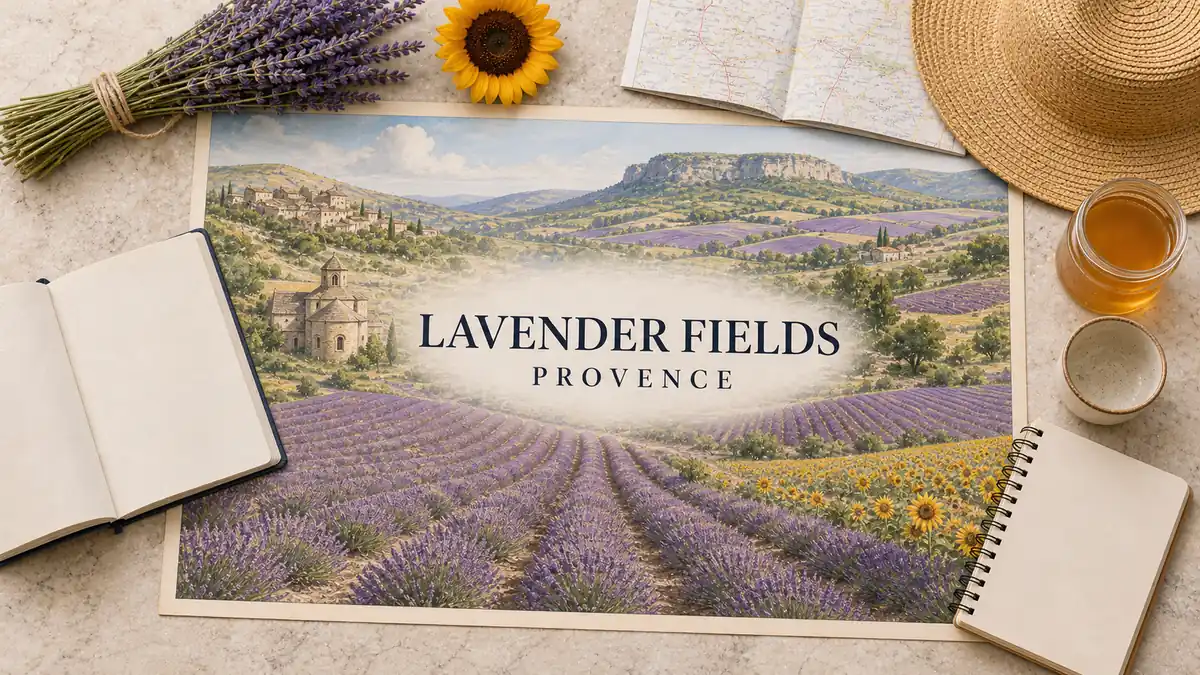
Provence does not have one lavender season — it has several, stacked by altitude. The low fields of the Luberon colour weeks before the high plateau around Sault, and the plateau in between, Valensole, runs on its own clock. That is why the most common lavender disappointment is not bad weather. It is arriving at a famous field that was cut the week before, standing in front of rows of grey-green stubble while the photograph that brought you there was taken on higher ground, later in the summer.
This guide works the other way round. It explains the mechanism — how elevation sets the bloom order, and why farmers harvest when the oil peaks instead of when the field looks best — so you can pick the right area for the dates you already have. Understand the altitude rule and the harvest logic, and you can time a lavender trip in any year, without a calendar.
Quick Answer
Valensole is the classic pick for the postcard scenery; Sault is the quieter, later-blooming alternative. Altitude drives bloom order — the lower Luberon colours first, Valensole next, Sault latest — so your travel window picks your area. Travelers arriving later in the season, or wanting fine lavender without the buses, should head for Sault.
Trust Layer
Tripstou selection guide for travelers choosing between multiple places. Covers selection criteria, traveler fit, and trip value.
Produced with AI assistance and reviewed by Alex Perrut, working in tourism since 2015, for the Tripstou editorial team. See our editorial process for details.
Last factual review: August 24, 2026.
Official sources consulted: France.fr, Atout France.
Key Takeaways
- Altitude sets the bloom order: the low Luberon colours first, Valensole follows, and the Albion plateau around Sault runs last.
- Valensole delivers the postcard scale and the classic image, and pays for it with coach traffic through the middle of the day.
- Sault sits highest, blooms latest and stays quiet, which makes it the answer for trips landing late in summer.
- Pick your area from the dates you already have, because the season shifts from one year to the next and your flights do not.
- Farmers cut for oil potency, not photographs, so a purple plateau can be stubble within a week.
- A car decides the trip: no bus serves the fields, and the early start is the whole crowd strategy.
Table of Contents
Altitude Decides When the Lavender Blooms
The higher the ground, the later the bloom — that one rule replaces every calendar. The low Luberon colours first, the Valensole plateau follows from late June into mid-July, and the higher Albion plateau around Sault runs latest, holding into August. The same plant on higher, cooler ground simply opens later.
The season moves, and the mechanism explains why it still behaves predictably. Spring temperature and rainfall shift the whole sequence forward or back, but they shift it as a block, so the order never changes. Sault never beats the Luberon. What moves is the timing, and the timing is the one thing no guide can promise you in advance.
Peak colour on any single field lasts days, not weeks. That is where planning usually goes wrong: travelers budget a fortnight of purple and get a narrow window that also has to survive the harvest. Two trips a week apart can see completely different plateaus.
Calling ahead is the professional habit, not a hedge. Farm shops, distilleries and the tourist offices in Valensole, Sault and the Luberon villages all track what is standing and what has been cut, and one phone call in the days before you travel is worth more than any published forecast. If you are still choosing the month for the wider trip, our guide to the best time to visit France sets lavender against the rest of the country’s calendar, and the France travel guide covers the first-trip basics that sit around it.
Lock the elevation, not the week. Your dates are usually fixed months ahead; the altitude you drive to on the morning is not, and it is the only variable still in your hands once the flights are booked.
What’s the difference between lavender and lavandin?
Lavandin is a hybrid, and it is what most Provence photographs actually show. It grows lower down in big rounded bushes that form the dense, uniform rows of the Valensole image, and it yields far more oil per hectare. Fine lavender — lavande fine — grows higher up, around Sault and the Albion plateau, in smaller, looser, paler clumps.
Fine lavender is the perfumers’ plant, and it is why Sault smells different from Valensole. The botany is also why the altitude rule holds so reliably: fine lavender needs the elevation, so the fields that look wilder and less uniform are the same fields that bloom last.
The Four Lavender Areas of Provence, Compared
Four areas matter, and they differ in altitude, crowd level and bloom order. Valensole delivers scale and the postcard image, Sault offers quiet fine lavender and the latest bloom, the Luberon colours earliest and holds the Sénanque view, and the Drôme Provençale draws the fewest visitors.
| Area | Character | Relative altitude | Bloom order | Crowds |
|---|---|---|---|---|
| Valensole plateau | Vast lavandin rows, the classic postcard image | Open plateau, lower than Sault | Middle of the four-area sequence | Heaviest, with coach traffic through the middle hours |
| Pays de Sault | Fine lavender in smaller, looser plants | Highest, on the Albion plateau | Latest, and holds colour longest | Light even during the bloom weeks |
| Luberon and Claparèdes | Small parcels between hilltop villages | Lowest ground of the four | Earliest colour of the sequence | Concentrated at Sénanque, thinner elsewhere |
| Drôme Provençale | Lavender at scale with open space | Rolling ground at moderate elevation | Middle, overlapping the Valensole window | Lightest of the four areas |
Valensole Is the Postcard — at Postcard Crowds
Valensole is the largest and most photographed lavender area in Provence, and the image in your head is almost certainly from here. The plateau runs in long unbroken lavandin rows to the horizon, which is exactly what makes it photograph like nowhere else and exactly what makes it a coach destination.
Scale is what separates it from the other three — nothing else in Provence gives you that horizon-to-horizon effect. The price is traffic on the main Manosque road and a line of parked cars at the two or three fields that appear on every itinerary. Sunflowers share the plateau and overlap the late part of the lavender window, a bonus no other area offers. Moustiers-Sainte-Marie sits at the edge of the plateau and is the natural stop on the way out.
Pick this if: you want the image everyone recognises and will get up before dawn to have it half to yourself.
Sault Blooms Latest and Quietest
Sault sits high at the foot of Mont Ventoux and holds its colour into August, after Valensole has been cut. The lavender here is fine lavender, much of it grown organically, and the fields are broken up by wheat, stone and open hillside instead of running flat to the horizon.
The distinct axis is the window. Sault is the answer for anyone whose trip lands late in the summer, and it is quiet in a way Valensole is not during the bloom. Coach traffic thins at this altitude because the drive is longer and the fields sit further from the motorway. Expect a different look, too — smaller, softer, more silver than solid purple. Travelers who arrive expecting Valensole’s density are sometimes surprised; travelers who arrive expecting quiet never are.
Pick this if: you are traveling in the later part of the season, or you would trade scale for a field with nobody standing in it.
The Luberon Colours First — and Holds the Sénanque Image
The Luberon is the earliest of the four areas and the closest to the villages most visitors already have on their list. Fields sit on the Claparèdes plateau above Bonnieux and scatter around Gordes and Roussillon, in small parcels framed by dry-stone walls and oak scrub.
Its defining feature is the Abbaye de Sénanque, whose small field in front of a Cistercian facade is the second-most photographed lavender image in Provence. It is a working monastery rather than an attraction, and access to the site is managed — check before going. The trade-off for the early colour is size: these are parcels, not plateaus, and Sénanque itself is one modest field with an audience in front of it. Gordes, Roussillon and Bonnieux sit on the drive anyway; what else fills a day around them belongs in our guide to things to do in Provence.
Pick this if: you are already based among the hilltop villages and want colour at the front end of the season.
Drôme Provençale Is the Overlooked Fourth
The Drôme Provençale grows lavender at scale and draws the fewest visitors of the four areas. It occupies the northern, Rhône-facing edge of lavender country, across the plateaus and valleys above the river, and it delivers the wide purple sweep without the coach parks.
Space is what it trades on. Where Valensole funnels its crowd into a handful of famous roadside fields, the Drôme spreads its lavender across a much wider area with no single must-see viewpoint, which is precisely why it stays calm. The cost is iconography — there is no Sénanque here and no one photograph everyone recognises, so the area rewards driving and looking over ticking off a view. It also suits travelers arriving from the north, since it is the first lavender you reach coming down the Rhône corridor.
Pick this if: you are approaching Provence from the Rhône side and value open space over famous views.
Valensole or Sault: Match the Area to Your Travel Window
Your dates decide it: Valensole peaks earlier, Sault blooms later and quieter. Traveling in the earlier part of the summer, choose Valensole for scale and the classic image. Traveling later, or unwilling to share a field with coaches, choose Sault. Both are working farmland at full bloom; the timing and the crowd load differ.
The trade-off is scale against solitude, and your window decides which one is even on the table. Valensole gives you the horizon and the iconography, paid for in parked cars and drone noise at the few fields the tours use. Sault gives you a quiet hillside, a subtler plant and a later bloom, paid for in a longer drive and a less dramatic photograph. Neither is a compromise.
Most disappointing lavender trips begin with the area and hope the season cooperates. Pick the area from your travel window rather than the window from the area — Valensole in the wrong week is a green field with a famous name.
Accommodation follows the same logic: beds near both plateaus go early for the bloom weeks, and the villages around them are small. Where to base yourself for the wider trip is resolved in the Provence travel guide. If you are pairing lavender with the coast, geography tilts the decision — Valensole sits on the side of Provence that flows naturally down to the sea, while Sault pulls you north and inland, which is worth weighing against the plans in our French Riviera travel guide.
Harvest Can Turn a Purple Field to Stubble in a Week
Fields are harvested for oil potency, not photographs, and can be cut with no warning to visitors. Harvest starts around the middle of July on Valensole, while Sault is still being cut into August. A field that was full purple on a Monday can be rows of stubble by the weekend.
Harvest is a farm decision, and it moves fast once it starts. Cutting follows the same altitude sequence as the bloom, working up from the low ground to the high plateaus. A plateau can look untouched on one drive and be half baled on the next.
Peak colour lasts days, not weeks, on any individual field. That is why the same week can look completely different two years running — a warm spring pulls the bloom forward and the harvest with it, a cool wet one pushes both back. The plants do not read calendars.
Treat the drive up to Sault as insurance, not a fallback. A traveler who builds a whole trip around one plateau and one narrow window has no move left when the tractors come early; a traveler who knows the higher fields are still standing has an afternoon’s drive and a different photograph.
What if the field is already cut?
Drive higher. The mechanism that staggers the bloom also hands you the recovery move: when Valensole is stubble, Sault and the Albion plateau are usually still in colour, and shaded pockets in the Luberon can hold on longer than the open parcels. Distance is the price, and it is a small one.
On Valensole itself, the sunflowers take over as the lavender goes, overlapping the late part of the window — the plateau changes colour instead of turning brown. Farm shops and local tourist offices know which parcels have been cut and which are standing, and asking on the morning saves an hour of driving to a field that is already gone.
Do You Need a Car for the Lavender Fields?
A car is close to essential: the fields sit on farm roads no bus serves. There is no useful public transport to the plateaus, and the best fields are the ones you stop at on impulse. Without a car, the working answer is a guided day trip from Avignon, Aix-en-Provence or Marseille.
A car changes what the trip actually is. The famous fields are the ones visible from the main Manosque road; the better ones usually sit a few minutes down the quieter back roads, and stopping at them is a decision you make in the moment. Early starts are only possible with your own vehicle, and the early start is the entire crowd strategy.
The tour alternative buys you the icons on someone else’s clock. Guided day trips run in season from Avignon, Aix-en-Provence and Marseille, and they deliver the recognisable stops with no driving and no parking. They also arrive when the coaches arrive, in the middle of the day, and leave before the light turns good. For one day of a broader trip that is a fair trade; as the basis of a lavender-focused trip it is thin. Routes, rentals and sequencing belong in our France road trip planner.
Marseille is the usual arrival gateway if you are flying in, and the plateaus are an easy morning’s drive from there — the Marseille travel guide covers the city end of the trip. Distances between the areas stay modest: Valensole to Sault is roughly an hour and a half of pleasant driving, with the Luberon sitting between them.
How many lavender areas can you see in one trip?
Two are comfortable on a short trip, and three are realistic across a week with a car. The areas sit close enough to form a natural drive, and there is a logical order to it: because they do not bloom together, the sequence follows the season, not the map. Start low and finish high if your trip straddles the change.
Trying to cover all four in a few days turns a lavender trip into a driving trip. Two areas chosen to match your dates will always beat four seen through a windscreen.
Tours and activities
Book skip-the-line tickets, day trips and local tours with free cancellation on most activities.
You can also browse everything on getyourguide.com.
Tripstou may earn a commission if you book through this link, at no extra cost to you.
How to Avoid the Crowds at Valensole
Early morning and evening belong to independent travelers; the middle of the day belongs to the tour buses. Coaches reach the famous roadside fields mid-morning and work a short list of stops. Go at first light or in the last hour of daylight, or trade Valensole’s icons for Sault’s quiet.
The coaches follow a predictable pattern. They come up on the day-trip routes from Avignon, Aix-en-Provence and Marseille, reach the roadside fields on the main Manosque road in the late morning, and cluster at the same two or three parcels where a lavender row meets a stone hut or a lone tree. Between those stops, the plateau is close to empty.
- Arrive at first light. The plateau is yours for an hour or more, and low sun does work that no midday photograph can match.
- Come back in the evening — the last hour before sunset is the second quiet window, long after the coaches have left.
- Turn off the main road. Ten minutes on a quieter back road puts you at fields as good as the famous ones, with nobody there.
- Give the signposted viewpoints the middle of the day and spend those hours on lunch, a village, or the drive to the next area.
- Move up to Sault when quiet matters more than scale. The crowd thins as the altitude climbs.
The coaches come for the roadside. Ten minutes of unpaved track buys you a field to yourself, and it is the cheapest upgrade on the whole trip. Provence rewards that instinct beyond lavender too — our guide to hidden gems in Provence covers the region’s quieter corners in general.
Lavender Field Etiquette: These Are Working Farms
Every lavender field in Provence is private farmland, and access is a courtesy, not a right. The rows are a crop with a harvest and a market value, and a trampled row is lost income. Stay at the edges, follow signage, and treat the field as a workplace that happens to be beautiful.
- Never walk between the rows. Footprints break plants, and the damage stays visible for the rest of the season.
- Never pick or cut lavender. The stems belong to whoever farms them, and the distilleries weigh the crop.
- Park clear of farm access. Tractors and trailers need those verges and gateways, often at first light.
- Read the signage. Where a farmer marks a field closed or asks visitors to keep to a path, that is the rule.
- Give the bees room. Hives sit along the field edges through the bloom, and the fields hum for a reason.
- Check local rules before flying a drone. Several communes restrict them around the fields and the abbey.
None of this costs you a photograph. The best images come from the headland at the edge of a field anyway, where the rows converge.
Frequently Asked Questions
Is the lavender still blooming in Provence in August?
Yes, at altitude. The high Albion plateau around Sault holds its colour into August, well after the lower Valensole plateau has been cut and baled. Anyone traveling in the last stretch of summer should plan around Sault and treat the lower plateaus as a bonus.
Can you walk into the lavender fields in Provence?
No — not between the rows. The fields are private working farms, and the crop is someone’s income, so visitors stay on the headland at the edge or on a path the farmer has marked. That edge is where the rows converge anyway, so photographs lose nothing.
Can you see sunflowers and lavender at the same time in Provence?
Yes, on the Valensole plateau, where sunflowers share the ground with lavandin and open as the lavender window closes. The overlap falls in the late part of the season, so a trip timed for the end of the bloom often gets both crops in one frame.
Is there a lavender festival in Sault or Valensole?
Both hold one. Valensole’s falls in July and Sault’s in mid-August, each built around the harvest in its own area. The timing moves, so confirm with the local tourist office before building a trip around either — and expect the village to be busy on the day.
Do you have to pay to visit the lavender fields in Provence?
The fields themselves are free. They are farmland seen from public roads and verges, not ticketed attractions, so the real costs are the car, the fuel and the parking. Individual sites set their own terms — the Abbaye de Sénanque manages access to its field, so check before going.
Are the lavender fields a good stop with young children?
Yes, in short doses. A field visit is a brief roadside stop, which suits small attention spans, but the plateaus are open farmland with little shade and working hives along the edges. Go early while it is cool and quiet, keep everyone out of the rows, and pair it with a village lunch.
Related Guides
- Provence travel guide — where to base yourself, how long to stay, and how the region fits together.
- Things to Do in Provence — the wider attraction roster around the lavender drives.
- Hidden Gems in Provence — the region’s quieter villages and corners.
- Best Time to Visit France — how the lavender window sits inside the national calendar.
- France road trip planner — routes, rentals and sequencing for a driving trip.
- Marseille travel guide — the usual arrival gateway for Provence.
- French Riviera travel guide — pairing the fields with the coast.
- France travel guide — first-trip planning context for the whole country.
Did this guide save you time or money? Tripstou is independent and reader-funded — if you'd like to give something back, you can support the site with a crypto contribution of any size.