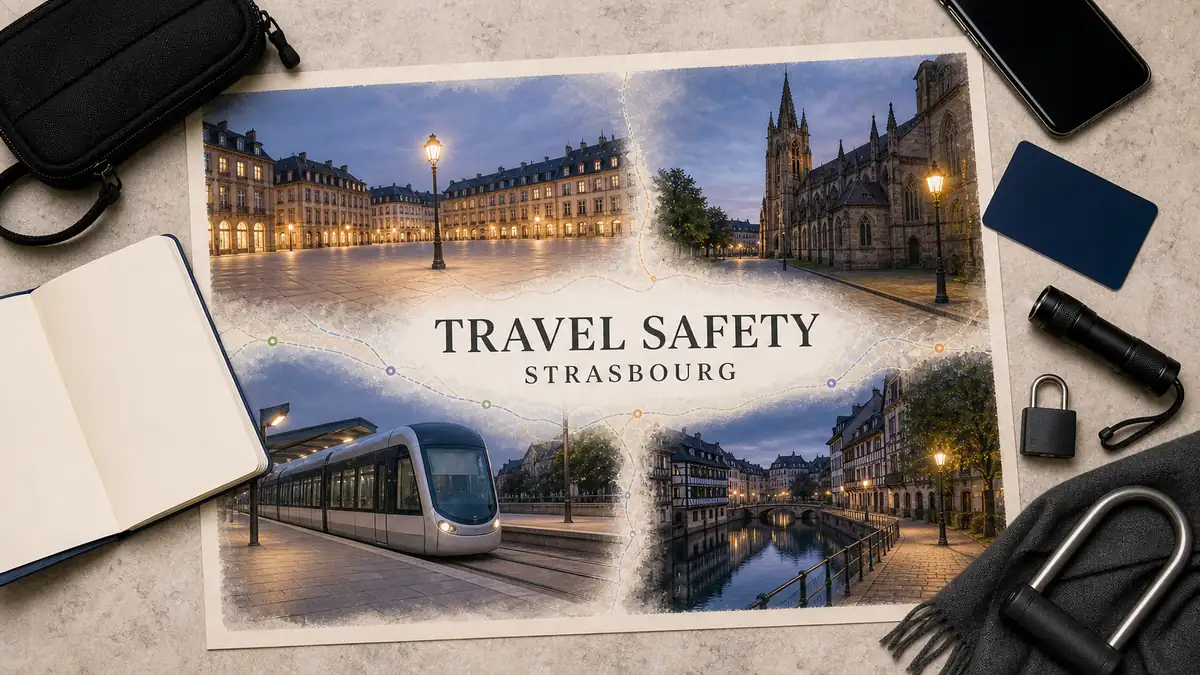
Most people asking whether Strasbourg is safe have already decided to go. The trip is booked or nearly booked — often built around the Christmas markets — and one question is still hanging over it. The answer is calmer than the search results suggest. Strasbourg is a low-risk city, and the realistic problem for a visitor is theft in a crowd.
This page sets out where that risk actually sits, how the hour changes it, which scams you might meet and how to recognise them mid-approach, what market season does to the odds, how the trams factor in, what solo women and families need to know, whether travel insurance earns its cost, and what to do if something goes wrong. It carries no safety scores and no incident reports, because neither tells you anything useful about how to behave on a crowded square.
Quick Answer
Strasbourg is one of France’s safer major cities, and violent crime against visitors is rare. The real risk is opportunistic pickpocketing in crowded central spots — the cathedral square, Place Kléber, packed trams — and it sharpens during the Christmas-market season. Keep valuables zipped and in front of you in crowds and on trams.
Trust Layer
Tripstou safety guide for travelers deciding how safe a destination is and what precautions actually matter. Covers real risk levels, common scams, situational awareness, and protection choices.
Produced with AI assistance and reviewed by Alex Perrut, working in tourism since 2015, for the Tripstou editorial team. See our editorial process for details.
Last factual review: August 23, 2026.
Official sources consulted: France.fr, Atout France.
Key Takeaways
- Violent crime against visitors is rare in Strasbourg; opportunistic property theft is the only realistic exposure.
- Crowd density drives the theft risk: cathedral square, Place Kléber, packed trams, and sharply the Christmas markets in season.
- Every common scam — petition clipboard, friendship bracelet, distraction team — needs you to stop, so decline while still walking.
- Strasbourg’s centre is fine to walk after dinner; plan the last stretch between transport and your bed before setting out.
- Travel insurance is worth buying for most non-EU visitors, chiefly for medical exposure and the realistic loss of a phone.
- Dial 112 free from any phone in France, including a foreign mobile, for police, ambulance or fire.
Table of Contents
Strasbourg Is a Low-Risk City — Here’s Where the Risk Actually Sits
Strasbourg sits at the low-risk end for a French city, and the realistic risk is theft in a crowd. Attacks on tourists are rare. What is common is opportunistic — a hand in an open bag on a busy square, a phone lifted from a café table. The exposure is to your things, not to you.
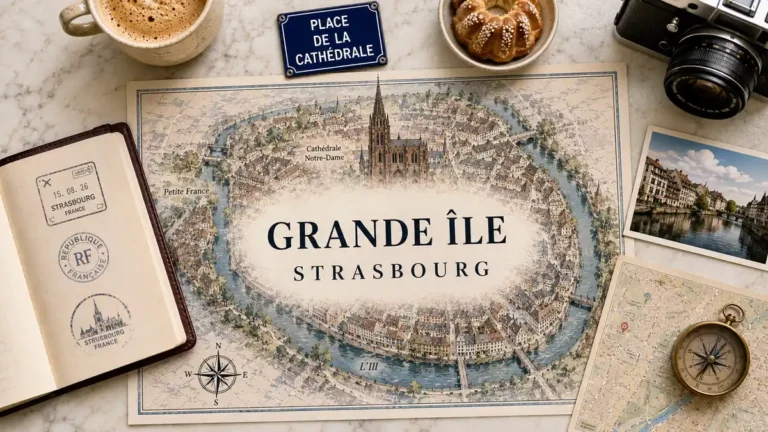
Risk here follows density and distraction. Strasbourg concentrates almost its entire visitor life on one island, the Grande Île, and theft happens where visitors are guaranteed to be: the crowd in front of the cathedral, Place Kléber, the queue for a boat tour, a tram carriage at capacity. The historic core is compact, heavily frequented and heavily policed, which is exactly why what reaches visitors is theft and almost never confrontation.
Because the whole visitor circuit fits on a single island, Strasbourg’s risk map is a crowd map. The same square is a different proposition empty on a wet weekday morning and packed shoulder-to-shoulder on a market evening. Change the hour and you change your odds on an identical street. Change the district and you often change nothing at all.
Country-level questions sit one level up. France is a safe country to travel in, and the same crowd-theft pattern runs more intensely through its biggest cities — the national picture, French rules and the wider scam catalogue belong in our guide to safety in France. If the trip itself is still taking shape, start from the Strasbourg travel guide and come back here for the precautions.
Is Strasbourg Safe at Night?
Strasbourg’s centre is comfortable to walk at night, and it stays populated late. Restaurants, the cathedral quarter and Petite France keep people on the streets well into the evening. Caution belongs to the edges — empty tram stops, unlit side streets, and residential districts with nothing open. The change is the hour and the setting more than the address.
What actually shifts after dark is how alone you are, and the Grande Île empties in stages. The dinner streets stay busy long after the daytime crowds thin. The lanes around them go quiet the moment the last tables clear, and a canal path in Petite France that felt charming at nine can feel like a different city an hour later. Neither is dangerous. Both are simply emptier, and emptiness is what makes people uneasy.
- Stay on the lit, populated routes. The walk between the cathedral quarter, Place Kléber and Petite France stays busy late; the shortcuts between them do not.
- Take licensed transport for the long stretches. A tram or a booked taxi beats a long walk through an unfamiliar quiet quarter, especially in winter when the streets clear early.
- Keep your drink in sight. Ordinary bar awareness, no more, and it applies in a busy Strasbourg winstub as much as anywhere else.
- Know the last stretch before you set out. The part of the night worth planning is the distance between where transport leaves you and where you sleep.
That last stretch is the honest Strasbourg night variable, and it runs longer than it looks because the island’s quiet arrives early and arrives suddenly. Winter compounds it: dark by teatime, few people outside, and a centre that reads as deserted while being perfectly fine. For opening hours, seasonal rhythms and the daily practicalities that shape an evening here, see our Strasbourg travel tips.
Is the Train Station Area Safe?
The station area is fine by day and through busy evenings. Gare de Strasbourg sits a short walk from the Grande Île, the surrounding streets are ordinary working city, and they stay busy through the day. Late at night the picture thins out without turning threatening: fewer travelers, more people with nowhere to be, occasional street drinking around the approaches.
The behaviour that fits is unremarkable. Walk out of the station with your bag closed and your phone away, take the main lit approach into the centre instead of cutting through the quieter side streets, and use a tram or a taxi if you arrive late with luggage. Arriving with a rolling suitcase after midnight is the moment you are most visibly a visitor, which is the only reason the hour matters at all.
Which Areas Deserve Extra Caution
Strasbourg has no central no-go zones. Everywhere a visitor actually goes — the Grande Île, Petite France, the cathedral quarter, the quays, the European institutions — is busy and well-trafficked. The only areas needing any thought are outer residential districts, and the reason to skip them after dark has nothing to do with danger. It is irrelevance.
Neuhof, Meinau, Cronenbourg and Koenigshoffen are residential outer districts. They hold nothing touristic, no visitor has a reason to be walking around them at night, and that is the whole of the advice. They are not a no-go list and they are not ranked, and the reputations attached to them online trace back to forums, with no official body designating any area of this city as one to avoid. Treat them the way you would treat the outer suburbs of any city you were visiting for three days.
The more useful way to read this section is as a signal about where you sleep. A base inside or immediately around the Grande Île means your evenings end on populated streets and your walks home stay short, which quietly removes most of the night-time question before it is asked. That is an accommodation decision with a safety side effect, and it belongs in where to stay in Strasbourg.
Common Scams in Strasbourg and How to Spot Them
Strasbourg’s scams are a short, recognisable set of crowd routines. Four cover almost everything a visitor meets: the petition clipboard, the friendship bracelet, the distraction team working a crowd, and the restaurant bill carrying items nobody ordered. None of them involve force. All of them need you to stop and engage.
- The petition clipboard. Someone approaches with a clipboard and asks you to sign for a charitable cause. It works the cathedral square, Place Kléber and the market lanes in season. The tell is the clipboard held at chest height, blocking your view of your own bag while a second person stands close. Say no without stopping and keep walking.
- The friendship bracelet. A friendly stranger starts tying a woven bracelet around your wrist before you have agreed to anything, then asks for payment. It happens on busy pedestrian streets and near the boat-tour departure points. The tell is physical contact you did not initiate. Keep your hands down and your arms uninviting, and move on.
- Distraction theft in a crowd. One person creates a moment — a dropped map, a spilled drink, a question, a sudden press of people — while another works your pockets. It concentrates wherever the crowd is thickest and slowest. The tell is being crowded when there is space to move. Put a hand on your bag first, look second.
- The restaurant add-on. Items arrive that you did not order, or the bill carries charges that were never mentioned. It shows up on the most tourist-facing terraces of the centre. The tell is a menu without prices, or a waiter who will not leave one on the table. Read the written menu before ordering, and query the line calmly when the bill comes.
All four routines depend on the same thing: you standing still and engaging. On the Grande Île the streets are narrow enough that stopping puts you inside a crowd within seconds, which is why “no thank you” delivered while still walking defuses every script above. There is no rudeness cost worth worrying about here. A stranger who genuinely needs help will still be there once your bag is secure.
Are There Pickpockets at the Strasbourg Christmas Market?
Yes — pickpocketing rises sharply during the Christmas markets. Late November to late December turns the Grande Île into a dense, slow-moving crowd in heavy winter coats, which is the exact condition thieves need. What is at risk is your pockets. The evening itself stays comfortable, and visitors are rarely the target of anything worse.
The crowd builds in a predictable shape. Weekends draw the heaviest volume, the pressure climbs from mid-December onward, and the densest hours are the dark evening ones when the stalls are lit and everyone is holding a cup of hot wine. Winter clothing does the rest of the work for a thief: a coat pocket is easier than a zipped bag, gloved hands notice less, and nobody registers a bump inside a crowd that is already pressed together.
The discipline that matters is small and physical. Carry a bag that closes, wear it across your body and swing it to the front the moment you join a queue at a stall. Keep your phone in an inside pocket instead of the back of your jeans. Pay with one card and leave the rest at the hotel. Never set a wallet down on a stall counter while your other hand holds a cup — one hand for the glühwein means the other stays on your bag.
Visible security at the markets is a standing arrangement rather than a fixed procedure. Expect a noticeable police presence around the Grande Île through the season, along with bag checks and traffic restrictions at the approaches as a general pattern. Practically, that means allowing for a short queue to get in, so travel light — and expect the exact arrangements to shift from one season to the next.
Market crowds are the one Strasbourg risk you can schedule around, and a weekday morning on the island is a completely different city from a Saturday at glühwein hour. If timing your days around the crowd is the plan, our 2-day Strasbourg itinerary covers a short winter stay and the 3-day Strasbourg itinerary gives the same ground a slower rhythm with more room to dodge the peaks.
Is the Strasbourg Tram Safe?
The tram is safe to ride. Strasbourg’s network is modern, well used and busy into the evening, and the problems on board are the ordinary crowd ones: open bags in packed carriages, phones held loosely near the doors. The genuine hazard is the tram itself, seen from the pavement. It is quiet, and it is fast.
On board, the risk window is the boarding moment. A full carriage at rush hour or after a market evening presses everyone together, and the doors closing is when hands move. Keep your bag in front of you, let the squeeze board ahead of you when it costs you nothing, and avoid door-side phone use where a grab can be followed by a step onto the platform. Empty stops late at night deserve the same judgement as any empty place after dark: wait where there is light and where there are people.
Off the tram, the crossing hazard is real, and it catches visitors far more often than residents. Strasbourg’s trams run at street level through pedestrian areas, they arrive almost silently, and they move faster than their surroundings suggest. Look both ways at every track crossing, including on streets that feel entirely car-free. Tracks running through a pedestrian square are still tracks.
The tram in Strasbourg is more of a danger to you on foot than on board, and that inversion is what visitors get wrong. For tickets, routes, validation and how to move around late in the evening, see our guide to getting around Strasbourg.
Safety for Solo Female Travelers and Families
Strasbourg is one of the easier French cities for both solo women and families. The centre is compact, flat and largely pedestrianised, evenings start early and stay social, and the distances between busy streets are short. Both groups face the same crowd-theft picture as everyone else, with a few differences worth naming.
Is Strasbourg Safe for Solo Female Travelers?
Strasbourg is comfortable for solo female travelers, including in the evening. Street harassment exists here as it does in any European city, and it registers mostly as the occasional comment in passing. The centre is easy to walk alone after dinner, which follows directly from a core that stays busy and is small enough to cross on foot in minutes.
The nuance is everyone else’s nuance, only sharper. Arriving at the station late with luggage, and walking a long quiet stretch home once the island has emptied, are the two moments worth engineering out — take the tram or a taxi and keep the final walk short. Treat feeling watched as reason enough to change what you are doing. Ducking into a bar or a lit shop costs nothing when you turn out to be wrong.
Is Strasbourg Safe for Families with Kids?
Strasbourg suits families unusually well. The historic core is largely traffic-free, the walking distances are short enough for small legs, and the canals, storks and cathedral do much of the entertaining. Tap water is potable throughout the city and food-hygiene standards are high, so the everyday worries of travelling with children mostly do not apply here.
Two things need a plan. Tram tracks cross pedestrian areas where children assume no vehicles run, so hands get held at crossings and the rule is worth saying out loud before the first one. And market crowds separate families fast — agree a meeting stall before you go in, put a note with your phone number in a young child’s pocket, and keep a photo of what they are wearing that day.
Do You Need Travel Insurance for Strasbourg?
For most non-EU visitors, yes — travel insurance is worth buying for Strasbourg. Medical exposure and theft cover are what justify it: an unplanned hospital visit is the expensive scenario, and a phone taken in a market crowd is the likely one. EU travelers with existing health cover can reasonably decide otherwise.
Three scenarios do the deciding. Medical treatment is the heavy one, because a visitor without cover carries the full cost of an accident or an illness that needs more than a pharmacy. Theft is the probable one, and everything above explains why: a stolen phone, camera or bag is the realistic Strasbourg claim. Cancellation is the quiet one, and it bites hardest on winter trips where flights and accommodation were paid for months ahead of a market weekend.
The case weakens when cover already exists. European visitors carrying a valid reciprocal health card have access to state healthcare in France, and some payment cards include travel medical and theft cover as standard. Check what you already hold before buying a second policy that duplicates the first.
The Strasbourg claim most likely to fail is the stolen-phone one, and it fails on paperwork: an insurer wants a police report filed in France, not an account written after you get home. That sequence is set out in the next section. If you are still sizing up the trip, our Strasbourg trip cost guide puts protection in budget context.
Travel medical insurance
SafetyWing Nomad Insurance provides travel medical coverage designed for travelers and digital nomads, with flexible Monthly and Annual plans.
Check Nomad Insurance coverage and current pricing →
New Nomad Insurance Essential members can get 8 weeks of electronic theft coverage free with reward code TRIPSTOU8.
Apply the reward before creating your SafetyWing account by looking for the pink camera icon on the Nomad Insurance page.
Tripstou may earn a commission if you purchase through this link, at no extra cost to you.
Emergency Numbers and What to Do If Something Goes Wrong
Dial 112 from any phone in France, free of charge, including a foreign mobile. It reaches police, ambulance and fire from a single call. Three French service numbers sit behind it for specific needs. Everything act-now for a Strasbourg trip is on this short list, and nothing else is needed.
- 112 — the European emergency number. Works from any phone, including foreign mobiles, free of charge, for any emergency service.
- 17 — police.
- 15 — SAMU, for medical emergencies.
- 18 — fire and rescue.
If something is taken, the order of your next moves matters more than the speed of any single one. Block your cards and your phone first, because that is the loss that keeps growing while you queue. Then file a formal complaint at a police station — that document, and not your memory of events, is what an insurer will ask for. If a passport has gone, your embassy or consulate handles the replacement, and the police report is the first thing they will want to see.
Frequently Asked Questions
Is Tap Water Safe to Drink in Strasbourg?
Yes, Strasbourg’s tap water is safe to drink throughout the city. Food-hygiene standards are high, so a refillable bottle covers a full day of sightseeing and bottled water is an expense you can skip. Ice, salads and washed produce need no second thought here either.
What Is the Crime Rate in Strasbourg?
Strasbourg’s crime level sits low for a French city of its size, and what exists is overwhelmingly non-violent property crime. Pickpocketing, bag theft and bike theft account for nearly everything a visitor could plausibly encounter. Numeric safety ratings circulate widely for Strasbourg, but they are survey aggregates that shift with whoever was asked.
Is Bike Theft Common in Strasbourg?
Yes, bike theft is routine in Strasbourg, roughly as common as pickpocketing. Cycling is a primary way of getting around here, so the supply of targets is large and thieves are practised. Use a U-lock through the frame and a fixed object, never just the wheel, and avoid leaving a bike out overnight.
Is Strasbourg Safe for LGBTQ+ Travelers?
Yes, Strasbourg is a comfortable and unremarkable city for LGBTQ+ visitors. It is a young, international university and institutional city, and same-sex couples draw no attention in the centre or in its bars and restaurants. The ordinary urban judgement you would apply anywhere is all that is needed.
Do I Need to Watch Out for Cyclists in Strasbourg?
Yes, cyclists deserve as much attention as trams when you are on foot. Bike lanes run through squares and along pavements that look entirely pedestrian, and riders move faster than the setting suggests. Check for a lane before stepping sideways for a photo, and keep children on the inside.
Are Pickpockets a Problem Outside the Christmas Market Season?
Pickpocketing eases considerably outside market season, though it never disappears. For most of the year the crowds are thinner, and with them the conditions thieves rely on. The hotspots stay the same — cathedral square, Place Kléber, boat-tour queues, full trams — but a quiet weekday there is nothing like a market evening.
Related Guides
- Strasbourg travel guide — the full picture of the city and how to plan a first visit.
- Where to stay in Strasbourg — how to choose a base, and what each area changes about your days and evenings.
- Getting around Strasbourg — trams, tickets, routes and moving around late.
- Strasbourg travel tips — opening hours, seasonal rhythms and the practicalities that shape a stay.
- Strasbourg trip cost — what a short stay realistically costs and where the money goes.
- 2-day Strasbourg itinerary — a short first stay, paced around the crowds.
- 3-day Strasbourg itinerary — the same city with room to slow down and dodge the peak hours.
- Safety in France — the country-level picture, national rules and the wider scam catalogue.
Did this guide save you time or money? Tripstou is independent and reader-funded — if you'd like to give something back, you can support the site with a crypto contribution of any size.