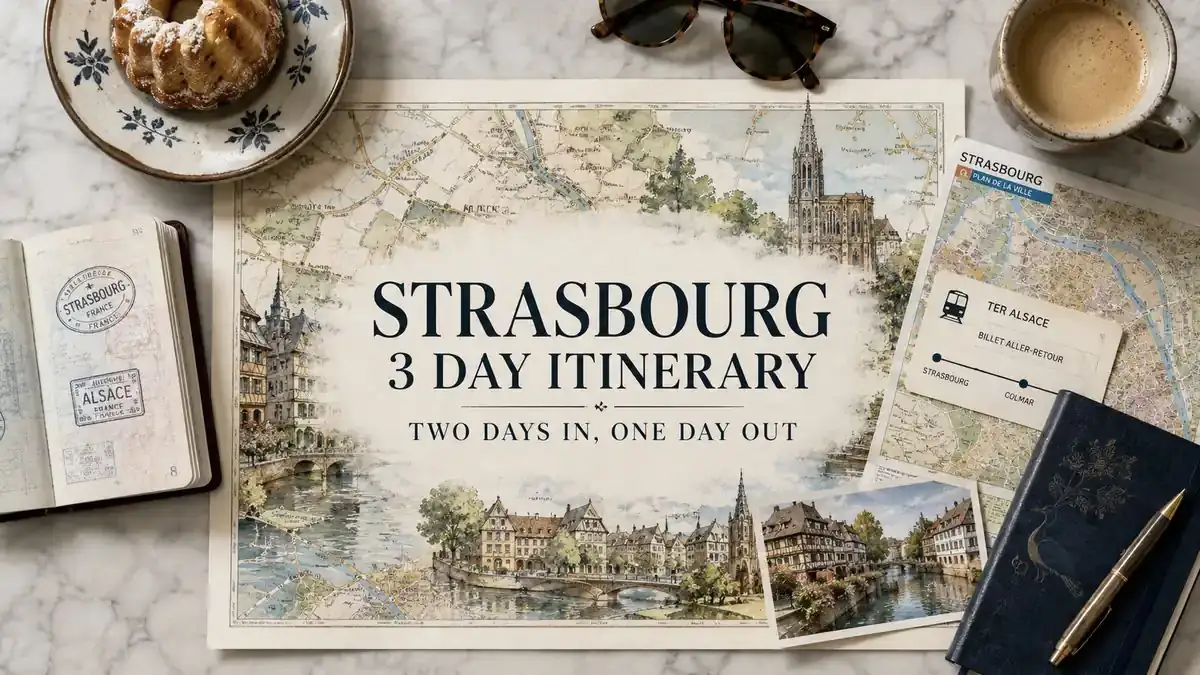
Strasbourg fits comfortably into two days. That is the awkward fact sitting underneath every three-day search: the city itself does not need the third day, so the real question three days asks is what the third day is for.
Most itineraries answer it with a list. Four towns, a paragraph each, no criterion for choosing between them — or they never leave the city at all and pad the third day with a second pass through the same streets. Both hand the decision straight back to you.
This route resolves it with a rule. Days 1 and 2 follow the shape the two-day route already sets, and the depth goes where the planning actually breaks down: the day out. The rule is about travel time, not about which town photographs best, and it settles the shape of the day before it settles the destination.
Quick Answer
Spend two days in Strasbourg itself and take the third out and back by train to one Alsatian town. Travel time decides the day’s shape: an under-an-hour town is a half-day that keeps the last Strasbourg evening. First visits default to one close town; Colmar only if Day 1 left you wanting more half-timbering.
Trust Layer
Tripstou itinerary guide for travelers planning a route. Covers pacing, stop count, stop order, base logic, and trip length.
Produced with AI assistance and reviewed by Alex Perrut, working in tourism since 2015, for the Tripstou editorial team. See our editorial process for details.
Last factual review: August 15, 2026.
Official sources consulted: France.fr, Atout France.
Key Takeaways
- Two days cover Strasbourg itself; the third day is worth more on a train out than on repeat streets.
- Travel time decides the shape of Day 3: inside an hour is a half-day, ninety minutes takes everything.
- Colmar repeats the Grande Île’s half-timbering, so it returns less if Day 1 already satisfied that appetite.
- The smaller Alsatian towns buy quiet, not scale — the right trade when Days 1 and 2 ran full.
- Freiburg is the only real change of register, and the only option that costs the whole day and the evening.
- Keep one base for all three nights, travel by train, and never attempt two towns in one day.
Table of Contents
Three Days in Strasbourg: Two for the City, One to Leave It
Three days is enough for Strasbourg, and the third day belongs outside the city. Two days cover the historic core and the Neustadt without rushing. A third day spent walking the same streets again returns less than a train ride to one nearby town and back. The extra day changes what the trip is.
Strasbourg is compact enough for that arithmetic to hold: the historic core sits on a river-ringed island small enough to cross on foot, so two days work through it at a human pace and leave the third genuinely free. Whether three nights is the right number for your dates, and which season you are walking into, is settled on how many days Strasbourg needs.
The Three-Day Route at a Glance
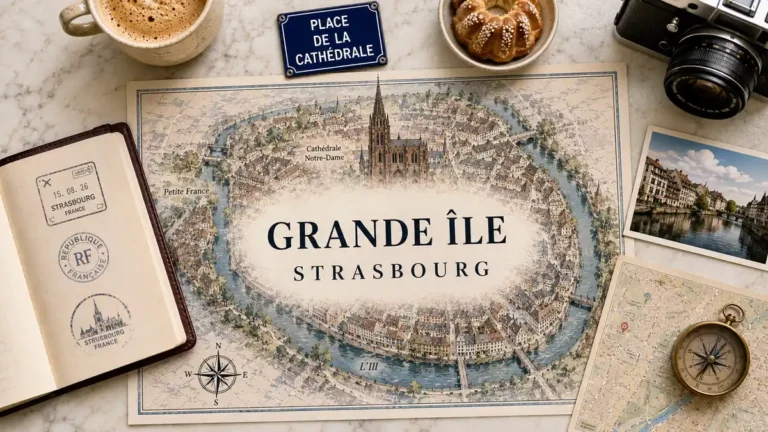
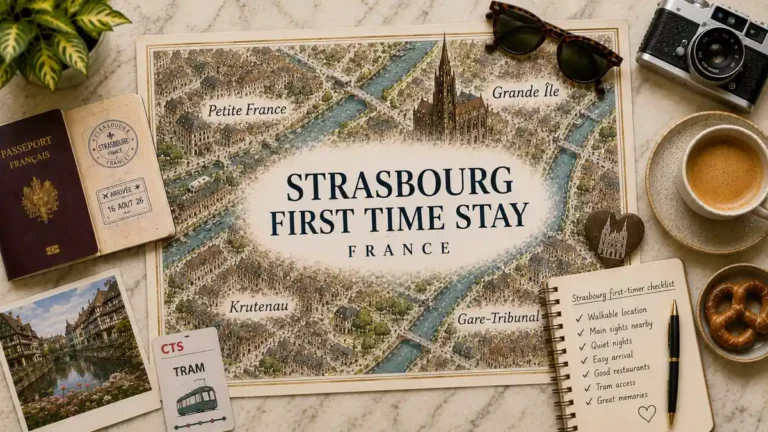
The route runs two days in and one day out. Day 1 is the Grande Île, the river-ringed UNESCO-listed core. Day 2 crosses into the Neustadt and the European quarter, with green space and one museum slot. Day 3 leaves by train for one town and returns for the evening.
- Day 1: Grande Île — the historic core on foot.
- Day 2: Neustadt and European quarter — the city’s other half.
- Day 3: one town out and back — change of pace, evening home.
The shape stays fixed whatever you spend on it: three nights in one place, one return train ride, no change of base. What that adds up to is worked out on what three days in Strasbourg costs.
Days 1 and 2 Follow the Two-Day Route
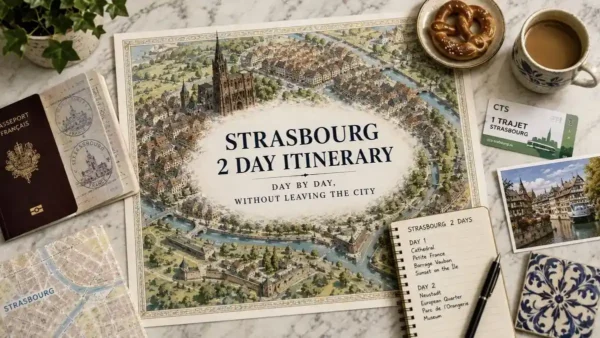
Days 1 and 2 are the two-day Strasbourg route, unchanged. Day 1 works the Grande Île from the cathedral square west into Petite France. Day 2 crosses to the Neustadt, the European quarter and the Parc de l’Orangerie, with one museum as the indoor slot. The stop-by-stop version already exists.
That order holds for one reason: the island is the orientation day, and the wide boulevards of the Neustadt read differently once you have walked the tight lanes first. Sending you outward on Day 2 and out of the city on Day 3 keeps the trip expanding. The full sequence, stop by stop, lives on the 2-day Strasbourg itinerary, which is why the recap above stays short. If it is your first time in the city, the first-visit Strasbourg tips cover the habits that make either version run smoother.
Day 3: Travel Time Decides the Day, Not the Destination
Travel time decides Day 3 before the destination does. Anything inside an hour each way is a half-day: out in the morning, back with the last Strasbourg evening intact. Ninety minutes each way is not a half-day at any pace — it takes the whole day and the evening with it.
For a first visit that ran Days 1 and 2 as the two-day route, the default is one under-an-hour town as a half-day, with the evening kept in Strasbourg. That last evening is not filler. It is the only unhurried block the trip has, and a winstub table is easier to hold when you are not watching a return departure. Every option below is a direct train ride, no car involved.
Picking Day 3 off a list of names is what leaves travelers with four options and no decision. Choose the band first — inside an hour, or an hour and a half — and the list collapses to something you can actually settle in a minute.
Is Colmar Worth It After a Day on the Grande Île?
Colmar is worth it as a half-day, and only if Day 1 left you wanting more of that particular look. It is the default choice for defensible reasons: roughly half an hour away by train, with services running frequently through the day, and it carries the most familiar name on the list.
It is also the one destination that repeats what you have already seen. Colmar is half-timbering and water again — the same visual register as the Grande Île, on a smaller and busier scale. Travelers who spent Day 1 photographing Petite France often find it returns less than its reputation, because the appetite it satisfies was fed forty-eight hours earlier. Travelers who felt the island ended too soon get precisely what they were after.
Either way, it is a half-day. The centre is small, and the extra hours buy repetition instead of discovery.
Sélestat, Obernai and Wissembourg Buy Quiet, Not Scale
Sélestat, Obernai and Wissembourg are the right Day 3 when the point is pace. All three sit inside an hour by train, all three are smaller than Colmar, and all three come with fewer people to work around. There is less to see, and that is the feature.
A half-day in a quiet Alsatian town ends with you sitting down somewhere instead of queueing for something. Pick one of these when Days 1 and 2 ran full and the trip needs a slower gear before the last evening — they reward walking without a plan, which the bigger names do not.
Freiburg Is the Only True Change of Register
Freiburg is the only Day 3 option that stops feeling like more of Alsace. It sits across the Rhine in Germany, around an hour and a half away by train, and the switch of country, language and streetscape is the entire reason to go. Nothing else on the list changes the register.
It is also the only option that costs the full day. Ninety minutes each way removes the half-day structure and takes the last Strasbourg evening with it — you return for the night, and the evening is already gone. Reserve Freiburg for travelers who want the German side specifically, or who are continuing east afterwards and want a first look at it. On a first visit built around Strasbourg, it is the expensive choice measured in time.
What Day 3 Should Not Attempt
Two towns in one day is the standard way Day 3 fails. The travel stacks up — out, across, back — and neither place gets the unbroken stretch that made it worth the trip in the first place.
- Two destinations in one day: the connections eat exactly what you came for.
- A ninety-minute town treated as a half-day: the evening goes anyway, so plan for its loss.
- A slow start on a close town: the half-day quietly shrinks into a rushed afternoon.
The day is built to return. Anything that puts the return in doubt has already broken the rule.
Do You Need a Car for Day Trips from Strasbourg?
No. Every destination on this page is reached by direct train from Strasbourg, and the day works best built as a rail out-and-back from a base that never moves. A car adds parking, a driving stretch and no useful extra reach on a route this short. The station does the job.
Build the day around the return. A mid-morning departure gives a close town its half-day and still puts you back in Strasbourg with the evening ahead of you. Leave much earlier and you arrive before the town has opened up; leave much later and the half-day becomes an hour on the ground. How the trains and trams fit together is covered in getting around Strasbourg.
The base does not move on a three-day trip. Three nights in one room, one set of bags, no check-out on the morning you least want one — relocating for a single night costs more time than any day trip saves. Which part of the city that base sits in does change the walk home at the end of Day 3, and where to base yourself in Strasbourg works through those trade-offs.
Hotels and places to stay
Compare hotels, apartments and stays for your dates in one search.
Search hotels and stays on hotels.com →
Tripstou may earn a commission if you book through this link, at no extra cost to you.
How to Adapt This Route to Two or Four Days
The route flexes at one joint: the day out of the city. Cut to two days and the trip becomes the city itself, whole and unrushed. Stretch to four and you gain a second out-and-back — the point where Freiburg finally costs the route nothing, because another day sits behind it.
- Cut to two days: the day out goes first, and the city days stay whole. Compressing Days 1 and 2 to squeeze in a town is how a short trip ends up doing neither properly.
- Stretch to four days: add a second out-and-back, not a second base. One close town as a half-day, one full day for Freiburg, and the city days untouched.
- Never: spread the same three days thinner across four. Extra time buys another leg out; it does not buy a slower version of what you already have.
One route, two flex rules. The structure survives the change of length because only the outward leg is negotiable.
Frequently Asked Questions
Can you visit Colmar and Freiburg on the same day from Strasbourg?
No. The two sit in opposite travel bands, so pairing them stacks a half-day town onto a full-day one and the connections swallow both. You would see a station, a main street and a return departure. Pick the band first, then one destination, and give it the whole slot.
Is Freiburg worth a day trip from Strasbourg?
Yes for a second visit or a rail trip continuing east, and rarely for a first one. It is the only Day 3 that changes country, language and streetscape, and the only one that spends the whole day plus the last Strasbourg evening to do it. Weigh that before you commit.
Do you need to change hotels for a day trip from Strasbourg?
No. One room for all three nights is the point: you leave in the morning with a day bag, not luggage, and come back to a room that is still yours. Moving base for one night adds a check-out to a morning that already has a train in it, and buys nothing.
Do day trips from Strasbourg still work during the Christmas market season?
Yes, but the close towns are busier than usual and the pace drags. The same season that fills Strasbourg fills its neighbours, so a half-day that would otherwise feel roomy feels compressed. Go out early in the day, keep the destination single, and expect the return train to be full.
How early should you leave Strasbourg to be back for dinner?
Mid-morning, for a town inside the travel hour — but set it by working backwards from the evening, not forwards from breakfast. Fix the return you want to be home for, subtract the travel hour, and the departure sets itself. Plan outward instead and you lose the evening you were protecting.
Is two days or three days better in Strasbourg?
They answer different questions. Two days is the city, complete and unhurried; three days is the city plus the region it sits in, which is a different kind of trip, not a longer version of the same one. Choose three if you want a day outside the city at all, and two if the city is the point.
Related Guides
- Strasbourg travel guide — how many days the city needs, seasons, and the wider planning picture.
- 2 days in Strasbourg itinerary — Days 1 and 2 stop by stop, in full.
- Getting around Strasbourg — trams, trains and how the network handles a day out.
- Where to stay in Strasbourg — the area trade-offs behind the base that never moves.
- Strasbourg trip cost — what three days adds up to, category by category.
- Strasbourg travel tips — first-visit habits worth knowing before Day 1.
Did this guide save you time or money? Tripstou is independent and reader-funded — if you'd like to give something back, you can support the site with a crypto contribution of any size.