Two days in Strasbourg is a sequencing problem, not a shortlist problem. The city hands you two very different halves: a river-ringed island core you cross on foot, and a newer, greener city spread out beyond it. Order them badly and you spend the second day re-walking the first, or you burn fresh morning legs on the wrong ground. Order them well and 48 hours feels generous.
This page gives you one committed route, in order, with the reasoning behind each block — why the island comes first, why the second day changes register, and what a half-day here can actually hold. It also gives you the flex rules: what to cut when a slot closes, what shifts when crowds arrive, and how the route bends without breaking. Both days stay inside Strasbourg.
Quick Answer
Day 1 walks the Grande Île end to end; Day 2 moves off the island into the newer, greener city. Almost everything runs on foot, with one short tram hop covering the off-island gap. The route suits first-timers on a short city break: the centre unhurried, plus a museum and a winstub dinner.
Trust Layer
Tripstou itinerary guide for travelers planning a route. Covers pacing, stop count, stop order, base logic, and trip length.
Produced with AI assistance and reviewed by Alex Perrut, working in tourism since 2015, for the Tripstou editorial team. See our editorial process for details.
Last factual review: August 15, 2026.
Official sources consulted: France.fr, Atout France.
Key Takeaways
- Give the whole first day to the Grande Île; the island rewards fresh legs and the best late light.
- Day 2 earns its place by changing register — off the island, into the newer and greener city.
- Confirm museum closing days for your dates before fixing day order; a collision simply swaps the two days.
- Both days stay inside Strasbourg; the third day is the one that leaves the city.
- Cut the museum slot first when time shrinks, and never cut the western end of Day 1.
- In market season the route holds but slows — start earlier, and book the winstub dinner ahead.
Table of Contents
Is Two Days Enough in Strasbourg?
Two days is enough for all of Strasbourg-the-city, taken unhurried. Forty-eight hours buys the historic centre at walking pace, one museum, and a proper winstub dinner without rushing a slot. The core is compact, and the second half-day changes scene entirely instead of repeating the first.
The honest arithmetic is measured in anchor slots. Each day holds one strong morning block and one afternoon-into-evening block, with a long meal and a sit-down somewhere between them. Push past that and the island stops being pleasant to walk on, which is the reason people came in the first place.
The route is built for first-timers on a short city break — people who want the centre properly, without a checklist to clear. Repeat visitors and travelers with one specific interest will find the same 48 hours stretches further, because they can skip the orientation that the first block does for you. The list is never the constraint.
Two days does not leave Strasbourg half-seen. The famous ground is genuinely small, and the second day covers the part of the city most short trips miss entirely. If you are still weighing the trip itself — season, base, how long to stay — the full Strasbourg guide resolves those decisions before the route matters. What 48 hours costs sits in the Strasbourg trip cost breakdown; this page deals only in time.
Daylight on the island is the real constraint here. The western end is at its best late in the day, so every extra you wedge into Day 1’s morning is paid for at the end of Day 1, where the walk is worth the most.
The 2-Day Strasbourg Route at a Glance
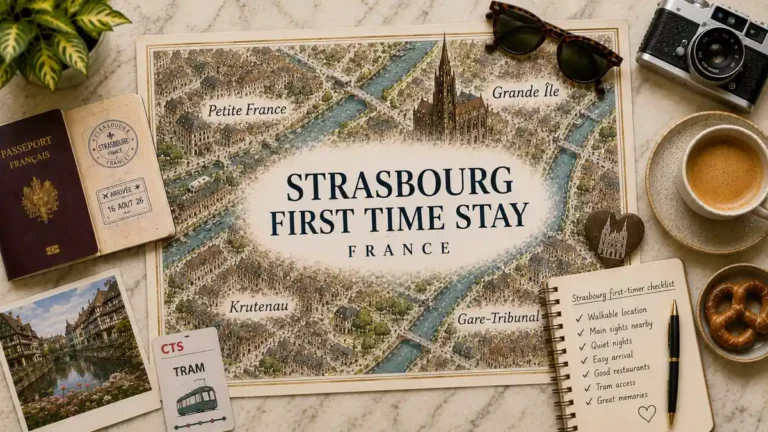
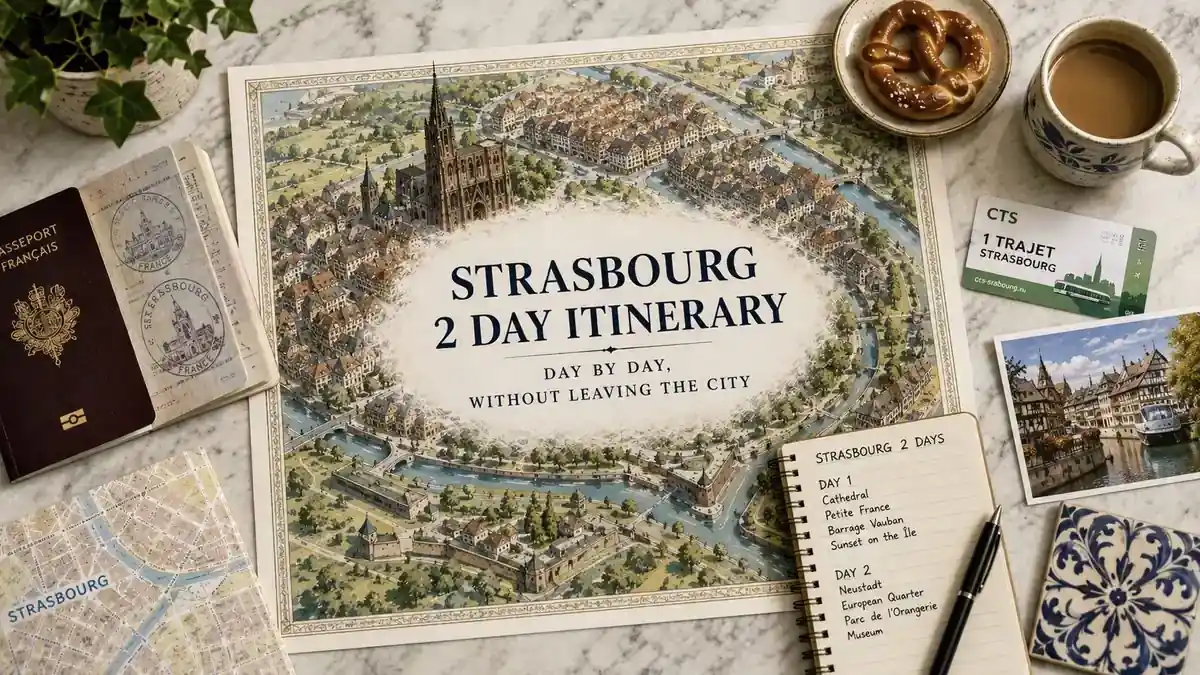
Day 1 belongs to the Grande Île, cathedral to Barrage Vauban; Day 2 leaves the island entirely. That order holds because the island rewards fresh legs and early light, while the off-island half absorbs tired feet, weather, and an indoor slot far better.
- Day 1, morning: the cathedral end of the island — the Gothic anchor first.
- Day 1, afternoon and evening: Petite France, the covered bridges, the Barrage Vauban terrace — the western end at its best, then a winstub dinner.
- Day 2, morning: Neustadt and the European quarter — the register change.
- Day 2, afternoon and evening: Parc de l’Orangerie and the museum slot — a green and indoor close.
Day 1 needs no transport at all. The Grande Île is ringed by water and crossed on foot, so the first day is a single walk with stops in it. Day 2 is where a tram hop earns its place, covering the gap out to the newer quarters and the park; mode is all this route needs to know, and the Strasbourg transport guide covers the network itself.
Where you sleep decides whether that stays true. A base in or immediately beside the historic centre keeps both days on foot, which is the whole design; anything further out adds a commute to each morning and quietly shortens both half-days. The where to stay in Strasbourg guide resolves that choice properly.
One variable can flip the day order, so settle it before you fix anything else: confirm the museums’ closing day for your own dates, and if it collides with Day 2, swap the two days whole. That swap costs you nothing here, and the design is deliberate — the museum slot sits at the end of a day instead of the middle of one, and neither day depends on the other running first.
Hotels and places to stay
Compare hotels, apartments and stays for your dates in one search.
Search hotels and stays on hotels.com →
Tripstou may earn a commission if you book through this link, at no extra cost to you.
Day 1: The Grande Île from the Cathedral to Petite France
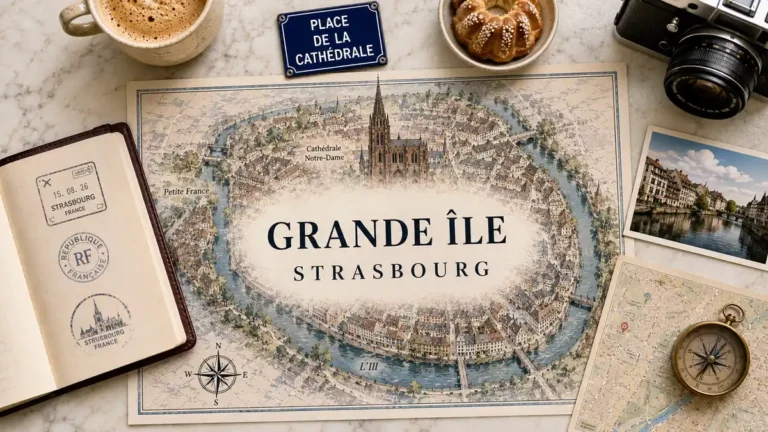
Day 1 starts at the cathedral and works west across the island to Petite France and the Barrage Vauban. The Grande Île is small enough to cross on foot, so the day is a single continuous walk westward, with each anchor falling on the line and the evening landing at the western end.
You spend the whole day on the island, and you sleep beside it. The Grande Île is the river-ringed historic core, UNESCO-listed as a complete centre, and the entire first day fits inside that ring without a single connection to plan.
The cathedral goes first because it sets the scale for everything after it. Pink Vosges sandstone, Gothic, one asymmetric spire where a matching second was intended — it is the anchor that makes the rest of the island legible. Starting there also puts you at the eastern side of the island with the whole day pointing west.
From the cathedral square the walk drifts west through the island’s streets toward Petite France. This is where the water takes over: half-timbered houses along the channels, the covered bridges, and the Barrage Vauban terrace above them, which gathers the western end into one view and gives the afternoon somewhere to arrive. Two or three anchors is the correct count for a first day here, and this is them.
The evening stays on or beside the island. A winstub dinner is the natural close because it is a short walk from where the afternoon ends, and because the island is at its quietest and best-lit once the day-walkers thin out.
Nothing on Day 1 is timed. Every anchor on it is a place you arrive at, never an appointment you keep — which is why starting early buys you pace instead of pressure, and why a slow morning never cascades into a broken afternoon.
How Much Time Do the Cathedral and Petite France Need?
Each of them is a slot, not a half-day. The cathedral is a stand-and-look anchor: you arrive, you go in, you circle the square, and you move on when you are ready. Petite France sets its own length — it is a walk you slow down for, so how long it takes depends entirely on how often you stop on the bridges.
Together they fill one comfortable day with room left for a long lunch and a drink before dinner. The failure mode is treating either one as a half-day in its own right, then reaching the western end with nothing left in your legs and the best light already going.
Day 2: Off the Island into the Newer, Greener City
Day 2 leaves the island for the newer city — a different century, a different scale, a different pace. It runs Neustadt and the European quarter in the morning, then Parc de l’Orangerie and one museum slot to close. The point is a change of register, never a second lap of Day 1.
Still Strasbourg, just past the water. Neustadt begins a short walk off the island’s eastern edge, and the tram covers the rest of the day’s gaps, which is the only mechanical difference between the two days.
Neustadt goes first because it is the hinge of the whole route. Broad avenues and imperial-era scale, built wide where the island was built tight — walking it straight after a day of half-timbering is what makes the contrast land. Reversed, it would simply flatten the island by comparison.
The European quarter follows because it extends the same idea to its far end: institutions, glass, open water and open space — a city that plainly kept growing after the postcard was taken. It is a walk-through rather than a study, and it earns its slot by finishing the register change Neustadt started.
Parc de l’Orangerie is the afternoon’s release valve. It is green, flat and unhurried, and it is the one place on this route where sitting down for an hour is the correct use of the time. Two days of island cobbles make that more valuable than it sounds on paper.
The museum slot closes the day indoors. One museum is the right number for 48 hours — enough to give the trip a subject, few enough that no morning gets rearranged around a door. Placed at the end of Day 2, it becomes the block you can shorten, extend or move without touching anything else.
Day 2 is the day that absorbs whatever goes wrong. Rain, tired legs, a late start, a closed door — all of it lands more softly off the island, and that is precisely why the island is never the day you leave to chance.
How Do Christmas Market Crowds Change This Route?
In market season the island fills, and the same route needs earlier starts and slower slot arithmetic. The order itself holds; density is what changes. You walk the identical route and simply move through it more slowly, reaching each anchor before the crowd settles into it.
The island half-day thickens first. The streets around the cathedral and the approaches to Petite France carry the heaviest foot traffic, so a westward walk that flows easily at other times becomes a shuffle in stretches. Build margin into Day 1 and take fewer things out of it.
The off-island day becomes the pressure valve. Neustadt, the European quarter and the park stay comparatively open, so Day 2 is where you recover the pace Day 1 gives up. Evenings crowd first.
The scarce resource in market season is a dinner table. Book the winstub ahead and the rest of the route absorbs the crowds on its own — the walking adapts, the seating does not.
How to Adapt This Route with More or Fewer Days
With one day, keep the island and cut everything off it; with three, the third day leaves the city. The route is built to shrink and grow in whole half-days, so you add or remove blocks without rebuilding the sequence underneath them.
Cut first, when time shrinks:
- The museum slot goes first — it is the one indoor block the city reads perfectly well without.
- The European quarter goes second — Neustadt already delivers the register change in a shorter walk.
- Parc de l’Orangerie goes third — a park is the easiest thing to trade back for daylight on the island.
- Never cut the western end of Day 1. The covered bridges and the Barrage Vauban terrace are what the whole island walk is aiming at.
Add first, when time grows:
- A spare half-day goes back into Day 1’s western end, where the standard route is most compressed.
- The next addition is depth in place — a second museum, or the cathedral end walked again at a different hour.
- A full extra day is the only addition that changes the trip’s shape, and it changes it by leaving the city.
Cut whole blocks. The common one-day mistake is dropping Petite France’s late afternoon because it sits last on the list, when it is the exact block the rest of the island walk was built to reach.
This 2-day route stays inside the city. Both days are Strasbourg — no day trip, no village, no wine route, no Colmar, no crossing the Rhine — and the third day is the day you leave the city, which is where the 3-day Strasbourg itinerary takes over. Its first move is outward, on the premise that a third pass through the same centre is worth less than a train out of it.
Whatever length you land on, a handful of first-visit habits make a walking-heavy city read easier; the Strasbourg travel tips page collects them in one place.
Frequently Asked Questions
Do You Need to Time the Astronomical Clock into Your Day?
No — build Day 1 so the clock is never load-bearing. It runs on a fixed daily display and closes at least one day a week, so a route pinned to it breaks easily. Confirm the display time and the closed day with the cathedral, then treat seeing it as a bonus.
Are Strasbourg’s Museums Open Every Day of the Week?
No. Strasbourg’s municipal museums share a single weekly closing day, and one major Alsatian collection is shut for a long renovation, so the choice of museum matters as much as the day. Check the city’s official museums page for your own dates before you fix which day is which.
Does a Late Evening Arrival Still Leave You Two Full Days?
Yes. This route assumes two full days on the ground, and an evening arrival costs none of them as long as the first morning starts on the island. Use the arrival night for dinner and a short walk, not for an anchor, and keep Day 1’s order exactly as written.
How Much Walking Is a Two-Day Strasbourg Itinerary?
Almost all of it is walked, on flat ground. Day 1 runs end to end on foot, because the Grande Île crosses easily. Day 2 adds one tram hop and then park-scale strolling. The load is volume, not gradient, so cobbles and shoes matter more than fitness.
Is a Boat Trip on the Ill Worth a Slot in Two Days?
Yes, if you treat it as a slot and not a half-day. A boat trip re-sees the island’s edges from the water, off your feet, which is worth more on a walking-heavy trip than it sounds. Fit it into Day 1’s middle, and drop it the moment the day feels tight.
Related Guides
- Full Strasbourg guide — the wider city decision: when to go, how long to stay, and what the trip is worth.
- 3-day Strasbourg itinerary — the same city core plus the third day that leaves it.
- Where to stay in Strasbourg — which areas keep a short trip on foot, and who each one suits.
- Getting around Strasbourg — the network, the modes, and how much of the city you can skip transport for.
- Strasbourg trip cost — what a short city break actually costs, broken down by category.
- Strasbourg travel tips — the practical habits worth knowing before a first visit.
Did this guide save you time or money? Tripstou is independent and reader-funded — if you'd like to give something back, you can support the site with a crypto contribution of any size.