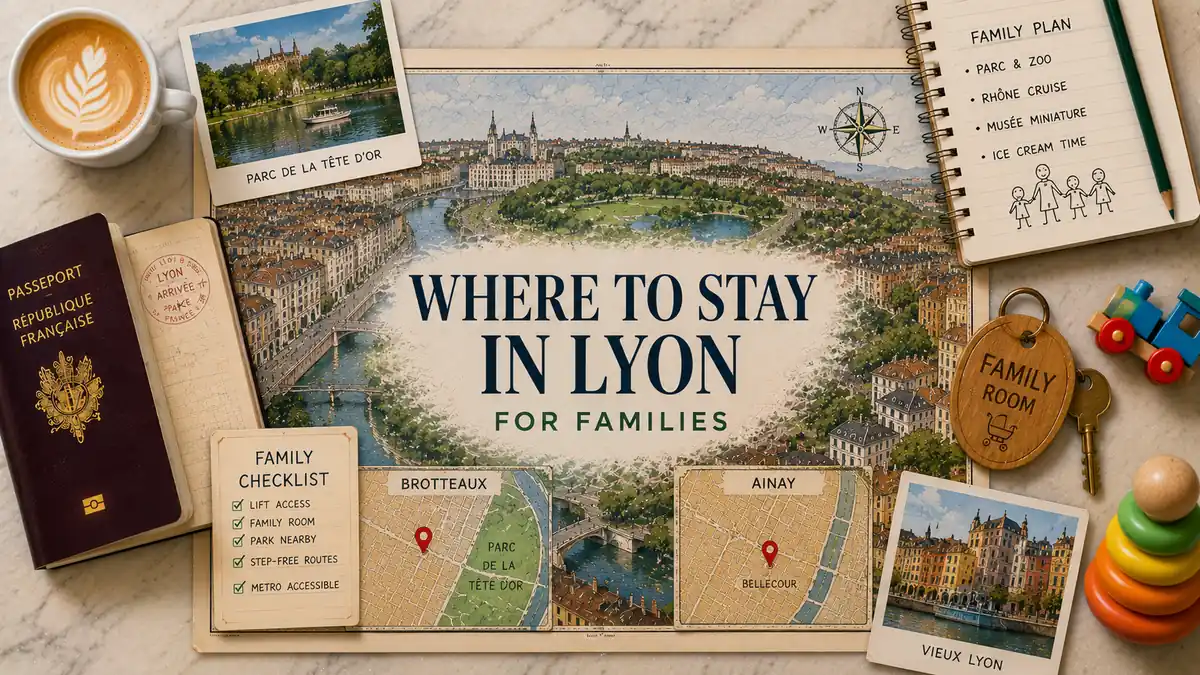
You are on a booking screen with children in the party, and the filters on offer — review score, distance to the centre, breakfast included — do not measure the thing that will decide your trip. What decides it is the midday return: the moment one child is finished walking, the pushchair is loaded with coats, and you need to get back to the room without the day collapsing. That moment happens every day of a family trip, and the address you booked weeks earlier either absorbs it or does not.
This page judges five Lyon areas on family-only variables: the floor and whether there is a lift, whether one booking sleeps everyone, the surface and gradient between your door and step-free transport, and how far the door is from free open space where children can be let out. It gives one verdict with the condition attached, and a routing by child age and trip length.
Quick Answer
Brotteaux is Lyon’s best family base — but only on the Tête d’Or side of the 6th. With children, the building decides more than the quarter: the floor, the lift, and one booking that sleeps everyone. For short trips with school-age kids, flat and central Ainay on the southern Presqu’île wins instead.
Trust Layer
Tripstou stay guide for travelers choosing where to base. Covers area atmosphere, budget, convenience, noise, and traveler fit.
Produced with AI assistance and reviewed by Alex Perrut, working in tourism since 2015, for the Tripstou editorial team. See our editorial process for details.
Last factual review: August 14, 2026.
Official sources consulted: France.fr, Atout France.
Key Takeaways
- Book Brotteaux on the Tête d’Or side of the 6th; the same arrondissement stretches to the Rhône and works far less well.
- With children the building decides the trip: ask about the floor and the lift before you compare anything else.
- One booking that sleeps everyone removes most Lyon inventory from your search, so confirm bed configuration with the property directly.
- For two or three nights with school-age children, flat central Ainay beats park proximity because nobody crosses a river before breakfast.
- Surface is the real distance in Lyon: cobbled Vieux Lyon and the Croix-Rousse slopes cost far more on the return leg.
- Parc de la Tête d’Or is free to enter, flat and paved, which makes it a genuine booking variable.
Table of Contents
In Lyon with Kids, the Building Decides More Than the Quarter
With children, the right Lyon base is a building that passes the midday return, not a well-rated quarter. Four variables decide it: the floor and lift, whether one booking sleeps everyone, the surface between your door and step-free transport, and the distance from the door to free open space.
The floor and the lift are the first filter, and they are the hardest thing to fix after you have paid. A third-floor room reached by stairs is a different holiday from the same room with a lift, because with children you will go up and down it four or five times a day instead of twice. Older Lyon buildings across Vieux Lyon, the Presqu’île and the Croix-Rousse slopes were not built with lifts, and many still have none. A listing rarely tells you reliably. Ask before you book.
One booking that sleeps everyone is the second filter, and it quietly removes most of the inventory from your search. A family of four is a different search from two adults: standard doubles do not take a third and fourth bed, and the properties that can take them do it in different ways — a family room, two connecting rooms, or an apartment. Configurations, extra-bed rules and child-age policies vary property by property and change without notice, so treat every one of them as a question to put to the property directly.
The distance from your door to step-free transport is measured in surface and gradient. Lyon’s ground changes fast — flat along the water, cobbled in the old town, steep on the two hills — so two addresses the same distance from the centre can hand you completely different walks with a loaded pushchair. A level, paved stretch is short. The same stretch over cobbles or uphill is not, and you will discover which one you booked on the first afternoon.
The fourth variable is how close the door sits to unticketed open space. Children need somewhere to be released that costs nothing and needs no plan — a park, a car-free river bank, a square with room to run. A base that puts that inside a walk you would still do on a bad afternoon does more for the trip than any amenity list on the booking page.
The midday return is what separates the two kinds of family base in Lyon. Ask what happens at 15:00 when one child is finished: if the honest answer involves cobbles, a slope and three flights of stairs, no amount of quarter charm rescues it.
Which Areas of Lyon Are Flat and Pushchair-Friendly?
The Presqu’île and both river banks are flat; Vieux Lyon is cobbled, and the hills punish pushchairs. Parc de la Tête d’Or is flat and paved throughout. Those three facts eliminate more Lyon addresses for families than anything else you can check before booking.
Flat ground in Lyon runs along the water and down the peninsula. The Presqu’île between the Rhône and the Saône is level from end to end, the banks on both rivers are car-free and flat, and Parc de la Tête d’Or is paved and level throughout. On this ground a pushchair rolls one-handed, a scooter works, and a tired six-year-old can be talked into one more block.
The hard ground sits in two places: cobbles and climbs. Vieux Lyon’s streets are cobbled, which turns a loaded pushchair into a two-handed job and wakes a sleeping child. The Croix-Rousse slopes and the Fourvière hill are climbs in the literal sense. The funiculars are the west-bank answer, running up from Vieux Lyon to the Fourvière and Saint-Just hilltops; they do not serve the Croix-Rousse climb, which stays a walk.
Cobbles cost you far more coming back than going out. Outbound you are fresh and the pushchair is empty; at the end of the afternoon it holds a sleeping child, two coats and the shopping, and every joint in the paving is felt. Judge a surface on the return leg.
| Area | Surface underfoot | Pushchair verdict | Free open space nearby | Best trip length |
|---|---|---|---|---|
| Brotteaux / Tête d’Or (6th) | Flat, wide pavements throughout | Easy in every direction | Parc de la Tête d’Or at the edge | Three nights and upward |
| Ainay / southern Presqu’île (2nd) | Flat peninsula, level pavements | Easy, though pavements get busy | Squares and the car-free Rhône bank | Two to three nights |
| Croix-Rousse plateau (4th) | Flat on top, steep approach below | Fine up top, hard in between | Plateau squares and the wide boulevard | A week or more |
| Confluence (southern 2nd) | Modern paving, level and wide throughout | The easiest surfaces in the city | Open quays at the rivers’ meeting point | Three to four nights |
| Vieux Lyon (5th) | Cobbled streets, hill rising behind | Hard work in both directions | Saône bank, one bridge away | Two nights, eyes open |
Read the table as an elimination scan, then read the two or three blocks that survive it. Surface is the real distance in this city.
Brotteaux and Tête d’Or: The Best Family Base — If You Stay Near the Park
Brotteaux is Lyon’s best family base, provided the address sits on the park side of the 6th. The 6th runs from the Rhône bank across Brotteaux to the park, so how close your door sits to that free open space is what actually varies. Book the park end.
Day to day, Brotteaux is residential in the way families need. The streets are wide and flat, the shopfronts are bakeries, pharmacies and greengrocers instead of souvenir windows, and the pavements have room for a pushchair to pass another pushchair. Evenings are calm. That calm is precisely what makes the quarter unremarkable to a couple and close to ideal with a five-year-old asleep by eight.
The park is the reason the verdict holds. Parc de la Tête d’Or is one of France’s largest urban parks, entry is free — including the zoo and the botanical garden — and the ground is flat and paved. That combination is worth booking around: unticketed, level open space you can walk into without a plan, leave the moment it stops working, and walk into again the next morning.
Convenience is the honest tradeoff. Brotteaux sits across the Rhône from the Presqu’île, so the older city is a river crossing away, and the crossing is flat but it is real. This matters less with children than it sounds, because a family makes fewer trips per day than a childless traveler, and makes them around a nap. On spend, the 6th reads mid-range for Lyon, with high-end pockets along the park edge. Brotteaux is also the family line in the hub’s roster, and this page confirms it; the all-travelers view of how every Lyon quarter compares lives in our full guide to where to stay in Lyon.
The park side of the 6th earns its keep on the days you do nothing — the bad-weather morning, the post-arrival afternoon — when free open space at the end of the street quietly replaces a paid activity nobody had the energy to attend.
Best for: families with young children staying three nights or more who want free open space at the end of the street.
Ainay and the Southern Presqu’île Win Short Trips with School-Age Kids
On a short trip with school-age children, flat central Ainay beats the park side of town. Two or three nights leave no room for a river crossing before every outing, and Ainay puts the peninsula’s level pavements, food and squares directly outside the door.
Ainay is the quiet southern end of the Presqu’île: a residential grid around its old church, small squares, everyday shops, and streets that go to bed while the northern half of the peninsula is still out. It is central without being the middle of the crowd, which is an unusual combination and the whole reason it works with children.
What you buy in Ainay is convenience, and it arrives as flatness. The peninsula is level from end to end, so every outing starts as a walk and nothing needs a plan; the car-free Rhône bank is a straight, level release valve when a child needs to run; and the major squares sit inside the same flat grid.
The fit narrows to school-age children, and the reason is legs. A child who can walk most of a day converts flat centrality into real value, covering the city on foot and skipping the crossings entirely. A toddler in a pushchair gets far less from it, because you are wheeling either way, and gains more from a door beside the park. On spend, this stretch sits mid-range, rising toward high-end around the main squares. How the peninsula behaves block by block — where it shops, where it eats, where it gets loud — is mapped in the Presqu’île guide, which routes families to Ainay for the same reasons.
Best for: two- or three-night trips with school-age children who will walk the city on foot.
The Croix-Rousse Plateau Suits Longer, Self-Catering Family Stays
The Croix-Rousse plateau works for families who stay a week and self-cater, and badly for two-day sprints. Once you are up top the plateau is flat, with markets, ordinary shops and a village rhythm. What sits between the plateau and the centre is a gradient, and with children you cross it in both directions.
Life on the plateau is domestic in a way no other Lyon base is. There is a street market, a wide boulevard with room to walk four abreast, small squares, and the kind of everyday shopping that makes cooking for four a normal evening instead of an expedition. Book on the plateau itself. Addresses on the slopes below inherit the gradient without the flat top, which is the worst of both arrangements with a pushchair.
The kitchen is what the plateau is really selling. A week with children involves meals nobody wants to eat out, laundry that has to happen, and mornings that start before any breakfast service. On spend, the plateau reads budget to mid-range, and apartment-style stays make up a large share of what is available up there.
The gradient never negotiates, and with children it is the return leg that hurts. Families who make the plateau work treat it as home and the centre as an outing — one descent, one return, and the rest of the day spent up top. Where the plateau ends and the slopes begin, and how each behaves day to day, is covered in the Croix-Rousse guide.
Length of stay is what turns that gradient from a cost into a routine. On two nights you pay it as pure friction; over a week you learn the one route you actually want to walk up, and it becomes the shape of the day.
Best for: week-long stays with a kitchen, where the trip is lived slowly instead of sprinted.
Confluence Is the Step-Free Modern Pick — With Quiet Evenings as the Tradeoff
Confluence gives families modern buildings and step-free streets, and charges for it with quiet evenings and a peripheral position. The district was built recently on flat ground at the tip of the peninsula, so the pavements are wide, the ground is even, and the built form is level by design.
Day to day, Confluence is the easiest part of Lyon to move a loaded pushchair through. Nothing here fights the wheels. The open quays where the two rivers meet give children space to run without a ticket, and a covered cluster of shops, cinema and eating makes a wet afternoon solvable without any planning — which is worth considerably more with small children than it sounds on paper.
One caution about the phrase step-free: here it describes the streets and the district’s layout, not any particular address. Whether your building has a lift, and which floor your room sits on, remain questions to put to the property before you pay.
Confluence charges for that ease after dark, and in where it sits. The district occupies the southern tip, away from the dense old city, and it empties once the shops close, so families hoping to wander out and choose a restaurant will find the choice thin. Reaching the historic quarters means making a trip of it. On spend, the district reads mid-range, with apartment-style stays well represented.
Best for: families who need genuinely level ground — a young toddler, a buggy, or anyone in the party who cannot manage stairs.
Vieux Lyon Works for Families Only in Saint-Paul or Saint-Georges
Vieux Lyon is a mixed fit for families, workable only at the Saint-Paul and Saint-Georges ends. The streets are cobbled throughout, the central lanes are walked through all day by visitors, and the buildings are old. Book it for the setting, with your eyes fully open.
With children, Vieux Lyon reduces to its cobbles, and they deserve to be taken literally. Small wheels lose to cobbles. A loaded pushchair becomes a two-handed job, the noise carries up through the frame, and a child who fell asleep on the walk back will not stay asleep. Run the midday return against this quarter before you book, because it ends on cobbles, every day, in both directions.
Saint-Paul at the northern end and Saint-Georges at the southern end are the two workable options. Both are quieter than the middle, both sit closer to the Saône, and both put you one bridge from the flat peninsula. That last point does most of the work: when the cobbles have won for the day, level ground is a single crossing away.
Old buildings also make the floor-and-lift question sharpest here. Nothing about the quarter tells you whether a given address has a lift, and plenty do not, so ask — and ask which floor in the same message. On spend, Vieux Lyon reads mid-range, with high-end rooms in converted historic buildings. The quarter’s streets, its traboules and where its noise concentrates are mapped in the Vieux Lyon guide, and if you are torn between the old town and the peninsula as a base, that head-to-head is settled properly on its own page: Vieux Lyon vs Presqu’île.
Best for: families with walking-age children on a two-night stay who want the Renaissance streets and accept the cobbles.
Other Lyon Areas Worth Knowing for Families
Four more Lyon areas come up in family searches, and each suits one narrow case only. Cité Internationale, Part-Dieu, La Guillotière and the Fourvière hilltop are all bookable and all commonly suggested; none of them earns a full block on this page.
- Cité Internationale. Sits on the park’s northern edge with the Rhône alongside, so free open space genuinely starts at the door. It is a self-contained complex with little ordinary neighbourhood around it, which makes evenings thin and everyday shopping awkward with children in tow.
- Part-Dieu. Works if your trip is built around train arrivals and departures, with a large covered shopping centre beside the station. It is a business district with a hard commercial character and no meaningful open space, and nothing about it invites a family walk after dinner.
- La Guillotière. Suits families on a tighter budget who want to be one bridge from the centre, with a broad spread of everyday food shopping. The streets are busy and mixed in character, and the ground becomes less family-forgiving the further you move from the river.
- Fourvière hilltop. Buys quiet and height above the old town, reached by funicular from Vieux Lyon. Living up there with children means every outing begins and ends with a climb or a funicular ride, and day-to-day shopping on the hill is limited.
None of them replaces the five above. Everything outside the base decision — what to do with the days, how they fit together, where a family eats — belongs to the Lyon travel guide instead of to this page.
Apartment or Hotel in Lyon with Children?
The deciding question is whether one booking sleeps everyone, and how many nights the kitchen has to earn. Hotels win on short stays and on service; apartments win from roughly four nights up, when laundry, breakfast at your own table and somewhere to put sleeping children start to compound.
Three configurations solve sleeps-everyone, and each fails differently. A family room puts everyone in one space, which is simple and space-efficient, but the adults’ evening ends when the children’s does. Connecting rooms buy that evening back at a higher price and with real booking risk, because at many properties “connecting” is a request and not a guarantee. An apartment gives you separate rooms, a kitchen and a washing machine, and takes away the front desk, the daily clean and anyone to ask when something goes wrong late at night.
The night an apartment earns its keep is the one where a child goes down early and the adults still have an evening. On a two-night trip that never comes up. From four nights on, it happens every single night.
None of the details below are things a listing answers reliably, and none are stable enough to publish property by property. Put them to the property in writing before you pay:
- Does one booking sleep everyone, or are you being sold two rooms that happen to sit near each other?
- Is there a lift, and which floor is the room on? Ask both together; either answer alone is useless.
- What is the actual bed configuration — real third and fourth beds, or a sofa bed nobody wants to sleep on?
- What are the child-age and extra-bed rules, and do they change the price you were quoted?
- Is a cot available, is it free, and does adding it change which room you are assigned?
- For apartments: is check-in staffed or by keybox, and what happens if your train arrives late with two tired children on it?
Once the decision moves from configuration to actual properties, shortlist from the best boutique hotels in Lyon and run the lift-and-floor questions against every candidate before you compare anything else.
Hotels and places to stay
Compare hotels, apartments and stays for your dates in one search.
Search hotels and stays on hotels.com →
Tripstou may earn a commission if you book through this link, at no extra cost to you.
The Right Lyon Base by Child Age and Trip Length
Match the base to the age doing the walking and the number of nights you have booked. Toddlers push the answer toward open space and level ground; school-age children push it toward flat centrality; teenagers push it toward being where the city actually is. Trip length decides the rest.
Nights change the answer. On two or three the base is somewhere to sleep between outings, and the quality that wins is flat centrality — fewer crossings, shorter returns, less negotiation. From four nights up the base becomes a household, and the qualities that win become open space at the door and a kitchen you will genuinely use.
| Family profile | Short stay, two to three nights | Longer stay, four nights or more | What actually decides it |
|---|---|---|---|
| Toddler in a pushchair | Confluence, for level ground everywhere | Brotteaux, on the park side of the 6th | Surface underfoot and free open space |
| One or two school-age children | Ainay, walk the flat city on foot | Brotteaux, with the park as daily release | Whether legs or crossings cost you more |
| Mixed ages, toddler plus older child | Ainay, with the car-free Rhône bank | Brotteaux, park at one end, bridges at the other | Somewhere free to release the older one |
| Teenagers, no pushchair involved | Ainay or the Presqu’île, city at the door | Croix-Rousse plateau with a kitchen | Independence, food, and space to spread out |
Toddlers and teenagers want opposite things from a Lyon address, and that is exactly why a family carrying both ends up on the peninsula: it is the one base flat enough for the pushchair and central enough for a fifteen-year-old to be let out of sight for an hour.
Vieux Lyon wins no cell in that table, and that is the honest position. It is a setting chosen deliberately by families who want the Renaissance streets and have priced the cobbles in, which is a different kind of decision from the ones the table resolves.
Frequently Asked Questions
Is Parc de la Tête d’Or free?
Yes. Entry to Parc de la Tête d’Or is free, and that includes the zoo and the botanical garden. The ground inside is flat and paved, so it works with a pushchair, a scooter or a child who has run out of legs. Free plus level is why it changes where families book.
Do hotels in Lyon have family rooms for four people?
Some do, but you cannot assume it and you should never infer it from a listing. Configurations vary property by property: some sell a genuine family room, some sell two connecting rooms as a request rather than a guarantee, and some solve it only with a sofa bed. Ask the property directly before paying.
Is the Lyon metro accessible with a pushchair?
Broadly yes: the metro is largely step-free, with one gradient exception at Croix-Paquet on the Croix-Rousse line. Lift status at individual stations can change, so check the operator’s current accessibility page before relying on one. On the west bank, funiculars climb from Vieux Lyon to the hilltops.
How far is Brotteaux from the centre of Lyon?
Brotteaux sits across the Rhône from the Presqu’île, one flat river crossing away. There is no single answer in distance, because the 6th runs from the river bank all the way to Parc de la Tête d’Or. Your address inside it decides whether the park or the centre is closer.
Is it worth staying near the park or in the centre in Lyon?
Near the park for longer stays and younger children; central for short trips with children who walk. Free, level open space at the end of the street earns its keep across a week of unplanned afternoons. Over two nights it rarely gets used, and the crossings cost you more.
Related Guides
- Where to stay in Lyon — the full area roster for every kind of traveler.
- Presqu’île, Lyon — the peninsula block by block, including Ainay.
- Croix-Rousse, Lyon — the plateau, the slopes, and the climb between them.
- Vieux Lyon — the old town’s streets, ends and noise, mapped in full.
- Vieux Lyon vs Presqu’île — the close call between the two, resolved.
- Best boutique hotels in Lyon — for when the shortlist moves to actual properties.
- Lyon travel guide — days, food, and how the city fits together.
Did this guide save you time or money? Tripstou is independent and reader-funded — if you'd like to give something back, you can support the site with a crypto contribution of any size.