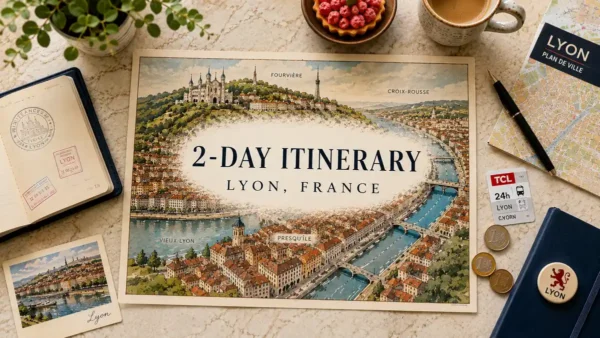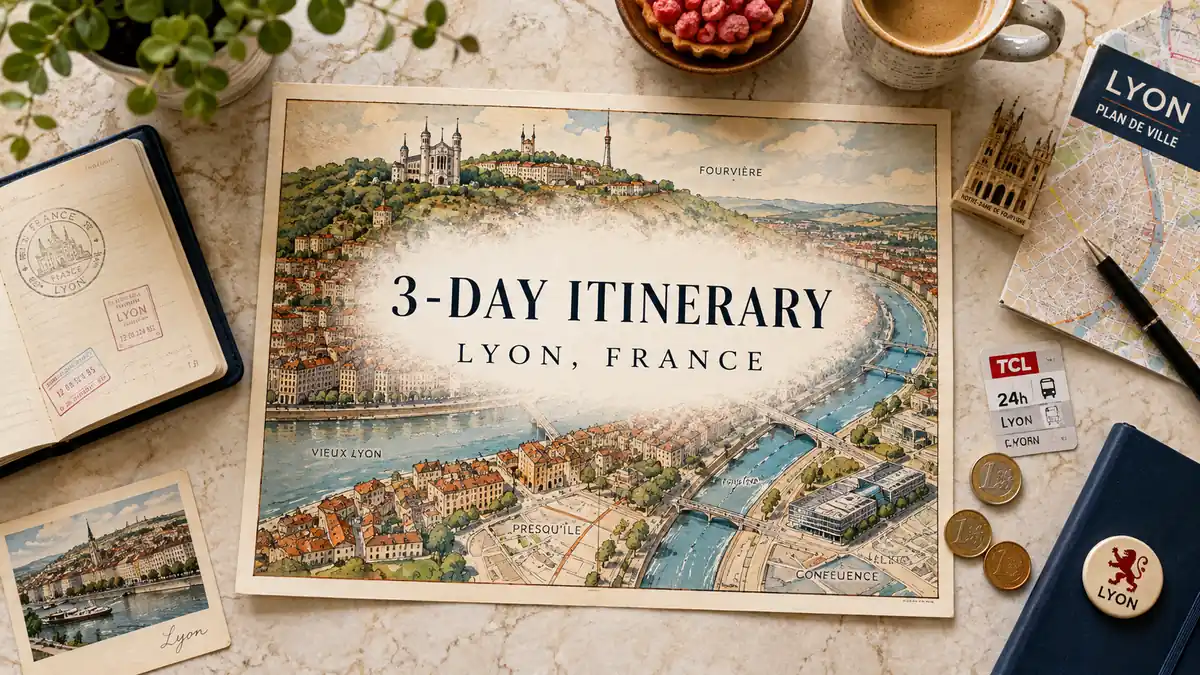
Lyon is decided and three days are booked. What remains is the order — which day goes where, and what the third day is actually for. This route runs old to new: Day 1 in the Renaissance old town and up Fourvière hill, Day 2 from Croix-Rousse down through the Presqu’île, Day 3 along the modern riverside at Confluence and the park. The sequence is deliberate. Each day sits at one altitude and one era, so you are never doubling back across the city or repeating the same kind of street twice.
The third day is where most three-day plans go soft, and this page answers it as a decision instead of a list. The default is a city day. The exception is a day trip, and there is a clear condition that decides between them. Everything below assumes one central base for all three nights and a walking pace that leaves room for a long dinner.
Quick Answer
Day 1 covers Vieux Lyon and Fourvière, Day 2 Croix-Rousse and the Presqu’île, Day 3 the modern riverside. Day 3 is the fork: default to the city — Confluence, the quays, the park — unless the region pulls harder than Lyon. One central base works for all three days, and the pace suits first-timers who want depth without rushing.
Trust Layer
Tripstou itinerary guide for travelers planning a route. Covers pacing, stop count, stop order, base logic, and trip length.
Produced with AI assistance and reviewed by Alex Perrut, working in tourism since 2015, for the Tripstou editorial team. See our editorial process for details.
Last factual review: August 10, 2026.
Official sources consulted: France.fr, Atout France.
Key Takeaways
- Three days splits cleanly into one era and one altitude per day: the old town and hill, Croix-Rousse and the Presqu’île, then the riverside.
- The third day buys Lugdunum on Day 1, one indoor stop on Day 2, and a whole unhurried day at the end.
- Swap Day 3 for a day trip only if you already know central Lyon or came for the surrounding region.
- Keep one central base for all three nights; every day on this route starts and ends at the same door.
- Cap museums at one a day and pick two across the trip, or the walking rhythm collapses.
- Cut Day 3 whole at two days; at four days, run the city day and the day trip together.
Table of Contents
Is Three Days Enough for Lyon?
Three days is enough for Lyon, and it is the length that stops the trip feeling rushed. Two days cover the historic core and the Presqu’île at speed. The third day buys depth on the hill, one indoor stop you would otherwise skip, and a whole unhurried day.
The gain shows up in three specific places. On Day 1, the hill becomes a real visit: the Gallo-Roman theatres and the Lugdunum museum sit just below the basilica, and a compressed trip treats them as a view from the terrace. On Day 2, you get one indoor stop — a museum on the Presqu’île or an hour inside Les Halles Paul Bocuse — instead of walking past both. And Day 3 exists at all, which is what turns a checklist into a trip.
Pace is the quiet variable. Lyon’s sights sit at different altitudes, and it is the climbing that tires people out, not the distances between things. Three days let you spend the altitude once a day. For everything outside the route itself — when to come, how the city fits a wider trip — the full Lyon planning guide covers it.
The Three-Day Lyon Route at a Glance
The route runs old to new. Day 1 stays in the Renaissance old town and on Fourvière hill, Day 2 walks Croix-Rousse down into the Presqu’île, and Day 3 follows the rivers south to Confluence and north to the park. Each day holds one era and one altitude.
- Day 1: Vieux Lyon + Fourvière — the historic core
- Day 2: Croix-Rousse + Presqu’île — the working city, downhill
- Day 3: Confluence, the quays, Parc de la Tête d’Or — the modern, slower day (or a day trip)
The order matters more than it looks. Starting in the oldest quarter and finishing at the newest gives the three days a direction, and it front-loads the climbing while your legs are fresh. Reverse it and Day 3 becomes the hardest day of the trip.
Where should you base yourself?
Stay central for all three nights and do not move. The Presqu’île sits between the two rivers, with Vieux Lyon, Croix-Rousse and Confluence all radiating out from it, so every day on this route can start and end at the same door. Changing hotels mid-trip buys you nothing on a three-day stay. For the area-by-area detail, see choosing where to stay in Lyon.
Hotels and places to stay
Compare hotels, apartments and stays for your dates in one search.
Search hotels and stays on hotels.com →
Tripstou may earn a commission if you book through this link, at no extra cost to you.
Day 1: Vieux Lyon and Fourvière, Taken Slowly
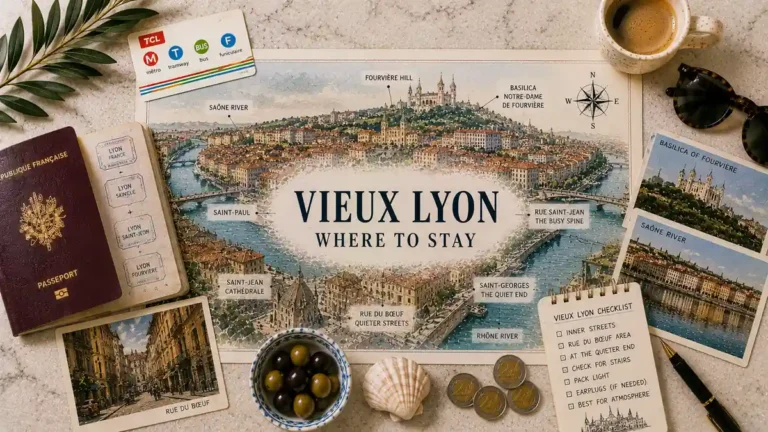
Start in the old town at street level and finish the day on top of the hill. Vieux Lyon’s Renaissance lanes and traboules come first, then the climb to Fourvière for the basilica, the panorama and the Roman site above the city. Doing it in that order means one climb, not two.
Give the morning to Vieux Lyon on foot. Cathédrale Saint-Jean anchors the lower end of the quarter, and the traboules — the covered passageways cutting between streets and courtyards — are why this UNESCO-listed area reads differently from any other old town in France. It is one of the largest Renaissance quarters in Europe. Some traboules are open to the public and some are not; treat finding two or three as the morning’s work.
The funicular runs from Vieux Lyon up the hill and is the standard way to Fourvière. It closes periodically for maintenance, so check it is running before you build the afternoon around it, and keep the walk-up through the hillside gardens and the F1 line as fallbacks. Route and ticket detail sits in getting around Lyon.
On top, the basilica and the terrace panorama take less time than people expect, and that is precisely where the third day pays. The Gallo-Roman theatres are cut into the slope below, and the Lugdunum museum explains what you have been standing on all afternoon. A two-day trip looks down at the theatres from the terrace and moves on. Three days lets you walk into them.
Come down as the light goes and eat in Vieux Lyon or across the Saône. A bouchon dinner is a slow, seated, several-course affair, so give it the whole evening.
Day 2: Croix-Rousse Down Through the Presqu’île
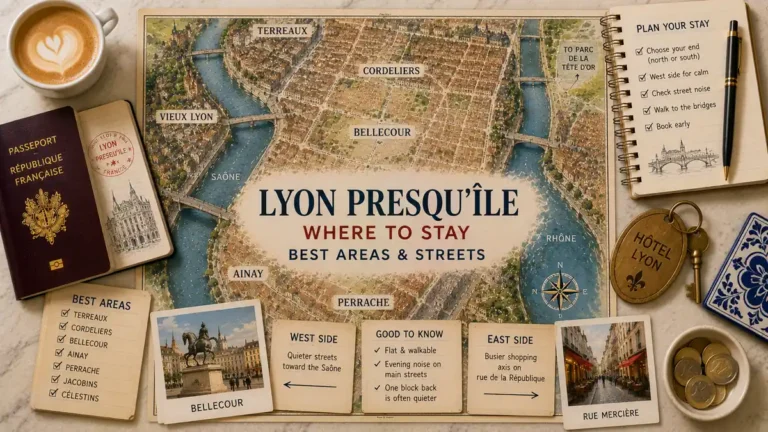
Day 2 starts at the top of Croix-Rousse and walks downhill all day. The silk-weavers’ hill opens the morning, the slopes drop into the Presqu’île, and Place des Terreaux, the Hôtel de Ville and Place Bellecour carry the afternoon. Gravity does most of the work.
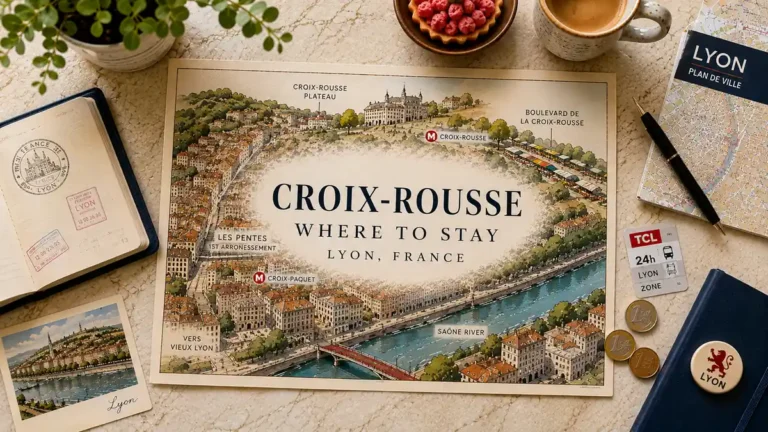
Start on the plateau, not at the bottom. Croix-Rousse was built for silk weaving, and the Mur des Canuts — the huge painted wall that is periodically repainted as the neighbourhood changes — is the one anchor worth aiming for before you drift down. The descent through the montées and the stairways is the real content of the morning, and it only works in this direction.
The Presqu’île is where the third day shows up again: it pays for one indoor stop. Choose a single one — a museum on the peninsula, or an hour inside Les Halles Paul Bocuse — and slot it mid-afternoon, when walking fatigue arrives. Taking both is how a comfortable day turns into a forced march, and it is the most common way three-day Lyon plans fall apart.
Finish at Place Bellecour, the vast square that functions as the city’s meeting point and a natural place to stop moving. Dinner needs deciding earlier in the day than most travelers expect, since booking in the morning for the same evening is the local habit at popular bouchons. More on that in booking a bouchon and local habits.
Day 3 in the City: Confluence, the Quays and Parc de la Tête d’Or
Spend Day 3 in the city by default. Confluence sits at the southern tip of the peninsula where the Saône meets the Rhône, the quays connect it back north, and Parc de la Tête d’Or closes the day on the Rhône’s left bank. It is the modern half of Lyon.
Confluence is the morning: contemporary architecture on reclaimed dockland, with the Musée des Confluences standing at the exact point where the two rivers join. Make it your one museum of the day if the building and its collections appeal, and skip going inside entirely if the Roman hill already used your museum appetite on Day 1.
The quays are the connective tissue. Walking or cycling north along the river is the whole transition between Confluence and the park, and it is the only stretch of this itinerary where you see Lyon at a distance rather than from inside it. Parc de la Tête d’Or then does what no other day on this route does — nothing in particular. A rowing lake, a botanical garden and long lawns are the right ending for three days of pavement.
The riverbanks are the city’s default outdoor gathering place and get busy and social in warm months; general awareness and evening notes live in staying comfortable in Lyon after dark.
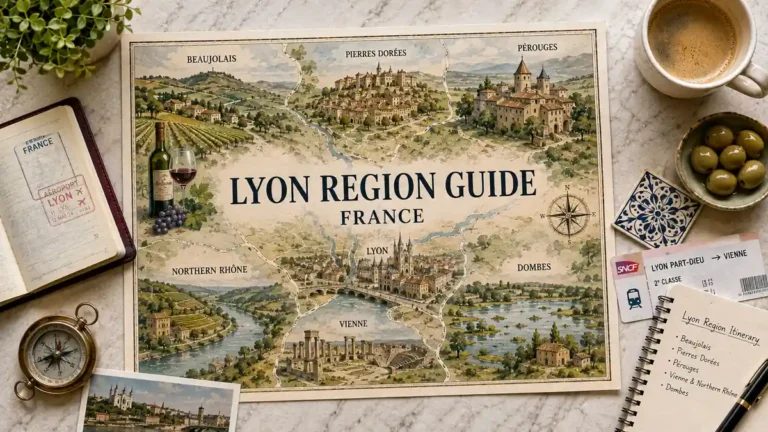
Should You Swap Day 3 for a Day Trip?
No for most first-time visitors — the city day is stronger. Swap Day 3 for a day trip only when you have already seen central Lyon, or when the surrounding region is the reason you came in the first place. Otherwise you trade a whole side of the city for a train.
Four options carry a single day out of Lyon, and they divide by how much of the day you are willing to spend travelling.
| Option | Who it suits | Why it fits one day |
|---|---|---|
| Vienne, Roman ruins on the Rhône | Anyone wanting ancient sites without a long journey | Closest of the four, under an hour by train |
| Pérouges, a walled medieval village | Travelers after a quiet, compact half-day out | Small enough to see fully in half a day |
| Annecy, an Alpine lakeside town | People who want mountains and water over more city | Doable in a day, but a couple of hours each way |
| Beaujolais, the vineyard country | Travelers coming for wine and vineyard scenery | Works best as a guided day out; villages sit far apart |
The choosing rule is short. If you want the day to be easy, take Vienne or Pérouges — both are close, and a late start still leaves a usable day. If you want the day to be the highlight of the trip, take Annecy and accept that the morning and the evening belong to the train. If wine is the point, book a tour instead of improvising with public transport, since the Beaujolais villages tend to be spread out and awkward to link without a car.
Annecy earns the swap only for people who genuinely enjoy train days. The lake gets the middle of your third day and the train gets the rest, and that is the whole trade: a famous view in exchange for Confluence, the quays and the park.
Tours and activities
Book skip-the-line tickets, day trips and local tours with free cancellation on most activities.
You can also browse everything on getyourguide.com.
Tripstou may earn a commission if you book through this link, at no extra cost to you.
How to Fit Lyon’s Museums into Three Days
Cap it at one museum a day, and let the route decide which one. Each day on this itinerary already passes a natural candidate, so the museum becomes a stop inside the walk, not a detour across the city. Two museums in one day breaks the pacing that makes three days work.
The slots are set by geography. Lugdunum belongs to Day 1, because it sits on the hill you are already climbing. Day 2’s indoor stop belongs to the Presqu’île — a museum on the peninsula, or Les Halles Paul Bocuse if food interests you more than collections. The Musée des Confluences belongs to Day 3, at the river tip where that walk ends anyway.
Across the whole trip, pick two of the three. Three museums in three days is technically possible and reliably kills the walking rhythm, because each visit costs most of a half-day once you count getting in, going round and the flat hour afterwards. Whether a city pass earns its keep depends entirely on how many you actually enter, and that arithmetic sits in what three days in Lyon costs.
How to Adapt This Route to Two or Four Days
Cut Day 3 first when time shrinks, and add the day trip first when it grows. The two-day version keeps the historic core and the Presqu’île and drops the modern riverside entirely. The four-day version takes both day-3 forks: the city day and the trip out.
- At two days: drop Day 3 whole, keep Days 1 and 2 in the same order, and cut the indoor stops down to one for the entire trip — the full shorter route is written up in the two-day Lyon route.
- At four days: run both forks — the modern city day first, the day trip second, so the trip finishes closer to home on the last evening.
- At four days, the slower alternative: split Day 1 in two, giving Vieux Lyon its own morning and the Roman hill an unhurried afternoon with no clock on it.
What does not work is thinning all three days evenly to squeeze in a fourth thing. This route holds together because each day owns one part of Lyon, and a day that borrows from the next one loses the shape that makes the sequence easy to walk.
Frequently Asked Questions
Is three days too long for Lyon, or should you add a fourth day?
Three days is not too long — Lyon fills them without padding. A fourth day only earns its place if you want both the modern city day and a trip out of town. If you only want one of them, spend that day elsewhere in France.
How much walking does a 3-day Lyon itinerary involve?
Expect a full walking day each day, with the climbing concentrated on Day 1. Lyon’s distances are short but its levels are not, so fatigue comes from hills and stairs, not from distance covered. Day 3 is deliberately flat and slow, which is what makes the pace hold.
Can you do this 3-day Lyon itinerary with kids?
Yes, with two pacing swaps. Move Parc de la Tête d’Or earlier so the park lands before anyone is tired, and cut the museums to one for the whole trip. Take the funicular up Fourvière instead of walking, and keep the traboule hunt to a single street.
Do you need a car for a day trip from Lyon?
Not for most of them. Vienne, Pérouges and Annecy are all reachable by train, so a day out of Lyon needs no car. The wine country north of the city is the exception: its villages sit far apart, and a guided tour usually works better than improvising.
Can you day trip to Annecy from Lyon in one day?
Yes, but it is a train day. Annecy sits a couple of hours each way, so you leave early, get a long afternoon by the lake, and return in the evening. It works if the Alpine setting is the point; it is a poor trade if you still want Lyon.
Is the funicular the only way up to Fourvière?
No — the funicular is the easiest way up Fourvière, but not the only one. The hillside gardens give a walking route, and the F1 line and local buses reach the hill as well. It closes periodically for maintenance, so confirm it is running before you build the afternoon around it.
Related Guides
- Planning a trip to Lyon: the full city guide
- The two-day Lyon route
- Where to stay in Lyon and which area suits you
- Getting around Lyon: metro, funiculars and trains
- What a trip to Lyon costs
- Practical Lyon tips and local habits
- Staying comfortable and safe in Lyon
Did this guide save you time or money? Tripstou is independent and reader-funded — if you'd like to give something back, you can support the site with a crypto contribution of any size.