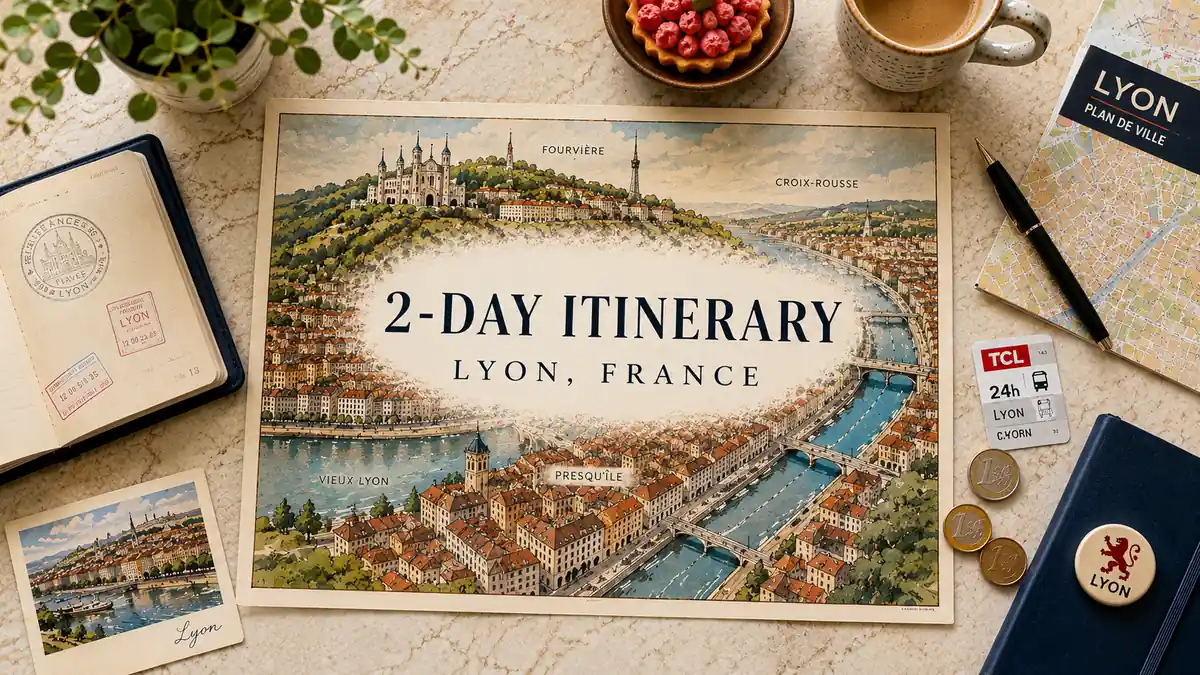
Lyon is booked and the two days are fixed. The only question left is what order to walk the city in. This guide answers it with one committed route: Day 1 covers Vieux Lyon and the Fourvière hill, Day 2 runs from Croix-Rousse downhill through the Presqu’île. Both days work on foot from a single central base.
This is not a Lyon overview and not a things-to-do list. It is a sequencing guide — why each half-day sits where it does, which climb to handle early, where a bouchon lunch fits without wrecking the afternoon, and what to cut or add if the trip turns out to be one day or three. Read it as a route you follow in order, adjusting the edges instead of rebuilding the middle.
Quick Answer
Two days covers Lyon’s core: Day 1 in Vieux Lyon and Fourvière, Day 2 across Croix-Rousse and the Presqu’île. The route works entirely on foot from one central base, with the hill climb handled early on Day 1. That pace suits first-timers; skip day trips and keep both days inside the city.
Trust Layer
Tripstou itinerary guide for travelers planning a route. Covers pacing, stop count, stop order, base logic, and trip length.
Produced with AI assistance and reviewed by Alex Perrut, working in tourism since 2015, for the Tripstou editorial team. See our editorial process for details.
Last factual review: August 10, 2026.
Official sources consulted: France.fr, Atout France.
Key Takeaways
- The two-day route buys Lyon’s historic core and both hills; it costs you museum interiors and any trip out of town.
- Run Day 1 uphill through Vieux Lyon to Fourvière, then let Day 2 fall from Croix-Rousse into the Presqu’île.
- Book one central base for both nights; moving hotels costs more usable hours than a two-night trip can spare.
- Each hill is climbed once and never repeated, which is what keeps a two-day walking route from feeling punishing.
- Skip day trips entirely: leaving Lyon consumes half of only four usable half-days and breaks the route’s coverage.
- With one day, keep Day 1 whole and drop Croix-Rousse; with three, add interiors before adding an excursion.
Table of Contents
Is 2 Days Enough for Lyon?
Two days is enough for Lyon’s core, but not for its museums. You can walk the Renaissance old town, climb Fourvière, cross the Croix-Rousse hill and finish on the Presqu’île without rushing. What you give up is depth indoors and any trip outside the city.
Lyon’s historic centre is unusually compact for a city of its size. Vieux Lyon, the Presqu’île and the foot of Croix-Rousse sit within a couple of kilometres of each other, separated by two rivers and two short climbs. That geography is what makes a two-day plan honest. You are not spending half the trip in transit.
The route suits first-time visitors who want the city read in one clean pass. Anyone returning, or anyone who came mainly for the Gallo-Roman collections and the fine-art museums, will feel the ceiling on the second afternoon. For the wider planning picture — when to come, how Lyon fits into a longer French trip — start with the full Lyon travel guide.
A third day does not add new geography to this route; it adds time inside the buildings you walked past on the first two. That is the trade-off in one line. Two days buys the city’s shape, a third buys its interiors.
Your 2-Day Lyon Route at a Glance
Day 1 is the hill day and Day 2 is the downhill day. You climb once, early, while your legs are fresh, then spend the second day losing altitude from Croix-Rousse into the flat Presqu’île. Reversing the order means two uphill afternoons and a much harder trip.
- Day 1: Vieux Lyon + Fourvière — the Renaissance and Roman hill day.
- Day 2: Croix-Rousse + Presqu’île — downhill through the living city.
Each day has one climb and one payoff. Day 1 works upward from cobbled Renaissance streets to the basilica terrace and its panorama. Day 2 starts high on the silk-weavers’ hill and drifts down through squares, shopping streets and river banks until the day ends flat beside the water.
Hold that order and you never repeat a climb. Every ascent in this itinerary happens once, in the morning half of its day, which is the whole reason two days in Lyon feel longer than they are.
Where to Base Yourself and Where to Start
One central base carries the whole route; do not split two nights between neighbourhoods. Anywhere on or beside the Presqu’île puts both days within walking distance of your door, which is the condition this itinerary depends on, and it keeps a two-night trip free of check-out logistics.
Two nights is too short to justify moving. Every hour spent checking out, hauling bags and checking in again comes straight out of a plan that contains only four usable half-days. Pick one address near the peninsula’s spine, or just across a bridge in Vieux Lyon, and both mornings begin on foot. Which street, and the trade-offs behind it — quiet against central, budget against riverside — is a separate decision, resolved in our guide to where to stay in Lyon.
Arriving by train, start the route from the station side and walk into it. Lyon’s main stations sit at the edges of the centre, so the natural first move is to drop bags at your base and join the route at whichever point is closest: Bellecour if you are on the Presqu’île, the Saône bridges if your base sits nearer Vieux Lyon.
Late arrivals should simply begin Day 1 the next morning. The hill day does not compress into an evening, and a half-hearted first night costs you less than a rushed Fourvière.
Hotels and places to stay
Compare hotels, apartments and stays for your dates in one search.
Search hotels and stays on hotels.com →
Tripstou may earn a commission if you book through this link, at no extra cost to you.
Day 1: Vieux Lyon and the Fourvière Climb
Spend the morning in Vieux Lyon and the afternoon on Fourvière. The old town is best early, before tour groups fill its narrow lanes, and the hill rewards a later visit when the light softens over the rivers. Lunch in Vieux Lyon sits naturally between the two.
Doing the hill first inverts the day badly. You would reach Fourvière with the old town still shuttered below, then descend into Vieux Lyon at its most crowded and eat late. Climbing after lunch keeps the day moving in one direction: up, then a single descent at the end.
Morning: Vieux Lyon, the Cathedral and the Traboules
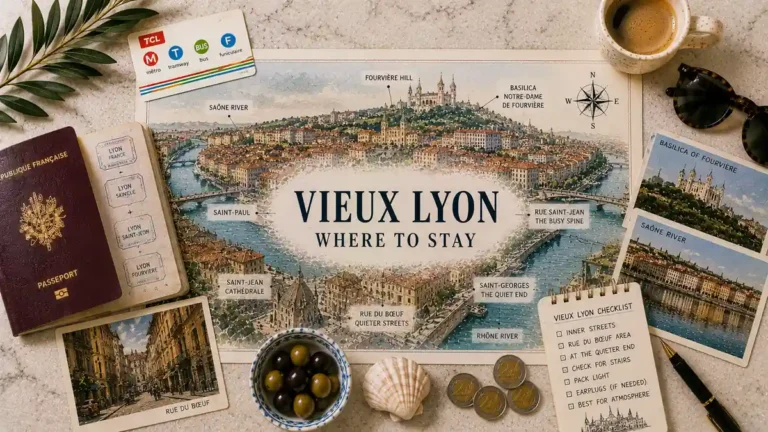
Vieux Lyon is the morning’s whole job. The quarter sits under Fourvière hill on the west bank of the Saône, and it is one of Europe’s largest Renaissance districts — a UNESCO-listed grid of cobbled lanes, courtyards and shopfronts you can cover comfortably on foot in a few hours.
Two anchors carry the morning. Cathédrale Saint-Jean marks the quarter’s southern end and is the obvious starting point. The traboules — the covered passageways cutting between streets through private courtyards — are the reason to wander instead of walking in straight lines.
Work north through the lanes and you finish the morning near the foot of the hill, which is exactly where the afternoon begins.
When to Fit Your Bouchon Lunch
Eat your bouchon lunch in Vieux Lyon, before the climb. A long lunch is the point of eating in a bouchon, and this route is built to absorb one: the morning ends in the old town, the way up the hill starts a few minutes away, and the afternoon has no fixed start time.
Booking ahead changes your pacing more than it changes the meal. Bouchons are small and the well-known ones fill up, so an unplanned lunch can mean waiting around at the exact moment the day should be moving uphill. Reserve before you travel and the afternoon stays intact — the booking habits and table etiquette are covered in our Lyon travel tips.
Getting Up to Fourvière: Funicular or Walk?
Take the funicular up and walk back down. A funicular runs from Vieux Lyon to the top of the hill and turns the climb into a short ride. Check that it is running on the day you go; the plan does not depend on it.
The walk up is steep but entirely possible. Stairways and a garden path climb the hillside from just behind the cathedral, and plenty of visitors take that route deliberately for the views on the way. Allow more energy than you expect. It is a genuine hill.
Either way, plan the descent on foot. Coming down through the gardens returns you to Vieux Lyon at the end of the day with no waiting, and it means the afternoon works whether or not the funicular is operating in both directions.
Afternoon: Basilica, Roman Theatres and the Panorama
The afternoon is three stops on one hilltop. The Fourvière basilica dominates the summit and is why most people come up. The Gallo-Roman theatres, cut into the slope a short walk away, are the oldest thing you will see in Lyon. The esplanade beside the basilica holds the city’s main panorama.
Save the viewpoint for last. From the terrace the whole route reads as a map: the Saône directly below, the Presqu’île beyond it, Croix-Rousse rising on the far side, and the Alps on the horizon when the air is clear. Seeing tomorrow’s ground from above is the quiet reason this day goes first.
Walk back down as the light goes. The descent puts you in Vieux Lyon or on the river bridges, which is where the evening should stay.
Tours and activities
Book skip-the-line tickets, day trips and local tours with free cancellation on most activities.
You can also browse everything on getyourguide.com.
Tripstou may earn a commission if you book through this link, at no extra cost to you.
Day 2: Croix-Rousse Down Through the Presqu’île
Start high on Croix-Rousse and finish flat beside the Rhône. Day 2 runs in one downhill direction: the silk-weavers’ hill in the morning, the Presqu’île through the middle of the day, the river banks or the park at the end. Gravity does the work.
The reverse direction is the mistake to avoid here. Croix-Rousse sits on a steep plateau north of the Presqu’île, so climbing it at the end of a full walking day — on a trip that already included Fourvière — turns a pleasant descent into a slog. Take the hill while the morning is fresh and the rest of the day costs you nothing in altitude.
Morning: Croix-Rousse and the Mur des Canuts
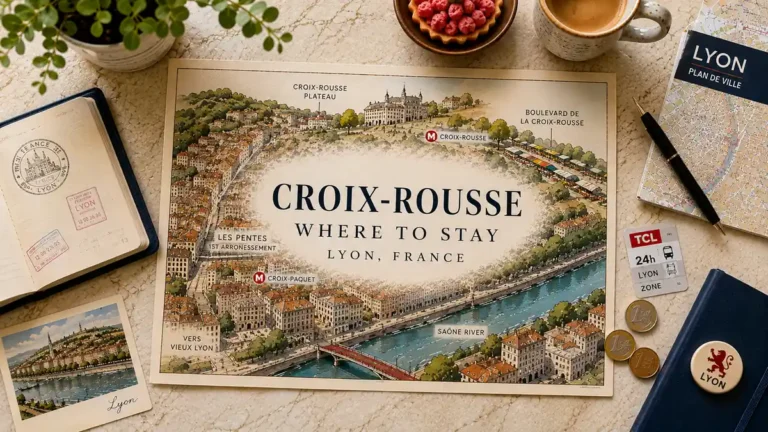
Croix-Rousse is the morning, and one mural anchors it. The hill was the working district of Lyon’s silk weavers, and it still reads differently from the polished centre below: steeper streets, a market atmosphere, workshops converted into flats that kept the tall windows the looms needed.
The Mur des Canuts is the one fixed stop up here. It is a vast painted wall showing the quarter as a living street scene, and it works as the morning’s turning point — see it, then start heading downhill.
From there the slopes lead south towards the Presqu’île. The descent through the hill’s stairways and passages is part of the experience, so leave time to drift rather than take the fastest line down.
Afternoon: Presqu’île from Hôtel de Ville to Bellecour
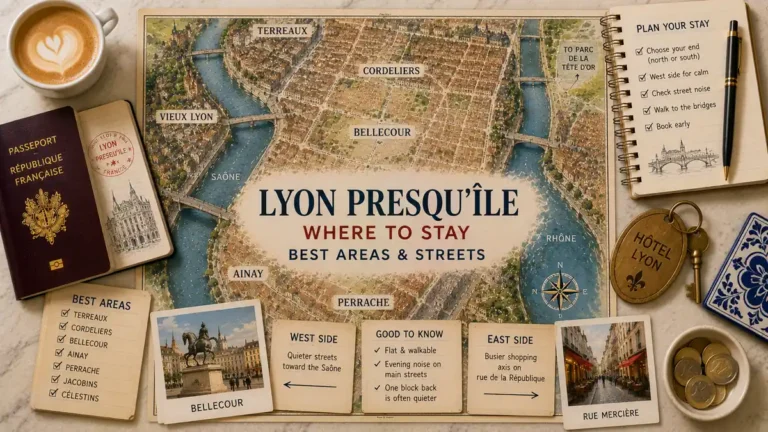
The Presqu’île afternoon runs north to south, from Hôtel de Ville to Place Bellecour. The peninsula between the Saône and the Rhône is Lyon’s civic and commercial spine, and walking its length is the quickest way to understand how the city works day to day.
Hôtel de Ville marks the northern end, where the hill flattens into the peninsula’s grand squares. Place Bellecour, a straight walk south, is the city’s central reference point and the natural place to close the formal part of the route. Everything after it is optional.
Between the two, the streets are for browsing. This stretch is where the schedule should be loosest, and it is the part of the itinerary that compresses without damage when the morning has run long.
Ending the Day: the Rhône Banks or Parc de la Tête d’Or
End on the Rhône banks or in Parc de la Tête d’Or, depending on how much walking is left in you. The riverside promenade starts a short distance east of Bellecour and runs flat along the water. The park sits further north and is easier to reach with a short transit hop at the end of a long day.
Choose the river if you want dinner within reach, the park if you want green space and still have energy. Both close the route without adding a climb.
Evening comfort tilts the choice for some travelers. The riverside is lively in warm months and much quieter off-season, and the streets back up through Croix-Rousse feel different at night than they do at noon. Our guide to how safe Lyon feels at night covers what actually matters after dark.
Can You Do This Route on Foot?
Yes — this route is built to be walked end to end. Lyon’s centre is compact, and the itinerary handles each of the two hills exactly once, on the day that suits it. The only assist worth planning for is the funicular up Fourvière.
The design does the work, not your fitness level. Both days move in a single vertical direction — up on Day 1, down on Day 2 — so you never repeat a climb or backtrack uphill to reach the next stop. Distances between anchors are short. The tiring part of Lyon is gradient and cobbles, not distance.
Two conditions change the answer. Anyone limiting hill walking should ride the funicular in both directions on Day 1 and reach Croix-Rousse by metro on Day 2, then walk only the downhill half. The route survives that edit intact. Anyone with small children should expect the Presqu’île stretch to absorb the slack.
Public transport exists for the moment your legs give out, and it is worth understanding before you need it. How the metro, funiculars, trams and buses fit together is covered in our guide to getting around Lyon, and whether a transport pass or the city card earns its keep across a short stay belongs with what two days in Lyon costs.
Should You Squeeze In a Day Trip?
No day trip earns its place inside two days. Leaving the city removes roughly half your available time from a plan that already holds only four usable half-days, and Lyon’s own core would not survive that cut. Save the excursions for a longer trip.
The maths is unforgiving. Any worthwhile destination outside Lyon costs a return journey plus a few hours on the ground, which becomes a full day once you count getting to and from the station. Spend it and you lose either Fourvière or Croix-Rousse — the two elements that make this route feel complete.
Day trips become reasonable at three days. With a third day the city core is already secured, so an excursion is an addition to the trip and never a substitution for it.
How to Adapt the Route to One or Three Days
Cut Day 2 first and keep Day 1 whole. With one day in Lyon, Vieux Lyon and Fourvière are the non-negotiable half of this route. With three, the gain is depth and breathing room, not more ground covered. The order of the route never changes.
If you only have one day, cut in this order:
- Drop Croix-Rousse entirely — it is the furthest from the core and the steepest to reach.
- Keep Vieux Lyon and Fourvière in the same morning-then-afternoon sequence.
- Add a short walk down the Presqu’île to Bellecour at the end if the light holds.
- Shorten the bouchon lunch; a long sit-down meal eats a quarter of a one-day trip.
If you have three days, add in this order:
- Depth first: the Gallo-Roman and fine-art collections you walked past on Days 1 and 2.
- Then unhurried time — markets, a proper Presqu’île evening, Parc de la Tête d’Or in daylight.
- A day trip last, and only once the city core is fully covered.
The instinct at one day is to speed up and keep everything. The better move is to keep the climb and delete half the city outright, because a rushed Fourvière is worth less than no Croix-Rousse at all.
If your trip does stretch, the third day has its own sequence and its own logic, set out in the 3 days in Lyon itinerary.
| Trip length | What it buys | What it gives up | Best for |
|---|---|---|---|
| One day | The Renaissance old town and the Fourvière panorama | Croix-Rousse, the Presqu’île and a long lunch | Stopovers and travelers passing through on a longer trip |
| Two days | Both hills, the old town and the full Presqu’île | Museum interiors and anything outside the city | First-time visitors wanting the whole city on foot |
| Three days | The same route plus interiors, markets and an excursion | Little; pace stops being the limiting factor | Repeat visitors and slower travelers who dislike rushing |
Frequently Asked Questions
Is one day enough for Lyon?
One day covers a real slice of Lyon, not the city. You come away with the Renaissance quarter and the hilltop panorama, which is enough for a stopover or a work trip with an afternoon free. Croix-Rousse, the Presqu’île and a long lunch all disappear.
Can you visit Lyon’s traboules for free?
Yes — the traboules open to visitors cost nothing to walk through. They are passageways cutting between streets inside working residential buildings, so access depends on the doors being unlocked and on visitors staying quiet. Treat them as someone’s hallway, not an attraction, and wander at street level.
Is Fourvière better in the morning or late afternoon?
Late afternoon wins on light, and that is why this route puts it there. The panorama reads best when low sun warms the rooftops below and the Alps stand clear on the eastern horizon. Choose the morning only if you would rather have the hilltop quiet than the view at its best.
Does the season change a two-day Lyon plan?
The route holds year-round; the season changes its pace, not its order. December’s Fête des Lumières fills the same streets this itinerary walks, so allow extra time between stops and expect the Presqu’île to move slowly. Summer stretches the evenings, which makes the riverside finish far more rewarding.
Is two days in Lyon enough with young children?
Two days works with children if you shorten the hill day. Cobbles in Vieux Lyon and the stairways up Fourvière are hard on strollers, so ride the funicular where you can and treat the flat Presqu’île as the day’s recovery stretch. Cut stops before you cut rest.
Where should you start the route if you arrive in the afternoon?
Start on the Presqu’île and borrow it from Day 2. An afternoon arrival is too short for the hill and too long to waste, so walk the peninsula from Hôtel de Ville to Bellecour on arrival day. Day 1 then begins whole the next morning, and Day 2 gains an easy afternoon.
Related Guides
- Lyon travel guide — the broad planner behind this route, including when to come and how Lyon fits a longer trip.
- 3 days in Lyon itinerary — the longer route, and where a third day actually goes.
- Where to stay in Lyon — the area-by-area depth behind this page’s one-base rule.
- Getting around Lyon — metro, funiculars, trams and buses, and how tickets work.
- Lyon trip cost — what a short stay costs and whether a city card pays off.
- Lyon travel tips — booking a bouchon, local habits and first-timer conventions.
- Is Lyon safe? — practical awareness for riverside evenings and the hill streets at night.
Did this guide save you time or money? Tripstou is independent and reader-funded — if you'd like to give something back, you can support the site with a crypto contribution of any size.