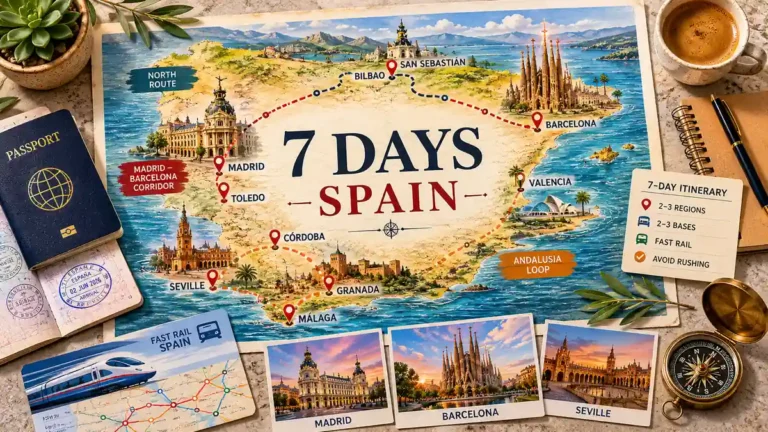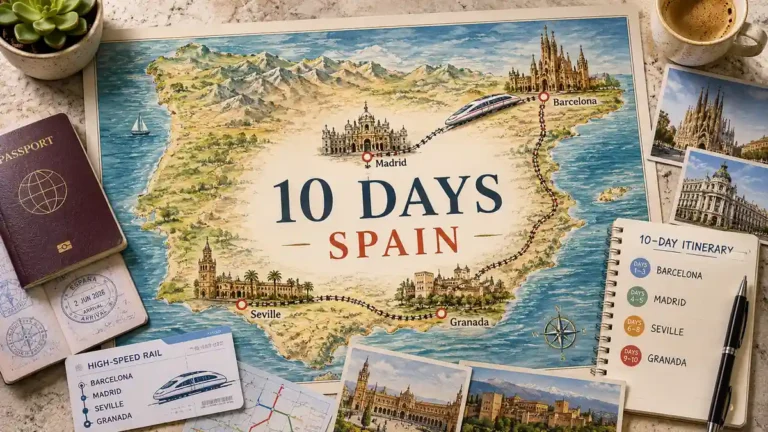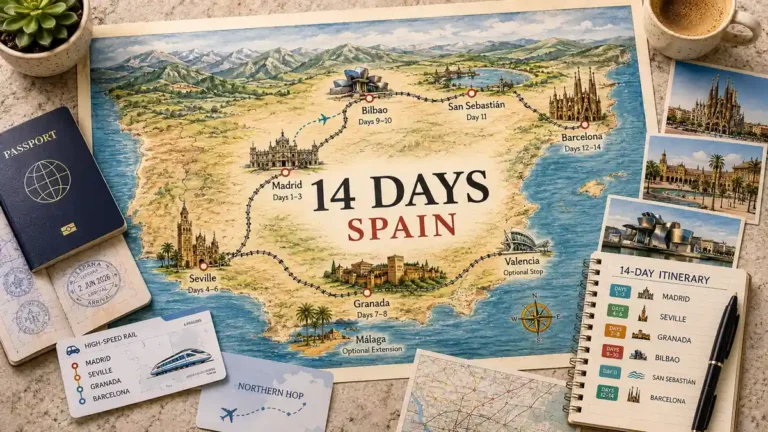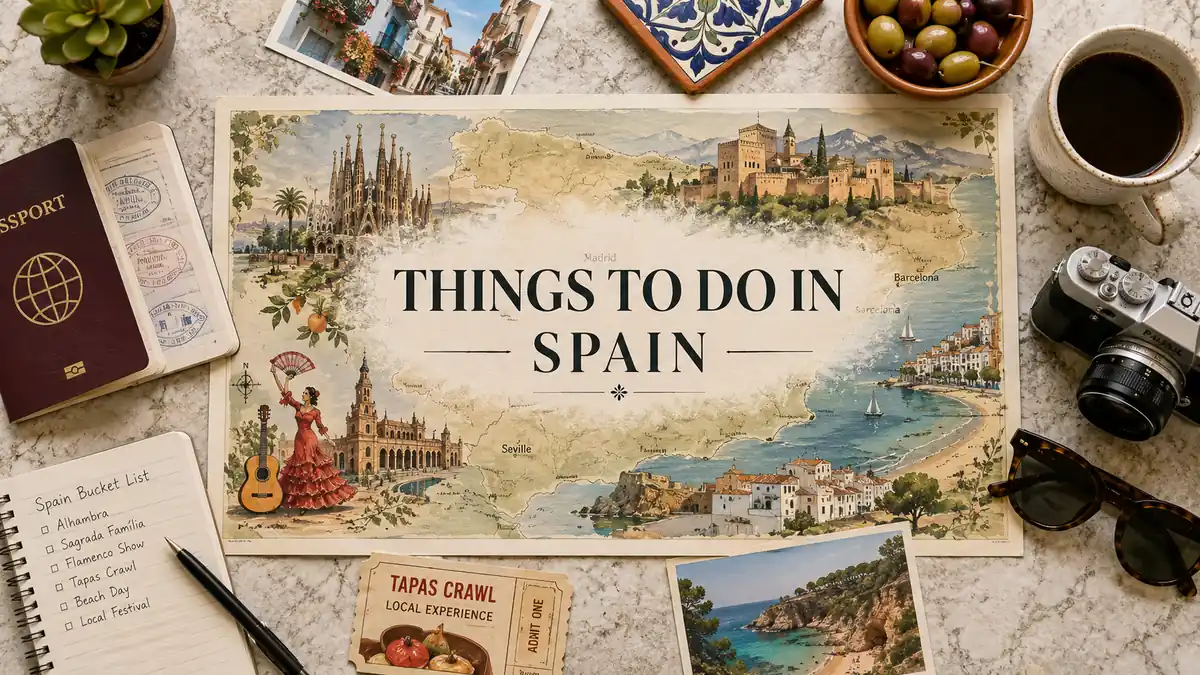
Spain’s essential experiences are flamenco, a tapas or pintxos crawl, Gaudí’s Barcelona, the Alhambra, and one major festival. The real choice is balancing those icons against local culture, so this list groups experiences by type, starting with the landmarks and festivals that need planning, then the evenings you can decide on the ground. Outdoor and coastal travelers get equal weight — the Camino, the Picos de Europa, and island calas rival the landmarks.
Spain packs more bucket-list experiences into a single trip than almost anywhere else in Europe, and the hard part is choosing between them: a flamenco tablao, a pintxos crawl, Gaudí’s Barcelona, the Alhambra, festivals that take over entire cities, and a coastline built for three-hour lunches all compete for the same few days.
This guide is a curated list of the experiences worth planning a Spain trip around, grouped by type — landmarks, festivals, cultural, food, outdoor, and coastal. Each pick answers three questions: what the experience is, why it earns its place, and where in Spain it is at its best, with routes down to the city and region guides that carry the local depth. Destination rankings and day-by-day routes live in their own guides, and the country’s planning, timing, and logistics sit in our Spain travel guide; this page settles what you will actually do.
What Is Spain Famous For?
Spain is famous for flamenco, tapas, Gaudí’s architecture, Moorish palaces, wild festivals, beach culture, and the Camino de Santiago. These are experiences you do, not sights you tick off. First-timers get the best trip by anchoring on two or three icons plus one local-culture experience — not by attempting all of them.
The signature experiences, and where each is at its best:
- Flamenco — an art form best experienced live in a tablao; Seville and wider Andalusia are its heartland.
- Tapas and pintxos — eating as the evening’s activity; Madrid, Seville, and Granada for tapas, San Sebastián for pintxos.
- Gaudí’s architecture — Sagrada Família and Park Güell make Barcelona a pilgrimage in itself.
- Moorish Spain — the Alhambra in Granada and Córdoba’s Mezquita, southern Europe’s great Islamic monuments.
- Festivals — San Fermín, Las Fallas, and Semana Santa turn whole cities into the event.
- The outdoors — the Camino de Santiago, the Picos de Europa, and Teide’s volcanic national park.
- Beach culture — chiringuito lunches and cove-hopping on the Costa del Sol, the Balearics, and the Costa Brava.
First-timers usually over-schedule the icons. The pattern repeats on almost every first trip: the calendar fills with timed monument tickets, yet the memory travelers rank first afterward is usually a tablao night or a tapas crawl nobody planned around. Anchor the trip on a few icons, add one immersive cultural experience, and leave slack for the rest. Where you base yourself for all of this is a separate decision — our roundup of the best places to visit in Spain handles it — and turning your shortlist into a workable route is the job of our Spain itinerary guide.
Landmarks and Architecture You Can’t See Anywhere Else
Sagrada Família and the Alhambra are the two landmarks worth structuring a Spain trip around. Both are experiences you move through, and Córdoba’s Mezquita completes Spain’s Moorish triangle. Give each a full morning — these are immersion pieces, and rushed drive-by visits waste them.
These are also the only entries on this page that can genuinely fail without planning: Sagrada Família and the Alhambra both use timed entry and sell out in high season, so book well ahead. Treat that booking, the Alhambra’s Nasrid Palaces slot above all, as the fixed point of your trip and plan the surrounding days around it.
Walk Through Gaudí’s Barcelona
Few buildings beat their own hype. Sagrada Família does. The interior — stone columns branching into a canopy of coloured light — justifies the trip on its own, and Park Güell’s mosaic terraces complete a half-day inside one architect’s imagination. No other Spanish city is shaped this completely by a single mind. On a first Spain trip, skipping Gaudí is the omission people regret most. Our guide to things to do in Barcelona covers the city around it, and things to do in Catalonia extends the trail to Gaudí works and medieval towns beyond it.
Spend a Morning Inside the Alhambra’s Nasrid Palaces
The Alhambra is a Moorish palace-city above Granada, and the Nasrid Palaces at its heart hold the finest Islamic architecture in Europe — carved stucco, quiet courtyards, and water engineered into art. It rewards slowness. Where Gaudí overwhelms with invention, the Alhambra works by restraint and detail, which is why the two make such a complete pairing on one trip. Go early, take the whole morning, and let the Generalife gardens close the visit. It is Spain’s Moorish story at full strength, in one unforgettable morning. Our guide to things to do in Granada covers the city below.
Stand Under the Arches of Córdoba’s Mezquita
The Mezquita is Córdoba’s mosque-cathedral, a UNESCO World Heritage site where striped red-and-white arches recede in every direction — with a Renaissance cathedral rising straight through the middle. No building states Spain’s layered history more bluntly. It is calmer than the Alhambra, and Córdoba’s compact old town makes it the easiest of the three Moorish-era visits to add to a southern trip. Pair it with an evening wander through the flower-hung Judería.
Of the three, this is the world-class Moorish monument without big-city crowds around it.
Tours and activities
Book skip-the-line tickets, day trips and local tours with free cancellation on most activities.
You can also browse everything on getyourguide.com.
Tripstou may earn a commission if you book through this link, at no extra cost to you.
Spain’s Festivals Are Bucket-List Experiences in Themselves
Timing your trip to one major festival delivers more of Spain than any monument can. The choice is intensity: San Fermín is the extreme, Las Fallas the spectacle, Semana Santa and the Feria de Abril the deep tradition. Pick by temperament — every one of them takes over its city completely.
Pick the festival before you pick the region. A trip built around Las Fallas or Semana Santa rarely regrets it, while a trip that stumbles into festival week inherits full streets and closed roads without the payoff of planning for them.
Run (or Watch) San Fermín in Pamplona
San Fermín takes over Pamplona every July: the morning bull runs are the famous part, but the festival is really a week-plus of round-the-clock street life in white outfits and red scarves. Watching from a balcony is the sane version. Running carries genuine physical risk, and any honest recommendation says so. Nothing else in Spain concentrates this much adrenaline into one small city, which is exactly why it fills. It belongs to travelers chasing maximum intensity who accept the crowds, the chaos, and the early starts.
Burn Winter Away at Las Fallas in Valencia
Las Fallas fills Valencia each spring with giant satirical sculptures — built over months, displayed for days, then burned in one coordinated night. Daily firework barrages shake the squares in between. It is the spectacle tier: easier to join than San Fermín, safer, and family-friendly by day. Spectacle and noise over ritual and solemnity: that is the temperament Las Fallas rewards. If late summer fits your dates, La Tomatina — the giant tomato fight in nearby Buñol in late August — is the region’s other great excess. Our guide to things to do in Valencia covers the city beyond the flames.
Follow Semana Santa or Dance at the Feria de Abril in Andalusia
Semana Santa — Holy Week, around Easter — brings hooded brotherhoods, candlelit floats, and processional music into Andalusian streets, with Seville and Málaga staging the most intense versions. In the weeks after Easter, Seville’s Feria de Abril flips the mood entirely: flamenco dresses, horse carriages, and dancing until dawn in a city of striped casetas. Solemnity and celebration, back to back. These are the deepest festival experiences on the list, free to watch and rooted in neighbourhood life. You watch all of it from the street, without buying a ticket to anything.
Cultural Experiences Worth Building a Trip Around
Flamenco in an Andalusian tablao is the cultural experience most worth planning a Spain trip around. Spanish culture rewards participation — a live show, a football match, a museum evening — over monument-ticking. The three picks here are the ones that put you inside the culture in a single evening.
Watch Flamenco in a Seville Tablao
A tablao is an intimate flamenco venue: small stage, live guitar and song, dancers close enough to feel the footwork through the floor. Ninety minutes here lands harder than any monument. Seville is the place for it — flamenco’s roots are Andalusian, and our guide to things to do in Seville covers the scene around the shows. The heartland runs across the whole region; things to do in Andalusia maps it. Book small venues over dinner-show halls. One night in a tablao explains Andalusia better than any museum could.
See Spain’s Golden-Age Masters in Madrid’s Art Triangle
Madrid’s art triangle — the Prado, the Reina Sofía, and the Thyssen-Bornemisza — concentrates Velázquez, Goya, and Picasso’s Guernica within a short walk. The Prado alone justifies the visit. What separates this from the other cultural picks is scale: nowhere else in Spain puts this much world-class art into one afternoon, and the museums pair naturally with the capital’s late tapas hours. Put it near the top of the list when rainy-day plans and world-class art matter more to you than beach hours. For the city around the galleries, start with our guide to things to do in Madrid.
Feel Match Day at Camp Nou or the Bernabéu
Football in Spain runs closer to civic religion than sport, and a match at Barcelona’s Camp Nou or Madrid’s Bernabéu is the loudest way to feel it. The experience starts hours before kickoff — bar crowds, chants, whole neighbourhoods moving in one direction. Unlike the other cultural picks, it needs no background knowledge. The stadium does the explaining. If the fixture calendar fails you, both clubs run stadium tours on non-match days.
The trade: one monument ticket for ninety minutes of shared obsession with eighty thousand locals.
Spain’s Best Food Experiences: Tapas, Pintxos, and Wine
A tapas crawl — moving bar to bar, one dish and one drink each — is Spain’s essential food experience. Eating here is the activity itself, built for standing, sharing, and moving. San Sebastián’s pintxos bars are the upgrade, with market halls and wine regions as the supporting acts.
Do a Proper Tapas Crawl
The rules are simple: one dish and one drink per bar, stand at the counter, then move on. Three or four bars make an evening. Madrid and Seville are the classic crawls, while Granada still serves a free tapa with every drink — the tradition at its most generous. What makes this the essential pick is accessibility: no booking, no schedule, no dress code, just the willingness to keep walking. It works solo, as a couple, or as a loud group of six. Dinner doubles as the evening’s entertainment.
Bar-Hop for Pintxos in San Sebastián’s Old Town
Pintxos are the Basque evolution of tapas — intricate, individually priced bites lined up along the bar. Each bar guards one or two specialties. San Sebastián’s old town holds Spain’s densest concentration of serious pintxos bars, and food travelers treat the city as a destination in itself. The difference from a tapas crawl is ambition: this is some of Spain’s best cooking, served standing up. It rewards anyone who travels mainly to eat and will happily build a day around bar counters. Our guide to things to do in the Basque Country covers the region beyond the counters.
Graze a Market Hall, Then Eat Espetos on the Sand in Málaga
Málaga compresses two food experiences into one easy day: a morning grazing Atarazanas market — jamón, fried fish, vermouth — and a lunch of espetos, sardines grilled on skewers over open fire at a beach chiringuito. The espeto is the city’s signature. It barely exists inland, and Málaga is the place to eat it properly. No other entry pairs market culture and beach eating this naturally; our guide to things to do in Málaga covers the rest of the city.
Taste Your Way Through a Wine Region
Spain’s wine regions turn drinking into travel: La Rioja for reds among vineyard villages, Jerez for sherry in old bodegas where the barrels do the decorating. That slower pace is the point. A day of cellar visits and long lunches runs on a completely different clock from the tapas circuit — quieter, more rural, easier to stretch into two days. Rioja suits classic wine travel; Jerez adds Andalusian atmosphere and a style of wine most visitors have never tasted properly. Give it a day when slow days, cellar visits, and long lunches appeal more than city sightseeing.
Outdoor Experiences: The Camino, Peaks, and Volcanoes
Walking even a few stages of the Camino de Santiago is Spain’s defining outdoor experience. The country’s wild side rivals its monuments — green Atlantic hills, alpine peaks, and volcanic islands. The Picos de Europa and Teide are the wilder alternatives for travelers who prefer summits to trails with cafés.
Walk a Stage of the Camino de Santiago
The Camino does not demand weeks or faith. Walking a stage — or the final stretch into Santiago de Compostela — delivers its essence: rhythm, landscape, conversations with strangers, and an arrival that feels earned. It is also the one outdoor pick needing no gear, fitness plan, or rental car, which is why it suits more travelers than flashier hikes. The memory it leaves is built on effort: arriving means more when you walked there. Galicia’s green, village-dotted finale is the classic taste, and our guide to things to do in northern Spain covers the coast around the route.
Hike the Picos de Europa
The Picos de Europa are serious limestone mountains rising just behind Spain’s green northern coast — a compact national park of gorges, high meadows, and peaks with an alpine profile. The Cares Gorge path, carved into a canyon wall, is the classic day walk. Where the Camino is social and gentle, the Picos are raw scenery. Fewer people, bigger views, more effort. Mountain cheese villages at the trailheads soften the landings. Proper mountain scenery is the reward, for anyone happy to drive to reach it.
Cross Teide’s Volcanic Landscapes in the Canaries
Teide National Park on Tenerife surrounds Spain’s highest peak with lava fields, ochre craters, and rock forms from another planet. It is UNESCO-listed. Nothing on the mainland compares, which makes this the pick for travelers who assume they already know what Spain looks like. Walks range from short crater strolls to full ascents, and the night skies above the park are famous in their own right. Our guide to things to do in the Canary Islands sets the island context.
Beach and Island Experiences Beyond the Sunbed
A long chiringuito lunch on the sand is the Spanish beach experience, not the sunbed. Beach life here has its own culture — grilled fish, cala-hopping, and coastal footpaths. Each coast delivers a different version: Costa del Sol for the lunch, the Balearics for coves, the Costa Brava for the walking.
Do a Chiringuito Day on the Costa del Sol
A chiringuito is a beach restaurant on the sand, and the Costa del Sol perfected the formula: espetos, cold drinks, a swim between courses, and a lunch that quietly absorbs the whole afternoon. The experience is the unhurried day itself. It is the most accessible coastal pick — no boat, no hike, no planning — which is exactly its value after a week of tickets and museums. It suits anyone whose ideal beach day revolves around a three-hour lunch with sand under the table. Our guide to things to do on the Costa del Sol maps the towns and beaches.
Cala-Hop the Balearics by Boat or on Foot
Calas are the small rocky coves ringing Mallorca, Menorca, and Ibiza — turquoise water, pine cliffs, often no development at all. The hunt is half of it: rent a small boat or walk the coastal paths and string three or four coves into a day. Menorca’s south coast is the benchmark. Effort filters the crowds, which keeps the best calas rewarding even in peak summer. The calas belong to travelers who prefer small hidden coves to long famous beaches and will travel to reach them. Our guide to things to do in the Balearic Islands covers island choice and the best cala clusters.
Walk the Costa Brava’s Coves via the Camins de Ronda
The camins de ronda are old coastal watch paths threading the Costa Brava’s cliffs, linking whitewashed villages and pine-backed coves. Walk, swim, repeat. It is the active version of Spanish beach life — a hiking day that keeps dissolving into swims, with the stretch around Calella de Palafrugell as the classic introduction. No other coastal pick combines scenery, exercise, and water this completely. Our guide to things to do on the Costa Brava covers the villages and the best sections of path.
Still Deciding? What Travelers Ask Next
What are the best free things to do in Spain?
Spain’s best free experiences are the evening paseo, its beaches, and festival street life — Semana Santa and the Feria de Abril cost nothing to watch. Many major museums run free entry windows, and cathedral and palace exteriors reward slow wandering. Street life is the show here, and it never charges admission.
What are the best things to do in Spain with kids?
Beach culture is Spain’s best family experience — chiringuito lunches and calm-water coves absorb whole days without a schedule. Add a market-hall graze, Park Güell’s playful mosaics, and festivals by day: Las Fallas’ giant sculptures delight children before the night crowds build. Spain’s late, relaxed rhythm suits families better than a monument-heavy plan.
What is there to do in Spain at night?
Spanish nights revolve around eating late — dinner rarely starts before nine, and a tapas or pintxos round is the evening’s main event. Flamenco tablaos run late shows, terrace culture keeps squares full past midnight, and in summer the paseo stretches into the dark. The night is the social day here.
Can you see flamenco outside Seville and Andalusia?
Yes — Madrid has some of Spain’s most respected tablaos, and Barcelona stages regular shows too. Andalusia remains the art form’s heartland, so a Seville or Granada tablao carries deeper context, but a strong Madrid performance is far better than skipping flamenco altogether. Wherever you watch, intimacy matters more than production values.
Is walking part of the Camino de Santiago worth it on a short trip?
Yes, when you treat the walk as a trip highlight, not a detour. Even a short stretch changes the trip’s texture — slower pace, open country, instant camaraderie among walkers — at the cost of a city day. If your icons are already booked, the trade almost always pays off.
How This List Was Made
A curated pick of the experiences that define a trip to Spain, chosen by what each one is, who it suits, and where in the country it is at its best. It is not a ranking of Spanish destinations, a day-by-day itinerary, or a planning guide to transport, costs, and seasons.
Alex Perrut, working in tourism since 2015, reviewed this guide for the Tripstou editorial team. Produced with AI assistance; our editorial process explains how.
Last factual review: July 17, 2026.
Official sources consulted: Spain.info, Turespaña.
Did this guide save you time or money? Tripstou is independent and reader-funded — if you'd like to give something back, you can support the site with a crypto contribution of any size.