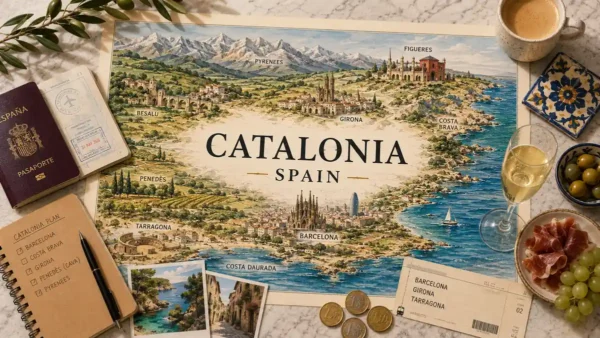
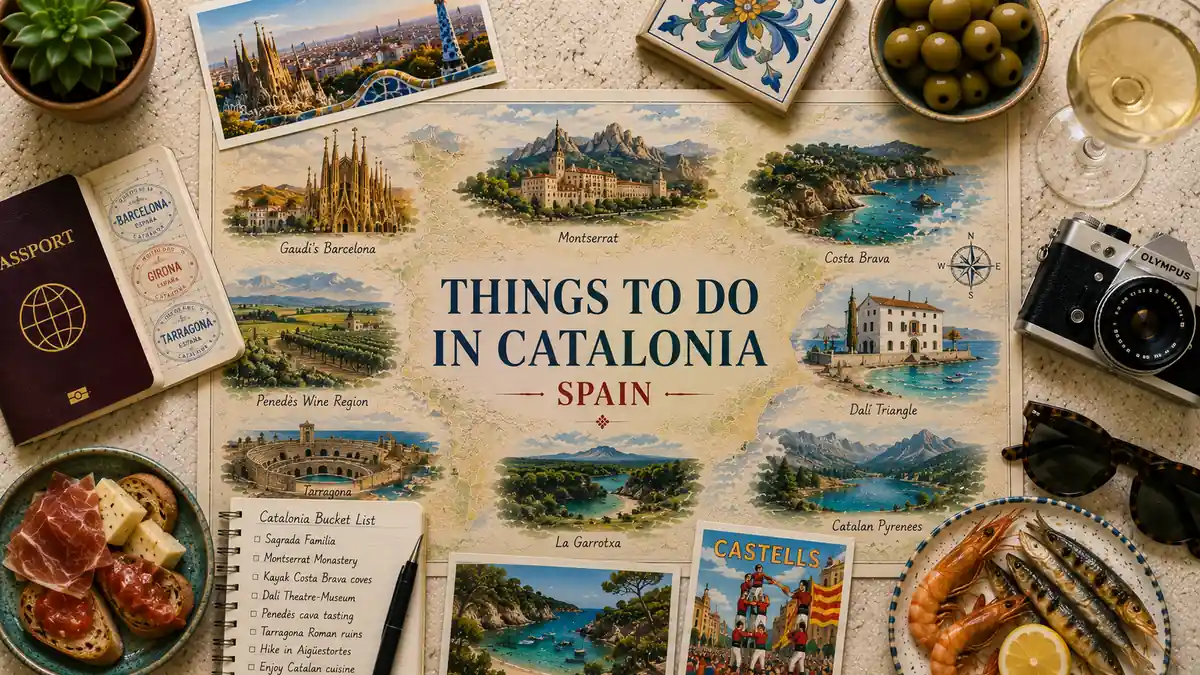
Catalonia’s best experiences are Gaudí’s Barcelona, Montserrat, the Costa Brava coves, the Dalí triangle, and Penedès cava country. The real choice is how you balance coast, mountains, and culture, and how far beyond Barcelona you travel. Even a short trip fits one beyond-Barcelona experience; longer trips earn a second base and deeper themes. For easy nature, La Garrotxa’s volcanic paths beat the demanding climbs of the high Pyrenees.
Catalonia packs more variety into one region than almost anywhere else in Spain, and most visitors only ever see Barcelona. Gaudí’s Modernism, a coastline of hidden coves, real mountains you can hike for days, Salvador Dalí’s surreal house-museums, Roman ruins, and a cuisine that stands apart from the rest of the country all sit within a few hours of each other. The problem is not finding things to do. It is choosing well. This guide is a curated shortlist of the experiences that actually define a Catalonia trip, grouped so you can build around coast, mountains, or culture depending on what you came for. Each pick tells you what it is, what makes it different from the others here, and exactly who it suits — with honest notes on which deserve a full day and which can wait for a return trip.
Which of Catalonia’s Highlights Work as Day Trips From Barcelona?
Many of Catalonia’s highlights work as day trips from Barcelona, though not all. Montserrat, the Penedès cava cellars, and Roman Tarragona sit close enough to visit and return the same day. The Costa Brava, the Dalí triangle, and the high Pyrenees reward their own base, giving you time to slow down and go deeper.
The bigger question behind every pick is how far beyond Barcelona you go. The city holds Gaudí and deserves its days, but Catalonia’s real depth sits outside it — on the Costa Brava, in the Pyrenees, across the wine country and the Dalí triangle. A short trip can fold in one of these as a day trip. A longer one earns a second base.
Choosing which towns to actually visit or where to stay is a separate decision — the region’s Catalonia travel guide covers bases, getting around, and when to go in depth. And if you want to sequence these experiences into a day-by-day route, that belongs on our Spain itinerary guide, not here.
What Is Catalonia Famous For?
Catalonia is famous for Gaudí’s Modernism, the Costa Brava, the Pyrenees, Salvador Dalí, and its own food culture. That combination is what makes it more than a Barcelona city break — few regions in Europe hand you world-class art, serious mountains, and a distinct culinary identity in one place.
The picks in this guide are experiences, not towns. That distinction matters: the point is what you do — kayaking a hidden cove, riding up to a mountaintop monastery, tasting cava at its source — not ticking off a list of place names. To keep the choices clear, they are grouped into three threads: coast, mountains, and culture. Most trips end up mixing two of the three.
Catalan identity is the thread running through all of it: a language of its own, a Modernist architectural movement, human-tower traditions, and a cuisine no other region shares.
Art and History Experiences: Gaudí, Dalí, and Roman Tarragona
Catalonia’s three signature culture experiences are Gaudí’s Barcelona, the Dalí triangle, and Roman Tarragona. Together they anchor the culture side of any trip, spanning surrealism, Modernist architecture, and two-thousand-year-old ruins. Only Gaudí sits inside Barcelona itself — the other two reward travelers willing to head out of the city.
Book Gaudí’s timed slots before you fix anything else in Barcelona. It is sold-out entry dates, not travel logistics, that force most visitors to skip the Sagrada Família.
See Gaudí’s Barcelona: Sagrada Família and Park Güell
Gaudí’s Barcelona is the one culture experience you cannot do anywhere else, and the only signature site inside the city. The Sagrada Família, Park Güell, Casa Batlló, and La Pedrera form the largest concentration of his work anywhere; several, along with the Palau de la Música Catalana, hold UNESCO World Heritage status. Of all the picks on this page, it is the one that needs almost no planning to reach — it is on your doorstep the moment you land. The catch is access, not distance: the headline sites use timed entry, so book ahead and treat any posted prices as ranges to confirm. It is the first stop for anyone who wants the icons everyone associates with Barcelona and has limited time before heading beyond the city.
Follow the Dalí Triangle: Figueres, Portlligat, and Púbol
The Dalí triangle is worth it for anyone drawn to surrealism or offbeat museums, and underwhelming for those who want polished art-gallery calm. It links three sites the artist shaped himself: the Dalí Theatre-Museum in Figueres, his house at Portlligat near Cadaqués, and the Castell de Púbol he gave to Gala. It is a route, not a single stop: the experience is following Dalí across the landscape he lived in, which no single museum replicates. The house at Portlligat runs on small timed groups, so booking ahead matters more than at Figueres. As a day trip it stretches thin; the triangle rewards its own overnight base near the coast. This is the pick for anyone who would sooner chase an artist’s real world than stand before one famous painting behind glass.
Walk Roman Tarragona
Roman Tarragona hands you one of Spain’s best-preserved Roman cities as a walkable open-air experience, an hour down the coast from Barcelona. The archaeological ensemble of Tárraco holds UNESCO World Heritage status, and you can take in a seafront amphitheatre, a circus tucked under the old town, and stretches of forum and wall in a single stroll. What separates this from the Dalí and Gaudí picks is the scale of time — you are walking through two thousand years of continuous city, not one artist’s vision. It works comfortably as a half-day out and pairs naturally with the coast. Anyone who likes history they can physically walk through gets ancient ruins here without leaving the coastline.
Tours and activities
Book skip-the-line tickets, day trips and local tours with free cancellation on most activities.
You can also browse everything on getyourguide.com.
Tripstou may earn a commission if you book through this link, at no extra cost to you.
Things to Do on the Costa Brava: Coves, Kayaking, and Coastal Paths
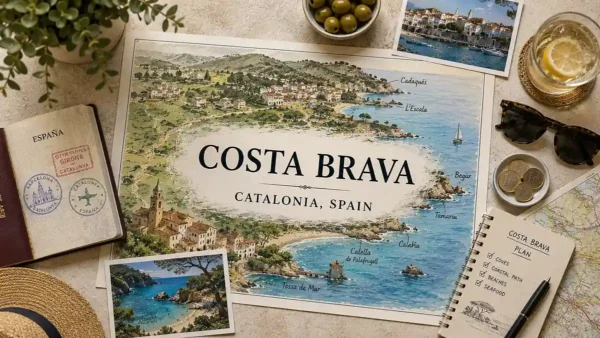
The Costa Brava is Catalonia’s best coastal experience — rocky coves, clear water, and a coastline you can walk. It suits travelers who want sea and slow days over city sightseeing, with pine-backed inlets far more dramatic than the flat resort beaches further south. The two headline experiences are getting on the water and walking the cliffs above it.
The coves that photograph best are the ones you can only reach by water. A morning kayak gets you to inlets that stay empty in peak season, while the road-accessible beaches fill by mid-morning.
Kayak and Swim the Costa Brava Coves
Kayaking the Costa Brava coves is the region’s signature water experience, and the only way to reach the inlets that stay quiet in high season. Paddling out from a small beach, you string together hidden calas, snorkel over clear shallows, and land where no road goes. It suits confident swimmers and anyone happy to spend a half-day on and in the water; the broad summer months bring the calmest sea. Compared with the coastal walk below, it asks for commitment: this is an active, get-wet experience, not a viewpoint. Go for it when you want to be in the water and reach coves that road-trippers never see.
Hike the Camí de Ronda Coastal Path
The Camí de Ronda is the Costa Brava for people who prefer walking to paddling, tracing old footpaths along the cliff edge. The trail links cove after cove on foot, dipping to beaches and climbing back to headland views the whole way. It is low-commitment and flexible — you can walk a short scenic stretch or string together a longer day, with no gear and no booking. Unlike the Pyrenees hikes later on, it stays coastal and gentle, with sea on one side the entire time. It is the better choice for coastal scenery on foot without the effort or planning of a mountain hike.
When the question shifts to which Costa Brava towns to base in — Cadaqués, Begur, Tossa de Mar — that is a place decision, not an experience one, and our guide to the best places to visit in Spain handles it without duplicating it here.
Mountains and Nature: Montserrat, the Pyrenees, and Volcanic Garrotxa
Catalonia’s mountains are worth serious trip time, led by three very different experiences. Montserrat delivers the iconic short hit — a monastery on a mountain of rock fingers. Aigüestortes offers real, multi-day hiking. La Garrotxa gives you a green volcanic landscape no other Spanish region can match.
Montserrat and the Pyrenees look like the same “mountains” box on a map, but they are opposite commitments — one is a half-day with a train, the other needs its own base and two or three days. Trying to fold Aigüestortes into a Barcelona day trip is the classic mistake.
Ride Up to Montserrat
Montserrat is worth visiting for almost every kind of traveler, and it is Catalonia’s easiest mountain experience to reach. The serrated massif holds the Benedictine monastery of Santa Maria de Montserrat, a working abbey with a famous boys’ choir, set against rock formations you can hike between on marked trails. You reach the top by rack railway or cable car — either mode climbs from the valley floor, so check current schedules and fares before you go. Its strength is the mix: spirituality, sweeping views, and short walks in one compact half-day. It works cleanly as a day trip. A dramatic mountain and a working monastery, without committing more than half a day, is exactly what it gives.
Hike the Catalan Pyrenees: Aigüestortes i Estany de Sant Maurici
Aigüestortes i Estany de Sant Maurici is Catalonia’s only national park, and its answer for travelers who want genuine high-mountain hiking. Glacial lakes, granite peaks, and waterfalls fill the park, with trails ranging from lake circuits to multi-day treks between mountain refuges. This suits fit hikers who came for the mountains themselves, not a viewpoint you drive to. Montserrat is a quick hit by comparison; this is a destination in its own right, needing its own base and ideally a couple of days. Come for serious hiking and glacial-lake scenery, and build your days around the mountains.
Explore La Garrotxa’s Volcanic Landscape
La Garrotxa is the low-effort nature pick that no other Spanish region can offer, a dormant volcanic zone wrapped in beech forest. Dozens of extinct volcanic cones and lava-rock villages sit inside a natural park laced with gentle, well-marked paths. The terrain itself sets it apart: you walk through craters and cool green woodland, not the arid landscapes most people picture in Spain. It rewards a relaxed pace and suits families or anyone wanting nature without a hard climb. Its draw is easy walking through unusual volcanic scenery, not a demanding summit.
Can You Ski in Catalonia?
Yes, you can ski in Catalonia, in the Catalan Pyrenees during the winter months. The mountains along the northern edge of the region hold several ski areas reachable from Barcelona, offering both downhill and cross-country terrain. Snow conditions vary by season and altitude, so check current reports before planning a trip around the slopes.
Train and bus tickets
Compare routes, schedules and prices across rail and bus operators in one search, with mobile tickets on your phone.
New to Omio? Code NEW10 takes 10% off your first booking — or APPNEW10 if you book inside the Omio app. Both apply to bookings up to €80.
Search routes and compare prices on Omio →
Tripstou may earn a commission if you book through this link, at no extra cost to you.
Food, Wine, and Catalan Culture Experiences
Eating and drinking are core Catalonia experiences, not side notes to the sightseeing. Catalonia has its own cuisine, its own wine country, and living traditions you can actually witness. The three experiences here are tasting cava at its source, eating through the region’s markets and dishes, and catching Catalan culture in motion.
Cava country is the rare Catalonia experience that is genuinely better as a day trip than an overnight. The Penedès cellars sit close enough to Barcelona that you can taste and still get back, while the wine towns give you little reason to stay the night.
Taste Cava and Wine in the Penedès and Priorat
Tasting cava in the Penedès is the easiest wine experience to reach from Barcelona, and Catalonia’s answer to anyone who thinks Spanish sparkling plays second to Champagne. The Penedès is the heartland of cava, its cellars open for tastings a short train ride from the city; the steep, slate-soiled Priorat, further inland, produces some of Spain’s most prized reds. The Penedès day-trips easily, while the Priorat rewards drivers willing to go deeper. Next to the food pick below, the focus is narrower: the glass and the vineyard, not the plate. Serious wine lovers who can spare a relaxed day out of Barcelona get the most from it.
Eat Your Way Through Catalan Food Culture
Catalan food is its own cuisine, distinct from the tapas-and-paella image of Spain, and eating through it is an experience in itself. Boqueria-style markets, seafood off the coast, and dishes like pa amb tomàquet, escalivada, and fideuà define a kitchen shaped by both sea and mountains. In the cooler months, the calçotada — a communal grilled-onion feast running through winter into early spring — is the region’s signature food ritual. This pick is everywhere and constant, threaded through every other experience on this list rather than confined to one stop. For anyone who treats food as the main event, it is a cuisine that surprises people expecting standard Spanish fare.
Watch Castells and Catch a Festival
Castells — human towers built by teams of climbers — are Catalonia’s most striking living tradition, and watching one is unlike any other experience on this page. Recognised by UNESCO as intangible cultural heritage, the towers rise several people high in town squares during local festivals, alongside fire runs, giants, and street music. This is culture happening, not culture preserved behind glass — you witness a community doing something it has done for generations. Timing takes some luck, since the biggest displays cluster around town festival calendars. It rewards anyone after a genuine local spectacle who can build a little flexibility into when they travel.
These experiences are Catalonia at its most distinct, but they are one chapter of a much larger story — for the country-wide picture, from Andalusian flamenco to Basque pintxos, see our roundup of the best things to do in Spain.
How These Picks Were Checked
This is a curated selection of things to do across Catalonia, from Gaudí’s Barcelona and the Dalí triangle to the Costa Brava, Montserrat, the Pyrenees and Penedès cava country, chosen by what each experience offers, who it suits and whether it works as a day trip from Barcelona. It is not a Catalonia region guide, a ranking of Catalan towns, or a day-by-day itinerary.
Written with AI assistance, then checked by Alex Perrut (working in tourism since 2015) for the Tripstou editorial team. See our editorial process.
Last factual review: July 18, 2026.
Official sources consulted: Spain.info, Turespaña.
Best Season and Family Fit
What is the best time to visit Catalonia?
Late spring and early autumn suit Catalonia best, balancing warm weather with thinner crowds. Summer delivers the calmest sea for the Costa Brava but the busiest beaches and hottest cities. The high Pyrenees favour summer for hiking and winter for snow, so the ideal window depends on whether you came for coast, mountains, or culture.
Is Catalonia good for families?
Catalonia is very family-friendly, with experiences that work for a range of ages. La Garrotxa’s gentle volcanic trails, the Costa Brava’s swimmable coves, and Montserrat’s easy rack-railway ride all suit children, while castells and market food turn culture into something to watch and taste, not view behind glass. Pair a relaxed nature pick with one cultural highlight.
Did this guide save you time or money? Tripstou is independent and reader-funded — if you'd like to give something back, you can support the site with a crypto contribution of any size.