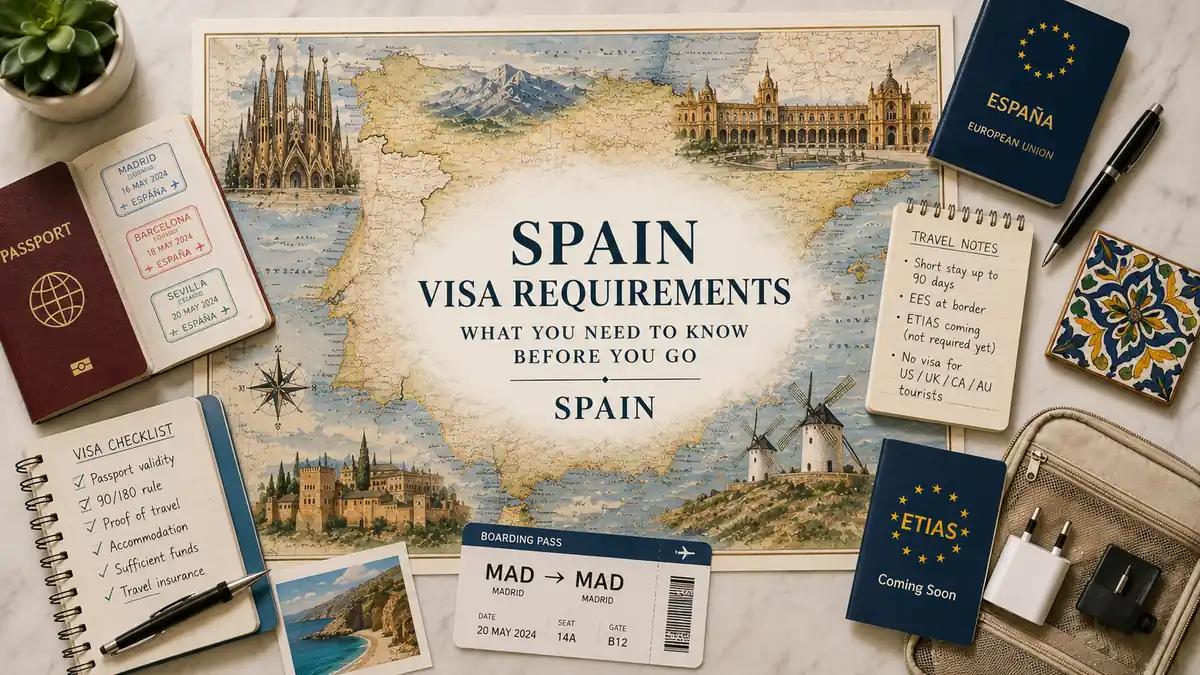
No: most major-nationality tourists do not need a visa for a short stay in Spain. Your nationality and trip length decide it, and visa-free stays are capped under the Schengen short-stay rule. Check your passport validity and confirm your nationality’s status before booking; longer stays, work, or study need a national visa.
The verdict depends on your nationality, how long you plan to stay, and why you are visiting. The sections below give the nationality-based answer first, then the rules that shape it: how the Schengen short-stay limit works, the passport validity Spain expects, and what the EES and ETIAS systems mean for travelers right now. They also flag when a longer stay, work, or study pushes you into a different process entirely, and what to have ready when you reach the border.
How These Entry Rules Were Checked
This page settles one planning decision for Spain: whether a short tourist trip needs a visa, and which entry rules apply to it. It is not a long-stay, work or residence application guide, an itinerary, or a broad Spain destination guide.
Produced with AI assistance. Alex Perrut, working in tourism since 2015, checked these entry rules for the Tripstou editorial team; our editorial process explains the method.
Last factual review: June 16, 2026.
Official sources consulted: the European Union, Travel to Europe, ETIAS.
Do you need a visa to visit Spain?
Citizens of the US, UK, Canada, Australia, and many other visa-exempt countries do not need a visa for short visits. Spain follows the Schengen visa-free list, so the answer depends on the passport you hold. Your nationality and trip purpose set the rule, not Spain alone.
Spain is part of the Schengen area, which means it shares a common visa-free list with the other Schengen states. If your country is on that list, you can enter for tourism without applying for anything in advance. The major English-speaking nationalities — American, British, Canadian, and Australian travelers — are all visa-exempt for short tourist stays, as are many others.
The verdict changes only when your purpose changes. Tourism, visiting family, and short business trips fall under the visa-free allowance; working, studying, or settling does not. If you hold a passport from a country that is not visa-exempt, you must apply for a Schengen short-stay visa before you travel. Use the table below as a quick reference for the most common cases.
EU, EEA, and Swiss citizens move freely and are not covered by these short-stay tourist rules.
| Nationality | Visa for short tourist stays | Maximum visa-free stay |
|---|---|---|
| United States citizens | Not required for tourism | Up to 90 days in any 180-day period |
| United Kingdom citizens | Not required for tourism | Up to 90 days in any 180-day period |
| Canadian citizens | Not required for tourism | Up to 90 days in any 180-day period |
| Australian citizens | Not required for tourism | Up to 90 days in any 180-day period |
| Most other non-EU nationals | Check your nationality before travel | Varies by nationality and agreement |
Do you need a visa for a layover in Spain?
For visa-exempt travelers, a short airport layover in Spain needs no separate transit visa, and entering the country uses the same visa-free allowance. Some visa-required nationalities may need an airport transit visa, so confirm your own nationality’s rule with an official source before booking connecting flights.
How long can you stay in Spain without a visa?
Visa-free visitors can stay up to 90 days within any rolling 180-day period. This cap applies across the entire Schengen area, not Spain on its own. Days spent in any other Schengen country count toward the same 90-day total, so plan multi-country trips carefully.
The 90/180 rule is a rolling window, not a fixed calendar count. On any given day, you look back over the previous 180 days and add up the days you have already spent in the Schengen zone; the total cannot exceed 90. This matters most on multi-country trips, because time in France, Italy, or Portugal eats into the same allowance as your days in Spain.
For most holidays this is generous, but it shapes how you sequence a longer European trip. If you plan to move slowly or combine several countries, map your days against the limit before you commit. The best time to visit Spain can help you decide when to spend your allowance, and our breakdown of Spain trip cost is useful when you are deciding how long to stay. Stays beyond 90 days require a different route entirely, covered further down.
What happens if you overstay your visa-free limit in Spain?
Overstaying the 90/180 limit can lead to fines, deportation, or an entry ban across the Schengen area, and it may complicate future trips. Border systems track entry and exit automatically, so track your own days carefully and leave before the allowance runs out to avoid these consequences.
What passport validity do you need for Spain?
Your passport must be valid for at least three months beyond your planned departure from the Schengen area. It must also have been issued within the previous ten years to be accepted. Both rules apply to every visa-free traveler, so check the dates well before booking.
These two conditions catch travelers out more often than the visa question itself. A passport that still has months left can fail the “issued within ten years” test if it was renewed early, and one that looks fine today may not clear the three-month buffer for a trip later in the year. Check both the issue date and the expiry date as soon as you start planning, and renew early if either is borderline.
Passport validity is one piece of pre-trip compliance worth handling alongside the others. Arranging Spain travel insurance early is a sensible companion step, and sorting connectivity such as getting a Spain SIM card rounds out your arrival prep. Getting the documents right first means everything else falls into place smoothly.
Do children need their own passport to enter Spain?
Yes, every child needs their own valid passport to enter Spain, regardless of age. The same passport-validity rules apply as for adults. Some families travelling without both parents may also be asked for consent documentation, so check your airline’s and Spain’s requirements before you travel.
What are the EES and ETIAS, and do they affect you now?
The Entry/Exit System registers non-EU travelers biometrically at the border and is fully operational across the Schengen area. ETIAS is a pre-travel authorisation for visa-exempt nationals that is not yet in operation; the European Union will announce the start date several months before launch. The EES is an automated entry/exit system that logs your fingerprints and photo.
It helps to keep the two systems distinct. The Entry/Exit System (EES) is a border process: instead of a manual passport stamp, it digitally registers when non-EU visitors enter and leave, capturing biometric data to track the 90/180 allowance automatically. ETIAS, by contrast, is a pre-travel authorisation that visa-exempt visitors will eventually apply for online before departure — it is not a visa, and it is not something you need to act on yet.
Before you travel, confirm the current ETIAS position through the official EU travel authorisation channels, and see our complete Spain travel guide for the wider trip-planning picture.
What if you want to stay longer, work, or study in Spain?
Longer stays, work, or study require a Spanish national long-stay visa or residence permit. These are arranged before you travel, through official Spanish consular channels in your home country. The 90-day visa-free rule covers tourism only, not employment or extended residence.
The visa-free allowance is strictly for short visits. The moment your plans involve staying past 90 days, taking a job, enrolling in a course, or relocating, you move out of tourist territory and into the national immigration system. Spain issues specific long-stay visas and residence permits for these situations, each with its own eligibility rules, and they are handled by Spanish consulates and immigration authorities rather than at the border.
This guide stops at the decision point instead of walking through application steps, because the procedures are official government scope and change by category. Start the process early, since long-stay routes take far longer than booking a holiday. For broader preparation around a longer trip, our Spain travel tips cover the practical groundwork.
Can you extend a 90-day visa-free stay in Spain?
No, the 90-day visa-free allowance generally cannot be extended for tourism, and overstaying it risks penalties. If you need more time, you must apply for a Spanish national long-stay visa or residence permit before the limit, through official consular channels, instead of topping up days at the border.
Can you work remotely in Spain on a tourist stay?
A visa-free tourist stay is meant for tourism, not employment, and working locally is not permitted on it. Remote work for a foreign employer sits in a grey area, so travelers planning to work from Spain should check Spain’s digital-nomad and long-stay visa options through official channels first.
What should you carry at the Spanish border?
Carry a valid passport plus proof of onward travel, sufficient funds, and confirmed accommodation. Border officers may ask any visa-free visitor to show these documents on arrival. Having them ready keeps your entry smooth and avoids unnecessary questions at passport control.
Visa-free entry is not automatic; officers can ask you to demonstrate that your trip fits the tourist allowance. In practice that means being able to show a return or onward ticket, evidence that you can support yourself during the stay, and where you will be staying — a hotel booking, rental confirmation, or a host’s address. Keep these accessible, ideally both on your phone and as a backup.
You will rarely need to produce everything, but readiness removes friction and stress. Treat it as the final box to tick once your documents and dates are sorted. If border procedures make you uneasy, our guide on staying safe in Spain offers wider reassurance for first-time visitors.
Do you need travel insurance to enter Spain as a tourist?
Visa-exempt tourists are not generally required to show travel insurance to enter Spain, though border officers can ask about funds. Travelers applying for a Schengen short-stay visa usually must prove insurance cover. Arranging a policy is still a sensible pre-trip step even when it is not mandatory.
Once Entry Is Sorted: Plan the Rest of Spain
These guides take over once your entry requirements are clear, from where to go to how to get around.
- Spain Travel Guide — the country planner this page sits under.
- Best Places to Visit in Spain — choosing where to go first.
- Best Beaches in Spain — picking a coast for a beach trip.
- Spain Food Guide — what to eat once you arrive.
- Spain Road Trip Planner — routes if you plan to drive.
- Spain Train Itinerary — a route built around rail travel.
- Spain Islands Guide — comparing the island groups.
- Andalusia Travel Guide — planning the south.
- Balearic Islands Travel Guide — the Mediterranean islands.
- Canary Islands Travel Guide — the Atlantic islands.
- Basque Country Travel Guide — the Basque cities and coast.
- Northern Spain Travel Guide — the wider green north.
- Catalonia Travel Guide — Barcelona’s region.
- Costa Brava Travel Guide — Catalonia’s northern coast.
- Costa del Sol Travel Guide — the southern beach coast.
- Madrid Region Travel Guide — the capital and its surroundings.
- Valencia Region Travel Guide — the east coast.
- Spain Digital Nomad Visa: Requirements & How to Apply — eligibility, requirements, and how to apply, for the remote-work route this page only points to.
Did this guide save you time or money? Tripstou is independent and reader-funded — if you'd like to give something back, you can support the site with a crypto contribution of any size.